
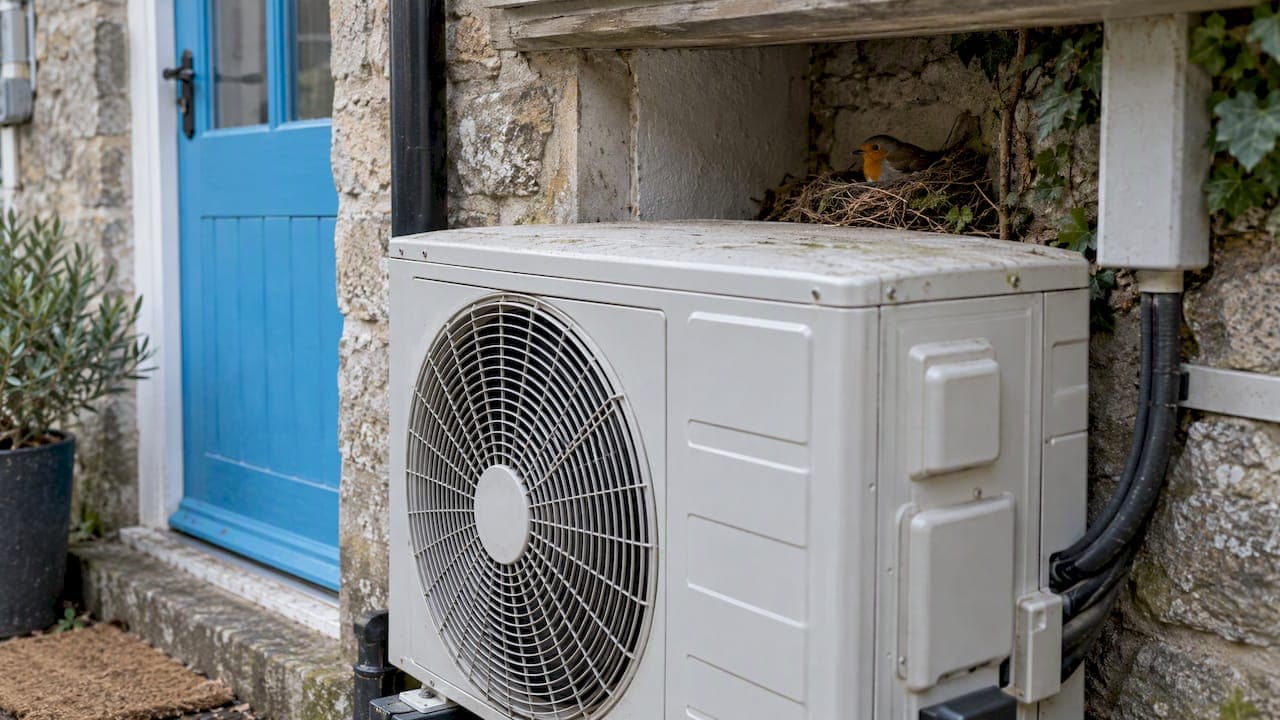
If you think an animal has got into your air conditioning, stop and work out what it is before you do anything else. A mouse in the outdoor unit is a repair job. A bat in a pipe-run or a bird's nest with eggs in it is protected by law, and moving it the wrong way can be a criminal offence. This guide covers the animals we see around air conditioning in Devon and Cornwall, the signs to look for, who to call, and how to stop it happening again.
TL;DR
- Mice, rats, birds, wasps and sometimes bats use air conditioning units and pipe-runs for shelter, warmth and nesting.
- Warning signs are scratching or fluttering noises, patchy airflow, odd smells, droppings near the unit and a system that suddenly behaves differently.
- In the UK, all wild birds' active nests and all bats and their roosts are protected. Do not block, remove or disturb them until you have taken advice.
- Switch the unit off if you suspect an animal inside, and call a qualified engineer rather than opening panels yourself.
- Prevention is mostly sealing gaps, keeping the outdoor unit clear and having it serviced once a year.
Table of Contents
- Which animals get into air conditioning?
- Signs that something has moved in
- What wildlife can do to your system, and to you
- What the law says about bats and nests
- What to do if an animal is in your air conditioning
- How to stop wildlife getting in
- Wildlife and pets, a note for households
- Our view: where wildlife problems really start
- Get it fitted and looked after properly
- FAQ
- Sources
Which animals get into air conditioning?
An air conditioner is a sheltered, often warm box with moving air, dark gaps and cable runs. For a small animal that looks like a good place to live. The animals we hear about most in the south west are:
- Mice and rats. They look for a warm, dry place and squeeze through very small gaps. Outdoor units, the pipe and cable entry points and any loft or ceiling void with ducting are all fair game.
- Birds. Pigeons, starlings, house sparrows and the occasional jackdaw nest in eaves, behind units and in vents. Gulls are a common sight on flat roofs in coastal Devon and Cornwall, and rooftop plant gets used as a perch and sometimes a nest site.
- Bats. Bats roost in roof spaces, soffits and gaps around buildings. They are rare in air conditioning equipment itself, but a pipe boxing, a ceiling void or an external duct cover can be used as a roost.
- Wasps and other insects. A wasp nest can start in a quiet cavity, including behind trunking or inside a ceiling void near a cassette unit. Ants and spiders are also drawn to condensate moisture and warmth.
- Squirrels and, in some gardens, even frogs. These tend to turn up around the condensate drain and the base of an outdoor unit.
Small animals usually get in where something has not been sealed: a gap where pipes or cables pass through a wall, a damaged grille, or a cover that has come away. A neat installation closes those gaps at the time. An older or badly finished one often has them.
Signs that something has moved in
Wildlife damage tends to be quiet. Many homeowners only notice once airflow has dropped or something smells wrong. Watch for:
- Noises. Scratching, scuttling, fluttering or squeaking from the indoor unit, the ceiling void or the outdoor unit, especially at dusk and early morning.
- Weak or uneven airflow. Nesting material in a duct or on a fan can block air or throw the fan off balance.
- Smells. A sharp ammonia smell, a musty smell or the smell of something dead. Do not assume it is the filter: a musty AC smell has several causes, and an animal is one that needs ruling out.
- Droppings, feathers, shredded insulation or twigs on or around the unit, on the ground beneath it, or on the wall.
- A system that suddenly trips, shows an error code or stops cooling. Chewed cables and damaged insulation cause faults that look electrical or mechanical, not animal. Our common AC problems list helps you narrow down faults, and our troubleshooting tips for Devon and Cornwall cover the checks that are safe to do yourself.
- Wasps or bees coming and going from a gap near the unit or its pipework.
If you see any of these, the safest assumption is that something is in there, and that it may be protected.
What wildlife can do to your system, and to you
The damage runs both ways.
To the equipment. Rodents gnaw. Cables, pipe insulation and condensate hoses are soft and easy targets, and a chewed cable is a fire and shock risk, not just a fault. Damaged insulation on refrigerant pipework costs you efficiency and can cause condensation to drip where it should not. Nesting material can block fans, coils and drain outlets, so water backs up and the system leaks or shuts down. Refrigerant work can only be done by a certified engineer, so a damaged line is never a DIY repair.
To your health. Birds, rodents, bats and insects can carry bacteria, viruses, parasites, fungi and allergens, and if they get into a heating or cooling system the contaminants can be spread around the building, according to guidance from the US Department of Energy's Pacific Northwest National Laboratory. That research is American, but the principle applies to any system that moves air through a building. Droppings and nesting debris are also a common trigger for people with asthma or allergies. If anyone at home is sensitive, our guide to air conditioning and allergies explains how clean filtration helps, and why a contaminated unit does the reverse.
To the animal. A split system's fan, fins and live electrics are dangerous to a trapped animal. Switching on a unit with something inside it can kill or injure the creature, and in the case of bats and nesting birds that can be an offence.
What the law says about bats and nests
This is the part most guides miss, and it matters in the UK more than the mechanical side.
Bats
All British bat species and their roosts are legally protected. The Bat Conservation Trust explains that you may commit an offence if you damage or destroy a breeding site or resting place of a bat, and that this applies even when the bats are not there at the time. Under the Wildlife and Countryside Act 1981 it can also be an offence to intentionally or recklessly disturb a bat in a structure it uses for shelter, or to obstruct access to that place.
GOV.UK gives the same message for homeowners: it may be an offence to disturb or damage a place a species uses for shelter or breeding, and disturbing or destroying bats or their roosts is an offence even if they are inside your home.
In practice: if you think bats are in or near your air conditioning, do not seal the gap, do not switch on the unit if they are inside it, and contact the Bat Conservation Trust helpline or your statutory nature body (Natural England in England) for advice before any work goes ahead.
Nesting birds
Wild birds, their nests and their eggs are protected. The RSPB advises that where birds are nesting and there is no conflict, you should allow them to stay, and if access must be blocked, wait until they are no longer nesting. It adds that pigeons can nest all year round, so it is worth checking an area before you block it, not assuming a season.
The practical result: if a bird has nested behind your outdoor unit or in a vent, you may need to leave the system off, or the work on hold, until the young have fledged. A good engineer will tell you that, not just start work.
Rats, mice and wasps
Rodents are not protected in the same way, and pest control is a legitimate answer. GOV.UK's guidance on pest control on your property is the place to start, including how to check that any treatment does not harm protected species nearby. For wasp nests, use a professional pest controller rather than disturbing the nest near electrics.
What to do if an animal is in your air conditioning
Do these in order.
- Switch the unit off at the isolator or the fused spur, not just with the remote. A running fan can injure the animal and you.
- Do not open panels or reach inside. Live electrics, sharp fins and a frightened animal are a poor combination. Refrigerant pipework must not be touched.
- Work out what it is from a distance. Listen, look for droppings or feathers, and note the time of day the noise happens. Take photos if you can do so safely.
- If it might be a bat or a nesting bird, stop and get advice before anything is blocked, removed or cleaned. Call the Bat Conservation Trust helpline for bats, or your local authority or the RSPB's advice pages for nests.
- If it is a rodent or insects, call a pest controller and, once the animal is gone, an engineer to check for damage. A single animal can be resolved quickly. If you suspect several animals, a nest or major damage to ducting, treat it as a job for professionals from the start.
- Have the system inspected before you switch it back on. Look for chewed cables, damaged insulation and blocked drains. Droppings and nesting material need to be cleaned out safely, and a contaminated indoor unit needs a proper clean, not a wipe.
If it is a unit we installed or serve, call us and we will arrange an engineer. For breakdowns, our service and maintenance page covers emergency response.
How to stop wildlife getting in
Most wildlife problems are prevented by a handful of dull jobs done well.
Seal the gaps. Where pipes and cables pass through the wall, the hole should be neatly sealed with a suitable material, and the pipe cover or trunking should be fixed tightly. Small animals get in through gaps in vents, damaged grilles and the gaps around pipes and wires entering a house. Rodents can pass through remarkably small openings, so a gap you can fit a finger in is worth closing.
Fit durable screens where they are appropriate. The US guidance mentioned above recommends corrosion-proof wire mesh with holes of ¼ inch or smaller over vent openings, apart from vents that supply an air handler. That distinction matters. A split system's outdoor unit and indoor head need free airflow, so never wrap them in mesh or cover them yourself: ask your engineer what can be fitted without hurting performance. For the rest of the house, a door and window insect screen keeps flying insects out of rooms where cooling is running with the door open.
Keep the area around the outdoor unit clear. Leaf litter, stored boxes, long grass and ivy provide cover. Leave a clear space around the unit, as the manufacturer's installation manual specifies, and remove debris regularly.
Mind the moisture and the filter. Condensate drips, a dirty filter with trapped food debris and wiring are what draw pests to an outdoor unit, according to a US home-warranty maintenance guide. A tidy condensate run and clean filters take away much of the attraction. Our guide to stopping aircon mould with a dry cycle shows a simple routine that also keeps the inside of the unit less inviting.
Do not block a nest or roost to "prevent" a problem. Preventive sealing is fine when nothing is using the space. It is not fine on a space that currently holds birds or bats. Check first.
Service it every year. An engineer who opens the unit once a year will spot the early signs: gnawed insulation, droppings, nesting material, a blocked drain. It is much cheaper to fix a small hole than a chewed circuit board.

Wildlife and pets, a note for households
If you share the house with a dog or cat, a rodent or bird in the system is one more reason to keep the equipment clean and sealed. We cover the other side of this in pet safe air conditioning for UK homes. For the wider picture of how a well-kept system affects what you breathe, see how air conditioning impacts home health and comfort and how it can improve your home's air quality.
Our view: where wildlife problems really start
We install and maintain systems across Exeter, Devon and Cornwall, and what we say here comes from the type of work we do: installation by our own F-Gas certified engineers, and servicing under annual contracts.
In our experience the unit is rarely the problem. The finish is. An air conditioner with a tidy, sealed wall penetration, pipework that is properly clipped and covered, and a condensate line that runs where it should is a poor home for a mouse. A rushed or subcontracted job that leaves gaps, loose covers and unsupported pipes is not. That is one reason we do not use subcontractors and why the survey comes first: we look at where the outdoor unit will sit, what is around it and how the pipework will run, including whether there is a nesting spot or a known roost nearby.

The second thing we would say is that wildlife is not always something to "get rid of". If a bird has nested near your unit, or you suspect bats, the right engineer will pause and tell you what the law requires. We would rather rearrange a job date than have a customer commit an offence by accident.
The third is that annual servicing matters more than most owners think. A service visit takes a few minutes to look for droppings, chewed insulation and blocked drains, and that is when we catch problems before they become faults.
— James
Get it fitted and looked after properly
If you are planning a new system, we will survey the site for free, design the layout around your property and install it, typically within one to two days, with same-day and next-day installs available. We fit Samsung, Mitsubishi, Toshiba and Daikin systems, and every job is done by local F-Gas certified engineers. Details of what we fit in homes are on our domestic installation page, and 0% finance is available if you want to spread the cost.

If you already have a system, our service plans and annual contracts include an inspection of the unit and its surroundings, and our service and maintenance team can respond to breakdowns. We cover Exeter, Devon, Cornwall and the wider south west.
FAQ
Can a bat live in my air conditioning unit?
It is uncommon inside the machine itself, but bats can use roof voids, soffits and the spaces around pipework and ducting. All bats and their roosts are protected in Britain, and a roost remains protected even when the bats are away. If you suspect one, leave the area as it is and contact the Bat Conservation Trust before any work.
What if a bird has built a nest in or behind my outdoor unit?
Leave the nest alone while it is in use, and switch the unit off if running it would disturb the birds or damage the nest. The RSPB advises waiting until nesting has finished before blocking access, and notes that pigeons can nest year-round. Once the young have gone, have the area cleaned and sealed by an engineer.
How do I know if mice have chewed my air conditioner?
Typical signs are droppings near the unit, shredded insulation, a burning or ammonia smell, scratching noises and a system that trips or shows errors for no obvious reason. Switch it off and have an engineer inspect it. Chewed cables are a safety risk, so do not keep running it to see what happens.
Can I clean up droppings or nesting material myself?
Outside the unit, in a well-ventilated area, you can with gloves and a mask and by washing your hands afterwards. Inside the unit, ducting or behind panels, leave it to a professional, because the debris may be contaminated and the parts are live. Check first that nothing in it is protected.
Will servicing stop animals getting in?
A service does not make the unit animal-proof, but it is where gaps, damage and early nesting get found. Combined with good sealing at installation and a clear area around the outdoor unit, it is the most reliable protection.
Sources
- Bats and the law, Bat Conservation Trust
- Pest control on your property, GOV.UK
- What to do if birds are nesting in your roof or eaves, RSPB
- Screens and other deterrents for birds, rodents and other pests, Pacific Northwest National Laboratory
- Insect curtain door and window screen, Homable