
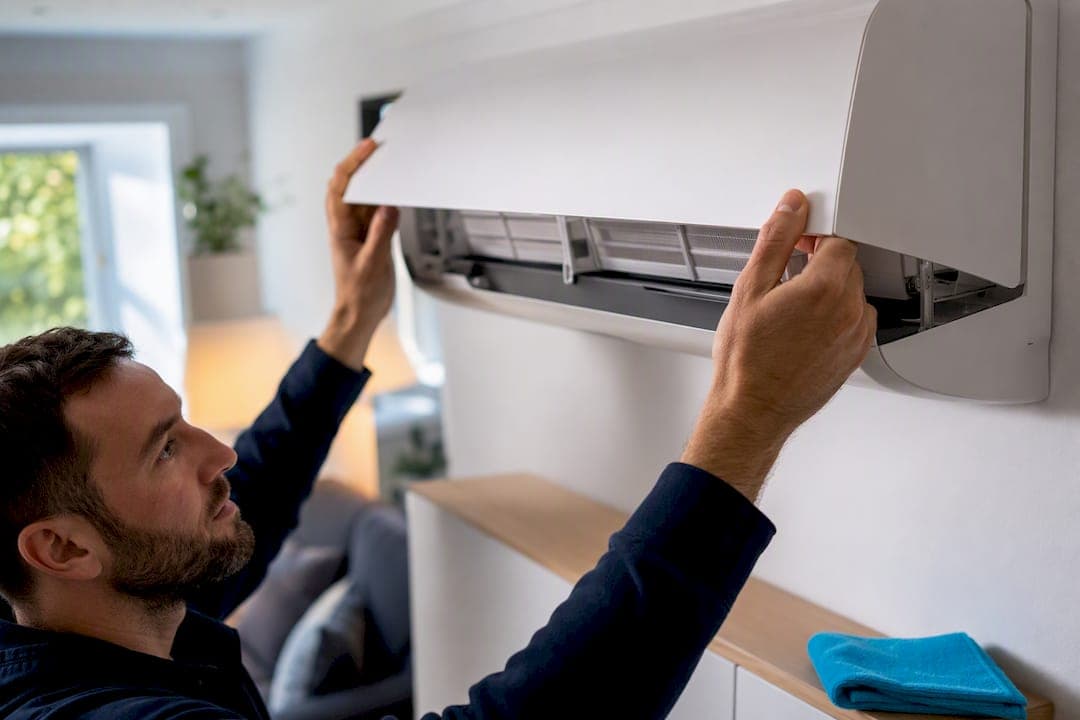
The essential aircon service checklist runs like this: clean or replace filters monthly during peak season, keep the outdoor unit clear, check the condensate drain and controls each visit, and book a qualified engineer for an annual service or the moment you spot leaks, ice, or electrical faults. Anything involving refrigerant or live electrics is a job for a certified technician, not a weekend project. Larger systems carry legal inspection triggers under F‑Gas and TM44 rules that most homeowners never hear about until something breaks.
TL;DR:
- Homeowners can safely clean filters and clear debris but must hire licensed technicians for refrigerant work, electrical repairs, and coil disassembly.
- Regular seasonal checks include booking professional services in spring, cleaning outdoor units in autumn, and testing heating in winter to prevent breakdowns.
- UK regulations require leak checks for systems with over 3kg of refrigerant and TM44 inspections every five years for systems over 12kW rated output.
- Maintaining a simple temperature split between 8°C and 12°C and monitoring airflow can help gauge system performance at home.
- A typical professional service involves inspecting filters, coils, condensate drains, electrical connections, and refrigerant levels, with longer intervals for systems in constant use.
Table of Contents
- Seasonal aircon maintenance checklist: what to do and when
- Indoor and outdoor unit checklist: what to check on each component
- What are the legal requirements for aircon servicing in the UK?
- DIY vs professional: where should you draw the line?
- How do you measure aircon performance at home?
- When should you call a professional instead of doing it yourself?
- What Frostairconditioning sees on a typical service visit
- Why preventive checks matter more than most homeowners think
- Book a service that actually checks everything on the list
- Sources
- FAQ
Seasonal aircon maintenance checklist: what to do and when
Air conditioning wear follows the calendar, not the manual. A seasonal aircon service checklist spreads the workload sensibly instead of leaving everything to a panicked call in July.
- Spring: Book your annual professional service before the first heatwave. Engineers are less booked out in March and April, and catching a slow refrigerant leak now saves you a breakdown mid summer.
- Summer: Check filters monthly, or more often if you run the system daily. Watch for reduced airflow, longer cooling times, or unusual noise, all early signs of a clogged filter or coil.
- Autumn: Clear leaves, seed pods, and grass cuttings from around the outdoor unit. Check the condensate drain for the algae build up that tends to appear after a humid summer.
- Winter: If your system runs in heat mode, or you have a heat pump, test heating operation before the cold sets in and check that outdoor coils aren't icing over unnecessarily.
This rhythm mirrors what other seasonal guides recommend, including a summer maintenance checklist covering similar filter and coil priorities, and a spring HVAC checklist that flags ventilation checks before the cooling season starts. For deeper winter guidance specific to UK conditions, our winter care guide covers heat pump defrost cycles and frost protection in more detail.
Indoor and outdoor unit checklist: what to check on each component
A proper air conditioning service checklist works through each part of the system in sequence, not at random. Here's the technician-style breakdown.
Indoor unit:
- Remove and inspect the filter monthly during peak use; wash reusable filters or replace disposable ones once they're visibly grey or clogged.
- Check the evaporator coil for dust or mould buildup, a common cause of musty smells and weak cooling.
- Listen to the blower fan for rattling or grinding, which usually signals a loose mount or worn bearing.
- Flush the condensate drain and trap; algae and dust form a sludge that blocks drainage and causes water leaks indoors.
Outdoor unit:
- Keep at least 30cm of clearance around the condenser, free from plants, leaves, and debris.
- Rinse the condenser coil gently with a hose (never a pressure washer) if it looks caked in dirt or pollen.
- Check the fan blade and guard for damage or obstruction.
- Look for oil residue near pipe joints, a visual clue that a refrigerant leak may be developing.
Controls: Confirm the thermostat reads accurately against a separate room thermometer, then test heating and cooling modes to make sure the system responds within a few minutes.
A full technician-style service typically takes 45 minutes to 1.5 hours per single split unit, depending on access and how dirty the coils are.
Pro Tip: If your filter looks fine but airflow still feels weak, the problem is often further inside, on the evaporator coil itself. A filter that looks clean doesn't guarantee a clean coil behind it.
Deep coil cleaning, electrical connection checks, and anything touching the refrigerant circuit belong to a qualified engineer. Homeowners can safely manage everything on the indoor filter and outdoor clearance list; our cleaning guide walks through the filter removal process step by step if you've never done it.
What are the legal requirements for aircon servicing in the UK?
Compliance isn't optional once a system crosses certain thresholds. Systems containing 3kg or more of F‑gas refrigerant require documented leak checks and record keeping, with check frequency depending on the refrigerant's CO2 equivalent, starting from 5 tonnes CO2 equivalent and getting more frequent as the charge increases.
Systems over 12kW rated output require a professional TM44 inspection regularly, with intervals not exceeding five years, covering efficiency, faults, and control settings. CIBSE's TM44 guidance frames these inspections as preventive, catching problems through routine checks rather than waiting for failure.
Only F‑Gas certified engineers can legally handle refrigerant work, and they should leave you a service record. Never open the refrigerant circuit yourself, and always isolate power before removing any panel. If your system falls near these thresholds, our guide to TM44 and F‑Gas compliance breaks down the timelines property owners actually need to track.
DIY vs professional: where should you draw the line?
Homeowners can safely handle filter cleaning, debris clearance, and simple condensate drain flushes without any special training, and doing these monthly during peak season keeps small problems from becoming expensive ones.

Everything electrical, refrigerant related, or involving deep coil disassembly needs a qualified technician. That's not caution for its own sake. Recharging refrigerant without first fixing the leak behind it is poor practice and often makes the underlying fault worse.
Before hiring anyone, ask:
- Are you F‑Gas certified and REFCOM registered?
- Do you carry public liability insurance?
- Can I see a sample service report from a previous job?
Our F‑Gas compliance checklist covers exactly what to verify before you hand anyone the keys. Most domestic systems do well with one professional service a year, or twice yearly if you run the unit almost constantly through the summer.
How do you measure aircon performance at home?
A few simple readings tell you far more than guesswork.
- Temperature split: Measure the air temperature going into the indoor unit and the air coming out. A healthy split is usually between 8°C and 12°C; anything much lower suggests a struggling system.
- Airflow and noise: Weak airflow or a new rattle, hiss, or buzz usually points to a blocked filter, loose fan, or failing motor.
- Refrigerant pressure: This is a technician-only reading, but low pressure directly explains poor cooling and rising energy bills.
- Track it over time: Jot the temperature split down every service visit. A gradual drop over a year is your earliest warning sign, well before the system fails outright.
When should you call a professional instead of doing it yourself?
Certain signs mean stop what you're doing and call an engineer, not push through with a DIY fix.
- Visible ice on the indoor or outdoor coil
- Water leaking from the indoor unit despite a clear drain
- A burning smell from either unit
- A breaker that trips repeatedly when the system starts
- No heating or cooling at all, especially paired with unusual noise
Compliance failures also warrant a call: a failed F‑Gas leak check or an overdue TM44 inspection both need professional sign off, not a home fix. A genuine emergency callout should get an engineer diagnosing the fault quickly, with parts sourced fast where possible and a written summary of what was found and repaired.
What Frostairconditioning sees on a typical service visit
Filter maintenance takes minutes if you build it into a habit: pull the filter out, vacuum or rinse it, let it dry fully before refitting. A quick reset (power off for 30 seconds, then back on) often clears minor control glitches without needing a technician at all.
On a standard visit, engineers typically document filter condition, coil state, condensate flow, electrical connections, and refrigerant readings where relevant, alongside an F‑Gas record if the system requires one. Across homes in the South West, the most common finding isn't a major fault. It's a blocked condensate trap or a coil that's overdue a clean, both of which are cheap to fix early and expensive to ignore.

Why preventive checks matter more than most homeowners think
Most people wait for a breakdown to think about servicing. That's backwards. A five minute filter check each month does more for your system's lifespan than any single repair ever will, and it costs you nothing but a bit of routine.
— James
Book a service that actually checks everything on the list
A practical route for homeowners and business owners who want an F‑Gas certified engineer to run through this checklist properly rather than gamble on doing it themselves. Every visit under our service and maintenance plans covers the same ground this article does, filters, coils, condensate, electrical connections, and refrigerant checks where needed, with a written report left behind and F‑Gas records kept where the system requires them.

Annual service contracts and one-off visits are both available, and engineers working locally without subcontractors often means the person who surveys your system is the one who services it. If you're weighing up a new system entirely, premium units from Samsung, Mitsubishi, Toshiba, and Daikin can be installed, often within one to two days. Request a quote or book a survey through our service and maintenance page and get a proper diagnosis before small issues turn into a breakdown.
Sources
- Gov
- TM44 inspection of air conditioning systems - CIBSE
- Free Split System Service Checklist (PDF) 2026
FAQ
What should be included in an AC service?
A proper service covers filter cleaning or replacement, evaporator and condenser coil inspection, condensate drain clearing, electrical connection checks, thermostat testing, and a refrigerant check by a qualified engineer. Frostairconditioning's service and maintenance visits follow this same scope with a written report left on completion.
What does an aircon service consist of?
It's a component by component check: filters, coils, fans, drainage, controls, and electrical connections, followed by a functional test in both heating and cooling modes. A typical visit for a single split unit takes 45 minutes to 1.5 hours depending on access and condition.
What is the 3 minute rule for air conditioners?
The "3 minute rule" refers to waiting at least three minutes before restarting a system after it's been switched off, giving internal pressures time to equalise and protecting the compressor from strain. It's a widely repeated safety habit rather than a formal technical standard.
How often should your aircon be serviced?
Most domestic systems need one professional service a year, or twice yearly for units that run almost constantly through summer. Filters should be checked monthly during peak use, and larger commercial systems over 12kW carry a legal TM44 inspection requirement at least every five years.