
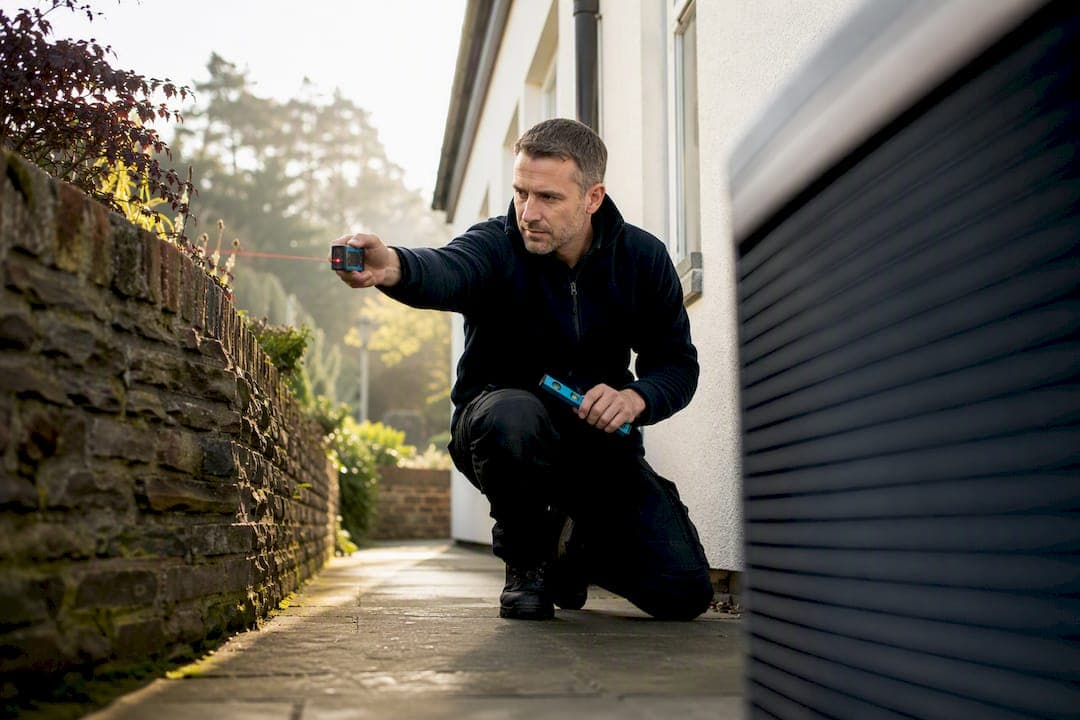
Most standard split-system air conditioning installs in England count as permitted development, meaning you won't need planning permission. That's only true if the outdoor unit meets the Class G tests on size, siting and number of units. Listed buildings, conservation areas, Article 4 directions and flats change the picture entirely, so the first thing to do before booking anyone is check your property's planning status with your local planning authority.
TL;DR:
- Units must comply with volume, boundary distance, wall placement, and roof rules, or they will fall outside permitted development rights.
- Confirm your installer holds current MCS 020a certification and F‑gas registration, with detailed documentation before proceeding.
- Installing solely for cooling without heating function may be outside permitted development, depending on local interpretation and system specifications.
- Full planning permission is required if your property is listed, in a conservation area, or affected by Article 4 directions, or if your installation breaches physical tests.
- Always photograph and document siting details, and seek advice from your planning authority before booking surveys or installation to avoid enforcement issues.
Table of Contents
- What does "permitted development" mean for air conditioning?
- What conditions must an outdoor unit meet to qualify?
- Which certifications should your installer hold?
- How is neighbour noise assessed, and can it trigger enforcement?
- When do you need full planning permission instead of relying on PD rights?
- How do you apply for planning permission or get a Lawful Development Certificate?
- Pre-install checklist: what to confirm before you book anyone
- Are air source heat pumps and standard air conditioning units treated the same?
- What happens if the council refuses permitted development or issues an enforcement notice?
- Installer perspective: common pitfalls and straightforward mitigations
- How Frost Air Conditioning handles the paperwork so you don't have to
- Sources
What does "permitted development" mean for air conditioning?
Permitted development rights come from a specific piece of legislation: Class G of the Town and Country Planning (General Permitted Development) (England) Order 2015. It sets out the conditions under which you can fit an air source heat pump or external condenser without applying for planning permission first. The Planning Portal translates that legal text into plain conditions homeowners can actually check against their own property, which is why it's worth bookmarking before you get any quotes.
Class G was updated in 2026 through an amendment order that changed volume thresholds and the number-of-units limits, and added a notable new condition: the heat pump must not be installed solely for cooling. That single insertion matters more than it looks. It signals that permitted development rights for this class of equipment are framed around heating provision, with cooling as a secondary function, rather than air conditioning as a standalone product.
In practice, this means the legal test most installers and homeowners now work from covers both air source heat pumps and conventional split-system condensers, provided the unit isn't purely a cooling appliance with no heating function. Read Class G and the Planning Portal summary side by side and you get the full picture: the statute sets the binding limits, the guidance tells you how to interpret them against your own house, garden and boundary lines.
What conditions must an outdoor unit meet to qualify?
Every test below has to be satisfied at once. Miss one and the whole installation falls outside permitted development, regardless of how small or quiet the unit is.
- Volume limit: the outdoor compressor/condenser unit (including its housing) must sit under the specified volume threshold set out in the 2026 Class G amendment. Manufacturer spec sheets state the unit's dimensions, so multiply height by width by depth to check it against the limit before you order.
- Number of units: detached houses are generally allowed more units than semi-detached or terraced properties, and blocks of flats face tighter limits again, often restricted to one unit per dwelling or none at all without consent.
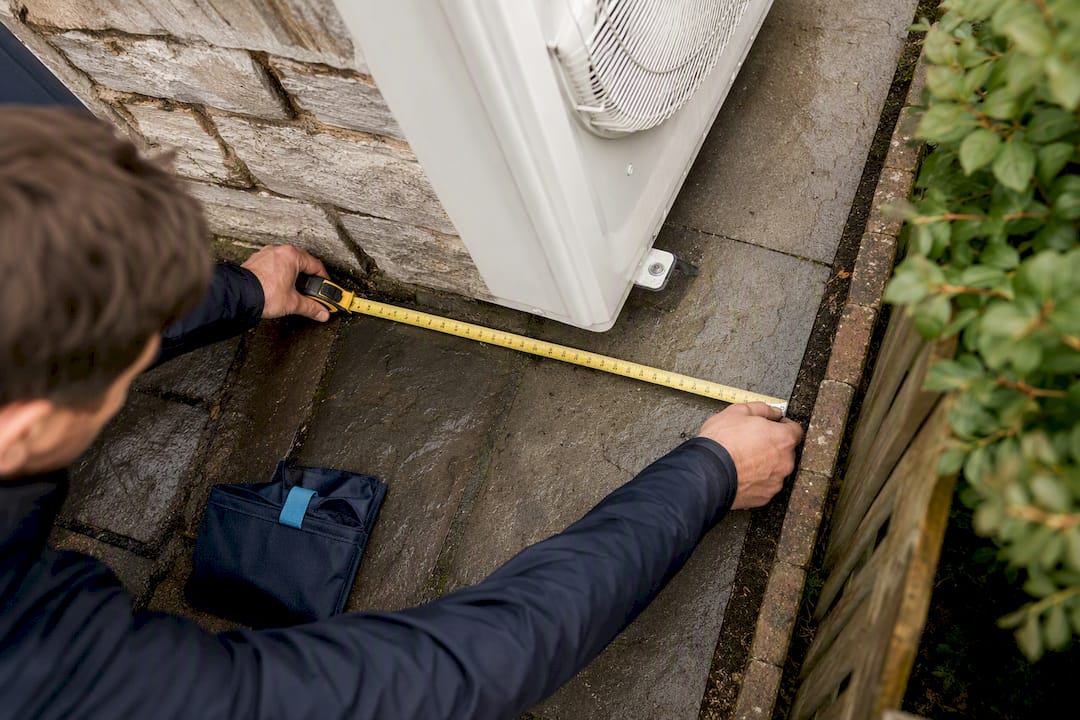
- Boundary distance: the unit must sit at least 1 metre from the property boundary. Measure from the closest edge of the casing, not the wall it's fixed to.
- Wall placement: units cannot be installed on a wall that fronts a road above ground floor level, per Class G conditions. Rear and side elevations at ground level are the safest bet.
- Roof rules: on a pitched roof, no permitted development installation is allowed. On a flat roof, the unit must be set back from the roof edge, as specified in Class G.
Pro Tip: Ask your installer to confirm the unit's stated volume in writing against the manufacturer's technical sheet before the survey, not after the equipment arrives. Swapping models later because the first choice was oversized wastes a site visit.
Which certifications should your installer hold?
Ask to see paperwork, not just take someone's word for it. The Planning Portal makes MCS certification to the MCS 020 planning standards a condition of permitted development for air source heat pumps, and from 28 May 2026, MCS 020a is the only accepted certification scheme for permitted development under Class G. If your installer can't produce current MCS 020a evidence after that date, the installation may not qualify as permitted development at all, whatever else is correct about it.
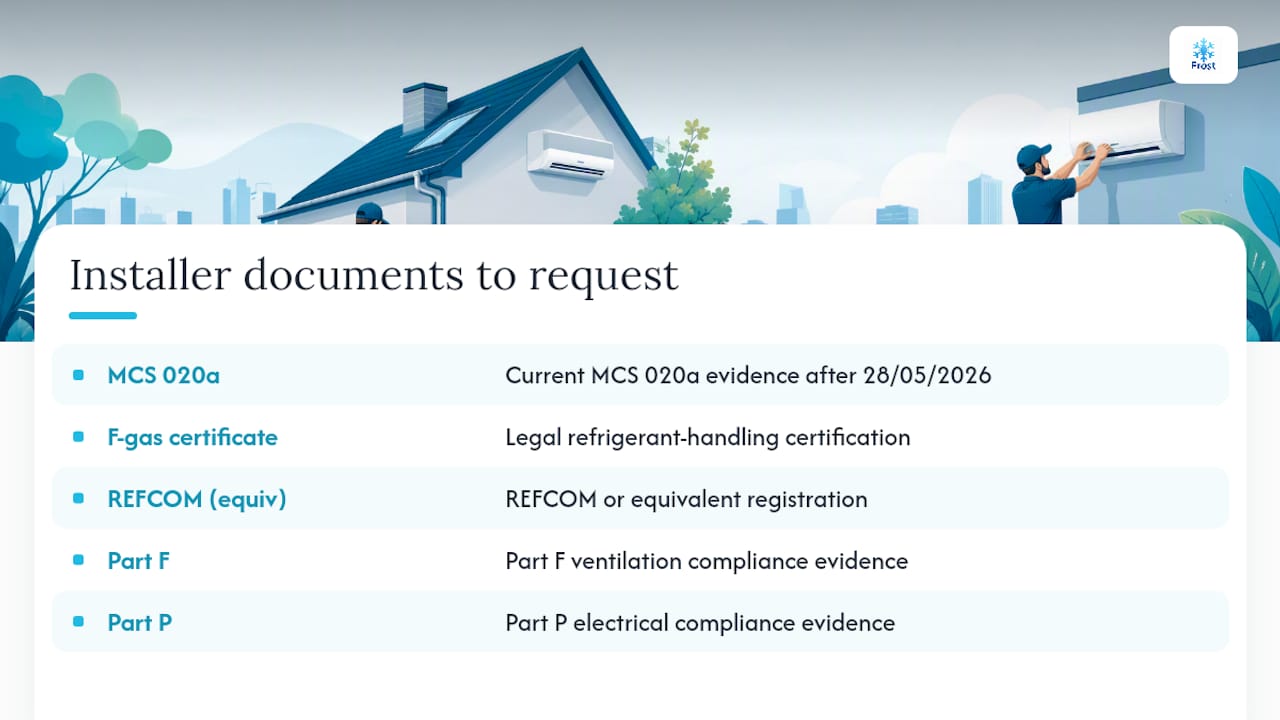
Separately, Gov sets out who is legally allowed to work on equipment containing fluorinated greenhouse gases. Refrigerant handling isn't optional extra training, it's a legal requirement, so ask for F‑gas certification alongside REFCOM or an equivalent registration. A professional installer should hand this over without being chased.
Where the job involves new circuits, isolators or structural fixings, Part F ventilation requirements and Part P of the Building Regulations may also apply. If your installer is subcontracting electrical work, confirm that person is separately qualified too.
How is neighbour noise assessed, and can it trigger enforcement?
Noise is the most common reason permitted development installations end up in dispute, even when every size and siting rule was followed correctly. Local authorities lean on BS 4142 and its Method Implementation Document when a neighbour complains, comparing the unit's rated sound level against background noise at the nearest affected window.
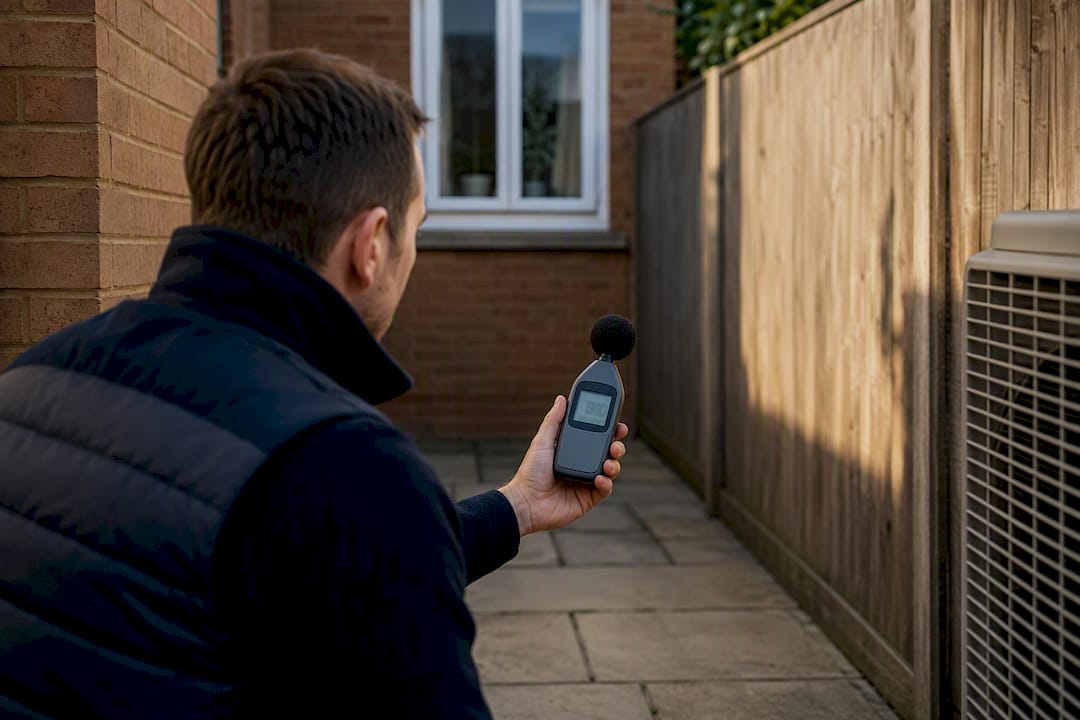
Reputable installers work from manufacturer dB(A) figures at rated distance and combine that with a site survey, factoring in fence lines, hard surfaces that reflect sound and how close the unit sits to a bedroom window next door. Getting this modelling right at survey stage is far cheaper than dealing with a complaint after commissioning, and understanding what those decibel figures actually mean in practice helps you ask the right questions.
Mitigation is usually straightforward:
- Site the unit away from your own and neighbouring windows, not just away from the boundary line.
- Fit anti-vibration mounts to stop structure-borne noise transmitting through walls.
- Use an acoustic housing or barrier where the unit sits close to a shared boundary.
- Keep the manufacturer's dB(A) data and your installer's siting rationale on file, in case a neighbour raises a complaint months later.
Pro Tip: Photograph the proposed unit location relative to both your boundary and the nearest neighbouring window before installation. It's the single easiest piece of evidence to produce if enforcement officers ever ask you to justify the siting decision.
When do you need full planning permission instead of relying on PD rights?
Several situations strip away permitted development rights entirely, and no amount of careful siting fixes them.
Full planning permission becomes necessary if your home is a listed building, sits within a conservation area, or falls inside a World Heritage Site. The same applies if your local authority has issued an Article 4 direction removing PD rights for air conditioning equipment specifically, which some councils do in sensitive residential areas. Beyond location, breaching any single physical test, mounting on a road-facing wall above ground floor, positioning within 1 metre of the boundary, or installing in a flat or maisonette, also removes permitted development rights outright.
Flats and maisonettes are treated differently under Class G regardless of noise or size, largely because shared structures and communal amenity carry different planning weight. If you live in one, permitted development is unlikely to apply to you at all, and you'll need alternative cooling approaches that don't rely on an external condenser fixed to a shared wall.
Leasehold ownership adds a separate layer entirely, one that sits outside planning law but can stop an install just as effectively. Freeholders and building management companies often hold veto rights over external alterations written into the lease itself, and some developments carry party wall obligations that require formal notice to neighbours before work starts. None of this shows up in a Class G check. Confirm your lease terms and get freeholder sign off in writing before you book a survey, not after.
Local authorities don't apply these rules identically. Some take a pragmatic view of borderline cases, others enforce strictly, especially where Article 4 is in force. Ring your planning department and describe your property and proposed unit before committing to anything.
How do you apply for planning permission or get a Lawful Development Certificate?
If your installation doesn't meet every Class G test, or you simply want certainty before spending money, you have two routes.
- Apply for a Lawful Development Certificate (LDC) if you believe the installation qualifies as permitted development but want written confirmation from the council. This protects you if a future buyer's solicitor or a neighbour questions the installation's legality years later.
- Apply for full planning permission if the installation genuinely fails one or more PD tests, whether that's unit volume, siting, or your property's protected status.
- Gather your supporting documents early: a site plan showing the unit's proposed position relative to boundaries, the manufacturer's volume and dB(A) specification, your installer's MCS 020a and F‑gas certification, and an acoustic report if the council requests one for a sensitive site.
- Submit through your local planning authority, checking their specific validation checklist, since requirements vary slightly between councils.
Expect validation to take a couple of weeks and full determination around eight weeks for a straightforward householder application, longer if the council requests additional information. Budget for the planning application fee itself, plus any acoustic survey your installer or the council specifies. An LDC application generally carries a lower fee than a full householder planning application, though exact figures are set by your local authority and worth confirming directly.
Pre-install checklist: what to confirm before you book anyone
Work through this before signing anything, not after the survey.
- Contact your local planning authority to confirm there's no Article 4 direction, listed building status or conservation area designation affecting your property.
- Ask your installer for current MCS 020a certification (the sole accepted scheme from 28 May 2026), F‑gas registration, and commissioning certificates for the specific equipment being fitted.
- Request the manufacturer's dB(A) rating and a written siting rationale explaining how the installer chose the unit's position relative to your boundary and neighbouring windows.
- Photograph the proposed installation site and keep it alongside your paperwork.
- If you're leasehold, get written consent from your freeholder or management company before any survey is booked.
- Check your buildings insurance covers external plant equipment, and ask whether the installer carries public liability cover.
Pro Tip: Keep every certificate, photo and email in one folder, digital or physical, from day one. If a neighbour ever complains or a future sale throws up a query, having everything to hand in one place saves weeks of chasing an installer who fitted the unit years earlier. A reputable UK installer will hand most of this over as standard practice, not as something you have to request.
Are air source heat pumps and standard air conditioning units treated the same?
Not quite, and the distinction matters more since the 2026 amendment. Class G was originally written with air source heat pumps in mind, appliances that provide both heating and cooling by reversing the refrigeration cycle. The updated wording specifically excludes equipment installed solely for cooling from the permitted development route.
A reversible heat pump that provides space heating in winter and cooling in summer generally sits within Class G's intended scope, assuming it meets every other test on size, siting and certification. A conventional air conditioning unit installed purely to cool a home, with no heating function at all, sits in a greyer area under the amended wording, and some planning officers may take the view that it falls outside permitted development on that basis alone.
This is genuinely unsettled ground in practice, and interpretation varies between local authorities. If the system you're having fitted has genuine reversible heating and cooling capability, and most modern split systems from major manufacturers do, that's worth stating clearly in any Lawful Development Certificate application or correspondence with your council. If you're installing cooling only, with no heating function whatsoever, it's worth raising the point with your local planning authority directly before committing, rather than assuming the same PD rights automatically apply. Your installer should be able to confirm the unit's heating and cooling specification from the manufacturer's technical documentation.
What happens if the council refuses permitted development or issues an enforcement notice?
If your local planning authority decides your installation doesn't qualify as permitted development, or a neighbour's complaint escalates into an enforcement notice, you have a formal right of appeal, but the clock starts ticking the moment the decision or notice lands.
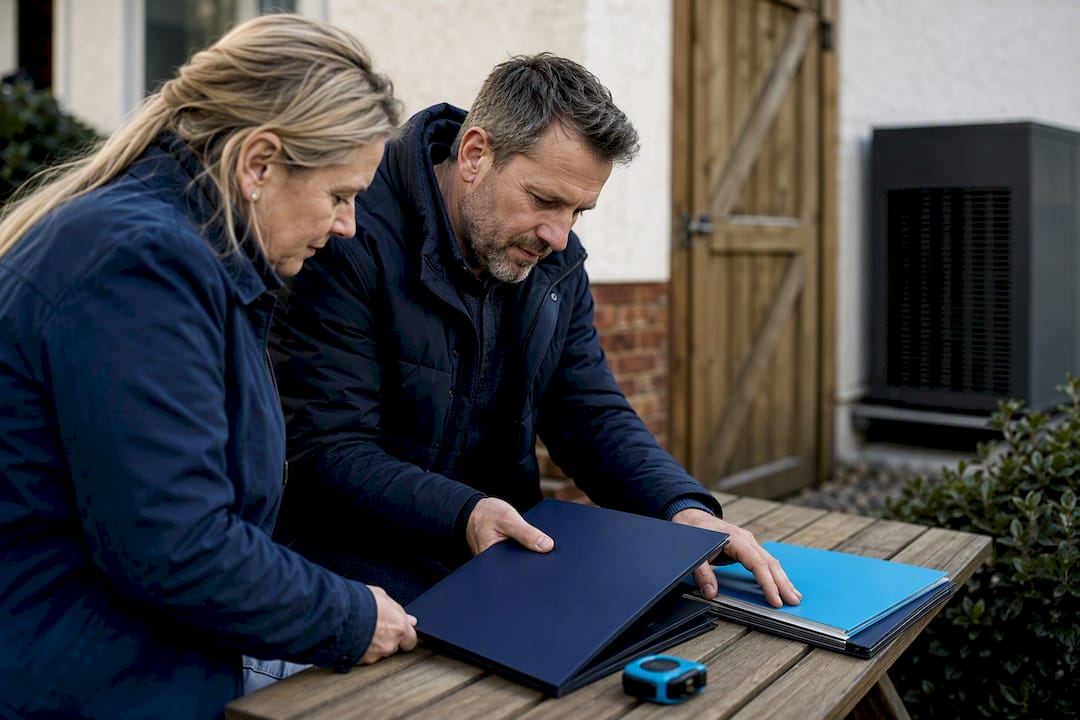
For a refused Lawful Development Certificate application, you can appeal directly to the Planning Inspectorate, generally within a limited appeal period after decision, often several months. The appeal is decided on the same legal tests as the original application, so gather any additional evidence, updated site plans, revised acoustic data, manufacturer specification confirming heating function, that strengthens your case before submitting.
An enforcement notice is more serious and carries its own appeal route and strict deadlines, typically 28 days from the date of the notice, though this varies by case. Ignoring a notice or missing the appeal window risks the council taking direct enforcement action, which can mean being required to remove the unit at your own cost. If you receive one, get advice from a planning consultant or solicitor promptly rather than waiting to see what happens.
In many cases, disputes are avoidable rather than something to fight after the fact. Councils and installers both point to poor initial siting decisions and missing paperwork as the root cause of most enforcement action, not genuinely ambiguous PD tests. Keeping installer certification, noise data and boundary photographs on file from day one, as covered in the checklist above, is what actually prevents most of these situations reaching an appeal at all.
Installer perspective: common pitfalls and straightforward mitigations
The mistakes I see repeated most often aren't complicated. Homeowners assume that because the indoor unit sits inside the house, no external permissions apply at all, then get caught out when the outdoor condenser breaches a boundary rule. Leaseholders skip checking their freeholder's consent because planning permission and lease covenants feel like separate issues, they aren't, in practice, either can stop an install. And plenty of people never once consider where a neighbour's bedroom window sits relative to the proposed unit.
A proper site survey catches every one of these before a single bracket goes on the wall. Paperwork done right, MCS 020a, F‑gas certification, a documented siting rationale, is what actually prevents enforcement and neighbour disputes, not luck.
— James
How Frost Air Conditioning handles the paperwork so you don't have to
A practical alternative is to hire installers who survey your property, check it against class development rules before ordering units, and handle certification and commissioning paperwork required on file.

Same day and next day installs are available across Exeter and the South West, and 0% finance spreads the cost without adding to it. Before installation, installers confirm siting against boundary and roof rules, check the property for listed status or restrictions, and provide noise and installer certification documents, so evidence for a Lawful Development Certificate can be prepared. Get in touch about domestic installation and we'll book a survey that tells you exactly where you stand before you commit to anything.
Sources
- The Town and Country Planning (General Permitted Development) (England) Order 2015 — Class G
- Planning Permission: Air source heat pump — Planning Portal
- Gov