

Most domestic air conditioning faults fall into ten categories: a clogged or dirty filter, the unit not turning on, warm air despite the system running, a frozen evaporator coil, a refrigerant leak, condensate or drainage leaks, unusual noises or vibration, electrical failures (capacitor, contactor, tripped breaker), thermostat and sensor faults, and a blocked or dirty outdoor condenser unit. Before anything else, check your filter and thermostat settings. Those two checks alone resolve a surprising number of air conditioner issues without any engineer involvement. Most domestic air conditioning faults fall into eight main categories: a clogged or dirty filter, the unit not turning on, warm air despite the system running, a frozen evaporator coil, a refrigerant leak, condensate or drainage leaks, unusual noises or vibration, and electrical or control failures (including thermostat/sensor faults and outdoor condenser issues). Before anything else, check your filter and thermostat settings. Those two checks alone resolve a surprising number of air conditioner issues without any engineer involvement. Nine out of ten AC problems fall into these eight failure modes, and many are simple maintenance oversights.
Table of Contents
- Run this checklist before you book an engineer
- 1. Dirty or blocked air filters
- 2. Cooling failures, refrigerant leaks and frozen evaporator coils
- 3. Condensate and drainage problems
- 4. What those unusual noises are telling you
- 5. Electrical and control failures
- 6. Thermostat and sensor problems
- 7. Outdoor condenser unit problems
- 8. When to stop DIYing and call a certified engineer
- 9. Practical maintenance to prevent most of these faults
- 10. UK regulatory note: F-Gas and REFCOM certification
- 11. How long does a domestic AC unit last, and what do repairs cost in the UK?
- Key takeaways
- What most homeowners get wrong
- Frostairconditioning: certified AC service for South West homeowners
- Useful sources for further reading
Run this checklist before you book an engineer
Symptom-based troubleshooting that starts at the thermostat and works outward catches inexpensive faults before expensive compressor work. Run these checks in order.
- Thermostat settings. Confirm the mode is set to "cool", the target temperature is below the current room temperature, and the fan is on "auto" rather than "on". A fan set to "on" blows uncooled air continuously and is frequently mistaken for a system fault.
- Batteries and display. Replace thermostat batteries if the display is dim or blank. Dead batteries are a common cause of a completely unresponsive system.
- Mains switch and isolator. Check the indoor unit's mains switch (usually on the wall near the unit) and the outdoor isolator. Both must be on.
- Consumer unit/fuse board. Look for a tripped breaker labelled "AC" or "air conditioning". Reset it once. If it trips again immediately, stop and call an engineer.
- Air filter. Pull the filter and hold it to the light. If you cannot see light through it, it needs cleaning or replacing now.
- Registers and return grilles. Walk through the property and confirm no furniture, curtains or stored items are blocking supply or return grilles.
- Outdoor unit visual check. From a safe distance, confirm the fan is spinning and there is no visible ice, debris or standing water around the unit.
- Condensate drain outlet. Find where the drain pipe exits the building (usually through an external wall) and check it is dripping or flowing normally during operation. A dry outlet during a long run suggests a blockage.
- Power reset. If the system still will not respond, switch it off at the mains, wait the full 3–5 minutes for refrigerant pressures to equalise, then restart. Restarting too quickly risks compressor damage.
Pro Tip: Before calling an engineer, photograph the fault — ice on pipework, water staining, error codes on the display — and note the time of day and how long the symptom has been present. Engineers diagnose faster with this information, which can reduce your callout time and cost.
1. Dirty or blocked air filters
Clogged or dirty air filters are the single most common cause of an AC running but not cooling. Restricted airflow reduces the heat transfer across the evaporator coil, causing the coil surface temperature to drop below freezing and ice to form. Once ice builds up, airflow drops further, and the system effectively stops cooling altogether.
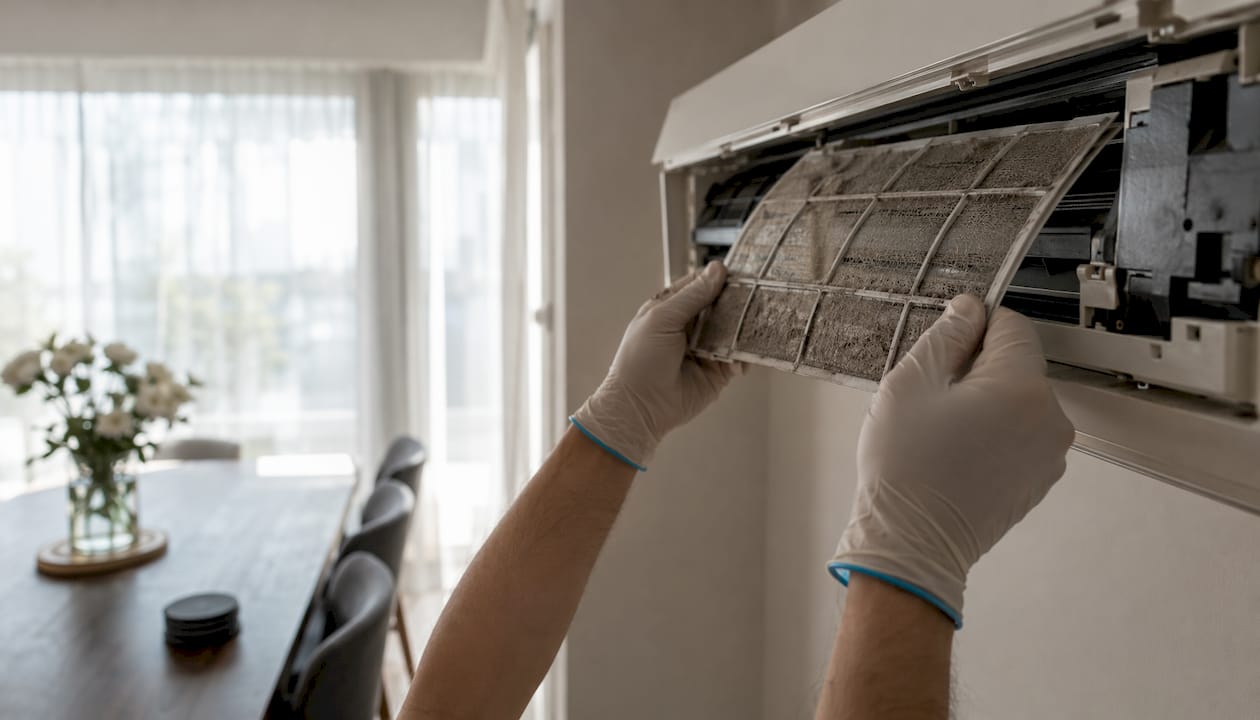
A standard 1-inch filter can become heavily loaded relatively quickly during heavy summer use. Even filters that look clean to the eye can restrict airflow significantly, which is why a visual check alone is not always enough.
Common filter-related symptoms:
- Weak or warm airflow from indoor vents
- Ice visible on the indoor unit or refrigerant pipework
- Higher-than-expected energy bills
- The unit running continuously without reaching the set temperature
How to inspect and replace your filter:
- Switch the system off at the thermostat.
- Locate the filter — on a split system it is usually behind the front panel of the indoor unit; on a ducted system it is typically at the return air grille.
- Remove the filter carefully to avoid shaking dust back into the unit.
- Hold it to the light. Blocked = replace or clean.
- Washable filters: rinse with lukewarm water, allow to dry fully before refitting.
- Disposable filters: replace with the correct size and MERV rating for your system.
- Refit, switch on, and check airflow at the nearest supply grille within five minutes.
For UK homes running AC through a warm summer, check filters monthly during peak use. Off-season, every three months is usually sufficient. Keeping filters clean is also one of the simplest ways to boost energy efficiency and reduce running costs.
Pro Tip: Write the replacement date on the filter frame in marker pen. It takes two seconds and removes all guesswork next time.
2. Cooling failures, refrigerant leaks and frozen evaporator coils
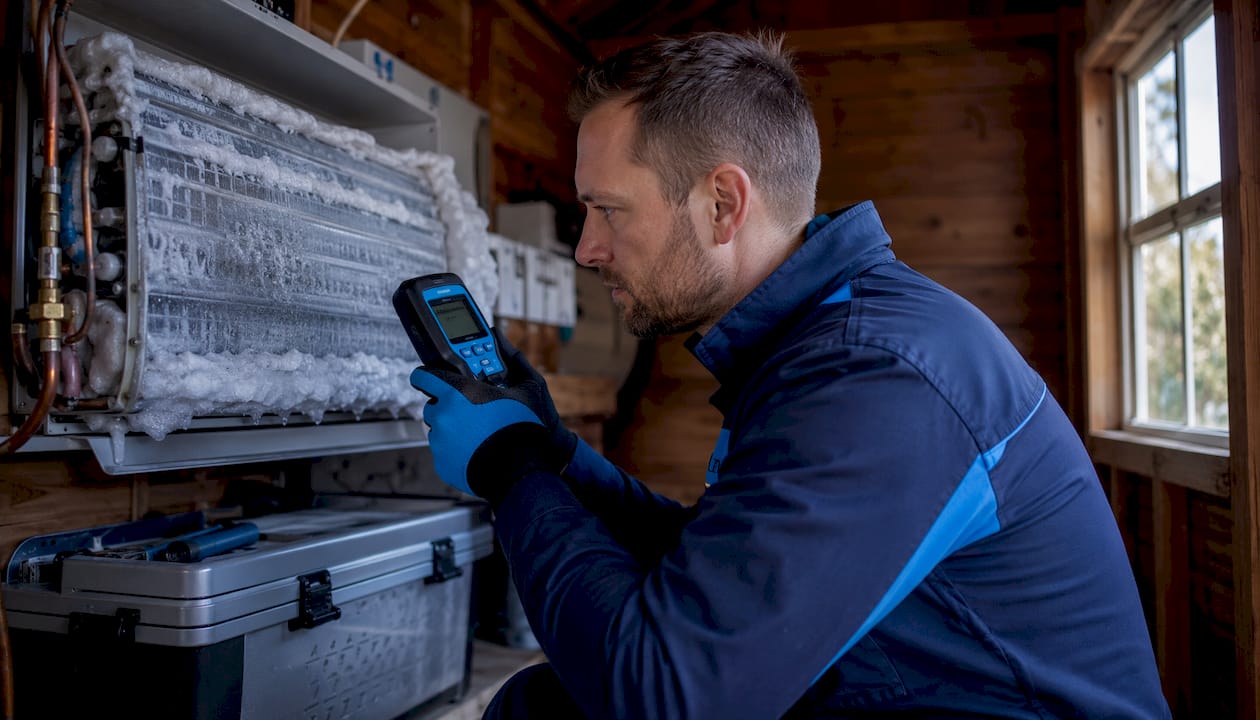
A frozen evaporator coil is behind a significant proportion of "AC not cooling" service calls. The three main causes are restricted airflow (usually a dirty filter), low refrigerant charge, and a failing blower motor. All three reduce the coil's ability to absorb heat, allowing the surface temperature to fall below 0°C and ice to form.
Signs pointing to a frozen coil rather than a simple airflow fault:
- Ice visible on the indoor unit or on the copper pipework running to it
- Water dripping from the indoor unit as ice melts
- Warm air from vents despite the compressor running
- The system cycling off repeatedly on its high-pressure limit
Signs that suggest low refrigerant specifically:
- Hissing or bubbling sounds near the indoor unit or pipework
- Ice forming even after the filter has been cleaned and airflow confirmed
- The system takes much longer than usual to reach the set temperature
- Frost on the outdoor unit's service valves
Refrigerant handling is regulated in the UK under F-Gas legislation. Adding, recovering or transferring refrigerant must only be carried out by a REFCOM/F-Gas certified engineer. Improper refrigerant charging causes long-term efficiency loss and environmental harm — it is not a DIY task under any circumstances.
Immediate homeowner steps for a frozen coil:
- Switch the system to fan-only mode (or switch off cooling but leave the fan running). This circulates warm room air over the coil and speeds thawing.
- Place towels or a shallow tray beneath the indoor unit to catch meltwater.
- Photograph the ice and note how long the system had been running before you noticed it.
- Once fully thawed (typically 1–3 hours), replace the filter and restart. If it freezes again within a few hours, the root cause is likely low refrigerant or a blower fault — call an engineer.
Pro Tip: Never chip or scrape ice off the evaporator coil. You risk puncturing the coil and causing a refrigerant leak that turns a £150 service call into a £600 repair.
3. Condensate and drainage problems
Every air conditioning system removes moisture from the air as it cools, and that water has to go somewhere. When the drainage path is blocked or damaged, water backs up and leaks indoors. Clogged condensate lines, cracked drain pans and failed condensate pumps are among the most frequent causes of indoor water damage from AC systems.
Common drainage fault causes:
- Algae or mould growth blocking the condensate drain line (especially in humid conditions)
- A cracked or corroded drain pan
- A failed or unplugged condensate pump (required where gravity drainage is not possible)
- Meltwater from a frozen evaporator coil overwhelming the pan
- A kinked or disconnected drain hose
Steps to locate and temporarily address a drainage leak:
- Switch the system off immediately to stop water production.
- Locate the indoor unit's drain pan (below the evaporator coil). If it is full or overflowing, that confirms a drainage fault.
- Check the condensate drain outlet outside. If it is dry during or after a long run, the line is blocked.
- For a simple blockage: use a wet/dry vacuum on the outdoor drain outlet for 60–90 seconds to pull the clog clear. Flush with a cup of water to confirm flow is restored.
- Place containers under the unit and lay towels to protect flooring and ceiling below.
- Document any water staining or damage with photographs for insurance purposes.
Call a professional if the pan is cracked, the pump has failed, or flushing does not restore drain flow. Persistent leaks above a ceiling void can cause structural damage quickly.
Pro Tip: Pouring a small amount of diluted white vinegar down the condensate drain line every few months inhibits algae growth and keeps the line clear without chemicals that could damage pipework.
4. What those unusual noises are telling you
Noise is one of the most useful diagnostic signals a domestic AC system gives you. Different sounds point to different components, and a few indicate an emergency that warrants an immediate shutdown.
Sound-to-fault map:
- Buzzing or humming (compressor area): often a failing run capacitor or worn contactor. The compressor may hum but not start.
- Grinding or scraping: worn motor bearings in the indoor blower or outdoor fan. Left running, this leads to motor seizure.
- Hissing or bubbling: refrigerant escaping through a leak. Switch off and call an engineer.
- Clicking at startup or shutdown: normal. Clicking that continues during operation points to a failing contactor or relay.
- Rattling or vibrating: loose panels, debris in the outdoor fan, or a fan blade slightly out of balance.
- Banging or clanking: a loose or broken component inside the compressor or a fan blade striking the housing. Power down immediately.
- Squealing: a worn fan belt (on older ducted systems) or a bearing beginning to fail.
Diagnostic clues to note before calling: does the noise occur at startup, during steady running, or at shutdown? Does it change when the compressor cycles on or off? Does it come from the indoor unit, the outdoor unit, or the pipework? This information cuts diagnostic time significantly.
5. Electrical and control failures
Electrical faults are the second most common reason a domestic AC system stops working entirely. The most frequent culprits are a tripped circuit breaker, a failed run capacitor, and a worn contactor.
Symptoms and what they suggest:
- Compressor hums but does not start, or outdoor fan does not spin: classic failed run capacitor. The run capacitor serves both the compressor and condenser fan on most residential systems (dual capacitor). The part itself is inexpensive, but the stored electrical charge inside a capacitor is lethal — replacement is a job for a trained engineer.
- System trips the breaker repeatedly: the circuit is drawing more current than it should. A single trip can be a voltage spike; repeated trips indicate a wiring fault, a failing compressor, or a short in a control board.
- System does not respond to any controls: check the mains isolator and consumer unit first. If power is confirmed and the unit is still dead, a PCB (printed circuit board) fault is likely.
- Visible burn marks or a burning smell from the outdoor unit: isolate power immediately and do not restart.
Pro Tip: If your system trips the breaker, note the exact time and what the system was doing (starting up, mid-run, or during a hot afternoon peak). Breakers trip more often when the grid voltage dips during high-demand periods, and that context helps an engineer distinguish a genuine fault from a nuisance trip.
6. Thermostat and sensor problems
A thermostat that reads the wrong temperature, or a sensor that has drifted out of position, can make a perfectly functional AC system behave erratically. The system may short-cycle, run continuously, or refuse to reach the set temperature.
Common thermostat and sensor faults:
- Dead or low batteries causing intermittent response or a blank display
- Thermostat positioned in direct sunlight, near a lamp, or above a heat-generating appliance, causing it to read higher than the actual room temperature
- The temperature sensor (on split systems, a small probe near the indoor unit's air intake) dislodged or positioned incorrectly
- Incorrect mode or fan settings (cooling mode vs heat mode; fan "on" vs "auto")
- A thermostat that has simply drifted out of calibration over time
Steps to check and correct thermostat issues:
- Replace batteries, even if the display appears normal. Low batteries cause erratic behaviour before the display fails.
- Check the thermostat's location. It should be on an interior wall, away from direct sunlight, draughts, and heat sources.
- Place an independent room thermometer next to the thermostat for 15 minutes. If the readings differ by more than 1–2°C, the thermostat needs recalibration or replacement.
- On a split system, check that the sensor probe near the indoor unit's air intake is seated correctly in its clip and not touching the coil directly.
- Confirm the mode and fan settings on the remote or wall controller.
If the thermostat is more than ten years old and recalibration does not resolve the discrepancy, replacement is usually more cost-effective than repeated engineer visits to chase a symptom.
7. Outdoor condenser unit problems
The outdoor unit does the heavy lifting of rejecting heat from your home into the outside air. When its airflow is restricted or its coil is fouled, the whole system works harder, efficiency drops, and component life shortens.
Typical outdoor unit faults:
- Vegetation, garden furniture or stored items blocking airflow around the unit
- Cottonwood fluff, seed pods or leaf debris clogging the condenser coil fins
- A failed or sluggish condenser fan motor
- Condenser coil corrosion, particularly in coastal locations in Devon and Cornwall where salt air accelerates oxidation
- Ice forming on the outdoor unit in winter (normal in heat-pump mode; abnormal in cooling mode)
Safe outdoor inspection steps:
- Isolate power first. Switch off the outdoor isolator (the weatherproof box on the wall near the unit) before approaching.
- Clear any vegetation, debris or objects within 600mm of the unit on all sides. Consumer Reports recommends at least 2–3 feet of clearance around the condenser and 5 feet above it.
- Inspect the coil fins through the grille. A layer of grey or green debris on the fins indicates fouling. For safe outdoor unit cleaning, use a garden hose on a gentle setting directed outward through the fins — never a pressure washer.
- Restore power and observe the fan from a safe distance. It should start within a few seconds of the compressor and spin freely.
Pro Tip: For properties near the coast in Devon or Cornwall, rinse the condenser coil fins with fresh water every few months during summer. Salt deposits accelerate corrosion and reduce heat transfer noticeably within a single season.
8. When to stop DIYing and call a certified engineer
Some faults are beyond safe homeowner intervention, and attempting them risks injury, system damage, or a legal breach of UK refrigerant regulations.
Call an engineer immediately for any of these:
- Smell of burning or melting plastic from any part of the system
- A chemical or sweet smell near the indoor unit or pipework (refrigerant leak)
- Visible sparking or scorch marks on the outdoor unit
- The circuit breaker trips more than once after a single reset
- Ice forming on the outdoor pipework or service valves despite a clean filter
- A major indoor water leak that is not resolved by clearing the condensate drain
- The compressor makes a banging or clanking noise
- Any fault on a system that is still under manufacturer's warranty (DIY work typically voids it)
Questions to ask your engineer before they start:
- Are you REFCOM or F-Gas certified? Can I see your registration number?
- What diagnostic steps will you carry out before quoting for parts?
- What is the estimated cost, and does that include parts and labour?
- Do the replacement parts carry a warranty, and for how long?
- How long will the repair take, and will the system be operational today?
9. Practical maintenance to prevent most of these faults
Proactive annual maintenance is the most effective way to avoid expensive compressor failures. Most of the faults in this list are either directly caused by neglected maintenance or made significantly worse by it.
Homeowner maintenance schedule:
- Monthly during peak use (June–September): inspect and clean or replace filters.
- Every three months: check condensate drain outlet is flowing freely; clear vegetation from around the outdoor unit.
- Before the cooling season (April/May): clean or replace filters, check thermostat batteries, inspect outdoor unit for winter debris, and run the system for 15 minutes to confirm operation before you need it.
- Annually: book a professional service. An annual service typically covers refrigerant charge check, coil cleaning, electrical connection inspection, condensate drain flush, fan motor check and a full system performance test.
- Before winter shutdown: follow seasonal care guidance to protect the outdoor unit from frost damage and debris accumulation.
What a professional annual service should include:
- Refrigerant pressure check and leak test
- Evaporator and condenser coil inspection and clean
- Electrical connections tightened and contacts inspected
- Condensate drain flushed and pump tested
- Fan motor and blade condition checked
- System performance verified against manufacturer specification
Understanding how HVAC maintenance schedules work helps you ask the right questions when booking a service and confirms you are getting value for the visit. A well-maintained system avoids the compressor failures that typically cost several times more than a decade of annual services combined.
10. UK regulatory note: F-Gas and REFCOM certification
UK law restricts who can legally handle refrigerants used in domestic air conditioning systems. This is not a technicality — it exists because common refrigerants such as R-32 and R-410A are potent greenhouse gases, and improper handling causes both environmental harm and safety risks.
What this means in practice:
- You can check filters, clear drains, reset breakers and clean outdoor fins yourself.
- You cannot legally add refrigerant, recover it, or repair a refrigerant leak yourself.
- Always ask for the engineer's REFCOM registration number before work begins. You can verify it on the REFCOM register.
- After any refrigerant work, the engineer should provide a written record of the charge weight added, the leak test result, and the refrigerant type used.
Pro Tip: Ask your engineer for before-and-after refrigerant pressure readings and a signed leak-test certificate. Reputable engineers provide these as standard. If they cannot or will not, that is a red flag.
11. How long does a domestic AC unit last, and what do repairs cost in the UK?
Domestic central air conditioning systems have an average lifespan of 15–20 years, with diligent maintenance potentially extending that toward 25 years. Split systems (the most common type in UK homes) follow a similar pattern. Signs a unit is approaching end of life include frequent breakdowns, a compressor that struggles to start, repetitive refrigerant leaks despite repair, and a noticeable drop in efficiency usually seen in higher energy bills.
Typical UK repair cost ranges (parts and labour, ballpark only):
| Repair | Approximate UK cost |
|---|---|
| Filter replacement (disposable) | £5–£20 (DIY) |
Repair vs replacement: when to replace rather than repair:
- The system is over 15 years old and requires a compressor replacement.
- Refrigerant leaks have recurred more than twice in three years.
- The system uses an older refrigerant (such as R-22) that is no longer legally available for top-up in the UK.
- Repair costs become a substantial proportion of the cost of a new equivalent system.
- Efficiency has dropped noticeably and energy bills have risen despite maintenance.
For guidance on choosing a replacement system that is correctly sized for your property, speak to a certified installer before committing to a like-for-like swap.
Key takeaways
Most domestic AC faults trace back to a handful of root causes, and a short checklist run before calling an engineer resolves a significant number of them without any professional involvement.
| Point | Details |
|---|---|
| Check filter first | A clogged filter causes frozen coils, warm air and high bills; inspect monthly during summer. |
| Run the checklist before calling | Thermostat, mains, filter, registers, outdoor unit and drain checks resolve many faults without a callout. |
| Refrigerant is regulated | Only REFCOM/F-Gas certified engineers may legally handle refrigerant in the UK; never attempt this yourself. |
| Electrical faults need a pro | Capacitors carry lethal stored charge; homeowner checks stop at the consumer unit breaker. |
| Frostairconditioning covers the South West | F-Gas certified, with same-day response and annual maintenance contracts for Devon, Cornwall and the wider South West. |
What most homeowners get wrong
The single most avoidable mistake is waiting. A slow refrigerant leak or a capacitor that is starting to fail will not fix itself, and the longer either runs unaddressed, the more stress it places on the compressor. Compressor replacement is the most expensive repair on the list above. Annual maintenance catches both faults early, typically for a fraction of the repair cost.
There is also a tendency to assume that because a system is running, it is working correctly. A system running continuously without reaching the set temperature is not fine — it is a system under strain, usually from a dirty filter, low refrigerant, or a fouled condenser coil. The energy bill tells the story before the breakdown does.
The DIY/professional boundary is clearer than most people think. Filter, thermostat, breaker reset, drain flush, outdoor debris clearance: all reasonable homeowner tasks. Refrigerant, capacitors, contactors, wiring, PCBs: certified engineer territory, full stop. The regulatory line on refrigerant is not bureaucratic caution — it is law, and the environmental and safety reasons behind it are real.
For homeowners in Devon, Cornwall and the wider South West, getting ahead of problems with an annual service from an F-Gas certified engineer is the single most cost-effective thing you can do for a domestic AC system.
Frostairconditioning: certified AC service for South West homeowners
When the checklist does not resolve the fault, or the problem is clearly in refrigerant, electrical or compressor territory, you need a certified engineer rather than another hour of troubleshooting.

Frostairconditioning is based in Exeter and covers Devon, Cornwall and the wider South West, offering domestic installation and service maintenance for homeowners who want the job done correctly the first time. Every engineer holds F-Gas/REFCOM certification, so refrigerant work is legal, documented and covered. Same-day and next-day response is available for breakdowns, and annual maintenance contracts keep systems running efficiently without the stress of chasing faults mid-summer. 0% finance is available on new installations where a repair-versus-replace decision points toward a new system.
Request a quote or book a service visit directly — no lengthy forms, no obligation.
Useful sources for further reading
- Common Air Conditioner Problems, US Department of Energy — authoritative guidance on refrigerant handling, efficiency impacts and the case for certified technicians.
- AC Troubleshooting Guide, HVAC PT Charts — a field-technician diagnostic flowchart covering ordered fault-finding from thermostat to compressor.
- How Long Do Air Conditioners Last? Carrier — industry lifespan data for central and split systems used in repair-versus-replace decisions.
- Air Conditioner Troubleshooting, Consumer Reports — eight common faults identified by AC engineers and Consumer Reports test staff, with practical homeowner checks.
- Industry Standards in Air Conditioning, Frostairconditioning blog — explains REFCOM and F-Gas certification requirements for UK homeowners, including how to verify an engineer's credentials.
- Air Conditioning Troubleshooting Tips for Devon and Cornwall, Frostairconditioning blog — region-specific guidance covering coastal corrosion, seasonal checks and South West property considerations.