
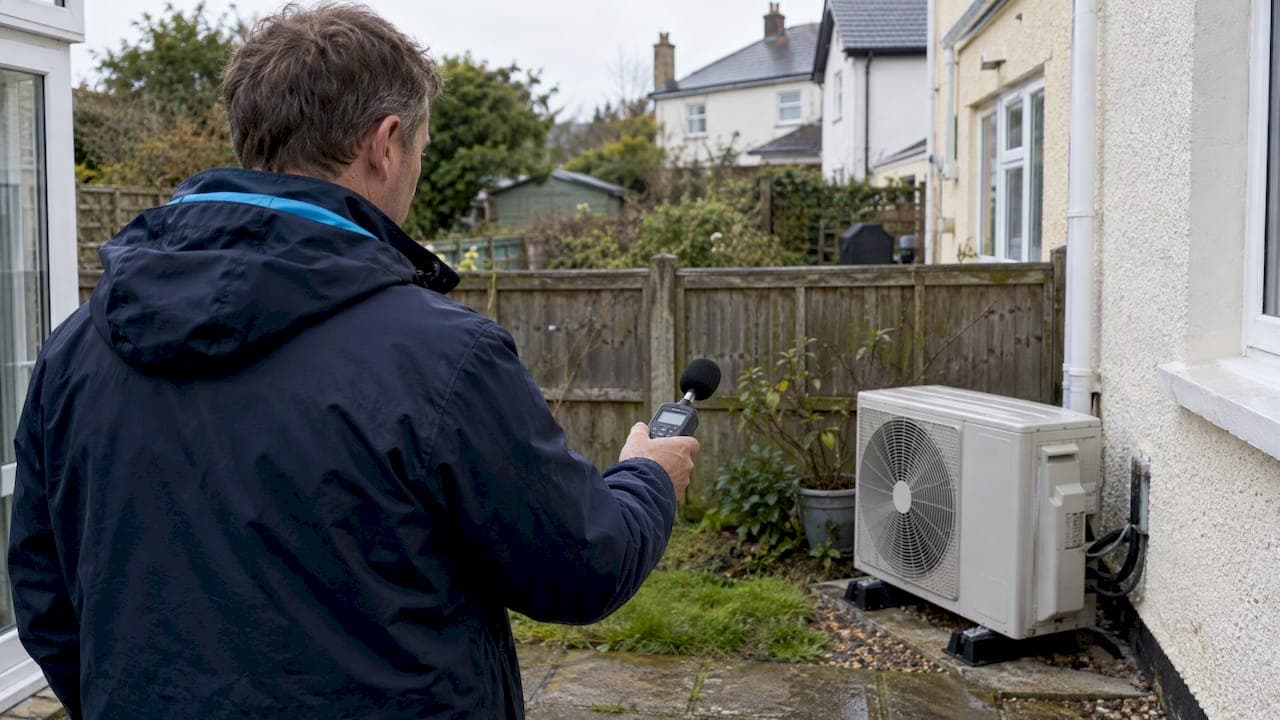
There is no single national decibel limit for domestic air conditioners in the UK. Instead, councils judge noise under the Environmental Protection Act 1990 using a statutory nuisance test, with the Noise Act 1996 and planning conditions providing extra tools. The practical fix is the same regardless: get a pre-installation acoustic assessment, site the unit carefully and keep maintenance records so you can demonstrate compliance if a complaint ever lands.
TL;DR:
- Noise from a domestic air conditioner is judged as a statutory nuisance based on its interference with property use, not a fixed decibel limit.
- Installing units with proper siting, a pre-installation acoustic assessment, and ongoing maintenance are crucial to prevent complaints and comply with regulations.
- Cumulative noise from multiple units, especially in areas with several heat pumps, can exceed effective limits and require additional mitigation measures.
- Councils may delay formal enforcement while attempting informal resolution, and evidence such as diaries, recordings, and measurement data are essential for complaint success.
- Planning conditions often specify noise limits and mitigation like acoustic enclosures, making early site assessment vital to avoid costly disputes later.
Table of Contents
- What the law says: statutory nuisance, Noise Act and planning rules
- How councils investigate and enforce noise complaints
- Permitted development and technical limits for heat pumps and condensers
- How to avoid complaints: practical mitigation before and after installation
- If your neighbour's aircon is noisy: step-by-step actions for affected residents
- Practitioner view: James at Frost Air Conditioning on preventing noise disputes
- How Frost Air Conditioning can help with a compliant, quiet installation
- FAQ
- Sources
What the law says: statutory nuisance, Noise Act and planning rules
Noise from a domestic air conditioner is not measured against a fixed decibel ceiling written into statute. Instead, it falls under Part III of the Environmental Protection Act 1990, which asks whether the noise amounts to a statutory nuisance, judged by how unreasonably it interferes with someone's use of their property. Local authorities must investigate such complaints and, where satisfied a nuisance exists, can serve an abatement notice requiring the noise to stop or be restricted. Ignoring that notice is a criminal offence.
For night-time disturbance, councils often lean on the Noise Act 1996, which lets them issue warning notices between 11pm and 7am when noise measured inside the complainant's home exceeds permitted levels. A warning notice gives a set period, at least ten minutes, to bring the noise down before the following morning.
Planning rules add a third layer:
- Permitted development rights allow many air source heat pumps and condenser units without a full planning application, subject to siting and noise conditions.
- Where planning permission is required, authorities can attach a site-specific decibel condition rather than relying on general nuisance law.
- Commercial and larger domestic installations are more likely to trigger a planning condition than a straightforward residential retrofit.
How councils investigate and enforce noise complaints
Councils tend to follow a fairly consistent sequence once a complaint about air conditioning noise comes in:
- The environmental health team logs the complaint and asks for basic details: times, duration and effect on daily life.
- An officer may ask the complainant to keep a noise diary before any site visit is arranged.
- If the noise appears to meet the statutory nuisance threshold, officers visit to assess it directly, sometimes using calibrated measurement equipment.
- Where a nuisance is confirmed, the council can serve an abatement notice, or a warning notice under the Noise Act 1996 for night-time cases.
- Continued breaches can lead to fixed penalties, prosecution, or in persistent cases, court orders affecting the equipment itself.
A Gov point worth knowing: councils can delay serving an abatement notice for up to seven days while they try to resolve the issue informally, which is often the fastest route to a fix without formal enforcement.
Acceptable evidence usually includes a written diary with dates and times, audio or video recordings where practical and, most persuasively, an officer's own measurements taken with approved equipment. Self-reported discomfort alone rarely moves a case forward quickly.
Permitted development and technical limits for heat pumps and condensers

Air source heat pumps installed under permitted development rights are governed by MCS 020, which sets a permitted development sound limit of 42 dB(A) that includes a nominal background assumption of 40 dB(A). In practice, this gives an effective limit of 37 dB(A) measured one metre from the nearest door or window of the neighbouring property most affected. The government's own review of this guidance flags a real weakness: the nominal background figure does not account for cumulative noise where several heat pumps or condensers sit close together, which can mean genuine disturbance even where each individual unit technically complies.
Where planning permission is required rather than permitted development, assessments typically follow BS 4142:2014+A1:2019, the British Standard method for rating industrial and commercial sound. It compares the unit's rating level against the existing background noise and applies penalties, commonly 2, 4 or 6 dB, where the sound is tonal or has a distinct character that makes it more noticeable than its raw level suggests.
- Planning conditions commonly require a unit to run at a set margin below background, for example 10 dB below background or a specified LAeq value measured at the nearest affected property.
- Where permission is granted with conditions, Planning Inspectorate decisions frequently require mitigation such as acoustic enclosures or absorptive panels to be fitted and maintained before the unit is ever switched on.
- Multiple installations in the same area, several heat pumps along a terrace, for instance, raise cumulative impact concerns that a single-unit assessment will not catch.
Pro Tip: check whether your proposed location already has other outdoor units nearby; a cumulative noise problem is far harder to resolve after installation than before.
How to avoid complaints: practical mitigation before and after installation
Most noise disputes are preventable at the design stage rather than fixed after the fact. A pre-installation acoustic assessment gives you a baseline background reading, usually expressed as LA90 or LAeq, against which the proposed unit's output can be checked before anyone commits to a position for the outdoor unit. Where planning permission or a permitted development submission is needed, that same assessment doubles as supporting evidence.
- Commission a baseline noise measurement before choosing a final position for the outdoor unit.
- Site the unit away from bedroom windows and shared boundaries, bearing in mind the one-metre measurement point used in MCS 020 assessments.
- Fit anti-vibration mounts correctly rather than bolting the unit directly to a wall or frame that can transmit vibration into the building structure.
- Add an acoustic enclosure or absorptive panelling where the baseline assessment or a planning condition calls for it.
- Choose a quieter model where noise-sensitive siting options are limited.
- Book regular servicing and keep a maintenance log, since worn fans or dirty coils are a common and avoidable source of rising noise over time.
Pro Tip: keep every survey report, siting decision and service record together; if a complaint ever arrives, that paper trail is often the quickest way to show the installation was done properly.
Anyone extending a property or adding a garden room alongside a new air conditioning installation should factor plant siting into that build from the outset rather than retrofitting around finished brickwork; firms such as EvoStruct that handle extensions and garden rooms can coordinate this at the design stage.

If your neighbour's aircon is noisy: step-by-step actions for affected residents
Before involving the council, it is usually worth a direct conversation: many noise issues come down to a unit sited too close to a shared boundary or simply needing a service, and a neighbour may not realise there is a problem at all.
- Keep a written diary noting the dates, times, duration and nature of the noise, ideally over several weeks.
- Make audio or video recordings where practical, noting the time and conditions for each.
- Ask politely whether the unit could be re-sited, serviced or fitted with an acoustic enclosure.
- If informal contact fails, submit a complaint to your local council's environmental health team, who will usually ask for your diary evidence first.
- Expect an initial response within days to a couple of weeks, followed by a possible site visit and, if a nuisance is confirmed, an abatement or warning notice.
- Persistent breaches after a formal notice can justify seeking independent legal advice, though most cases resolve at the council enforcement stage.
Practitioner view: James at Frost Air Conditioning on preventing noise disputes
In our experience, nearly every noise complaint traces back to a decision made before installation, not after. A proper pre-installation survey tells us exactly what background noise looks like on site, which shapes where the unit goes and whether extra mitigation is worth fitting from day one. Where a site is genuinely borderline, we recommend a formal acoustic assessment rather than guessing.
— James
How Frost Air Conditioning can help with a compliant, quiet installation
A noise complaint after installation costs far more time and money than getting the siting right the first time. We offer a free survey before any installation, so the position of your outdoor unit is based on your property's actual background noise rather than a rough guess, and our engineers can advise on mitigation such as anti-vibration mounts or acoustic enclosures where a site needs them.

- Book a domestic installation survey for home air conditioning; current finance options are available on eligible installs.
- For commercial premises or shop fitting projects where planning conditions are more likely, see our shop fitting and commercial service.
- Already have a unit that has become noisier over time? Our service and maintenance plans, including annual contracts and emergency breakdown response, often resolve noise that comes from wear rather than siting.
Get in touch to arrange a free survey and find out what a compliant, quiet installation looks like for your property.
FAQ
Can neighbours complain about air conditioning noise?
Yes. Neighbours can report air conditioning noise to their local council as a potential statutory nuisance under the Environmental Protection Act 1990. The council will investigate and can serve an abatement notice if it agrees the noise is unreasonable.
What can I do if my neighbour's air conditioner is loud?
Start by keeping a diary of when the noise happens and, where possible, raise it directly with your neighbour, since a service or re-siting often fixes it. If that does not work, report it to your local council's environmental health team, who can investigate under the Environmental Protection Act 1990 or the Noise Act 1996 for night-time cases.
How can I block or reduce noise from a neighbour's air conditioner?
Physical barriers such as fencing or dense planting between properties can reduce perceived noise, though they rarely solve a genuinely excessive source on their own. The more durable fix usually involves the unit owner fitting an acoustic enclosure, anti-vibration mounts or relocating the unit, often following a professional noise reduction assessment.
What are the rules for air conditioners in the UK?
There is no fixed national decibel limit for domestic air conditioners. Councils assess complaints under the statutory nuisance test in the Environmental Protection Act 1990, while heat pumps installed under permitted development follow the MCS 020 guidance with an effective limit of 37 dB(A) measured one metre from the nearest affected window or door.
Sources
- Legislation
- Gov
- Review of Air Source Heat Pump Noise Emissions, Permitted Development Guidance and Regulations (UK government report)
- Appeal decision and conditions relating to air conditioning unit and required acoustic mitigation (Planning Inspectorate)