
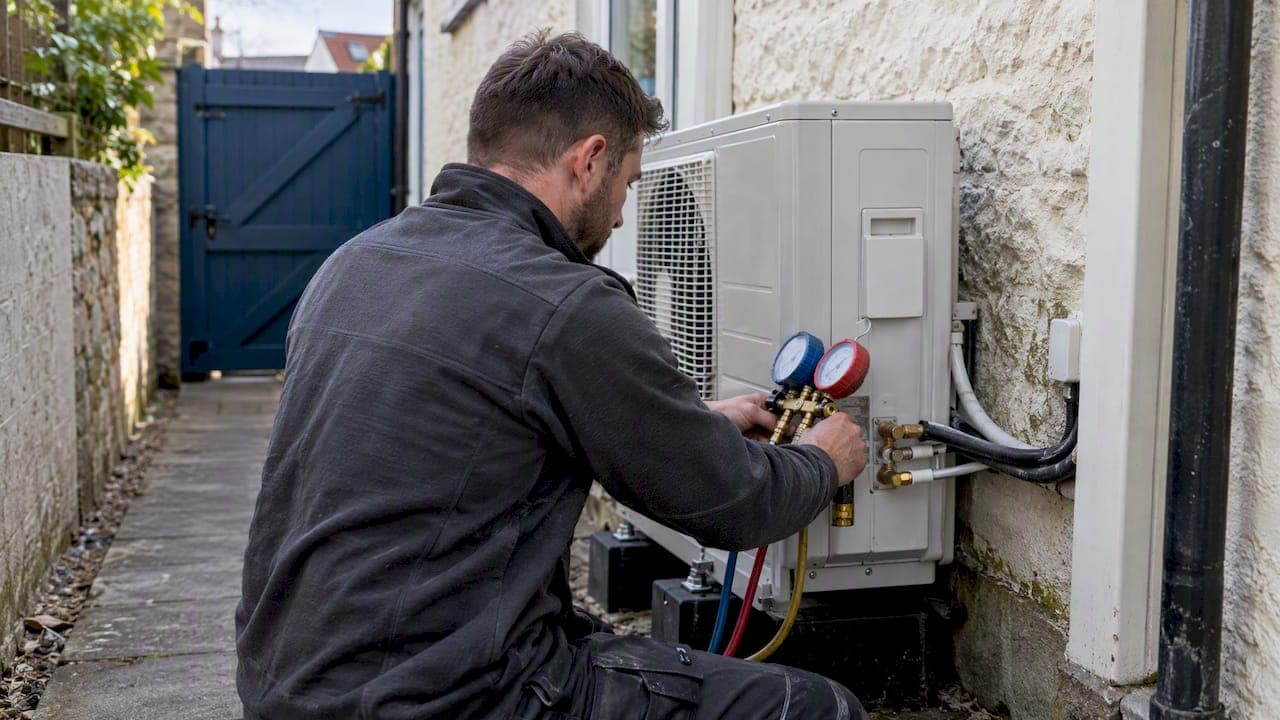
Air conditioning is legal in UK homes, and there is no single national rule that stops you fitting it. What you must get right is the detail: whether your property needs planning permission, how the work is signed off under Building Regulations, and who is legally allowed to handle the refrigerant. This guide covers each in plain terms, with the rules for England as the main reference, because that is where we work.
TL;DR
- It is not illegal to have air conditioning at home in the UK. It can go into existing and new homes, according to the government's own statement on air conditioning rules.
- Planning permission is often not needed for a small home system that does not change the building's appearance, but listed buildings, conservation areas and cooling-only units are the exceptions to check.
- A fixed system is notifiable under Building Regulations unless an installer on a Competent Person Scheme does the work.
- Only people holding the right F-gas certificate may install, service or recover refrigerant from an air conditioning system.
- Larger systems need an energy inspection every five years, and any unit needs sensible siting to avoid noise complaints.
Table of Contents
- Is it illegal to have air conditioning at home in the UK?
- Do you need planning permission for home air conditioning?
- Building Regulations: who signs the work off?
- Who is allowed to install or service a split system?
- Can you install a home air conditioner yourself?
- Outdoor unit siting, noise and neighbours
- Inspections and servicing
- Our perspective: compliance is mostly about the installer
- Getting a compliant installation from Frost
- A quick pre-installation checklist
- FAQ
- Sources
Is it illegal to have air conditioning at home in the UK?
No. Headlines about councils ordering residents to remove units have circulated, and they have left many homeowners worried. The government's position, set out in a Ministry of Housing, Communities and Local Government statement, is that air conditioning can be installed in both existing and new homes. There is no ban.
What exists instead is a patchwork of rules that apply to specific situations:
- Planning, which depends on your property type, location and the kind of system.
- Building Regulations, which govern how the work is notified and inspected.
- F-gas law, which controls who can work on refrigerant-based equipment.
- Noise and nuisance, which are handled locally if a neighbour complains.
- Inspection duties, which mainly affect larger systems.
The sections below take them in turn. If you are weighing up a project, the order matters: check planning first, because it can change which system and where the outdoor unit goes.
Do you need planning permission for home air conditioning?
In most cases, planning permission is not required to install air conditioning in a small home if the unit would not materially affect the external appearance of the building. That is the government's own guidance, and it also says homeowners should speak to their local council, because there is no blanket national rule for every residential installation.
The heating function catch
There is a technical point many guides miss. The Planning Portal explains that adding air conditioning may be permitted development if all the limits and conditions in the legislation are met, but those rights apply only if the system provides a heating function. A cooling-only system does not benefit from the same rights as a heat pump and will typically need a planning application in England.
In practice most modern split systems are reversible, meaning they heat as well as cool. That is one reason a specialist survey matters before you buy: the model you choose can affect your planning position.

Listed buildings and conservation areas
Council guidance on air source heat pumps, which is the closest published yardstick for outdoor units, says permitted development rights do not apply within the curtilage of listed buildings or scheduled monuments. In conservation areas, restrictions depend on where the unit sits relative to a highway. The same guidance applies to England and Wales.
That matters in the South West, where Devon and Cornwall have many listed cottages, town centres with conservation status and coastal terraces. If your home falls into one of these groups, ask your council before you order anything. Our own permitted development checklist walks through the questions to settle first.

Flats and leasehold properties
Planning is only one layer. If you own a flat, your lease or freeholder may restrict anything fixed to an external wall, whatever the planning position. Get written consent first. Some flats suit systems without an outdoor unit, which we cover in our guide to air conditioning for flats.
Building Regulations: who signs the work off?
This is where homeowners most often go wrong. Government guidance for England states that a fixed air conditioning system is notifiable work under Building Regulations unless it is carried out by an installer registered with a relevant Competent Person Scheme.
That gives you two routes:
| Route | What happens | What you do |
|---|---|---|
| Registered installer | The installer self-certifies the work under their scheme | Keep the certificate they provide |
| Non-registered installer or DIY | A Building Control Body must inspect the work | Submit a building notice or full plans application and pay a fee |
The same guidance says that if you are doing the work yourself and Building Control must be told, you should contact a Building Control Body before you start. Leaving it until after the unit is on the wall is the mistake to avoid.
Building Regulations differ in Scotland, Wales and Northern Ireland, so if you live outside England, check with your own local authority.
Who is allowed to install or service a split system?
Air conditioning relies on refrigerant gases, which are tightly regulated. Under UK F-gas rules, it is illegal for anyone without the correct individual qualifications to install, service, maintain or recover refrigerant from air conditioning systems. The government's qualifications page explains that Category 1 covers all activities, while Categories 2, 3 and 4 cover narrower activities and conditions.
This is why the idea of a quick cash-in-hand fit by a general handyman is a poor one. An engineer without the certificate is acting unlawfully when they connect and charge the system, and you are left with no proper commissioning record and possible trouble with your warranty.
Five things to ask before you hire
- Can you see the engineer's F-gas certificate, and which category is it?
- Is the company registered with a Competent Person Scheme for Building Regulations?
- Will the engineers be employees, or is the job subcontracted?
- Will I receive commissioning paperwork and a warranty registration?
- Who do I call if the system breaks down?
We have written two practical guides on this: five checks to verify F-gas compliance before you hire and how to verify certification and the company register. Both show where to look rather than asking you to take anyone's word for it.
Can you install a home air conditioner yourself?
Legally, it is more complicated than it sounds. A fixed system is notifiable work, so a DIY fit means contacting Building Control first and paying for inspection, as above. The refrigerant side is the bigger barrier: handling it without the F-gas qualification is unlawful, and a split system cannot be properly connected and commissioned without that work.
Portable units are a different matter. They do not involve connecting refrigerant pipework on site, so they avoid most installation requirements. They also tend to be less efficient and noisier than fixed systems, and they still need a hose to vent hot air outdoors. For a bedroom that overheats a few nights a year they can be a stopgap. For regular use, a fixed system fitted by a certified engineer is the sounder long-term choice.
Outdoor unit siting, noise and neighbours
The outdoor unit is where most disputes start. Even where planning permission is not needed, you can still face a complaint if the unit is loud or sited badly.
Council guidance on heat pumps, which sets expectations many local authorities apply by analogy, says a unit should, so far as practicable, be sited to minimise its effects on the area's amenity. It also admits the trade-off: the most efficient position may not be the best for limiting visual or noise impact, so you balance performance against neighbours.
Sensible habits:
- Keep the unit away from neighbours' bedroom windows and shared boundaries where you can.
- Avoid corners and enclosed spaces that bounce sound around.
- Mount it on anti-vibration feet or brackets.
- Choose a quieter model and use night or quiet modes.
Our guides on the 1 metre rule and MCS 020 for outdoor unit placement and on avoiding noise complaints go through placement in more detail.
Inspections and servicing
The government states that air conditioning systems must be inspected every five years by an energy assessor. This duty is aimed mainly at larger systems in commercial premises, and the threshold is based on rated output. Our guide to the TM44 trap and the 12 kW threshold explains who it catches. If you manage a business property, see our commercial aircon compliance guide.
A typical home split system is not caught by that inspection regime, but servicing still matters. Dirty filters cut performance, and a leaking system loses refrigerant, which must be handled by a certified engineer. Our guide on how often to service your aircon and a seasonal service checklist set out a sensible routine.
Our perspective: compliance is mostly about the installer
We install air conditioning across Devon, Cornwall and the wider South West, and the homeowners we meet are rarely worried about breaking a law on purpose. They are worried about not knowing what they should check. Our view is that most of the legal burden falls away when you pick the right installer, because the parts that trip people up are the parts a competent engineer handles as routine.
That is why we run our own certified, local engineers rather than subcontracting. When the person at your door holds the F-gas certificate and is registered with REFCOM, the refrigerant work, commissioning and Building Regulations sign-off sit with one accountable team. A free survey before quoting lets us flag planning issues early, such as a conservation area or a cooling-only model, and advise on where the outdoor unit should sit so neighbours have nothing to complain about.
Our honest advice: do not start with the brand or the price. Start with three questions. Does my property need planning permission? Who will sign off the Building Regulations notification? Can I see the engineer's F-gas certificate? If a quote does not answer them, keep looking.
— James
Getting a compliant installation from Frost
We install domestic systems from Samsung, Mitsubishi, Toshiba and Daikin, with free surveys, F-gas certified engineers and installations typically completed within one to two days. Same day installs are available in some cases, and 0% finance is available to spread the cost. Our domestic installation service covers survey, design, fitting and commissioning in one package.

If you would rather see the equipment first, our range includes models such as the Daikin Perfera and the Samsung Luzon S2. Already have a system? Our service and maintenance plans include annual contracts and emergency breakdown response.
A quick pre-installation checklist
Use this before you sign anything:
- Check your property status. Is it listed, in a conservation area, or a leasehold flat?
- Ask your council if you are unsure about planning. Make a note of who you spoke to and when.
- Choose a system with a heating function where possible, because that affects your planning position in England.
- Confirm the installer's credentials: F-gas certificate and Competent Person Scheme registration.
- Plan the outdoor unit position with neighbours and noise in mind.
- Keep the paperwork: commissioning record, Building Regulations certificate and warranty details. You may need them when you sell.
- Book a service at sensible intervals once it is running.
FAQ
Is it illegal to have AC in your house in the UK?
No. The government confirms that air conditioning can be installed in both existing and new homes. What the law controls is how it is installed: planning where it applies, Building Regulations notification, and F-gas qualifications for anyone handling refrigerant.
Do I need planning permission for a home air conditioning unit?
Often not, if the system is small and does not materially affect the building's appearance. Listed buildings, conservation areas and cooling-only systems are the main exceptions in England, so confirm with your local council before ordering.
Who can legally install a split air conditioning system?
An engineer holding the correct F-gas certificate, with Category 1 covering all activities. For Building Regulations, using an installer registered with a Competent Person Scheme means you avoid paying for separate Building Control inspection.
How often must a home air conditioner be inspected?
The five-year energy assessor inspection applies to larger systems, mainly in commercial buildings. A typical domestic split system is not usually caught by it, but a yearly service by a certified engineer keeps it efficient and spots refrigerant leaks early.
Sources
- Air conditioning rules, MHCLG in the Media
- Do I need planning permission to add air conditioning to my home, Planning Portal
- Air Source Heat Pumps: Guidance for Applicants, Sheffield City Council
- Building work, replacements and repairs to your home, GOV.UK
- Qualifications to work with F gas, GOV.UK
- Get your air conditioning system inspected, GOV.UK