
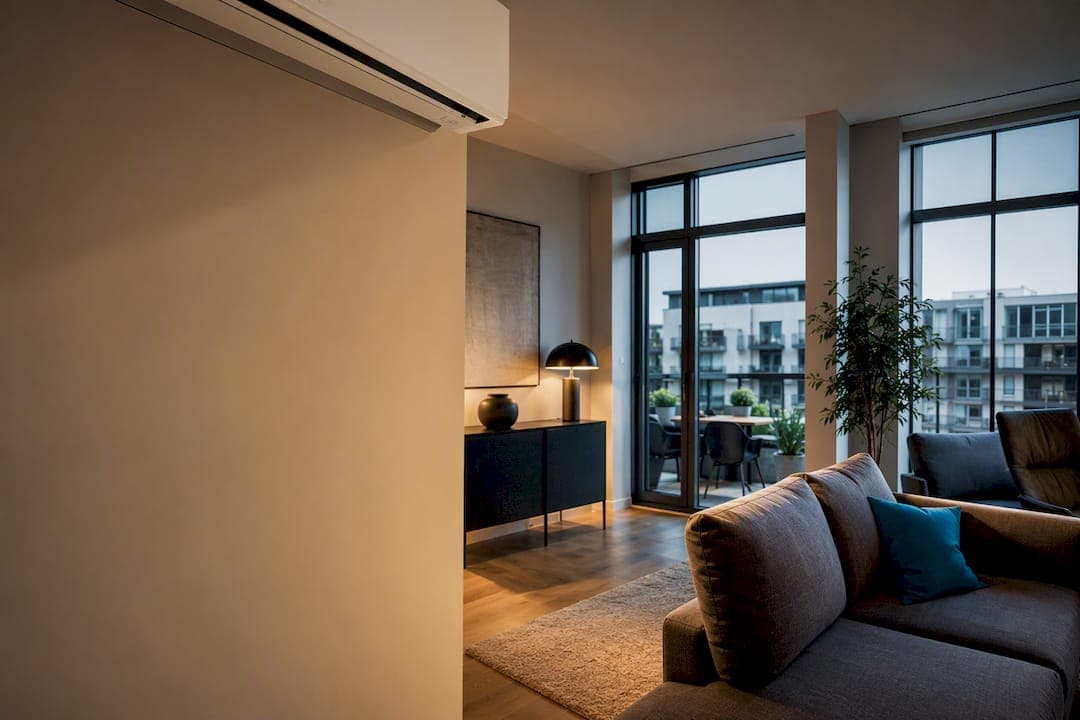
Yes, flats in the UK can have air conditioning, but which option works depends entirely on whether you own or rent and what your building allows. Renters usually start with a portable unit; owners and leaseholders typically get further with a single-split or internal water-cooled system. Either way, the first two moves are the same: check with your landlord or freeholder, then book a survey with an F-Gas certified installer before you spend a penny on equipment.
TL;DR:
- Portable units are suitable for renters due to no fixed installation but are noisier and less efficient than fixed systems for cooling multiple rooms.
- Most flats require permission from freeholders or building management before installing fixed air conditioning systems, especially external units or those connecting to shared services.
- Single-split mini-split systems are the most practical choice for one or two-bedroom flats, offering better efficiency, quieter operation, and dehumidification than portable options.
- Installation costs typically range from £1,400 to £2,400 for a single-split system, with multi-split setups costing more, and proper sizing is essential to avoid energy waste.
- Regular maintenance, including filter cleaning and condensate drain checks, helps prevent faults, noise issues, and high-energy costs in flat environments.
Table of Contents
- Which air conditioning systems actually work in a flat?
- Do you need permission to install air conditioning in your flat?
- What does air conditioning cost to install in a UK flat?
- Where can the outdoor unit go if you can't fit a condenser?
- How do you choose the right system and installer?
- Frost Air Conditioning: what a professional installer brings to a flat job
- How do you maintain air conditioning in a flat?
- What energy efficiency rating should you look for?
- Does air conditioning improve air quality in a flat?
- When and how should you run air conditioning across the seasons?
- Publisher perspective: why we recommend survey-first, permission-checked installs
- How Frost Air Conditioning can help with your flat installation
- Sources
Which air conditioning systems actually work in a flat?
Not every system suits flat living, and the constraints are different from a house with a garden and a side alley for the condenser. Space, shared walls, and building rules narrow the field fast.
Portable units plug into a standard socket and vent through a window with a hose. Renters like them because nothing gets fixed to the building and you can take them when you move. The trade-off is real: portable units are generally noisier and less efficient than fixed alternatives, and most struggle to cool more than one room properly.
Window units sit in the frame itself. They're less common in the UK than in the US, partly because many leases and window designs don't accommodate them easily, and they carry similar noise downsides to portable models.
Single-split mini-splits are usually the sweet spot for a one or two-bedroom flat. One outdoor condenser feeds a single indoor wall unit, and a correctly sized single-zone system tends to beat a portable unit on quiet running, efficiency, and dehumidification, according to small-apartment cooling guides. Inverter-driven versions modulate output rather than switching on and off at full blast, cutting energy use by up to around 40% compared with fixed-speed compressors while running noticeably quieter, which matters when your neighbour's bedroom is the other side of a party wall.
Multi-split and ducted systems connect several indoor units to one outdoor condenser, useful if you want to cool a living room and two bedrooms without three separate outdoor boxes cluttering a small balcony. They cost more and take longer to fit.
Fully internal or water-cooled systems dispense with an outdoor condenser altogether, using the building's water supply and drainage to reject heat instead of blowing it outside. These get specified in listed buildings and flats with strict façade rules where an external box simply won't get past planning or a freeholder.
- Portable: no fixed installation, weakest performance, best for renters with no permission route.
- Single-split: best all-round balance for one or two rooms.
- Multi-split/ducted: whole-flat coverage at a higher price.
- Internal/water-cooled: no external unit, but needs internal plumbing space.
Do you need permission to install air conditioning in your flat?
Almost always, yes, if the installation involves anything fixed to the outside of the building. Written consent from your freeholder or managing agent is the norm for any work that penetrates the external envelope or ties into shared services like communal drainage. Permitted development rights that let houses install a condenser without planning permission generally don't extend to flats, so assume you need a conversation with building management before assuming anything is allowed.
- Tenants should write to their landlord describing the exact system, where the condenser would sit, and whether any drilling is involved, then get the answer in writing rather than relying on a verbal yes.
- Leaseholders normally need to present the same information to the freeholder or managing agent, often alongside a method statement from the installer.
- Listed buildings and conservation areas carry extra layers: alterations to the external appearance can trigger listed building consent or planning constraints regardless of what your lease says.
- Documents worth requesting include a written consent letter, the installer's proposed condenser location with photos or a mock-up, and confirmation of who's liable for reinstatement if you move out.
Skipping this step is the single most common reason flat installations get delayed or ripped out after the fact.
What does air conditioning cost to install in a UK flat?
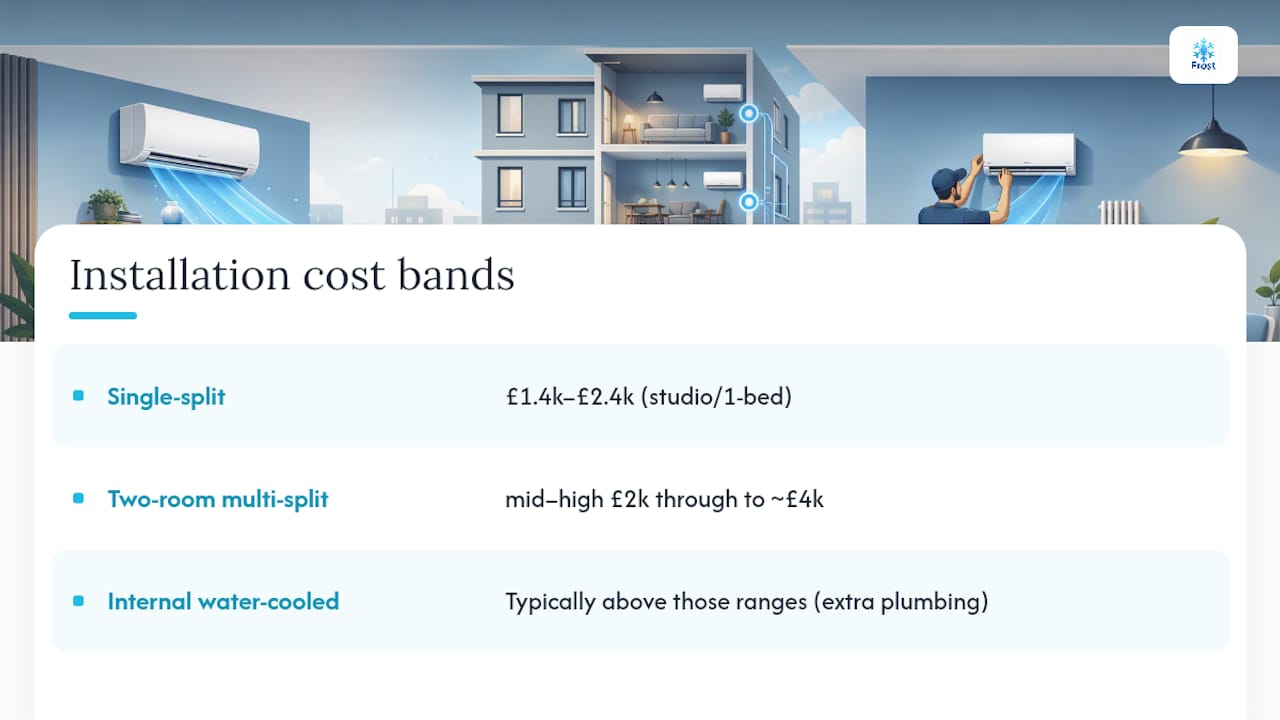
Budget roughly £1,400 to £2,400 for a single-split system in a studio or one-bed flat, supplied and fitted, rising to the mid-to-high £2,000s through to around £4,000 for a two-room multi-split setup. Internal water-cooled systems tend to sit above these figures because of the extra plumbing work involved.
Sizing rules of thumb (roughly 100 BTU per square foot as a rough starting point) are fine for a ballpark, but they ignore glazing, insulation, occupancy, and heat from appliances. A proper load survey catches the difference between a unit that's undersized and struggling on a July afternoon and one that's oversized, short-cycling, and wasting money.
Installation timelines vary by system: most single-split jobs complete in a single day, multi-split can run to a day or two depending on pipe routing, and internal systems often take longer once plumbing and drainage work is factored in. Running costs come down mainly to inverter efficiency, so check the SEER rating on any quote, not just the upfront price. Our guide to UK air conditioning costs breaks these figures down further.
Where can the outdoor unit go if you can't fit a condenser?
Placement options depend heavily on your building type. Some purpose-built blocks already have dedicated condenser ledges or rooftop plant areas, which removes most of the permission friction other flats face.
- Balcony bracket: common and usually straightforward, but visible from the street and subject to noise limits.
- Rear wall mounting: discreet if the flat backs onto a courtyard rather than a public-facing elevation.
- Roof plant or screened area: ideal where available, often already designed into new-build blocks.
- Concealment or acoustic screening: can satisfy a freeholder's aesthetic objection, though screening itself sometimes needs sign-off.
Where none of that works, internal water-cooled systems remove the external condenser entirely. They still need freeholder agreement, though, because they draw on the building's water supply and drainage rather than a wall bracket.
Pro Tip: Ask your managing agent early whether the block has an existing plant area or condenser policy. New-build flats increasingly design this in from the start, which can turn a six-week permissions headache into a same-day yes.
How do you choose the right system and installer?
Start with three questions about your own situation: do you own or rent, how many rooms need cooling, and how sensitive is your building to noise and visual impact on the façade. Those three answers rule out most options before you even get a quote.
- Ask about permissions first. A competent installer will ask to see your written consent before booking a fitting date, not after.
- Request a method statement. This should cover pipe routing, drilling locations, and how the condenser will be fixed.
- Confirm F-Gas certification. Anyone handling refrigerant in the UK legally needs this; ask for the certificate number.
- Check the warranty terms, including what's covered on parts versus labour.
- Ask how disruptive the job will be for neighbours below or beside you, particularly for drilling through solid walls.
- Get a clear reinstatement plan in case you sell or move out and the freeholder wants the bracket removed.
Pro Tip: Walk away from any installer who won't put the method statement in writing or asks for a large deposit before the survey. A proper site visit costs you nothing and should come before any commitment.
Frost Air Conditioning: what a professional installer brings to a flat job
Frost Air Conditioning offers a free site survey before any commitment, which matters most in flats because it flags permission risks and pipe-routing problems before they become expensive surprises. Engineers hold F-Gas and REFCOM certification, the standard required by law for anyone handling refrigerant in the UK. Frost fits systems from Samsung, Mitsubishi, Toshiba, and Daikin, with same-day installation available for straightforward single-split jobs and 0% finance for readers who'd rather spread the cost across a quieter month than pay it all upfront.
How do you maintain air conditioning in a flat?
Flats have less room for error than houses when a unit is neglected, because a dripping condensate pipe or a blocked filter affects a shared wall or a neighbour's ceiling, not just your own.
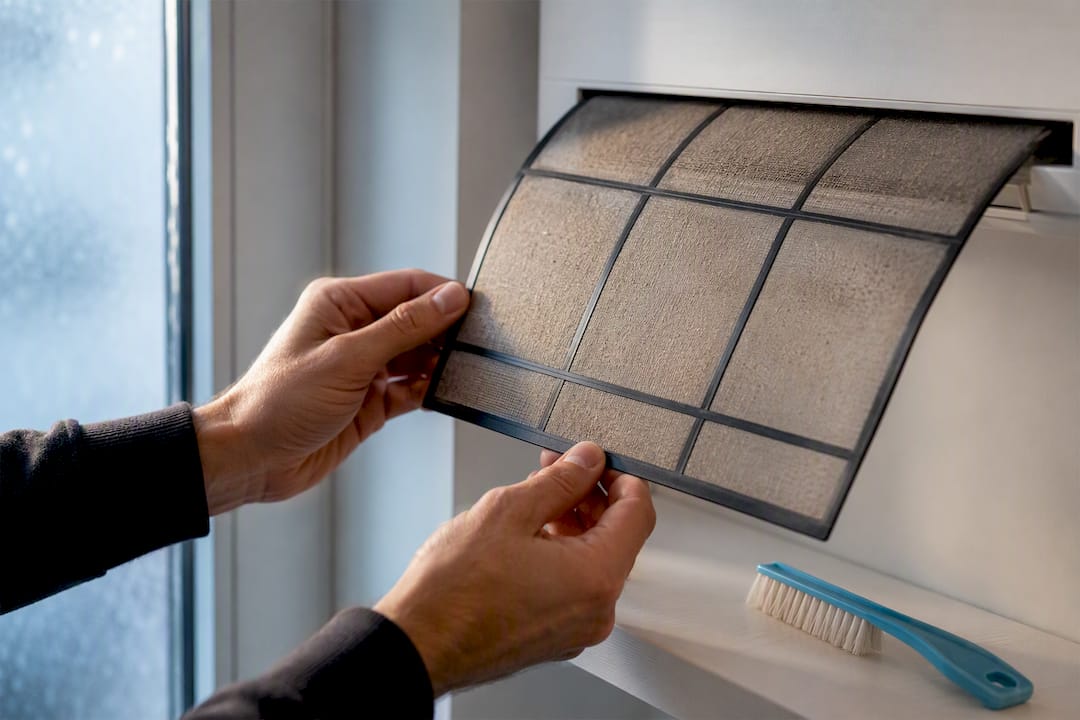
Clean or replace the filter every one to three months during heavy summer use. A clogged filter cuts efficiency and forces the compressor to work harder, which shows up on your electricity bill before it shows up as a fault.
Check the condensate drain regularly, particularly on wall-mounted internal units. Flats often route drainage through a compact route to a soil stack or external wall, and a blockage here can mean water tracking down into the flat below rather than dripping harmlessly onto grass.
Keep the outdoor condenser clear of debris. Balcony-mounted units collect leaves, dust, and pigeon mess faster than you'd expect on an upper floor, and restricted airflow around the condenser reduces cooling capacity and pushes up running costs.

Book an annual professional service. This covers refrigerant levels, electrical connections, and a proper clean of the coils, and it's usually a condition of maintaining your warranty. Frost Air Conditioning's maintenance packages cover this on a scheduled basis rather than leaving it to memory.
Listen for changes in noise. A unit that's suddenly louder or rattling is often cheaper to fix early than to ignore until the compressor fails.
What energy efficiency rating should you look for?
Look at the SEER (Seasonal Energy Efficiency Ratio) figure on any quote before you look at the price. A higher SEER means more cooling output per unit of electricity, and in a flat, where running costs land directly on a single household bill with no scope to share the load, that difference compounds over a full summer.
Inverter technology is the practical standard now, not a premium extra. Rather than cycling the compressor fully on and off, an inverter unit ramps output up and down to match demand, which is where most of the energy saving and noise reduction actually comes from. Fixed-speed units still exist and cost less upfront, but they run less efficiently and louder, which matters more in a flat than a detached house with a garden to absorb the noise.
Beyond the headline efficiency figure, check the unit's rated capacity against your room size rather than trusting marketing copy. An oversized unit cools fast but short-cycles constantly, which wastes energy and struggles to dehumidify properly. An undersized one runs flat out permanently and never quite reaches the temperature you want. Our inverter AC explainer covers how to read the technical specification sheet without needing an engineering degree.
Does air conditioning improve air quality in a flat?
Flats trap heat and stale air more readily than houses, particularly upper floors with limited cross-ventilation and windows that only open a few inches for security. Air conditioning does more than cool the room.
Dehumidification is the underrated benefit. Mini-split systems pull moisture out of the air as they cool, which reduces the damp conditions that encourage mould and dust mites, both common triggers for allergies and asthma in poorly ventilated flats.
Filtration reduces airborne particulates. Most fixed systems filter the air as it recirculates, catching dust, pollen, and some particulate matter, which matters more in flats near busy roads where opening a window means letting traffic pollution straight in.
Consistent temperature reduces heat stress. During heatwaves, flats on upper floors or with large west-facing windows can become genuinely dangerous for elderly or vulnerable residents. A properly sized system keeps the space liveable rather than just marginally cooler.
None of this replaces good ventilation habits, but it closes a gap that opening a window in a flat often can't.
When and how should you run air conditioning across the seasons?
Summer is the obvious season, but timing matters more than most people realise. Running the system for shorter bursts starting in the early afternoon, before the flat has fully heated up, uses less energy than blasting it once the rooms are already hot.
Set the thermostat sensibly rather than for a race to cool down. Around 24 to 25 degrees Celsius is comfortable for most people and puts far less strain on the compressor than chasing 18 degrees on a 30 degree day.
Most systems double as heating in winter, since heat pump technology reverses to draw warmth from outside air. This is worth factoring into the cost conversation: a system that handles both jobs can replace a portion of your existing heating rather than sitting idle for nine months of the year.
Between seasons, a light service check (filters, drainage, condenser clearance) before the first hot week of the year prevents the classic scenario of discovering a fault on the one weekend you actually need cooling.
Publisher perspective: why we recommend survey-first, permission-checked installs
Skipping the permission check is the single costliest mistake we see in flats, so we always push survey-first advice. Frost Air Conditioning offers 0% finance and same-day installs where the paperwork's already sorted.
— James
How Frost Air Conditioning can help with your flat installation
If you've read this far, you already know the two things that make or break an air conditioning install in a flat: getting permission sorted early, and choosing a system suited to your building rather than whatever's cheapest online. Frost Air Conditioning handles both sides of that. A free site survey identifies condenser placement, checks what your freeholder will realistically approve, and sizes the system properly before any quote is finalised.

Every installation is carried out by F-Gas and REFCOM certified engineers, working with systems from Samsung, Mitsubishi, Toshiba, and Daikin. Straightforward single-split jobs are often completed the same day, and 0% finance is available if you'd rather spread the cost. If you're ready to find out what will actually work in your flat, book a free survey through the domestic installation page and get a proper answer instead of a guess.
Sources
- 7 air conditioning planning permission rules you must know in the UK | 4D Planning
- Air Conditioning for London flats: complete guide - Simply Air Conditioning London
- Best AC for small apartment: complete guide to smart cooling