
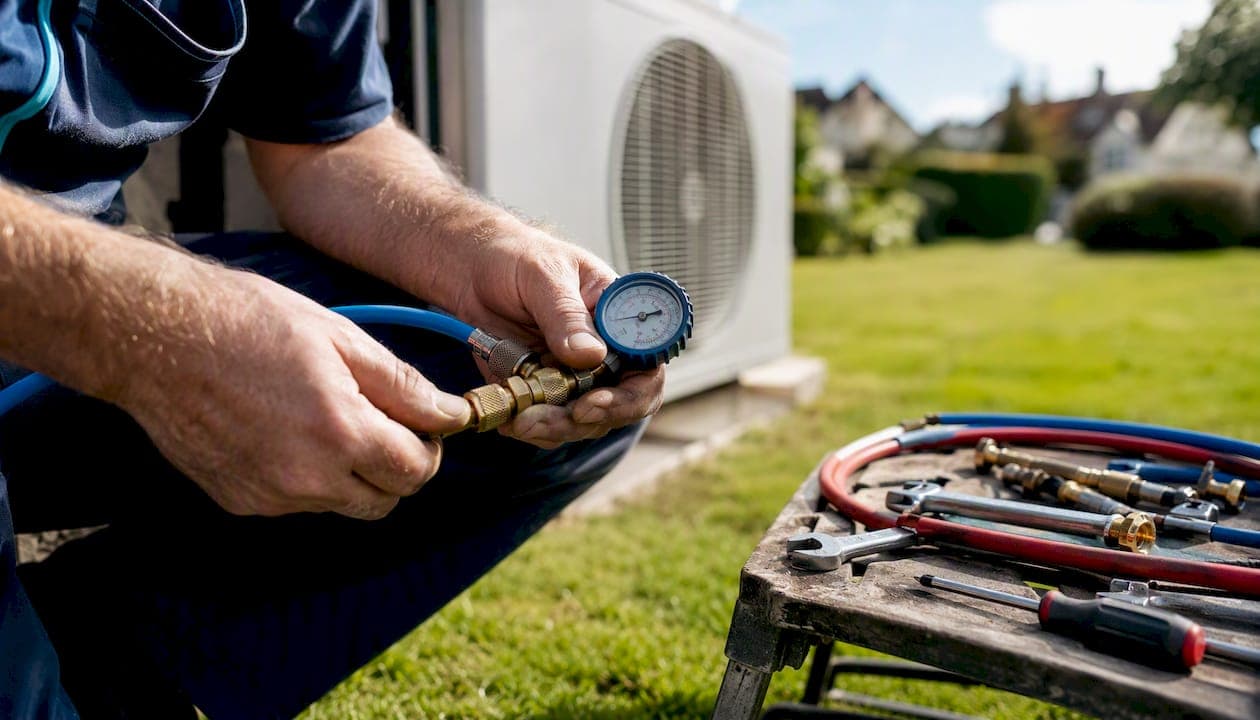
The refrigerant in your air conditioner — commonly called "air conditioner gas" — is a sealed working fluid that circulates in a closed loop to move heat from inside your home to outside. It does not get used up like fuel. If your system is running low, it has a leak, and that leak needs a certified engineer to find and fix it before any refrigerant is added. Carrier's refrigerant guide confirms this directly: a low reading always indicates a leak, not normal consumption.
If you suspect a problem right now, here is what to do:
- Check your filters and airflow first. A blocked filter causes most "no-cool" complaints and costs nothing to fix.
- Look for signs of a refrigerant leak: ice on the indoor unit, hissing sounds, oily residue near pipe connections, or a sudden drop in cooling.
- Arrange a certified inspection. Only an F-Gas or REFCOM certified engineer may legally handle refrigerant in the UK.
Key takeaways
Refrigerant is a sealed working fluid — if your system is low, it has a leak that must be repaired by a certified engineer before any refrigerant is added.
| Point | Details |
|---|---|
| Refrigerant does not run out | Low refrigerant always indicates a leak; repair the leak before recharging. |
| Certification is a legal requirement | Only F-Gas or REFCOM certified engineers may handle refrigerant in the UK. |
| Phase-outs affect older systems | R-22 is banned; R-410A faces tightening restrictions from 2025 onwards. |
| Maintenance prevents most faults | Annual professional servicing and regular filter cleaning resolve the majority of no-cool complaints. |
| Frostairconditioning covers the South West | F-Gas certified engineers, full paperwork, and 0% finance on qualifying installations across Exeter and the South West. |
Table of Contents
- Which refrigerant gases are used in UK air conditioners?
- How does refrigerant actually work in your air conditioner?
- What does UK law say about handling refrigerant?
- When is regassing appropriate, and what should the process look like?
- Can you refill AC gas yourself?
- How much does a regas cost in the UK, and when should you replace instead?
- Safety and environmental considerations: what to do if you suspect a leak
- Maintenance that prevents most refrigerant problems
- How a REFCOM-certified engineer diagnoses and repairs refrigerant issues
- A note from Frostairconditioning
- Certified refrigerant support across the South West
- Sources
Which refrigerant gases are used in UK air conditioners?
The refrigerant in your system depends almost entirely on when it was installed. The table below covers the gases you are most likely to encounter in UK homes and light commercial premises.
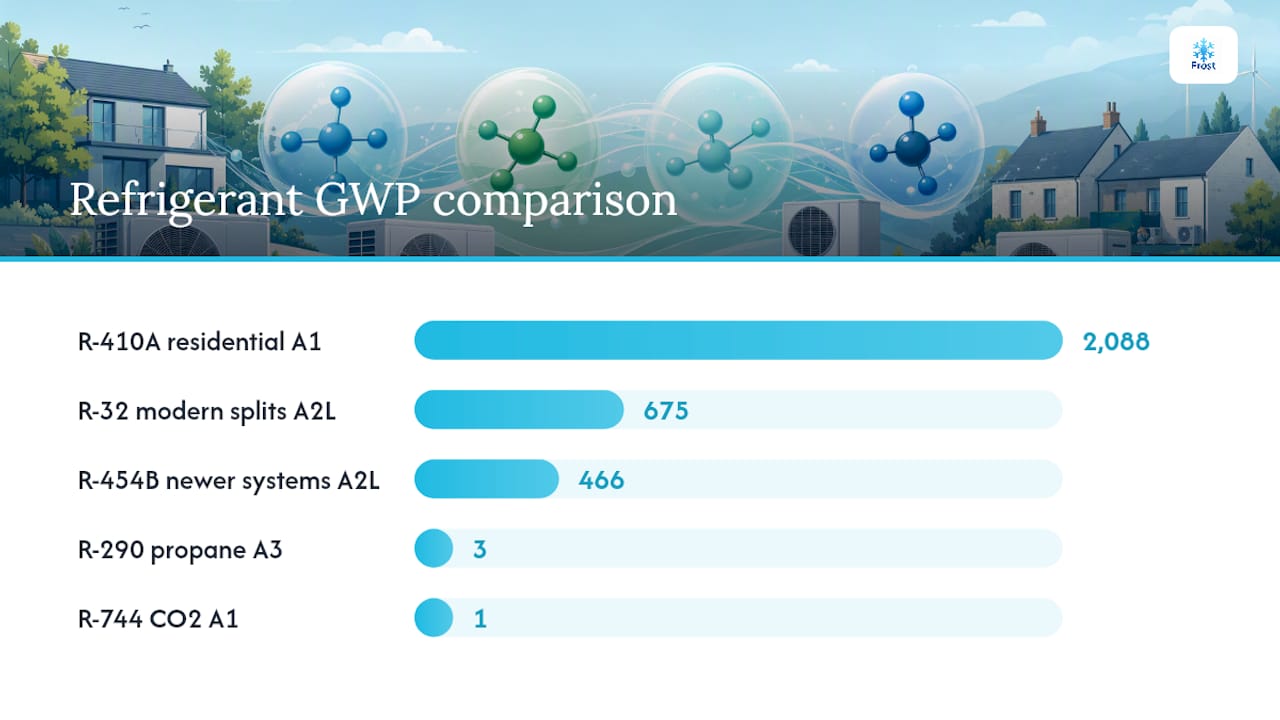
| Refrigerant | Typical use | GWP (approx.) | Safety class |
|---|---|---|---|
| R-22 | Legacy split systems | 2,088 | A1 |
| R-410A | Residential splits, 2004–2023 | 2,088 | A1 |
| R-32 | Modern domestic splits, heat pumps | 675 | A2L |
| R-454B | Newer residential and commercial AC | 466 | A2L |
| R-290 (propane) | Small commercial, portable units | 3 | A3 |
| R-744 (CO2) | Commercial refrigeration, some heat pumps | 1 | A1 |
| — | Mobile/automotive AC | 4 | A2L |
R-22 is a legacy ozone-depleting substance. It has been banned from new systems for many years and is now heavily restricted even for servicing. If your system still runs on R-22, replacement is not a question of if but when.
R-410A was the dominant refrigerant in residential split systems installed from around 2010 onwards. Manufacturers are now moving away from it because of its high global warming potential (GWP of 2,088), switching to R-32 and R-454B for new products, as Trane's HVAC refrigerant guide explains.
R-32 is the most common refrigerant in new domestic splits sold in the UK today. Its GWP of 675 is roughly a third of R-410A's, and it performs well in the compact wall-mounted units that suit most UK homes. It is classified A2L — mildly flammable — which means installation and servicing require specific handling procedures.
R-454B is the direction manufacturers are heading for larger and commercial systems, with a GWP of 466. R-290 (propane) and R-744 (CO2) are non-fluorinated options that the EU climate action guidance highlights as climate-friendly alternatives, though they are currently more common in commercial refrigeration than in domestic wall-mounted AC.
How does refrigerant actually work in your air conditioner?
Refrigerant moves heat from inside your home to outside by changing state — evaporating to absorb heat indoors, then condensing to release it outdoors. That is the whole trick.
The cycle runs in four stages. In the evaporator (the indoor unit), liquid refrigerant absorbs heat from the room air and turns into a low-pressure gas. The compressor then raises that gas to high pressure and temperature. In the condenser (the outdoor unit), the hot gas releases its heat to the outside air and becomes liquid again. Finally, the expansion valve drops the pressure before the refrigerant re-enters the evaporator and the cycle repeats.
Because it is a closed loop, the refrigerant never leaves the system under normal operation. Think of it like the coolant in a car radiator: it circulates continuously and should never need topping up unless something has gone wrong.
Three things happen when refrigerant escapes through a leak:
- The evaporator cannot absorb enough heat, so the indoor unit blows warm or barely cool air.
- The low refrigerant charge causes the evaporator coil to drop below freezing, forming ice that blocks airflow further.
- The compressor runs harder to compensate, shortening its life and raising your electricity bill.
What does UK law say about handling refrigerant?
Only F-Gas and REFCOM certified engineers are authorised to handle, recover, and recharge refrigerant in the UK. This is not a best-practice recommendation — it is a legal requirement under the UK F-Gas Regulation, which retained the substance of the EU framework after Brexit. Handling refrigerant without the correct certification is an offence.
The phase-out timeline matters for anyone with an older system. R-22 was banned from use in new equipment years ago and is now banned for servicing too. R-410A, which has a GWP of 2,088, faces tightening restrictions: the EU guidance sets prohibitions for certain equipment categories from 1 January 2025 and further limits from 1 January 2027, with the UK broadly tracking the same trajectory.
The practical consequence: if your system uses R-410A and develops a significant leak after 2025, sourcing refrigerant for a regas may become harder and more expensive. A modern R-32 or R-454B system removes that uncertainty entirely.
Manufacturer-specified refrigerant charge and compatibility also matter legally and practically. You cannot substitute a different refrigerant type without replacing compressor oil, metering devices, and potentially the compressor itself. Using the wrong gas voids the warranty and risks catastrophic system failure.
When is regassing appropriate, and what should the process look like?
The rule is simple: never add refrigerant to a system without first finding and repairing the leak. Topping up without fixing the source is non-compliant with F-Gas rules, temporarily effective at best, and environmentally harmful. GOV.UK's F-Gas guidance is explicit on this point.
A properly conducted regas by a certified engineer follows this sequence:
- Initial pressure test. The engineer checks system pressures against manufacturer data to confirm the charge is low and identify the likely fault area.
- Leak detection. Using an electronic leak detector or UV dye, the engineer locates the source — common sites include flare joints, Schrader valves, and coil damage.
- Repair. The leak is fixed before any refrigerant is added. This might mean re-flaring a joint, replacing a valve, or repairing a coil.
- Evacuation (vacuum). A vacuum pump removes all moisture and non-condensables from the system. Skipping this step causes acid formation inside the compressor.
- Recharge to manufacturer specification. Refrigerant is weighed in to the exact charge stated on the unit's data plate — not estimated, not approximated.
- Performance check and paperwork. The engineer verifies operating pressures and temperatures, then completes the F-Gas service record.
Before you agree to a regas, ask the engineer these questions: Are you F-Gas or REFCOM certified? What refrigerant type and quantity will you use? Will you provide a written F-Gas log? Does this work affect my manufacturer warranty?
Pro Tip: Keep the F-Gas service record somewhere safe — alongside your installation paperwork. You will need it if you ever sell the property, make a warranty claim, or need to demonstrate compliance to a future engineer.
Can you refill AC gas yourself?
No. In the UK, handling refrigerant without F-Gas certification is illegal, and no amount of YouTube tutorials changes that. The GOV.UK F-Gas guidance is clear: only certified personnel may recover, recycle, reclaim, or charge refrigerant.
Beyond the legal issue, the practical risks are serious:
- R-32 and R-454B are classified A2L (mildly flammable). Improper handling near ignition sources creates a fire risk.
- R-290 (propane) is A3 — highly flammable. Releasing it indoors is genuinely dangerous.
- Incorrect charging damages the compressor, often beyond economic repair.
- Any DIY work immediately voids your manufacturer warranty.
The single correct path is to call a certified engineer, describe the symptoms, and let them diagnose the system properly.
How much does a regas cost in the UK, and when should you replace instead?
Domestic HVAC regassing costs vary considerably depending on refrigerant type, whether a leak repair is required, system size, and the engineer's travel and labour rates. For context, the RAC's air-con regassing guide cites a commonly quoted range of roughly £50–£200 for vehicle AC regassing; domestic split system costs are driven by the same factors but typically run higher because of the larger refrigerant charge and the additional labour involved in leak detection and repair.
Always request an itemised quote that separates leak detection, repair, refrigerant cost, and labour. A quote that bundles everything into one figure makes it impossible to judge value.
Several factors push the decision firmly towards replacement rather than repair:
- The system runs on R-22. Refrigerant is restricted, parts are scarce, and the unit is almost certainly over 20 years old.
- The system has leaked more than once. Repeated leaks suggest corrosion or a structural fault that will keep recurring.
- The repair cost exceeds roughly half the value of a new equivalent system.
- The unit uses R-410A and is approaching end of life, given tightening phase-out restrictions.
A modern R-32 system not only sidesteps the phase-out problem but runs more efficiently than a decade-old unit, which often offsets the replacement cost over a few years. The energy efficiency case for upgrading is worth reading before committing to an expensive repair on an ageing system.
Safety and environmental considerations: what to do if you suspect a leak
Some refrigerants are mildly flammable, some are highly flammable, and a few are toxic. Treat any suspected leak seriously regardless of which gas your system uses.
If you think your system is leaking refrigerant:
- Open windows and doors to ventilate the space immediately.
- Switch off the air conditioning unit at the isolator — do not just use the remote.
- Do not use naked flames, cigarettes, or electrical switches in the affected area if you suspect a flammable refrigerant (R-32, R-290).
- Leave the building if the smell is strong or you feel unwell, and call a certified engineer before restarting the system.
The environmental picture is equally important. ASHRAE Standard 34 classifies refrigerants by both toxicity (A = lower, B = higher) and flammability (1 = none, 2L = mildly flammable, 2 = flammable, 3 = highly flammable). R-410A sits at A1 — non-toxic, non-flammable — but its GWP of 2,088 means a single kilogram released to atmosphere has the same warming effect as over two tonnes of CO2. R-32's GWP of 675 is substantially lower, and R-290's GWP of just 3 is negligible, though its A3 flammability classification demands much greater care during handling.
Refrigerant disposal is also regulated. A certified engineer must recover refrigerant using approved equipment before any system is decommissioned — releasing it to atmosphere is illegal.
Maintenance that prevents most refrigerant problems
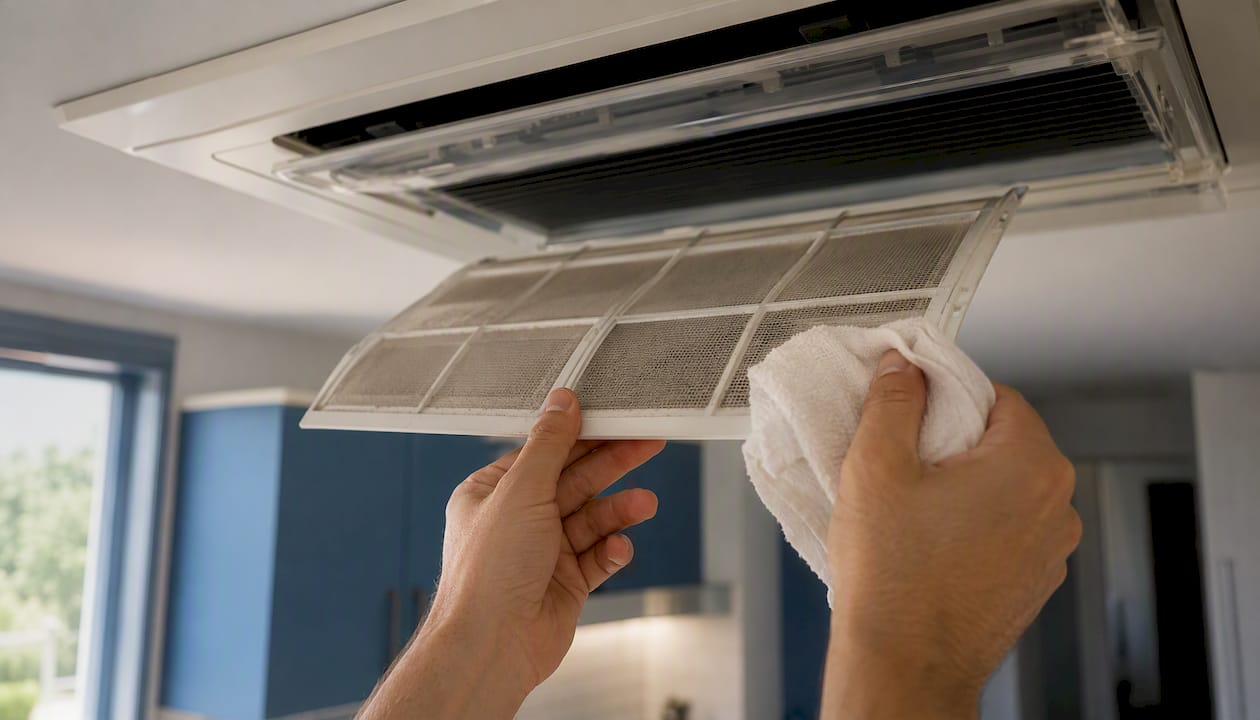
Most "no-cool" faults are not refrigerant problems at all. Blocked filters, dirty coils, and restricted airflow account for the majority of calls that homeowners assume require a regas. A qualified service visit to clean and check the system often costs less than an unnecessary refrigerant top-up.
A practical seasonal schedule looks like this:
Spring (before the cooling season): Book a professional service with an F-Gas certified engineer. They will clean the evaporator and condenser coils, check operating pressures, inspect electrical connections, and confirm the refrigerant charge is correct. Industry best practice is at least one professional service annually; heavily used systems benefit from a second visit in autumn. The homeowner aftercare guide covers this in more detail.
Monthly during use: Clean or replace the indoor unit's air filter. A clogged filter reduces airflow across the evaporator, causing the coil to ice up — a symptom that looks exactly like low refrigerant but costs nothing to fix.
Year-round: Keep the outdoor unit clear of vegetation, debris, and garden furniture. The condenser needs unrestricted airflow to reject heat effectively.
Pro Tip: If your system is blowing cool but not cold air, check the filter before calling an engineer. A 10-minute filter clean resolves this more often than you might expect.
The distinction between an airflow problem and a genuine refrigerant issue is usually straightforward: if the indoor unit is icing up and the filter is clean, that points to low refrigerant. If the unit runs but the air is just mildly cool and the filter is blocked, clean the filter first and retest.
How a REFCOM-certified engineer diagnoses and repairs refrigerant issues
A certified engineer does not guess. The diagnostic process is methodical, documented, and uses calibrated equipment — which is exactly why certification matters.
Here is the typical sequence:
- Visual inspection. Check for oily residue, corrosion, or physical damage at pipe connections, service valves, and coil surfaces.
- Manifold gauge set. Connect calibrated pressure gauges to the service ports and compare suction and discharge pressures against manufacturer data for the specific refrigerant and ambient conditions.
- Electronic leak detection. A refrigerant-specific electronic detector sweeps all joints, valves, and coil surfaces. Some engineers also use UV dye injected into the system, which glows under UV light at the leak site.
- Repair. Re-flare or replace the leaking joint, valve, or section of pipework. No refrigerant is added until this step is complete.
- Vacuum pump evacuation. The system is evacuated to a deep vacuum (typically below 500 microns) and held for a set period to confirm there are no further leaks and that moisture has been removed.
- Refrigerant weighing and recharge. Refrigerant is charged by weight using a calibrated digital scale, to the exact manufacturer specification on the data plate.
- Final performance check. Operating pressures, supply and return air temperatures, and superheat/subcooling values are verified.
- F-Gas paperwork. The engineer records refrigerant type, quantity added or recovered, their certification number, and the date. This is a legal requirement, not optional.
Request copies of the following documents before the engineer leaves: the F-Gas service log (refrigerant type, quantity, certification number), a full itemised invoice, and confirmation of whether the repair affects your manufacturer warranty. Keep these with your system's installation certificate.
REFCOM certification is the UK's recognised scheme for F-Gas competence in the HVAC sector. Asking for a REFCOM number before work begins is a straightforward way to verify you are dealing with a qualified engineer.
A note from Frostairconditioning
Working across Exeter and the South West, we see the same pattern repeatedly: homeowners who have been told their system "just needs a top-up" when the real problem is an unrepaired leak, an ageing R-22 unit that should have been replaced years ago, or a filter that has not been cleaned since installation. Every engineer at Frostairconditioning holds F-Gas certification, and every job comes with full paperwork — the F-Gas log, refrigerant type and quantity, and our certification number. You get documented, compliant work, not a verbal assurance.
Certified refrigerant support across the South West
When your air conditioner stops cooling properly, the last thing you need is an uncertified engineer adding gas to a leaking system and handing you a bill for a temporary fix. Frostairconditioning offers certified service maintenance covering leak detection, correct recharge to manufacturer specification, and full F-Gas documentation — all carried out by qualified engineers across Exeter and the South West.

For homeowners whose systems are beyond economic repair, the domestic installation service covers supply and installation of modern R-32 systems from Samsung, Mitsubishi, Toshiba, and Daikin, with 0% finance available on qualifying projects and same-day installations where possible. If you want a written estimate before committing, request a quote and a certified engineer will assess your system and give you a clear recommendation.
Sources
- Air conditioning - Climate‑friendly alternatives to F‑gases – Climate Action
- AC refrigerant guide: types, regulations & R‑454B updates | Carrier
- UNEP — ASHRAE refrigerant factsheet (April 2023)
- Air‑con regassing: everything you need to know | RAC Drive