
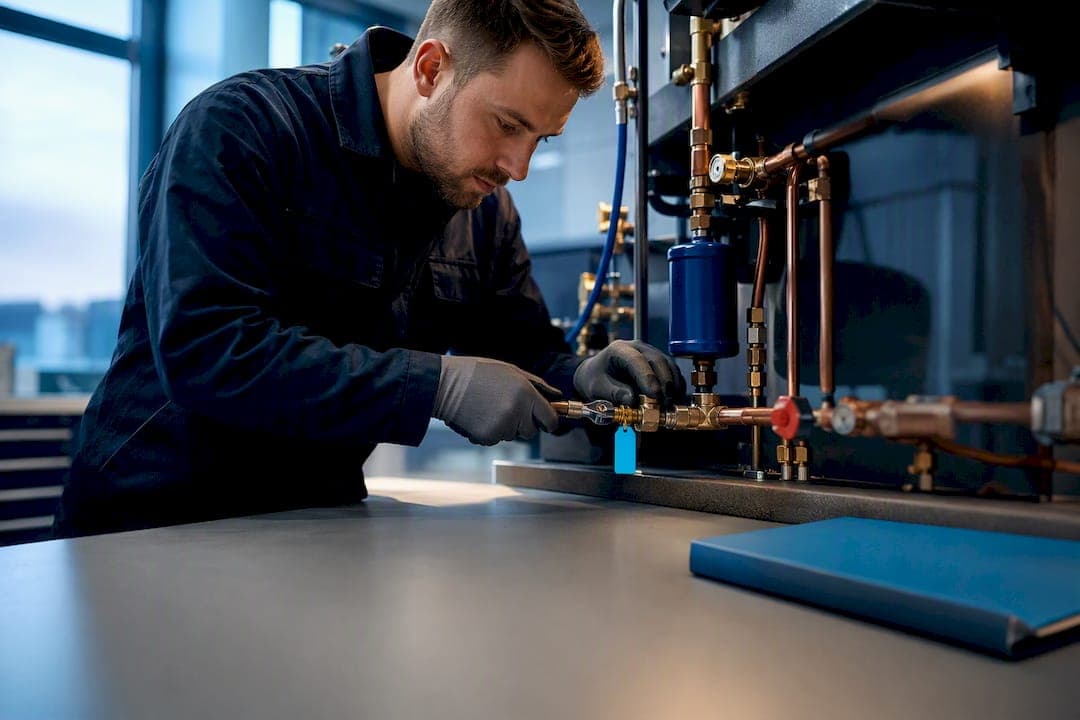
You must hold the correct individual F-gas qualification to lawfully work on stationary refrigeration, air-conditioning or heat-pump equipment in the UK. There's no way round it: identify which category matches the refrigerant charge and tasks in front of you, then book an assessment through an appointed awarding body. If you run a business, your company also needs its own separate certification.
TL;DR:
- Technicians must choose the correct certification category based on the largest refrigerant charge and scope of tasks, or they risk legal violations and scope restrictions.
- Courses must be issued by recognized bodies like City & Guilds, LCL Awards, or BESA, which include both theoretical and practical assessments to prove competence.
- Both personal certificates and company certifications are legally required, with companies needing clear documentation of each technician's qualifications and registration details.
- Training costs vary with category, duration, and provider, and additional fees apply for retakes, travel, and registration with the Environment Agency.
- Always verify certificates by asking for certificate numbers, issuing bodies, and evidence of supervised practical assessment to ensure genuine compliance.
Table of Contents
- What is F-gas certification and who legally needs one?
- Which F-gas category do you actually need?
- Which awarding bodies issue recognised F-gas qualifications?
- Personal certificate or company certificate: you need both
- What F-gas training actually costs and how long it takes
- How to verify a certificate before you hire or hand over payment
- Frost Air Conditioning's checklist before booking any F-gas work
- Why cutting corners on certification costs more than it saves
- Where to check the official rules yourself
- Sources
- FAQ
What is F-gas certification and who legally needs one?
Gov on this: anyone working on stationary refrigeration, air-conditioning or heat-pump equipment containing fluorinated gases must hold their own individual qualification. Working without one isn't a grey area. It's unlawful, and penalties can follow.
The requirement covers a specific list of hands-on activities, not just installation. You need a valid qualification to:
- Install refrigeration, air-conditioning or heat-pump systems
- Service or maintain equipment already in operation
- Carry out leak checks on F-gas containing systems
- Recover refrigerant from equipment being decommissioned
- Decommission systems permanently
Mobile air-conditioning (MAC) work in vehicles sits under a slightly different set of rules, so don't assume a stationary equipment qualification automatically covers van or car air-conditioning work.
Your qualification has to come from an appointed UK awarding body, or, in limited cases, an equivalent EU-issued certificate that's still recognised. The regulated professions guidance confirms that certificates must follow a formal theoretical and practical examination process, not a training day with a certificate handed out at the end.
Which F-gas category do you actually need?
Certificates split into four categories, and picking the wrong one is one of the most common mistakes technicians make when booking training on price alone.
- Category 1 covers every activity on any size of system, with no charge limit. If you install, service, leak check, recover and decommission across systems of all sizes, this is the one you need.
- Category 2 allows the same activities but only on smaller systems, typically up to a hermetically sealed threshold.
- Category 3 is restricted to recovery of refrigerant only, again below the relevant charge limit.
- Category 4 covers leak checking only, on hermetically sealed systems below 6kg.
The charge thresholds referenced across these categories generally sit at 3kg and 6kg for hermetically sealed systems. A domestic split system might fall well under those limits. A commercial multi-split or a supermarket refrigeration rack almost certainly won't.
Before booking anything, list the largest refrigerant charge you're likely to encounter and every task you expect to carry out. Choose the category that covers all of it, not just today's job. A Category 3 certificate might be cheaper, but it legally stops you accepting installation or servicing work later.
Which awarding bodies issue recognised F-gas qualifications?
Not every training provider issuing a certificate is issuing a valid one. GOV.UK names the recognised awarding organisations as City & Guilds, LCL Awards and BESA. CITB, which many older technicians will remember issuing F-gas certificates, no longer issues new ones. If a provider mentions CITB as the awarding body for a course you're booking now, that's a warning sign worth chasing up before you pay.
A valid course covers two distinct elements: theoretical knowledge and a practical assessment, usually involving refrigerant recovery, leak detection and system handling under observation. Attendance alone proves nothing; the certificate follows demonstrated competence.
Before booking, confirm:
- Which awarding body issues the certificate (City & Guilds, LCL Awards or BESA)
- Which category the course leads to, and whether it matches your actual work scope
- Whether assessment includes a supervised practical exam, not just a written test
- How and when you'll receive proof of certification, including a certificate number
Pro Tip: Ring the awarding body directly and ask them to confirm the training centre is currently approved to deliver that specific qualification. Providers occasionally lose approval status without updating their marketing.
Personal certificate or company certificate: you need both
Holding a personal F-gas qualification lets an individual technician legally carry out the work. It does not, on its own, let a business advertise itself as F-gas compliant. Company certification is a separate legal requirement for any business employing personnel who install, maintain or service F-gas equipment, and it demands proof of sufficient certified staff, proper tools, and record-keeping procedures.
Customers hiring a contractor should ask for both, not one or the other. A website badge saying "F-gas certified" tells you very little on its own, since it doesn't distinguish between an individual claim and a genuine company certificate.
Before work starts, ask for and keep:
- The engineer's personal certificate number and issuing body
- The company's own certification details and registration reference
- Written confirmation of the category covering your job
What F-gas training actually costs and how long it takes
Category 1 training typically runs several days, including the practical and theoretical assessment. Category 2, 3 and 4 courses are shorter because the scope of activities and equipment sizes covered is narrower.
Course fees from UK providers vary by category, location and whether training is delivered on-site or at a training centre, so get a written quote before committing. On top of training costs, businesses registering for the GB FGas Service face separate Environment Agency application and annual subsistence charges, entirely distinct from what a training provider charges you.
Costs climb when you factor in:
- Retake fees if the practical assessment isn't passed first time
- Travel and accommodation for courses run outside your area
- VAT added to quoted training prices
- On-site training premiums for group bookings
How to verify a certificate before you hire or hand over payment
Vague reassurance isn't proof. If a contractor's website says "fully F-gas certified" and nothing else, ask for specifics before booking.
- Ask for the engineer's personal certificate number and the awarding body that issued it
- Ask whether the company holds separate company certification and request its registration reference
- Confirm the certificate category actually covers the size and type of system you need worked on
- Ask what the practical assessment involved, since a genuine certificate always follows a supervised practical exam, not just classroom attendance
Watch for red flags: no named awarding body, reluctance to share a certificate number, or a company that can't separate its own certification from an individual engineer's qualification. Anyone planning cross-border work should also note that a UK certificate isn't automatically recognised in EU member states, so equivalence needs checking separately.
Pro Tip: If you're hiring for a commercial project, ask to see the company's certificate register rather than relying on a single engineer's paperwork. A properly compliant business tracks every certified employee, not just the one turning up on the day.

For a fuller breakdown of what to check before signing anything, see our checklist on verifying UK F-gas compliance.
Frost Air Conditioning's checklist before booking any F-gas work
Running an installation team across Exeter and the South West means we go through the same verification steps every time we take on new engineers or subcontract specialist work. It's worth doing whether you're hiring us or anyone else.
- Confirm the largest refrigerant charge and every activity involved before choosing a category
- Check the certificate category actually covers those tasks, not a narrower scope
- Record both the personal certificate number and the company certificate reference
- Keep copies of both for your own compliance file, not just the contractor's
| Check | Why it matters |
|---|---|
| Personal certificate number | Confirms individual is legally qualified for the task |
| Company certificate reference | Confirms the business itself meets legal requirements |
| Category matches charge/task | Prevents scope restrictions mid-project |
| Practical assessment proof | Confirms genuine competence, not just attendance |
Our engineers work with F-gas certification in place and handle installations locally without subcontractors for certified work.
Why cutting corners on certification costs more than it saves
Choosing a lower category because it's cheaper feels sensible until the job in front of you exceeds what your certificate covers. At that point you either turn work away or you carry out an activity your qualification doesn't legally permit, and neither outcome is good for a business trying to build a reputation.
Companies that take this seriously maintain a proper certificate register, checking expiry dates and category scope for every technician on the books, and they invest in proper assessment rather than the cheapest course available. That's not box-ticking. It's what stops a project stalling because the engineer on site turns out to be certified for leak checks only, when the job needs a full recovery and recommission.
If you're weighing up training providers or hiring a contractor, treat compliance as the deciding factor over price. The cheapest option that leaves you under-qualified for the job costs far more than the course fee ever will.
— James
Where to check the official rules yourself
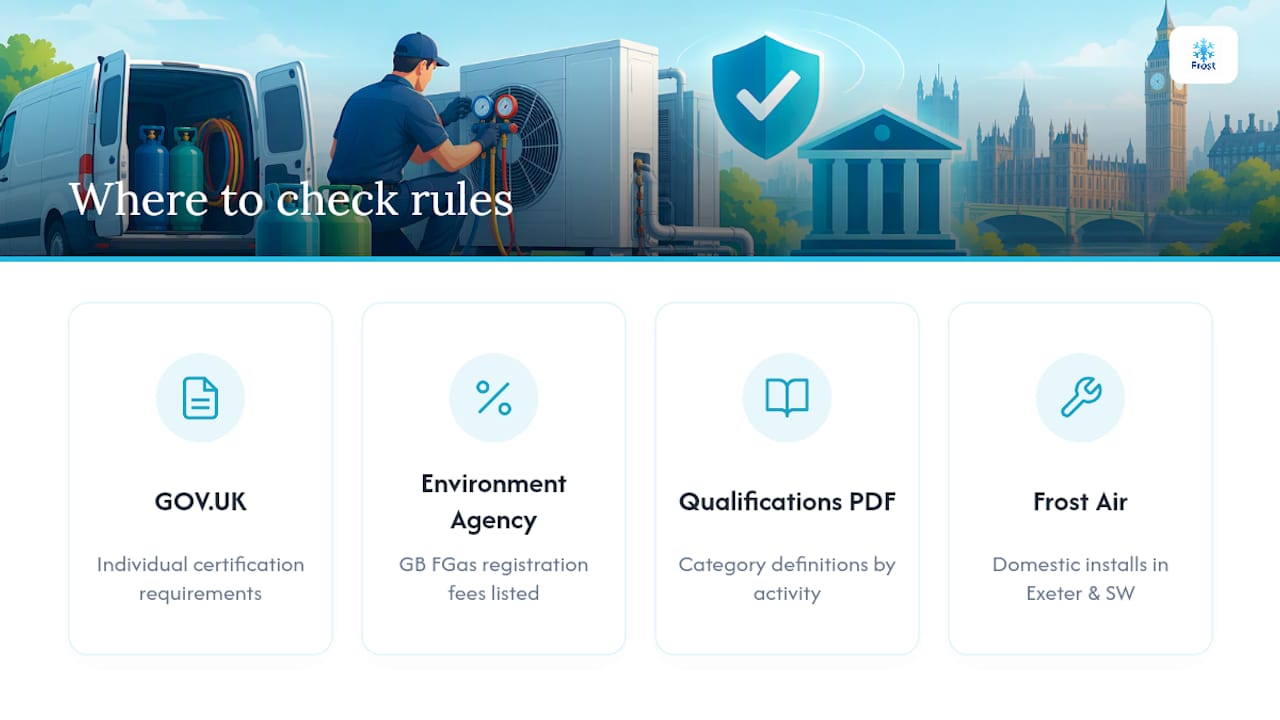
For the primary rules rather than secondhand summaries, go straight to the source. GOV.UK's qualifications guidance covers individual certification requirements in full, while the Environment Agency's charging scheme lists current registration fees for the GB FGas Service. The detailed qualifications and certificates PDF breaks down category definitions activity by activity, and is worth reading in full before booking any course.
Homeowners assessing whether planned work triggers wider legal obligations may also find our guide to UK air-conditioning maintenance rules useful, alongside Quay Point Plastering's guidance on Part F ventilation requirements for installation contexts that overlap with building regulations.
If you'd rather skip the paperwork entirely and hire engineers who already carry both personal and company F-gas certification, Frost Air Conditioning offers domestic installation across Exeter and the South West, with 0% finance available and premium systems from Samsung, Mitsubishi, Toshiba and Daikin. Businesses needing larger commercial work can look at our shop fitting and commercial installation service, and anyone with an existing system needing ongoing compliance can arrange annual service contracts and emergency breakdown cover.
Sources
- Gov
- F‑gas handler for stationary refrigeration, air‑conditioning and heat pump equipment — Regulated Professions Register
- Guidance for stationary refrigeration & air‑conditioning (qualifications and certificates) - UK government PDF
FAQ
How much does it cost to get F-gas certified in the UK?
Training fees vary by category and provider, with Category 1 courses running longer and costing more than the narrower Category 2 to 4 routes. Businesses registering with the GB FGas Service also face separate Environment Agency application and annual subsistence charges, on top of whatever the training provider charges.
Is F-gas certification a legal requirement?
Yes. GOV.UK confirms that anyone working on stationary refrigeration, air-conditioning or heat-pump equipment containing F-gas must hold their own individual qualification, and working without one is unlawful. Businesses need separate company certification on top of individual staff qualifications.
How can I check if a company is F-gas certified?
Ask directly for the company's certificate registration reference alongside the personal certificate number of the engineer doing the work, since these are legally distinct. A vague website claim of being "F-gas certified" isn't proof of either.
How long does it take to get an F-gas certificate?
Category 1 training, covering all activities and system sizes, typically takes around five days including the practical and theoretical assessment. Narrower Category 2 to 4 courses are shorter, often completed in a day or two, since they cover fewer activities and smaller charge limits.