

Any commercial air conditioning system with an effective rated output above 12 kW must be inspected by an accredited energy assessor at least once every five years, and any refrigerant work on that system must be carried out by an F‑Gas certified engineer. If you manage or own commercial premises, check your unit's rated output today, book an accredited assessor before your five‑year window closes, and never let anyone without F‑Gas certification touch the refrigerant circuit.
TL;DR:
- Commercial air conditioning systems with an effective rated output above 12 kW must be inspected every five years by an accredited energy assessor; systems controlled together are considered one system regardless of number of units.
- All refrigerant work must be performed by an F-Gas certified engineer, and contractors should be asked to show certification before beginning any refrigerant-related tasks.
- External condenser units in visible or protected areas often require planning permission, especially if the building is listed or in a conservation area, and pre-application advice can save installation delays.
- The combined output of units controlled from a single point determines whether compliance rules apply, not just the output of individual units.
- Maintaining a complete record of inspection reports, F-Gas certificates, and service logs is crucial for legal compliance, property transactions, and avoiding enforcement actions.
Table of Contents
- Commercial aircon regulations UK: your compliance checklist
- What do the inspection rules and TM44 actually require?
- When do you need planning permission for aircon units?
- What does the F‑Gas regime require from your contractor?
- Do building regulations cover air conditioning installations?
- How do noise rules like BS4142 affect your installation?
- How should you prepare for an inspection or a new install?
- Who enforces these rules and what happens if you don't comply?
- An installer's view on getting compliance right first time
- Where to check the official rules yourself
- Sources
- FAQ
Commercial aircon regulations UK: your compliance checklist
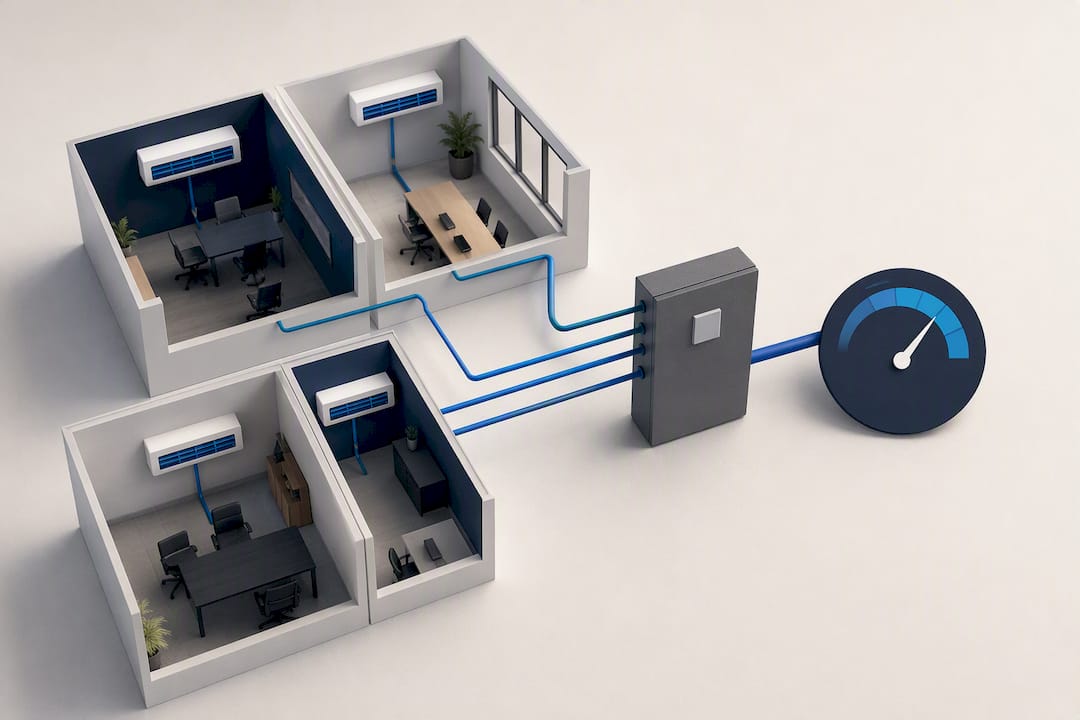
Start with the number on the nameplate. Effective rated output is the figure that decides whether the inspection duty under the Energy Performance of Buildings Regulations 2012 applies to you at all. Anything above 12 kW is caught. The trap most property managers fall into is assuming three separate 5 kW units in three separate offices sit safely under the threshold. They don't, if a single control point governs them. Regulation 17 treats units run from the same controls as one combined system, so three 5 kW heads add up to 15 kW and pull the whole set into scope.
Here's the sequence to run through this month:
- Add up your effective rated output across every unit sharing a control system, not just the one in the room you're standing in.
- Book an accredited energy assessor if you're above 12 kW and your last inspection (or installation date) is approaching five years old.
- Confirm the assessor lodges the report on the national register and get the unique reference number for your own files, not just a PDF emailed to you.
- Ask every contractor for their F‑Gas company certificate before they touch refrigerant, and keep a copy on file.
- Check with your local planning authority before any external condenser installation, particularly on a listed building or in a conservation area.
- Retain every inspection report, service record and F‑Gas log somewhere accessible, ideally for the life of the system, because Trading Standards and prospective buyers can both ask for them.
Verifying an assessor is straightforward: they should be registered with an approved accreditation scheme and able to give you a report reference before they've even finished the survey. If they can't explain how the report gets lodged on the register, that's a red flag worth acting on immediately.
Pro Tip: Keep a single folder, physical or digital, containing your inspection report reference, F‑Gas certificates, and service history. When you come to sell or let the building, a missing report can hold up completion for weeks while you scramble to arrange a late inspection.
What do the inspection rules and TM44 actually require?
The legal trigger is simple to state and easy to miscalculate: systems with an effective rated output above 12 kW must be inspected by an accredited energy assessor at intervals not exceeding five years. That threshold and the inspection duty both come from the Energy Performance of Buildings (England and Wales) Regulations 2012, specifically Regulations 17 and 18.
Regulation 17 defines what counts as a single system. Where several indoor units are controlled from one point, whether that's a single office building management panel or a shared thermostat network, they're aggregated for the purposes of the 12 kW test. A common and costly mistake is assuming a scattering of small wall units across a building each falls under its own separate assessment. If one person can adjust temperature across all of them from a single interface, the units count as one system, and the combined output is what matters.
Regulation 18 sets the timing. The duty falls on the "relevant person", usually the building owner or occupier with control of the system, to ensure the first inspection happens on a set schedule after installation and that subsequent inspections follow at intervals no longer than five years. Miss that window and you're in breach the day it lapses, not the day someone notices.
Only accredited energy assessors can carry out these inspections. They work through a defined process:
- Survey the system's design, controls, and actual operating condition.
- Check sizing against the building's cooling load, flagging units that are oversized or undersized for the space.
- Assess maintenance history and current efficiency against what's achievable.
- Produce recommendations for improving performance, often including specific, costed suggestions.
- Lodge the completed report on the central register, generating a unique reference number tied to the building.
The methodology behind all of this comes from CIBSE's TM44 guidance, the industry-recognised standard that assessors use to structure their surveys and reports. It's worth understanding what TM44 actually pushes assessors to look for, because the report you get back is not just a compliance certificate.
Statistic: The inspection threshold has stayed fixed at 12 kW effective rated output with a maximum five‑year interval since the regulations came into force, giving property managers a stable, predictable compliance calendar to plan against rather than a moving target.
A properly done inspection report should tell you whether your system is running efficiently, whether it's the right size for the space, and what specific changes would cut your energy bill. Treating the report as a box‑ticking exercise means missing genuine savings that a good assessor will identify as part of the same visit you're legally required to book anyway.
When do you need planning permission for aircon units?
External condenser units, wall‑mounted or roof‑mounted, are the most common trigger for a planning conversation. Many commercial installations qualify as permitted development and need no separate application, but that assumption breaks down fast in certain settings, and getting it wrong can mean a retrospective enforcement notice months after the unit's been running.
Follow this sequence before any external work goes ahead:
- Identify whether the building is listed or sits in a conservation area. Both categories routinely remove permitted development rights for external plant, meaning you'll need explicit consent even for a modest condenser bracket.
- Check visibility from public roads or neighbouring properties. Councils weigh visual impact heavily, and units visible from a street or a shared courtyard attract more scrutiny than one tucked behind a rear elevation.
- Request pre‑application advice from your local planning authority. A short conversation with a planning officer before you commit to a design can save weeks of delay if the proposed siting turns out to be a problem.
- Prepare the documentation officers typically ask for, which usually means manufacturer specifications, proposed siting drawings, and sometimes a noise assessment if the unit sits near a residential boundary.
- Budget for decision timelines. Straightforward applications often clear in a matter of weeks, but anything touching a listed building or conservation designation can run considerably longer, so factor that into your installation schedule.
Our guide to permitted development for air conditioning walks through the specific criteria councils apply in more detail, including size and siting limits that vary by property type.
Reducing visual and neighbour impact isn't just good manners, it materially improves your odds of a smooth approval. Screening the unit behind existing architectural features, painting housings to match the building facade, and siting condensers away from windows and shared boundaries all reduce objections before they're raised. Planning officers respond well to applicants who've clearly thought about how the installation looks from the street, rather than treating it as an afterthought bolted onto the side of the building.
Pro Tip: If your building is in a conservation area, ask your installer for siting options before you fall in love with one design. A unit that needs a full planning application because it's visible from the road can add months to a project that would otherwise take days.
What does the F‑Gas regime require from your contractor?
Refrigerant handling is not a job for anyone without formal certification, and the law is unambiguous about it. The Fluorinated Greenhouse Gases Regulations 2009 require any company or engineer working on stationary air conditioning equipment to hold the correct stationary equipment qualification company certificate, and operating without it is a criminal offence, not a paperwork oversight.
This applies to installation, servicing, and any work that involves opening the refrigerant circuit. It's the reason every reputable installer will show you certification without being asked, and why you should never accept a verbal assurance in its place.
The regime also introduces a threshold that catches larger commercial systems specifically: equipment containing refrigerant with a global warming potential equivalent to 5 tonnes of CO2 or more triggers mandatory leak checking at set intervals and formal record keeping of every check, repair, and refrigerant top‑up. Below that threshold the duty is lighter, but F‑Gas certification for anyone handling the refrigerant remains non‑negotiable regardless of system size.
What this means practically for your contractor checks:
- Ask for the company's stationary equipment qualification certificate before any refrigerant work begins, not after.
- Ask which individual engineer holds the personal F‑Gas qualification, and get their ID or certificate number.
- If your system sits above the 5 tonne CO2e threshold, ask to see the leak‑check log and confirm it's been maintained since installation, not started retrospectively.
- Request copies of every service and repair record involving refrigerant, and keep them alongside your inspection reports.
Skipping this check has real consequences beyond the legal exposure. Using an uncertified engineer can invalidate manufacturer warranties outright, and it raises the practical risk of refrigerant leaks going undetected, which costs you both in lost cooling performance and in wasted refrigerant. GOV.UK's guidance on F‑Gas qualifications sets out exactly which certificate types are acceptable, and our own breakdown of F‑Gas compliance checks walks through the specific questions to put to a contractor before you sign anything.
Pro Tip: Never accept "we're fully qualified" as an answer on its own. Ask for the certificate number and check it against the company's own paperwork, because the qualification sits with the company as well as the individual engineer.
Do building regulations cover air conditioning installations?
There's no single Building Regulation labelled "air conditioning," and that surprises a lot of property managers expecting one clean rulebook. What actually applies is a patchwork: electrical safety standards, workplace ventilation duties, and building control sign‑off for fixed installations, each triggered by different aspects of the work.
Fixed air conditioning installations still have to meet standard electrical safety requirements, which usually means the work falls under Part P of the Building Regulations for electrical work, requiring notification to building control or certification by a competent person scheme, depending on how the installation is carried out.
Separately, the Workplace (Health, Safety and Welfare) Regulations impose a general duty to provide "effective and suitable" ventilation in enclosed workspaces. This duty exists independently of the energy‑performance inspection regime. A system that passes its five‑year TM44‑style inspection can still leave you exposed if staff are working in poorly ventilated conditions that a general workplace assessment would flag.
Key intersections to keep straight:
- Electrical safety: fixed wiring for aircon units generally needs building control notification or certification through a competent person scheme.
- Workplace ventilation: employers have an ongoing duty to maintain adequate fresh air and temperature control, separate from the energy inspection cycle.
- Building control approval: substantial installation work, particularly anything altering the building's structure or services, may require formal sign‑off before completion.
- Energy performance interaction: an efficient, well‑maintained system that passes its EPB inspection also tends to satisfy workplace comfort duties more easily, but one doesn't automatically guarantee the other.
Our guide to industry standards in air conditioning covers how these overlapping duties tend to play out in practice across different building types, which is useful if you're managing a mixed-use property with different tenancy arrangements per floor.
How do noise rules like BS4142 affect your installation?
Noise complaints from neighbours are one of the most common reasons a compliant, legally installed system still ends up the subject of an enforcement complaint. BS4142 is the British Standard environmental health officers and planning departments use to assess whether plant noise, including air conditioning condensers, causes a genuine nuisance relative to the background sound level of the area.
An assessment under BS4142 measures the specific noise from your unit against the existing ambient sound level nearby, then applies a rating that accounts for the character of the noise, whether it's a constant hum or has a tonal or intermittent quality that's more noticeable. A condenser that's perfectly acceptable on a busy industrial estate might fail the same test on a quiet residential-adjacent high street.
Practical mitigation measures that make a real difference:
- Anti‑vibration mounts under the outdoor unit, reducing structure-borne noise transmission into the building itself.
- Acoustic enclosures or screens around the condenser, particularly effective where the unit sits close to a boundary.
- Sympathetic siting, choosing a wall or roof position that faces away from the nearest noise‑sensitive property rather than the most convenient spot for pipework.
- Limiting hours of operation where cumulative plant noise from multiple units on a site becomes a factor planners weigh during an application.
Cumulative impact matters more than most managers expect. A single condenser might sit comfortably within acceptable limits, but add it to three other units already running on the same roof and the combined noise level can tip a previously fine installation into breach territory.
If you're commissioning a formal noise assessment, get one before submitting a planning application in a noise‑sensitive area rather than after a complaint arrives. It's far cheaper to adjust siting on paper than to retrofit acoustic screening on an installed unit.
Pro Tip: If your site already has other plant running, get a cumulative noise reading before adding a new unit. Planners and environmental health officers assess total noise from the site, not your unit in isolation.
How should you prepare for an inspection or a new install?
Getting ready for an inspection, or bringing in a contractor for new work, comes down to having the right paperwork on hand and asking the right questions before anyone arrives on site.
Documents and access to prepare in advance:
- Gather previous inspection reports and their unique reference numbers, if this isn't your building's first assessment.
- Pull together service and maintenance logs covering at least the last few years, including any refrigerant top‑ups or repairs.
- Arrange roof or plant room access ahead of the visit, including keys, permits, or site inductions the assessor might need.
- List every unit on site with its rated output, so the assessor isn't starting from zero working out what's connected to what.
When procuring a contractor, whether for a new install or ongoing servicing, ask for:
- Their accreditation scheme membership and registration number.
- The company's F‑Gas stationary equipment qualification certificate.
- Proof of public liability and professional indemnity insurance.
- References or examples of comparable commercial work.
On procurement structure, planned preventative maintenance (PPM) agreements tend to keep you compliant more reliably than reactive, call‑when‑it‑breaks servicing. A PPM contract builds inspection scheduling, F‑Gas leak checks, and record keeping into a single recurring arrangement, so nothing quietly lapses past its five‑year deadline while you're focused on other things. Reactive servicing can work for low‑risk, small systems, but it puts the burden of tracking deadlines entirely on you.
On timelines and cost, arranging an accredited inspection typically takes a matter of weeks from enquiry to report, longer if your building has limited access windows. Costs vary by system size and complexity, and remedial works flagged in a report, from control upgrades to refrigerant top‑ups, add further variation, so get a written quote before committing. Our piece on why professional installation matters covers the risks of cutting corners on contractor selection, and High Pressure Mechanical's breakdown of common commercial HVAC failures is a useful read on what poor maintenance actually costs you over time.
Pro Tip: Ask any prospective contractor how they handle report lodgement. A properly accredited assessor should be able to tell you exactly which register the report goes on and roughly how long it takes to appear.
Who enforces these rules and what happens if you don't comply?
Enforcement sits across a few different bodies depending on which rule you've breached. Trading Standards officers handle missing or overdue inspection reports and can request evidence of compliance directly. The Environment Agency has oversight of F‑Gas breaches at a more serious regulatory level, while local planning and environmental health departments deal with unauthorised installations and noise complaints respectively.
The penalties scale with the seriousness of the breach. GOV.UK guidance notes that failing to provide an inspection report when requested can lead to a fixed penalty, commonly cited at £300 in official examples, which sounds modest until it's multiplied across a portfolio of non‑compliant sites. F‑Gas breaches carry far heavier consequences, since operating without the required certification is a criminal offence rather than a fixed‑penalty matter, and can expose the company to significant fines.
Where enforcement genuinely bites is in property transactions. A missing inspection report can stall a sale or a lease renewal at exactly the wrong moment, when a buyer's solicitor or a new tenant's surveyor asks for compliance evidence you can't immediately produce. Resolving an enforcement query quickly means having your documentation ready before anyone asks for it, not scrambling to book a late inspection once a query lands.
Enforcement bodies to know:
- Trading Standards for inspection report compliance and fixed penalties.
- Environment Agency for F‑Gas regulatory oversight.
- Local planning departments for unauthorised external installations.
- Environmental health teams for noise complaints and BS4142 assessments.
Statistic: GOV.UK's own guidance cites a fixed penalty of £300 as the standard sanction for failing to produce an inspection report on request, a figure worth keeping in mind when weighing the cost of a proactive assessment against the cost of getting caught without one.
An installer's view on getting compliance right first time
Get the scoping right and everything else follows. Most compliance headaches I see trace back to one thing: someone assumed a small unit or a scattered set of wall heads sat under the 12 kW threshold, when the combined output said otherwise. Check your total effective rated output honestly, book your accredited assessor before the five‑year clock runs out rather than after, and never let refrigerant work happen without an F‑Gas certificate in hand.
A local air conditioning company offers F‑Gas certified engineers and maintenance contracts designed to keep commercial systems inside their inspection windows rather than scrambling to catch up. If you're planning new external units, talk to your local planning department early, particularly on listed or conservation‑area buildings, and gather your documentation before you need it rather than after a query lands on your desk.
None of this is complicated once you know where the thresholds sit. It just needs someone to actually check the numbers.
— James
Where to check the official rules yourself
The primary sources are short, specific, and worth reading directly rather than taking secondhand.
- Gov sets out the inspection threshold, timing, and enforcement examples.
- The Energy Performance of Buildings Regulations 2012, Regulation 17 defines which systems the rules apply to.
- Regulation 18 of the same statute sets the five‑year inspection interval and timing duties.
- CIBSE's TM44 guidance explains the accepted inspection methodology.
- Gov lists acceptable contractor certifications.
If your situation doesn't fit neatly into any of these, your local planning authority or Trading Standards office can usually give a direct answer faster than guessing.
For ongoing servicing that keeps you inside your inspection window, some companies offer service and maintenance contracts built around this compliance cycle, and may also handle commercial shop fitting and installation work with F‑Gas certified engineers.
This article is general information, not a substitute for advice from a qualified lawyer. Consult a qualified legal professional about your own circumstances before acting on anything here.
Sources
FAQ
What are the rules for air conditioners in the UK?
Commercial systems with an effective rated output above 12 kW must be inspected by an accredited energy assessor at least every five years, and any refrigerant work must be done by an F‑Gas certified engineer. External units may also need planning permission depending on siting and building type.
What is the 12 kW rule for air conditioners?
Under the Energy Performance of Buildings Regulations 2012, any system with a combined effective rated output above 12 kW falls under mandatory five‑yearly inspection by an accredited assessor. Multiple units controlled from one point count as a single system for this test.
What is the "20 rule" for air conditioners?
There is no recognised statutory rule with a 20 kW threshold in UK air conditioning law. The figure that actually matters legally is the 12 kW effective rated output threshold that triggers the mandatory inspection duty.
What are the TM44 regulations in the UK?
TM44 isn't a regulation itself, it's the CIBSE guidance document that sets the methodology accredited assessors use when carrying out the inspections required under the Energy Performance of Buildings Regulations. It defines what an inspector checks and what the resulting report should contain.
What is the "3 minute rule" for aircon?
There is no statutory "3 minute rule" in UK commercial air conditioning legislation. It's not a recognised term in the regulations, guidance, or CIBSE TM44 methodology covered here.