
If you install, service, or run equipment containing fluorinated gases in the UK, you must hold the right certification, run leak checks on schedule, recover refrigerant properly, and keep records that prove it. These duties sit in the Fluorinated Greenhouse Gases Regulations 2015, reinforced by Gov. If any of that sounds unfamiliar, check your certificates and testing schedule today.
TL;DR:
- Companies must verify both personal and company F-gas certificates, ensuring they cover the specific equipment and refrigerants involved, before work begins.
- The UK HFC phasedown reduces allowable market volumes by 79% from 2015 to 2030 through a gradually tightening quota system affecting gas prices and supply.
- Banned products include high-GWP refrigerators, freezers, foams, aerosols, and certain fire suppressants, with labelling requirements for new equipment specifying refrigerant type and GWP.
- Regular leak checks are required based on CO2e thresholds, with strict record-keeping of leaks, repairs, and refrigerant recovery for at least five years to avoid enforcement actions.
- UK and EU F-gas rules remain aligned in substance, but regulations differ in administration, especially regarding quota allocations and Northern Ireland’s distinct legal position.
Table of Contents
- What UK f-gas rules actually cover
- Who needs F-gas certification and how does it work?
- How does the HFC phasedown and quota system work?
- What's banned, and what are the labelling rules?
- Leak checks, recovery and record keeping: the day-to-day duties
- Who enforces F-gas regulations, and what happens if you don't comply?
- Planning your move to low-GWP refrigerants
- Are there exemptions from UK F-gas regulations?
- What training do you need for F-gas certification?
- How do UK and EU F-gas rules differ now?
- Sector-specific compliance: refrigeration, air conditioning and fire protection
- The gap between the rulebook and what actually happens on-site
- Compliant installation and servicing from Frostairconditioning
- Where to check the rules yourself
- Sources
What UK f-gas rules actually cover
The Fluorinated Greenhouse Gases Regulations 2015 apply to hydrofluorocarbons (HFCs), perfluorocarbons (PFCs), and sulphur hexafluoride (SF6), the synthetic gases used as refrigerants, insulators, and fire suppressants because they don't deplete the ozone layer but trap heat ferociously in the atmosphere. If your business touches air conditioning, refrigeration, heat pumps, fire protection systems, or high voltage switchgear, you're almost certainly within scope.
This is retained EU law, meaning the original EU F-gas Regulation was copied into UK statute at the point of exit and now stands on its own as a UK-specific instrument. That distinction matters more than most business owners realise. The rules didn't vanish or get simplified after Brexit. They got renamed and, in places, adjusted.
Three amendment instruments have reshaped the framework since exit:
- The 2019 EU Exit Regulations, which fixed deficiencies in the retained text so it could function without EU institutions.
- A 2021 amendment addressing further operability issues and Northern Ireland arrangements.
- A 2023 update refining quota administration and reporting mechanics for the Great Britain market.
The 2019 instrument is worth reading if you want to understand exactly what changed at the point of departure. It didn't rewrite the substance of the obligations. It transferred administrative functions from the European Commission to UK bodies and adjusted quota baselines to reflect a smaller market.
The definitive legal text remains the statutory instrument itself, but almost nobody in the trade reads it cover to cover. In practice, GOV.UK's guidance collection does the interpretive work, translating the statute into checklists for users, producers, and traders. Treat the statute as the law and the guidance as the manual. Both matter, but they serve different jobs.
Who needs F-gas certification and how does it work?
Certification isn't a paperwork nicety. It's the line between lawful work and a criminal offence. Anyone who installs, services, maintains, leak checks, recovers refrigerant from, or decommissions equipment covered by the regulations needs a personal F-gas certificate matched to that specific type of work. The same applies to engineers working on refrigerated vehicles and trailers.
Here's what most people miss: a technician holding a valid personal certificate does not automatically mean the company employing them is compliant. Companies working on stationary refrigeration, air conditioning, or heat pump equipment need their own separate company certification, issued independently of any individual's qualifications. A sole trader with a personal certificate and no company certificate is still operating unlawfully on covered equipment.
The minimum training and assessment standards come from retained Regulation 2015/2067, which sets out what a technician must demonstrate before being awarded F-gas handler status. You can check whether an individual or business genuinely holds valid credentials through the Regulated Professions Register, which lists the recognised UK certification bodies and the scope each covers.
EU-issued qualifications obtained before exit generally continue to be recognised where they meet equivalent standards, though anyone relying on an EU certificate for UK work should confirm current standing with the certification body rather than assume automatic continuity indefinitely.
Before hiring anyone to touch F-gas equipment, run through this:
- Ask for the engineer's personal certificate number and the specific category it covers (not just "F-gas qualified").
- Ask for the company's separate certification number, not just the individual's.
- Confirm the certificate covers the exact equipment type and refrigerant involved, not a general HVAC qualification.
- Check the certifying body appears on the Regulated Professions Register.
- Request evidence of recent leak-check or service records from similar jobs.
Pro Tip: A contractor who can't produce their company certification number on request, only a personal card, is a red flag worth walking away from. It's the single fastest compliance check available to any building owner.
How does the HFC phasedown and quota system work?
The UK is legally committed to cutting the volume of HFCs placed on the market by 79% between 2015 and 2030, a target carried over unchanged from the original EU F-gas Regulation. It works through a shrinking quota system rather than an outright ban, so the phasedown tightens gradually rather than hitting a cliff edge.
Each year, the total volume of virgin HFCs allowed onto the Great Britain market falls against a fixed baseline. Producers and importers must hold quota allowance to place bulk HFCs on the market legally, and that allowance is allocated annually based on historical reference values and new-entrant applications.
The mechanics that matter for most businesses:
- Quota is required only for placing bulk HFCs on the market, not for buying pre-charged equipment or having a system serviced.
- Quota holders can transfer allowance between themselves, and the register of quota holders is published so you can verify a supplier's standing.
- Authorisation to use someone else's quota (rather than holding your own) is possible but must be formally recorded, not assumed.
- Reporting is mandatory for anyone placing more than a minimal threshold of HFCs on the market in a calendar year, covering quantities, gas types, and end use.
For most installers and building owners, the quota system operates invisibly in the background. It shows up as rising refrigerant prices and tighter supply of high-GWP gases like R410A, not as a form you personally fill in. The 2022 assessment report into F-gas regulation in Great Britain credits the phasedown with driving faster uptake of lower-GWP alternatives than would have happened on a voluntary basis. If your business only buys equipment and services rather than trading in bulk gas, your exposure to the quota system is indirect but real: it's the reason certain refrigerants are becoming harder and more expensive to source.
What's banned, and what are the labelling rules?
Several product categories are banned outright from the UK market because low-GWP alternatives exist and work. Domestic refrigerators and freezers using HFCs with a GWP of 150 or more have been barred from sale for years. Certain foams, aerosols, and one-shot fire extinguishers using high-GWP gases face similar prohibitions, referenced against the Annexes attached to the original Regulation and preserved in the retained UK text.
Pre-charged air conditioning and refrigeration equipment faces phased restrictions rather than a single cut-off date. The practical effect is that manufacturers have progressively shifted new equipment ranges toward R32, R290, and other lower-GWP refrigerants ahead of the deadlines that would otherwise squeeze out high-GWP stock. Anyone specifying a new system should check the refrigerant type before ordering rather than assuming last year's model spec still applies.
Key points for anyone buying, selling, or installing equipment:
- Bans apply to placing on the market, meaning new sales and installations. They generally don't force removal of existing compliant equipment already in service.
- Pre-charged equipment must carry a label stating the refrigerant type, GWP, and quantity in both kilograms and tonnes of CO2 equivalent.
- Hermetically sealed equipment has its own labelling requirement confirming the seal status, which affects the leak-check frequency applied to it.
- Retailers and installers should check labelling matches the paperwork before completing a sale or installation, since mismatched documentation is one of the easier enforcement triggers to spot.
If you're weighing up refrigerant choice for a new installation, the practical differences between common gases like R32 and older high-GWP options are worth understanding before you commit, not after the order for air conditioner gas has already gone in.
Leak checks, recovery and record keeping: the day-to-day duties
This is where most non-compliance actually happens, not in dramatic breaches but in missed paperwork and skipped checks on systems people forget contain regulated gas.
How often leak checks are required depends on the CO2e (carbon dioxide equivalent) of the refrigerant charge, not the physical weight of gas in the system. A small charge of a very high-GWP gas can trigger the same check frequency as a much larger charge of a lower-GWP alternative, because the regulations measure climate impact rather than mass. Systems above 5 tonnes CO2e generally need annual checks, rising to every six months above 50 tonnes CO2e and quarterly above 500 tonnes CO2e, though the exact bands and any leak detection system credits should be confirmed against current guidance for your equipment.
When a leak is found, the clock starts immediately:
- Isolate and stop the leak, or arrange repair, without unreasonable delay.
- Have the repair carried out only by a certified technician.
- Re-test the system within one month of the repair to confirm it's holding.
- Log the leak, the repair, and the re-test result in your equipment records.
- Escalate to decommissioning if repeated leaks make the system uneconomic to maintain.
Recovery obligations apply whenever equipment is serviced, maintained, or taken out of service permanently. Refrigerant must be recovered into an appropriate container by a certified technician before any component is opened up for repair, and at decommissioning, gas must be fully recovered before the system is scrapped. Recovered refrigerant that can't be reused goes for reclamation or destruction through a licensed facility. It never goes anywhere near the atmosphere deliberately, and venting is one of the more serious offences under the regulations.
Record keeping ties the whole system together, and it's the part enforcement bodies check first. For each piece of covered equipment you should hold:
- The type and quantity of refrigerant installed, and any refrigerant added or removed.
- Dates and results of every leak check.
- Details of any leak found, the repair carried out, and the re-test result.
- The certified technician or company that carried out each piece of work.
- Recovery, reclamation, or destruction records at decommissioning.
Guidance generally expects these records to be retained for at least five years, and inspectors will ask for them by equipment reference, not by a vague annual summary. If your air conditioning or refrigeration setup is complex enough that you're not sure how the system's core components map to your record-keeping obligations, it's worth getting that clarified before an inspection forces the question.
Pro Tip: Keep records against the equipment, not the calendar. A spreadsheet organised by service date is much harder to defend at inspection than one organised by asset, because inspectors ask "show me everything on this specific system" far more often than "show me everything from March."
Who enforces F-gas regulations, and what happens if you don't comply?
Enforcement in England falls to the Environment Agency, with the Scottish Environment Protection Agency (SEPA) covering Scotland, Natural Resources Wales (NRW) covering Wales, and equivalent agencies handling Northern Ireland. Local authorities also hold enforcement powers for certain premises, particularly around retail and commercial installations.
These bodies can issue civil penalty notices, seize non-compliant equipment or gas, and in serious or repeated cases pursue criminal prosecution. The most common triggers for enforcement action aren't dramatic. They're mundane: missing or incomplete leak-check records, work carried out by uncertified technicians, equipment sold without correct labelling, and refrigerant vented rather than recovered at decommissioning.
If an inspection happens, preparation is straightforward if your paperwork is in order:
- Have equipment-level records ready, not just annual summaries.
- Be able to produce the certification numbers, both personal and company, for whoever carried out the last service.
- Know your quota position if you place any bulk refrigerant on the market yourself.
- Have a named point of contact who can speak to the compliance history of each system on site.
Landlords managing multiple properties face a particular version of this challenge, since compliance calendars across several buildings and several contractors get messy fast. Similar record-keeping discipline applies to gas safety compliance in rented property more broadly, and the same "one file per asset" principle applies whether the certificate concerns F-gas or general gas safety.
Planning your move to low-GWP refrigerants
Lower-GWP refrigerants aren't just a compliance box to tick. They change the maths on leak-check frequency directly, because the CO2e threshold that triggers mandatory checks depends on GWP, not physical charge weight. A system running R290, with a GWP close to 3, can hold a much larger physical charge than an equivalent R410A system before it crosses into a stricter checking band.
The 2022 assessment report estimates the retained F-gas regulation has already driven cumulative emissions reductions of between 13.6 and 24.3 MtCO2e, with monetised gross benefits estimated at £1.9 billion to £8.5 billion. That range is wide because it depends heavily on assumptions about counterfactual behaviour, but the direction is unambiguous: the phasedown has materially accelerated the shift toward lower-GWP equipment across the market.
That shift shows up commercially as rising prices and tightening supply for high-GWP gases as quota shrinks year on year, a trend that rewards planning ahead rather than waiting for a breakdown to force the decision.
Before your next replacement or new installation, work through:
- What refrigerant does the proposed system use, and what's its GWP?
- What charge size does the system need, and does that push it into a stricter leak-check band?
- Is the system's charge size clearly labelled, including CO2e, at the point of sale?
- Is the installer's certification current for the specific refrigerant and equipment type?
- What's the realistic service life of the system relative to the phasedown timetable running to 2030?
Weighing up R32 against R290 for a home or commercial system is one of the more common decisions installers face right now, and the trade-offs between the two go beyond price into serviceability and future-proofing. It's worth reading through before committing to either, particularly if you want to avoid a compliance scramble as quota tightens further toward 2030.
Are there exemptions from UK F-gas regulations?
Exemptions exist, but they're narrower than most people assume, and none of them remove the certification requirement for anyone actually handling the gas.
Research, development, and analytical use of F-gases carries limited exemptions from certain placing-on-market restrictions, recognising that laboratory quantities serve a different purpose to commercial refrigeration. Military equipment has long-standing carve-outs reflecting operational necessity, a position that predates the UK's departure from the EU and continues under retained law.
Certain fire protection systems installed before specific ban dates can continue to be serviced with their original gas rather than being forced into immediate retrofit, though new installations using banned substances aren't permitted. Small hermetically sealed systems below a certain charge threshold face reduced leak-check obligations, though they're not exempt from certification requirements for whoever installs or services them.
None of these carve-outs exempt anyone from the certification requirement itself. A derogation on placing a specific gas on the market, or on leak-check frequency for a small sealed system, is not the same as a derogation from needing a qualified, certified person to do the work. That distinction catches out businesses who read "exemption" and assume it means the whole compliance framework falls away for their situation. It doesn't. It narrows one specific obligation while leaving the rest intact.
What training do you need for F-gas certification?
Getting certified means passing an assessment against the standards set out in retained Regulation 2015/2067, covering both practical handling skills and theoretical knowledge of the regulations themselves.
Training providers across the UK offer courses aligned to the specific certificate categories: stationary refrigeration, air conditioning and heat pumps, mobile air conditioning, and refrigerated trucks and trailers each have their own scope. Most courses combine classroom theory covering leak detection, recovery procedures, and regulatory obligations, with a practical assessment on real equipment. Course length varies with the category and the candidate's existing experience, running anywhere from a couple of days for an experienced refrigeration engineer topping up their qualification, to several weeks for someone starting from scratch.
The certification itself is issued by an approved certification body once the assessment is passed, not by the training provider directly, and it's the certifying body's number that appears on the Regulated Professions Register. Anyone choosing a training route should confirm upfront which certification body the course leads to and check that body's accreditation status rather than assuming all providers lead to equivalent outcomes.
Refresher or top-up requirements can apply where a technician's scope needs extending, for example moving from domestic split systems into commercial refrigeration work. There's no blanket requirement to periodically resit the whole qualification, but working outside your certified scope, even with a valid certificate in a different category, is still unlawful.
How do UK and EU F-gas rules differ now?
The UK regulation started as an identical copy of the EU F-gas Regulation at the point of exit, and the substance of the two regimes remains closely aligned. The 79% phasedown target, the certification requirements, the leak-check obligations, and the banned-product lists are all structurally the same because the UK version was built directly from the EU text.
The divergence that has actually emerged sits in administration rather than substance. Quota is now allocated separately against a UK-specific baseline rather than as part of the wider EU pool, which matters enormously for producers and importers but is largely invisible to a business simply buying equipment or getting a system serviced. The EU has continued to develop its own regulation independently since 2021, including a 2024 recast that tightened some elements ahead of schedule, while the UK has so far kept its retained text closer to the original 2015 baseline with targeted fixes rather than a full rewrite.
Northern Ireland sits in a genuinely different position, continuing to follow EU F-gas rules under the terms of the Windsor Framework rather than the Great Britain retained regime. A business operating across the UK internal market needs to know which side of that line its Northern Ireland operations fall on, because assuming Great Britain rules apply uniformly across the whole UK is a mistake that catches out multi-site operators more often than you'd expect.
For most installers and building owners in England, Scotland, and Wales, the practical day-to-day obligations feel identical to the pre-exit regime. The paperwork trail and the quota administration sit with different bodies now, but the certification, leak-check, and recovery duties haven't changed in substance.
Sector-specific compliance: refrigeration, air conditioning and fire protection
The core obligations, certification, leak checks, recovery, and record keeping, apply across every sector, but how they bite in practice differs.
Air conditioning, both domestic and commercial, is where most building owners first encounter these rules. Split systems and multi-split commercial installations fall squarely within the leak-check and certification framework, and the CO2e threshold for check frequency depends heavily on refrigerant choice, which is where a system's design and gas selection has real compliance consequences, not just an efficiency one. Landlords and businesses with multiple AC units across a site benefit from a single maintenance schedule covering every unit rather than treating each as an isolated asset, which is exactly the gap a structured maintenance contract is designed to close.
Commercial refrigeration, think supermarkets, cold stores, and catering, tends to run larger charge sizes and correspondingly stricter check frequencies, often quarterly or more, with leak detection systems increasingly used to earn reduced manual check intervals.
Fire protection systems using F-gas suppressants carry the same certification and recovery duties on servicing and decommissioning, but face some of the more specific banned-substance rules given how directly some legacy suppressant gases map onto the highest-GWP category. Anyone maintaining a fixed fire suppression system should confirm the gas type against current banned-substance lists before assuming a like-for-like recharge is still permitted.
The gap between the rulebook and what actually happens on-site
Most F-gas non-compliance isn't defiance. It's drift. A business gets a system installed correctly by a certified contractor, then two years later a different engineer does a repair without anyone checking their certification scope, because the person booking the job doesn't know what to ask for. The paper trail breaks quietly, and nobody notices until an inspection or a dispute forces the question.
The pattern worth watching for is the "personal certificate, no company certificate" gap. A sole trader or small firm's engineer might genuinely hold a valid personal F-gas card, which reassures the person hiring them. But if the company itself never registered for separate company certification, the work is still unlawful, and that distinction is not obvious to anyone outside the trade. It's the single question most building owners forget to ask, and it's the one that matters most.
Poorly documented work tends to share a signature: no equipment-specific log, service reports that say "system checked, no issues" without a leak-check figure or method attached, and no record of what refrigerant was added if any was. That's not proof of a leak or a breach on its own, but it's exactly the kind of gap an inspector, or a buyer during a property sale, will flag immediately.
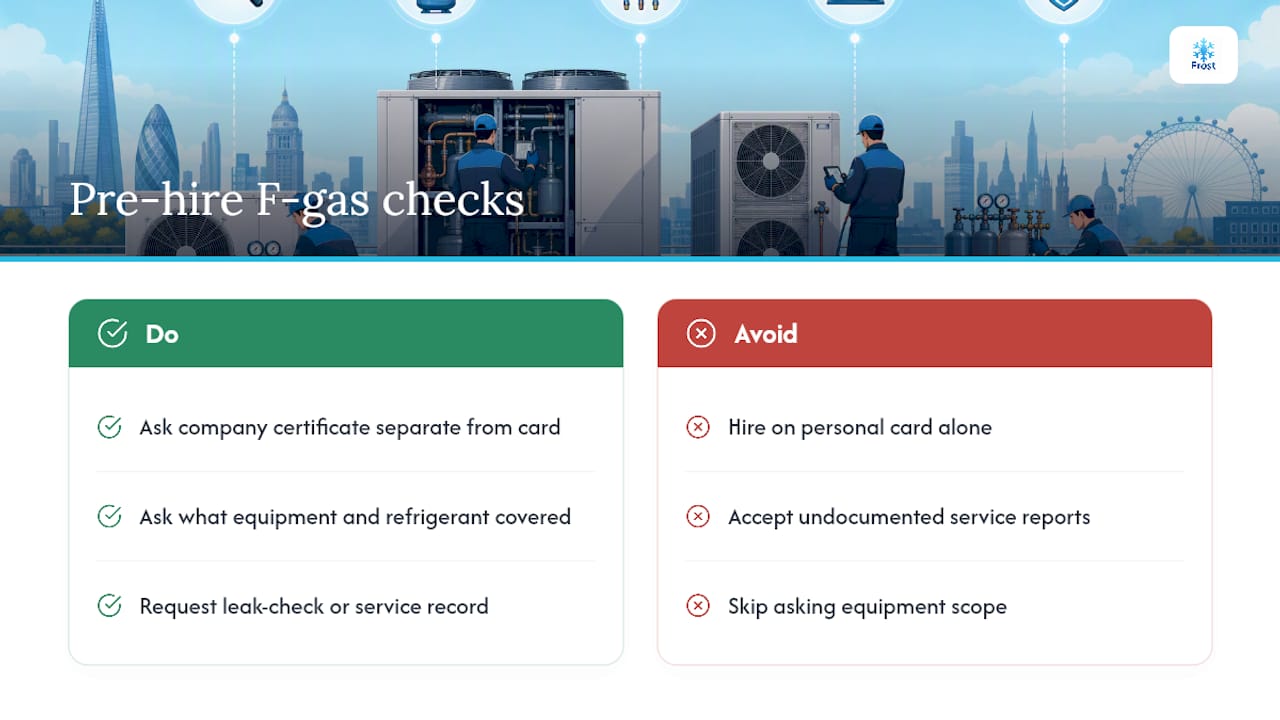
Building owners can protect themselves with three questions before any contractor touches covered equipment: What's your company certification number, separate from your personal card? What specific equipment and refrigerant does that certification cover? Can I see a leak-check or service record from a comparable job? Any contractor confident in their compliance answers those without hesitation.
Some contractors maintain equipment-specific records for every system serviced, covering leak-check results, refrigerant added or recovered, and re-test outcomes, precisely because that's what an inspection or a future buyer will ask for. Clients typically receive that documentation as a matter of course, not as a special request.
— James
Compliant installation and servicing from Frostairconditioning
Some air conditioning companies provide F-gas compliance services for homes and businesses in the South West, offering REFCOM and F-Gas certified engineers who hold company certification beyond personal certification. Installations and service visits often come with equipment-specific paperwork including leak-check results, refrigerant records, and recovery documentation prepared for inspections or property sales.

Whether you need a new domestic installation with a compliant low-GWP system from Samsung, Mitsubishi, Toshiba, or Daikin, a commercial shop fitting project, or ongoing service maintenance that keeps your leak-check schedule and records in order, the certification and the paperwork trail come as standard. Same day and next day installs are available where the job allows it, and 0% finance spreads the cost of a new system without compliance corners being cut to hit a budget. Get in touch through Frostairconditioning to book a compliant installation or arrange a maintenance visit before your next leak check falls due.
Where to check the rules yourself
Keep these bookmarked, not just for this year but for whenever a contractor's claim needs verifying:
- Gov for practical duties covering certification, leak checks, recovery, labelling, and quota.
- The Fluorinated Greenhouse Gases Regulations 2015 for the statutory text itself, the definitive legal source above any guidance summary.
- The F gas regulation in Great Britain assessment report for the evidence base behind the phasedown and its measured impact.
- The Regulated Professions Register to verify a certification body or check what a valid credential should look like.
A printed or saved copy of each sits well in an inspection file, next to your own equipment records.
Sources
- Gov
- The Fluorinated Greenhouse Gases Regulations 2015
- F gas regulation in Great Britain (assessment report, December 2022)
- F‑Gas Handler for Stationary Refrigeration, Air‑Conditioning and Heat Pump Equipment and Refrigerated Trucks and Trailers | Regulated Professions Register | GOV.UK