

If your air conditioning system has an effective rated output over 12kW, UK law requires a statutory energy inspection at intervals of no more than five years, carried out by an accredited energy assessor under the TM44 scheme. Anyone servicing or handling refrigerant on that system must hold F-Gas and REFCOM certification. You must keep the latest inspection report on file and produce it on request, and if control of the building changes hands without that report being passed on, a fresh inspection is due within three months.
TL;DR:
- Systems with a combined effective rated output above 12kW, especially when linked by shared controls, require a statutory TM44 inspection every five years.
- Contractors working on F-Gas refrigerant systems must hold proper certification, and property owners are liable if unqualified personnel handle their equipment.
- Location-specific installation restrictions, including conservation areas and boundary rules, may necessitate planning permission beyond permitted development rights.
- Maintaining a current, lodged TM44 report and comprehensive records is essential for legal compliance and smoother property transactions.
- Owners should schedule inspections proactively, especially if previous assessments flagged inefficiency or oversizing, to avoid shortened inspection intervals and potential penalties.
Table of Contents
- What are the air conditioning maintenance legal requirements in the UK?
- How often must a TM44 inspection be carried out?
- Who is legally allowed to work on F-Gas equipment?
- Do you need planning permission for air conditioning in the UK?
- What records must you keep and who enforces the rules?
- Your air conditioning compliance checklist
- Publisher perspective: what compliant servicing actually looks like
- How Frostairconditioning keeps you compliant and covered
- Sources
- FAQ
What are the air conditioning maintenance legal requirements in the UK?
Not every air conditioning unit falls under statutory inspection rules. The scope hinges on a technical measure called "effective rated output", and misunderstanding it is one of the most common compliance mistakes property owners make.
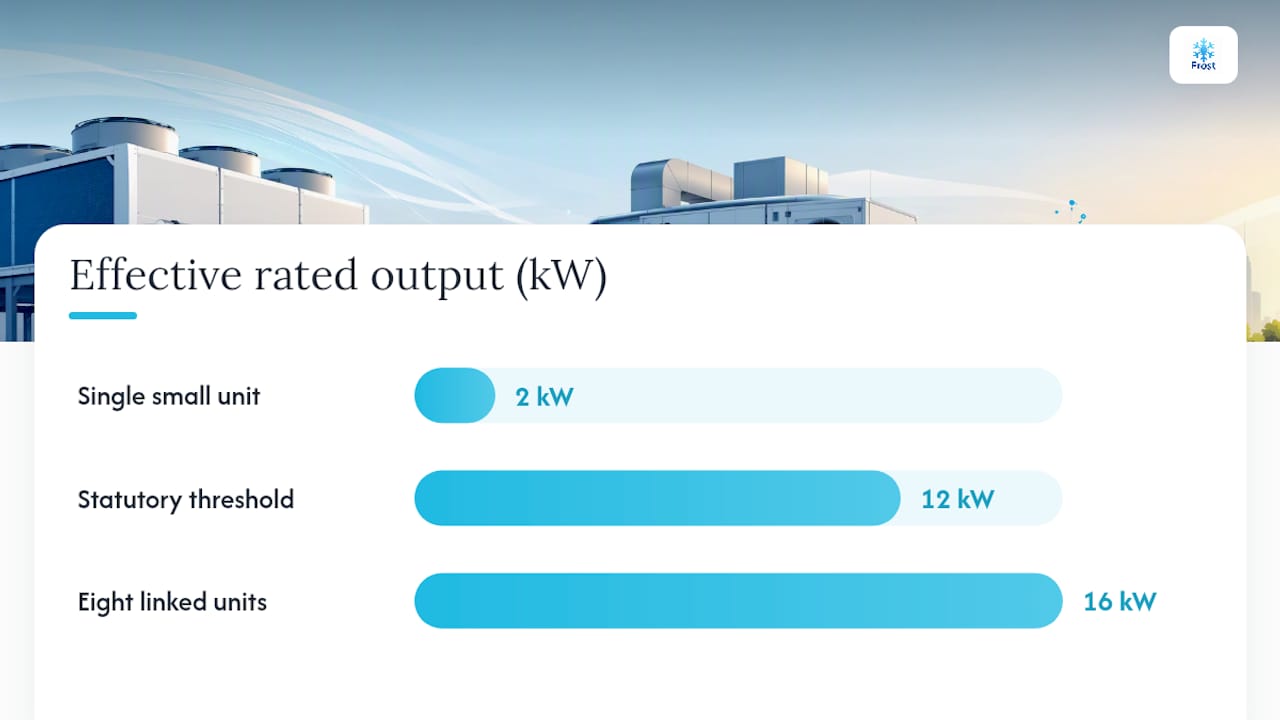
Effective rated output is broadly the cooling capacity of the system, measured in kilowatts. A single wall-mounted unit in a small office rarely reaches the 12kW threshold on its own. But here's the part owners often miss: if several units are linked by shared or central control, regulators treat them as one combined system for the purposes of the threshold. A building with eight 2kW units networked to one controller can easily exceed 12kW combined, even though no individual unit looks large enough to matter.
Certain systems fall outside the regime entirely. Common exemptions include:
- Portable air conditioning units that are not fixed installations
- Process cooling systems serving industrial equipment rather than occupied spaces
- Small units that operate independently, with no shared controls linking them into a larger network
Legal responsibility sits with what the regulations call the "relevant person", typically the building owner or the party with operational control of the system. This matters most during sales, lettings, or lease changes. If a new owner or occupier takes control and isn't handed the most recent inspection report, they must arrange a fresh inspection within three months. That three-month clock catches a lot of buyers off guard during conveyancing, particularly with older commercial buildings where paperwork has gone missing over successive tenancies.
How often must a TM44 inspection be carried out?
The maximum interval between statutory inspections is five years. That's a ceiling, not a target, and treating it as routine maintenance scheduling is where a lot of owners go wrong.
The GOV.UK guidance on air conditioning inspections is explicit: TM44 inspections are a distinct legal duty, separate from the servicing your engineer does to keep the system running efficiently day to day. You can have a spotlessly maintained system and still be non-compliant if you've never commissioned the statutory inspection.
Three things determine your actual obligations:
- First inspection timing depends on when the system was first put into service and its size. Larger systems and those installed longer ago generally faced earlier first-inspection deadlines under the original rollout of the regulations.
- Assessor accreditation is non-negotiable. Only an accredited energy assessor can carry out a valid TM44 inspection, and the report must be lodged on the statutory register once complete.
- Report content must cover system efficiency, whether the equipment is correctly sized for the space it serves, and recommendations for improvement, following the technical method set out in CIBSE TM44.
That third point is where TM44 earns its keep. It's not a tick-box safety check; it's an efficiency audit. An assessor who finds a system oversized for its space, or running well below its rated efficiency, can and often does recommend an inspection interval shorter than five years. Scottish technical guidance makes this point directly, flagging poor maintenance and oversizing as the two factors most likely to trigger a tighter schedule.
Pro Tip: Don't wait for your five-year deadline to approach before finding an assessor. Accredited assessors get booked up, and a rushed inspection close to your deadline leaves no time to act on any recommendations before you're technically out of compliance.
Once complete, the report needs to sit somewhere retrievable, alongside your servicing records. If you can't locate your last TM44 report, treat that as an active compliance gap, not paperwork to chase up eventually.
Who is legally allowed to work on F-Gas equipment?
Anyone installing, servicing, or leak-checking equipment containing fluorinated greenhouse gases must hold the relevant personnel certificate, and the company carrying out the work needs its own company certificate. The Fluorinated Greenhouse Gases Regulations 2009 make it an offence to carry out this work without the required qualifications, and that offence sits with both the individual and the business instructing them.
This is where a lot of property owners assume the risk stops with the contractor. It doesn't. If you knowingly hire someone without proper certification to touch refrigerant-containing equipment, you carry legal exposure too, not just the tradesperson holding the tools.
F-Gas certification isn't optional paperwork. It's the legal gate that determines who can lawfully touch refrigerant equipment, and the regulations set thresholds around leak checking, recordkeeping, and company accreditation that apply regardless of system size.
Before any contractor sets foot on site, check for:
- A current REFCOM or equivalent company certificate, not just an individual engineer's card
- Named personnel certificates covering the specific technicians who'll be doing the work
- A record of previous leak-check compliance if the contractor has serviced F-Gas equipment for you before
- Willingness to provide documentation in writing, not just a verbal assurance
Verifying credentials takes minutes. Discovering after the fact that an uncertified contractor has been handling your refrigerant system, potentially venting gas illegally or leaving a leak undetected, takes considerably longer to sort out, and the liability doesn't land solely on them. Our own guide on verifying F-Gas compliance before you hire walks through the specific documents worth asking for.
Do you need planning permission for air conditioning in the UK?
Most domestic air conditioning installations don't need planning permission, but "most" isn't "all", and the exceptions catch out more homeowners than you'd expect.
Under permitted development rules, a typical domestic split system mounted at ground or first-floor level, away from a boundary, usually proceeds without formal planning approval. Where things get complicated:
- Conservation areas and listed buildings often carry additional restrictions on external units, particularly visible ones facing the street
- Boundary distance rules can require external condenser units to sit a minimum distance from a neighbouring property
- Flats and maisonettes frequently fall outside permitted development rights that apply to standalone houses
- Roof-mounted or unusually large systems may trigger a full planning application rather than permitted development
Building regulations sit alongside planning permission as a separate question. Electrical safety rules apply to any hardwired installation, and Part L energy efficiency requirements can come into play depending on the scale of the system and the building type. Commercial installations, particularly larger multi-split or VRF systems, are far more likely to require building control sign-off than a single domestic unit. Checkatrade's guide to air conditioning building regulations is a useful starting point for the domestic detail, though local variation is real.
When in doubt, a five-minute call to your local planning department or building control team beats guessing. Get it wrong on a listed building or within a conservation area and you could face enforcement action, including applying retrospectively for permission or removal of the unit.
What records must you keep and who enforces the rules?
Keep your most recent TM44 inspection report somewhere you can lay hands on it fast, because you may only have seven days to produce it. Trading Standards, the local weights and measures authority, enforces the inspection and lodgement requirements, and can issue fixed penalty notices where an owner has failed to commission a required inspection or can't produce the report on request.
Good recordkeeping means storing more than just the report itself:
- The inspection report with its reference number and the accrediting body's details
- Servicing logs showing routine maintenance dates and work carried out
- Leak-test records for any F-Gas equipment on site
- Commissioning documentation from the original installation
This paperwork matters well beyond avoiding a fine. During a property sale or lease renewal, buyers and their solicitors increasingly ask for the current inspection report as standard due diligence. A missing report doesn't just risk enforcement; it can stall or complicate a transaction, and it hands the incoming owner a three-month inspection deadline they didn't ask for.
Your air conditioning compliance checklist
Work through this in order and you'll know exactly where you stand within an afternoon.
- Establish your system's effective rated output. Add up linked units under shared control, not just the largest single unit, to see if you cross the 12kW threshold.
- Locate your last TM44 report, if one exists. Check the date against the five-year maximum interval and note any recommendations the assessor made.
- Confirm the assessor's accreditation and check the report carries a register lodgement number. No number is a red flag worth chasing up.
- Check every contractor's F-Gas credentials before booking work: company certificate, named personnel certificates, and a REFCOM reference where applicable.
- Book your next inspection with margin, especially if your last report flagged inefficiency or oversizing, since a shorter interval than five years may already be recommended.
- Ask contractors for their servicing logs and leak-test history on your system if you're switching providers, so nothing falls through the gap between engineers.
Pro Tip: If your building has changed hands in the last three months and nobody handed over an inspection report, don't assume the previous owner's compliance carries over. The clock on your own inspection duty may already be running.
Older or heavily used systems deserve closer attention than the statutory minimum. An assessor's recommendation for a shorter interval isn't a suggestion to ignore; it's usually a sign the system is running less efficiently than it should, which costs you in energy bills long before it becomes a compliance problem.
Publisher perspective: what compliant servicing actually looks like
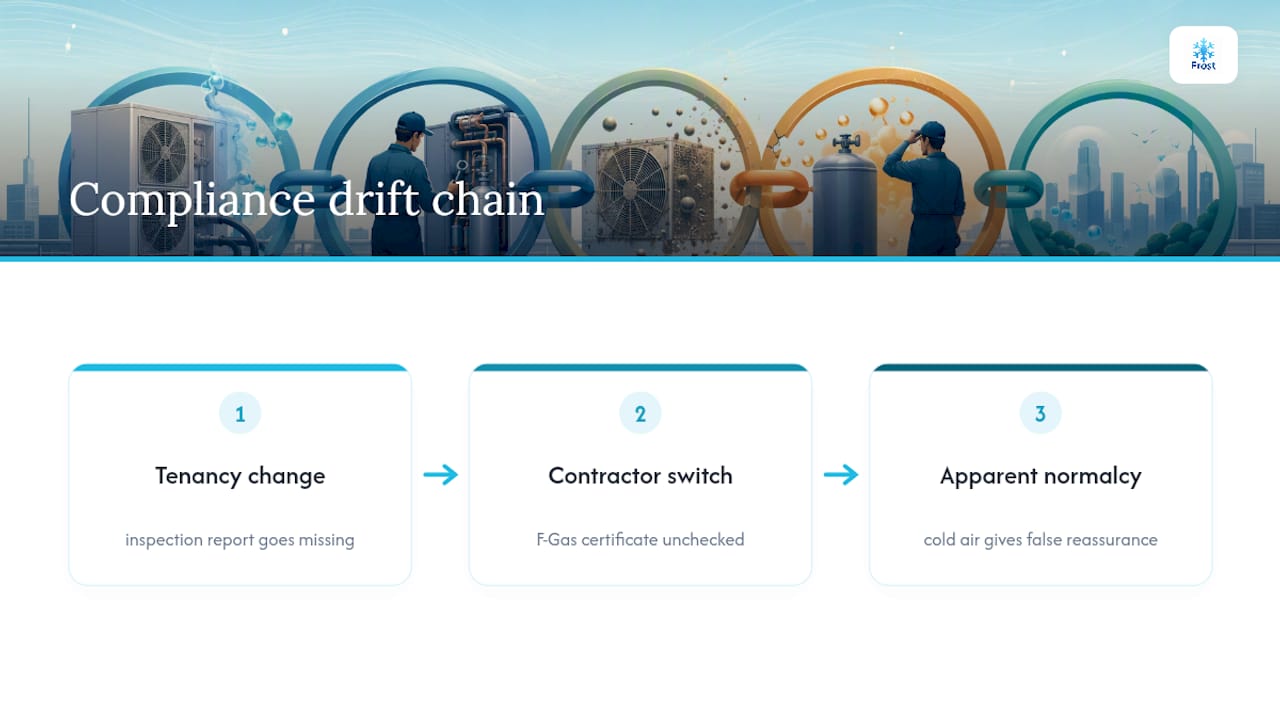
Most compliance failures happen quietly, not through defiance but through drift. An inspection report goes missing during a change of tenancy. A cheaper contractor gets hired without anyone checking their F-Gas certificate. Nobody notices because the air conditioning still blows cold air, and cold air feels like proof that everything's fine. It isn't.
Some local engineers work to REFCOM and F-Gas certification standards across domestic and commercial jobs in Exeter and the wider South West, satisfying credential checks required for contractors before arriving on site. A free survey at the start of a job can be the point where system sizing and effective rated output get established properly, rather than guessed at after the fact.
Good compliance practice isn't a separate task bolted onto maintenance. It's what happens when the engineer doing your service already knows what your inspection report needs to say, and keeps your records straight without you having to chase them.
— James
How Frostairconditioning keeps you compliant and covered
Staying compliant isn't a one-off task, it's an ongoing relationship with whoever services your system. Frostairconditioning's engineers are F-Gas certified and REFCOM registered, which means every service visit, leak check, and installation already meets the qualification standard the regulations demand, without you having to interrogate a stranger's paperwork on your doorstep.

For ongoing compliance, an annual service contract keeps your servicing logs current and your system running at the efficiency an assessor expects to see, which matters if you're hoping to avoid a shortened inspection interval. If you're installing new equipment, whether a domestic system or a full commercial or shop fitting project, Frostairconditioning's engineers handle commissioning properly from day one, with premium systems from Samsung, Mitsubishi, Toshiba and Daikin, and 0% finance available. Get in touch for a free survey and find out exactly where your system stands.
Sources
For the legal detail behind every claim in this guide, go to the source rather than a summary. The GOV.UK guide to air conditioning inspections covers assessor accreditation, report lodgement, and enforcement. The Energy Performance of Buildings (England and Wales) Regulations 2012 set out the statutory inspection duty itself, while the Fluorinated Greenhouse Gases Regulations 2009 govern who can legally work on refrigerant equipment. For the technical inspection methodology, see CIBSE TM44.
This article is general information, not a substitute for advice from a qualified lawyer. Consult a qualified legal professional about your own circumstances before acting on anything here.
- The Energy Performance of Buildings (England and Wales) Regulations 2012 — Part 4: Inspections of air‑conditioning systems
- Gov
- CIBSE TM44 — Inspection of air conditioning systems
- Building standards technical handbook 2020 (non‑domestic) — Scottish Government
FAQ
What is the law for air conditioning in the UK?
Systems with an effective rated output over 12kW must have a statutory TM44 energy inspection at intervals not exceeding five years, and anyone working on F-Gas equipment must hold the correct certification under the Fluorinated Greenhouse Gases Regulations 2009.
How often should air conditioning units be serviced in the UK?
Routine servicing frequency depends on system size and usage, but the statutory TM44 inspection is separate and legally required at least every five years for qualifying systems, sometimes more often if an assessor recommends it.
What are the requirements for installing air conditioning in the UK?
Domestic installations usually fall under permitted development and rarely need planning permission, though conservation areas, listed buildings, and boundary rules can create exceptions; all installation work involving F-Gas refrigerant must be carried out by certified personnel.
Is TM44 a legal requirement?
Yes, for systems with an effective rated output over 12kW, a TM44 inspection carried out by an accredited energy assessor is a legal requirement under the Energy Performance of Buildings (England and Wales) Regulations 2012, not an optional efficiency check.