

Ducted air conditioning is one of those terms that gets thrown around a lot, yet most homeowners aren't entirely sure what sets it apart from other systems, or whether it's actually worth the investment. Many assume it's only for large commercial buildings or that the installation is impossibly disruptive. Neither is true. If you own a home in Devon or Cornwall and you're tired of rooms that are too hot in summer, too cold in winter, and impossible to control, this guide will walk you through what ducted air conditioning genuinely involves, how it performs in real homes, and what it costs to install with flexible payment options that make it far more accessible than you might think.
Table of Contents
- Understanding ducted air conditioning: what it is and how it works
- Advantages of ducted air conditioning for Devon and Cornwall homes
- Ducted air conditioning versus ductless systems: which is right for your home?
- Maintaining ducted air conditioning: keeping your system efficient and healthy
- Budgeting for ducted air conditioning installation and flexible payment options
- Why ducted air conditioning is the smart choice for Devon and Cornwall homeowners
- Find expert ducted air conditioning installers in Devon and Cornwall
- Frequently asked questions
Key Takeaways
| Point | Details |
|---|---|
| Ducted system basics | Ducted air conditioning uses a central unit and ducts to deliver air evenly throughout the home for whole-house comfort. |
| Maintenance matters | Regular professional servicing every 1-2 years and frequent filter cleaning keep systems efficient and healthy. |
| Advantages for large homes | Ducted AC provides discreet aesthetics, consistent temperature control, and zoning ideal for bigger properties. |
| Comparison with ductless | Ducted systems suit full-home coverage, while ductless saves energy by avoiding duct losses in certain setups. |
| Professional installation | Choosing experienced local installers with flexible payment options helps ensure a smooth installation and service. |
Understanding ducted air conditioning: what it is and how it works
A ducted air conditioning system cools or heats an entire property through a central unit connected to ducts distributing air to multiple rooms. That central unit, typically installed in a loft or cupboard, draws in air, conditions it to your chosen temperature, and pushes it out through a network of insulated ducts hidden inside ceilings and walls. Small, discreet vents are the only thing you see in each room.
The system works in both directions. In summer, it extracts heat from your indoor air and expels it outside via a compressor unit, much like a fridge working in reverse. In winter, many ducted systems run as heat pumps, pulling warmth from the outside air and transferring it indoors. This dual function means one system handles your comfort all year round, which is particularly useful in a region like Devon and Cornwall where summers are warm and winters are damp.
Here are the core components you'll find in a typical ducted system:
- Central air handling unit (usually in the loft or a utility space)
- Insulated ductwork running through ceiling voids and wall cavities
- Supply vents in ceilings or walls of each room
- Return air grilles that pull stale air back to the central unit
- Outdoor compressor unit mounted on an external wall or ground
- Zone controllers or a central thermostat for temperature management
One of the most underrated features is zoning. Rather than conditioning your entire home to the same temperature, a well-designed ducted system lets you set different temperatures for different areas. Bedrooms can stay cooler at night while living spaces warm up in the morning, all from a single wall controller or smartphone app. If you're exploring the types of air conditioning for UK homes before committing, ducted systems consistently sit at the top for whole-home performance.
Advantages of ducted air conditioning for Devon and Cornwall homes
The ducted systems provide whole-property control, discreet design, and zoning capabilities, making them excellent for larger homes with varied room layouts. For properties in Devon and Cornwall, that description fits remarkably well. Many homes here are stone-built or listed, with character features you'd rather not cover with wall-mounted units. A ducted system keeps all of that intact.
Here's where ducted air conditioning genuinely earns its place:
- No cold or hot spots. Every room receives conditioned air simultaneously, so you're not walking from a comfortable lounge into a stuffy bedroom.
- Zoning flexibility. A farmhouse in Dartmoor or a coastal cottage near Falmouth can have entirely different comfort settings in different rooms without running multiple separate systems.
- Aesthetics. Ceiling vents are barely noticeable and don't compete with period features, exposed beams, or open-plan interiors.
- Year-round use. The same system heats and cools, replacing the need for separate heating solutions in many properties.
- Quieter operation. The loudest components sit outside or in the loft, so day-to-day noise inside the home is minimal.
Understanding the integrated air conditioning benefits for a home like yours goes beyond comfort. Running a well-designed ducted system is often more cost-effective than running multiple plug-in heaters, electric panel heaters, or portable air conditioning units. You can also boost air conditioning energy efficiency at home further by pairing your system with a programmable schedule and good insulation.
Pro Tip: If your home has more than four rooms, ducted air conditioning typically delivers better value per room than installing individual units throughout. Ask your installer to calculate cost per zone before you compare quotes.

Ducted air conditioning versus ductless systems: which is right for your home?
The key difference is straightforward. Ducted systems move air through hidden pipework; ductless systems (often called split systems or mini-splits) use compact indoor units mounted on walls or ceilings in individual rooms, connected directly to an outdoor unit. Both have their place.
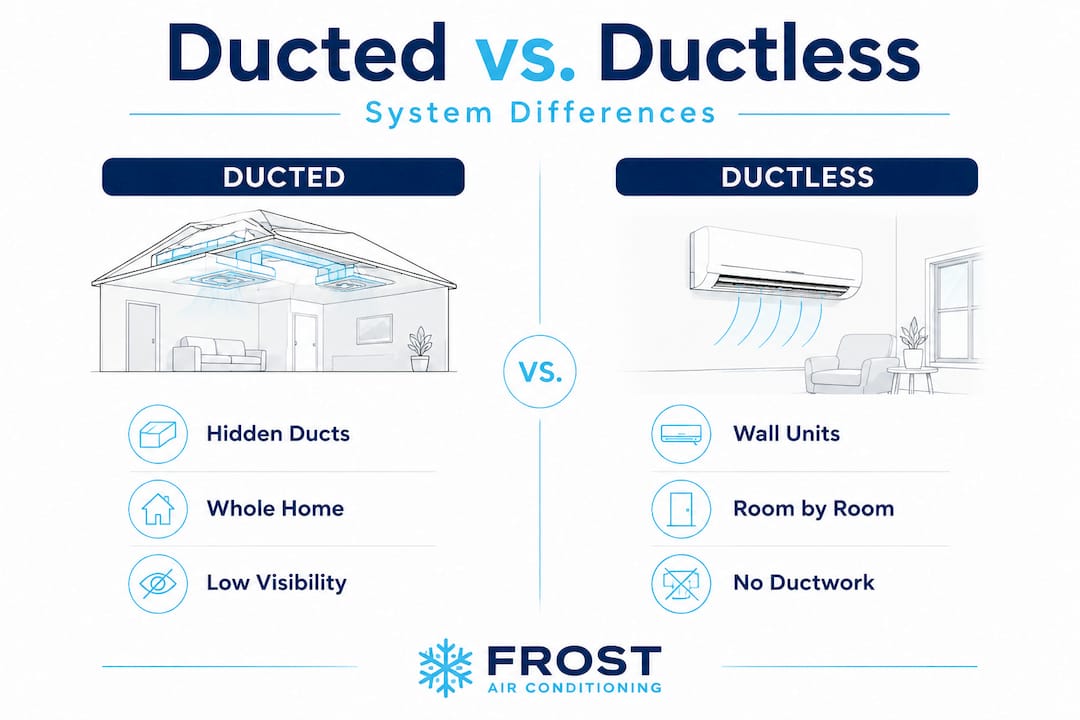
| Feature | Ducted system | Ductless split system |
|---|---|---|
| Visibility inside the home | Minimal (ceiling vents only) | Wall or ceiling units in each room |
| Whole-home coverage | Yes, single system | Requires multiple indoor units |
| Installation disruption | Higher (ductwork required) | Lower (no ductwork needed) |
| Zoning capability | Yes, via controllers | Yes, via individual units |
| Suited to older properties | Possible with planning | Easier in most cases |
| Upfront cost | Generally higher | Lower per zone |
| Aesthetics | Discreet | More visible |
Ductwork can cause energy losses up to 30%, which ductless systems avoid, but ducted systems offer whole-home coverage and a streamlined look that ductless simply cannot match. The 30% figure assumes poorly installed or uninsulated ducts. A properly installed ducted system with sealed, insulated ductwork reduces those losses significantly.
Ductless systems work well for a single room addition, a home office, or a retrofit project where opening up ceilings isn't practical. But if you want every room handled consistently and you value a clean interior, ducted is the stronger choice. For a more detailed breakdown of what suits Devon and Cornwall properties specifically, the guide on air conditioning pros and cons for local homes is worth reading before you decide.
Maintaining ducted air conditioning: keeping your system efficient and healthy
Here's the part most homeowners skip when researching ducted systems, and then regret later. Maintenance isn't optional. A neglected ducted system loses efficiency, circulates poor-quality air, and will cost you more to run and repair over time. The good news is that the routine is straightforward.
Ducted AC systems need professional servicing every 1 to 2 years, with filters cleaned monthly or quarterly to maintain efficiency and air quality. Here's how to approach it:
- Clean filters monthly if the system runs daily. Every three months is fine for lighter use.
- Inspect visible vents and grilles for dust build-up every couple of months.
- Check the outdoor unit seasonally. Clear any leaves, debris, or vegetation growing near the coils.
- Book a professional service every one to two years. This covers refrigerant levels, coil cleaning, duct integrity, and electrical checks.
- Review your service contract annually to make sure warranty conditions are being met.
Pro Tip: Set a calendar reminder for filter cleaning. It takes under ten minutes and is the single most effective thing you can do between professional services.
"Neglecting filter maintenance is the number one reason ducted systems underperform. It's not a mechanical failure. It's a clean-it-and-carry-on job that most homeowners never do."
If your system starts making unusual noises, losing cooling performance, or producing uneven temperatures across zones, these are early warning signs worth addressing before they become expensive. The air conditioning troubleshooting guide for Devon and Cornwall covers the most common issues and when to call a professional.
Budgeting for ducted air conditioning installation and flexible payment options
The cost of ducted air conditioning installation in Devon and Cornwall varies depending on several factors. There's no single number that applies to every home, but understanding what drives the price helps you budget realistically and compare quotes properly.
Key cost factors include:
- System size and capacity. Larger homes need higher-output units, which cost more upfront.
- Number of zones. Each additional zone adds to ductwork complexity and controller costs.
- Property layout. Open-plan homes are generally easier and less expensive to duct than older properties with solid walls or low ceiling voids.
- Existing infrastructure. Homes with accessible loft space or existing voids reduce installation labour considerably.
- Brand and specification. Premium systems with advanced zoning, Wi-Fi control, and higher efficiency ratings carry higher upfront costs but lower running costs.
Long-term, the energy savings are real. Running a ducted heat pump system is significantly cheaper per unit of heat than electric resistance heating, which many Devon and Cornwall homes still rely on. That gap compounds over years, making the initial outlay look considerably more reasonable.
Many professional installers now offer flexible financing, including 0% finance options, which spread the cost without adding interest. This makes a properly specified ducted system accessible even when the upfront figure feels daunting. Considering air conditioning as a smart home investment is more straightforward when you're not paying the full cost on day one.
Service contracts are worth factoring in too. Paying a modest annual fee for a maintenance package often works out cheaper than booking ad hoc call-outs, and it keeps your warranty valid.
Why ducted air conditioning is the smart choice for Devon and Cornwall homeowners
We install ducted systems across the South West regularly, and what strikes us most is how well they suit the homes in this region specifically. Devon and Cornwall properties tend to be older, character-rich, and spread across multiple rooms. They're exactly the kind of homes where a single wall-mounted unit struggles and where visible indoor equipment feels out of place.
The local climate makes the case even stronger. Summers here are getting warmer, and the damp winters aren't going anywhere. A ducted system that heats in winter and cools in summer isn't a luxury; it's a practical answer to a real problem that returns value every month of the year.
What surprises most homeowners after installation is how quiet the system is. The compressor is outside, the air handling unit is in the loft, and all you notice inside is a gentle airflow and a room that's at exactly the temperature you set. There's no noise from wall units cycling on and off and no visual clutter on your walls.
The maintenance point deserves more attention than it usually gets. Regular filter cleaning reduces energy consumption by up to 15% and improves indoor air quality, and it's the kind of task that takes less time than making a cup of tea. Pair that with a professional service every couple of years, and a well-installed ducted system will run reliably for 15 to 20 years. The fuller picture of benefits of air conditioning for Devon and Cornwall homes makes it very clear why homeowners who've made the switch rarely look back.
The one honest caveat: ducted air conditioning rewards investment in quality installation. A poorly designed system with undersized ducts or inadequate zoning will underperform and frustrate. Choosing an F-Gas certified installer who knows the local housing stock makes the difference between a system that lasts and one that disappoints.
Find expert ducted air conditioning installers in Devon and Cornwall
If you've read this far, you already have a clearer picture than most homeowners do before they call an installer. The next step is getting a proper assessment of your home so a system can be designed around your layout, your budget, and how you actually live in the space.

At Frost Air Conditioning, we're F-Gas certified, based in Exeter, and cover the whole of the South West. We offer same-day installations where possible and 0% finance options so you're not waiting months to get a comfortable home. Every job starts with a free quote tailored to your property. Request your quote today and let us design a ducted system that works properly from day one.
Frequently asked questions
How often should I have my ducted air conditioning professionally serviced?
Professional servicing is recommended every 1 to 2 years depending on usage, to keep the system operating at peak efficiency and maintain any manufacturer warranty.
What are the benefits of cleaning the ducted air conditioning filters regularly?
Regular filter cleaning reduces energy consumption by up to 15%, improves indoor air quality, and extends the overall lifespan of the system.
Are ducted air conditioning systems suitable for older homes in Devon and Cornwall?
Yes. Ducted systems can be adapted for many period properties across Devon and Cornwall, and experienced local installers can design discreet ductwork routes that preserve original features and character.
How do ducted and ductless air conditioning systems differ in energy efficiency?
Ductwork can cause energy losses up to 30% in poorly installed systems, which ductless units avoid, but a well-installed ducted system with properly sealed ducts delivers uniform whole-home comfort that individual ductless units cannot replicate efficiently.