

Shopping for air conditioning can feel oddly similar to reading a foreign language. Quotes arrive packed with terms like "tonnage," "SEER2," and "inverter compressor," and most homeowners either nod along or, worse, make a decision based purely on price. That is a costly mistake. When you understand what these terms actually mean, you can spot whether a system is the right size for your home, whether it will run efficiently in Devon and Cornwall's changeable climate, and whether the installer is genuinely recommending what you need. This guide walks you through every major term, clearly and practically, so you can have a confident conversation with any installer.
Table of Contents
- The basics: How air conditioning works and why terminology matters
- Key terms defined: Tonnage, BTUs, and cooling capacity
- Efficiency and performance: SEER2, ENERGY STAR, and variable systems
- Practical jargon: Dehumidification, zoning, inverter technology, and common features
- A local perspective: What Devon and Cornwall homeowners often get wrong
- Next steps: Expert advice and tailored air conditioning quotes
- Frequently asked questions
Key Takeaways
| Point | Details |
|---|---|
| Know the basics | Understanding key AC terms stops you buying the wrong system for your home. |
| Size is critical | Tonnage and BTUs must match your home's needs to avoid inefficiency or discomfort. |
| Efficiency saves money | A higher SEER2 or ENERGY STAR rating means lower bills and less energy waste. |
| Ask for clarity | Insist on jargon-free explanations from installers to get what you actually need. |
The basics: How air conditioning works and why terminology matters
Before diving into numbers and ratings, it helps to understand what an air conditioning system actually does. A common misconception is that an AC unit "creates" cold air. It does not. What it really does is move heat from inside your home to the outside, leaving cooler air behind. This process is called the refrigeration cycle, and AC moves heat via refrigeration cycle, using two key components: the evaporator (which absorbs heat from your indoor air) and the condenser (which expels that heat outside).
A useful side effect of this process is dehumidification. As warm, humid air passes over the cold evaporator coil, moisture condenses out of it, much like water droplets forming on a cold glass on a warm day. For homes in Devon and Cornwall, where damp, muggy summers are the norm rather than the exception, this dehumidification benefit is genuinely valuable.
Why does terminology matter? Because without it, two quotes that look similar on paper might be wildly different in practice. One unit might be sized for a large open-plan house when yours has thick stone walls and smaller rooms. Another might have a low efficiency rating that quietly adds £200 or more to your annual electricity bill. If you cannot read the numbers, you cannot compare the options.
Here are the core reasons why understanding AC terminology protects you:
- Accurate sizing prevents discomfort and wasted energy
- Efficiency ratings directly affect what you pay to run the system
- Feature terminology helps you separate genuine benefits from marketing language
- Knowing the basics means you can flag problems early, before they become expensive repairs
Pro Tip: If you ever suspect your installed system is not performing as it should, our guide on AC troubleshooting for Devon and Cornwall homes is a practical starting point.
"An air conditioner's job is not to produce cold. It is to remove heat. That small shift in understanding changes how you evaluate every specification on a quote."
Key terms defined: Tonnage, BTUs, and cooling capacity
With the mechanics in mind, it is time to break down the technical language you will most often encounter on quotes and in sales literature.
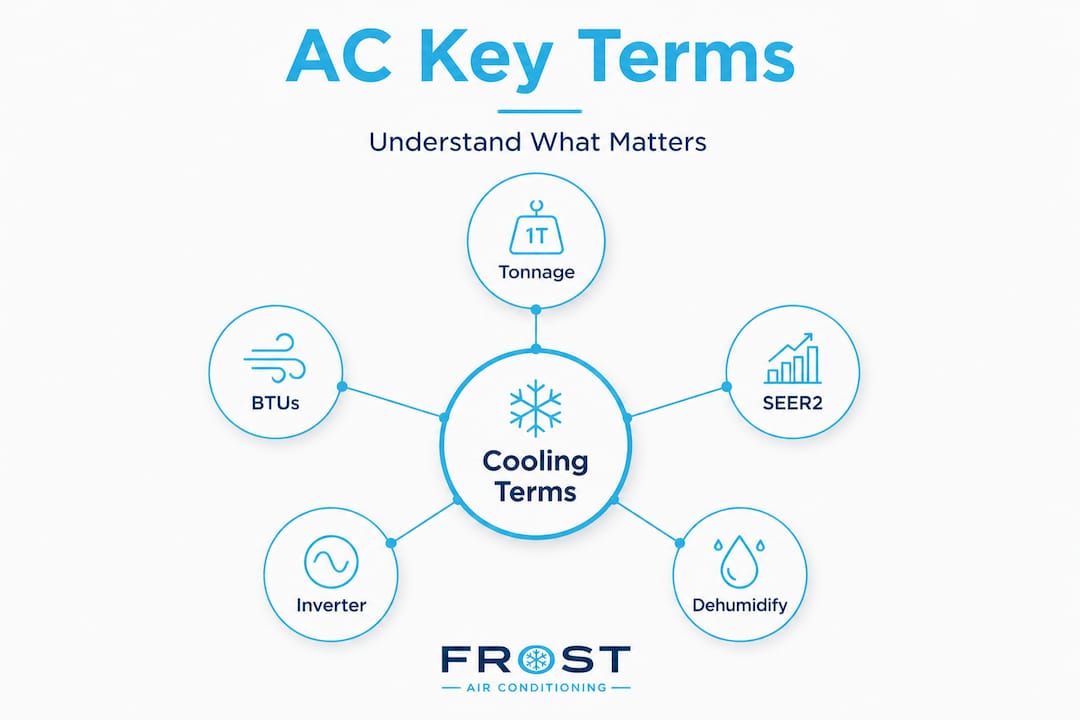
Tonnage is the term that confuses people most often. It has nothing to do with the weight of the unit. It refers to cooling capacity. Specifically, 1 ton equals 12,000 BTU/hour, and this figure comes from the amount of heat needed to melt one ton of ice over 24 hours. A BTU (British Thermal Unit) is simply a measure of heat energy. So when an installer says a unit is "2.5 ton," they mean it can remove 30,000 BTUs of heat from your home every hour.
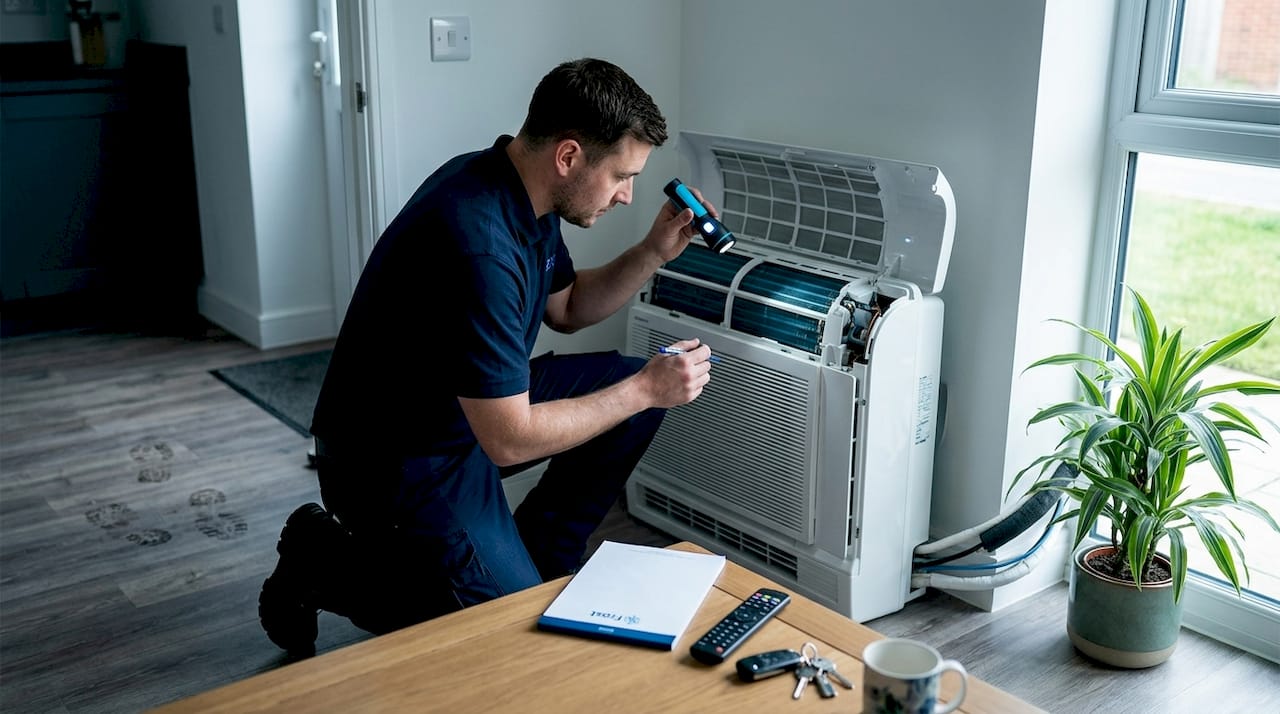
Getting the tonnage right is critical. Professionals calculate the correct size using a process called a Manual J load calculation, which accounts for your home's floor area, ceiling height, insulation levels, window sizes, and local climate. It is not a rough guess based on square footage alone.
Here is what happens when the sizing goes wrong:
- Undersized unit: The system runs constantly trying to hit the target temperature, never quite managing it. Your electricity bill climbs, and the unit wears out faster.
- Oversized unit: The system reaches the temperature set point very quickly, then switches off. This is called short-cycling. Short-cycling is bad because it means the system never runs long enough to properly dehumidify your air, leaving your home feeling cold but clammy. It also puts stress on the compressor.
- Correctly sized unit: Runs in steady, efficient cycles. Removes humidity properly. Maintains even temperatures throughout the room.
For West Country homes, where many properties have solid stone walls, unusual layouts, or older double glazing, a Manual J calculation is especially important. Do not accept a quote based on "roughly X square metres needs Y tonnage." That is not good enough.
| Home size | Approximate tonnage needed | BTU/hour equivalent |
|---|---|---|
| Up to 50 sq metres | 1 ton | 12,000 BTU/hr |
| 50 to 80 sq metres | 1.5 to 2 ton | 18,000 to 24,000 BTU/hr |
| 80 to 140 sq metres | 2 to 2.5 ton | 24,000 to 30,000 BTU/hr |
| 140 to 200 sq metres | 3 ton | 36,000 BTU/hr |
These are general guides only. Local factors in Devon and Cornwall, including coastal humidity and the thermal mass of older buildings, can shift these figures considerably. Use them as a starting reference, not a firm answer.
Pro Tip: When reviewing quotes, ask your installer directly: "Did you perform a load calculation for my specific property?" If they cannot answer clearly, treat that as a warning sign.
Efficiency and performance: SEER2, ENERGY STAR, and variable systems
Now you know the power and size fundamentals, let us demystify efficiency ratings and performance benchmarks that can make a long-term difference to your home.
SEER2 stands for Seasonal Energy Efficiency Ratio 2. It is the updated efficiency standard replacing the older SEER rating, and it measures how efficiently an air conditioning system cools over an entire season. The higher the SEER2 number, the more cooling you get per unit of electricity consumed. ENERGY STAR benchmarks approximately 15 to 16+ SEER2 as the threshold for genuinely efficient systems.
To make this practical: a system with a SEER2 of 18 uses notably less electricity than one rated at 13, even if both have identical cooling capacity. Over a five to ten year lifespan, that difference in running costs adds up to hundreds of pounds.
| SEER2 rating | Relative efficiency | Estimated annual running cost (average home) |
|---|---|---|
| 13 to 14 | Minimum standard | £350 to £420 |
| 15 to 16 | Good (ENERGY STAR threshold) | £280 to £340 |
| 17 to 19 | Very good | £230 to £280 |
| 20+ | Excellent | Under £230 |
Running costs are illustrative estimates based on average UK electricity tariffs and typical usage patterns.
Variable-speed and inverter systems are directly linked to high SEER2 ratings. Traditional AC compressors work in binary: they are either fully on or fully off. An inverter-driven compressor adjusts its speed continuously to match the actual demand at any given moment. The result is more precise temperature control, quieter operation, and significantly better energy use. For Devon and Cornwall's mixed seasons, where you might need cooling on a warm April afternoon but only light conditioning in August, a variable system handles those changes far more gracefully than a fixed-speed model.
Key points to keep in mind when evaluating efficiency:
- A higher SEER2 upfront cost often pays back within three to five years in electricity savings
- Inverter systems dehumidify more effectively because they run longer at lower capacity rather than blasting and stopping
- Look for systems with a seasonal heating performance (SCOP) rating too, since many units also provide heat in winter
- In a region with humid summers like the South West, a system that excels at part-load operation (running gently for longer periods) is worth prioritising
Practical jargon: Dehumidification, zoning, inverter technology, and common features
With the benchmarks explained, let us unpack some everyday features and buzzwords you are likely to come across in quotes or discussions with local installers.
Dehumidification deserves its own spotlight for South West homeowners. Cornwall and Devon regularly experience relative humidity above 80%, particularly near the coast and through spring and early summer. An air conditioner dehumidifies as a natural byproduct because the refrigeration cycle condenses moisture from the air as it passes over the cold evaporator coil. A well-sized and correctly operating system can remove several litres of moisture from your indoor air every hour. This is not a luxury feature. In a damp climate, it directly affects how healthy and comfortable your home feels.
Zoning refers to the ability to control temperatures independently in different rooms or areas of your home. A multi-split system, for example, uses one outdoor unit connected to multiple indoor units, each of which can be set to a different temperature. This is particularly useful in households where family members have different preferences, or in homes where only certain rooms are used at particular times of day. Zoning means you are not cooling an empty bedroom while someone works in the kitchen.
Inverter technology has already been touched on under efficiency, but it is worth restating in practical terms. An inverter compressor does not switch on at full power and then cut off. Instead, it ramps up gently, reaches the target temperature, and then ticks along quietly at low power to maintain it. The practical effect is a home that stays at a consistent, comfortable temperature without the temperature swings you get from older on/off systems.
Here is a quick-reference glossary of other terms you are likely to encounter:
- Refrigerant: The chemical fluid inside the system that carries heat. Modern systems use refrigerants like R32, which has a lower environmental impact than older types.
- Multi-split system: One outdoor unit serving multiple indoor units in different rooms.
- Monoblock/portable unit: A self-contained unit, less efficient and less effective than a split system, typically used as a temporary fix.
- WiFi control: Allows you to manage your system via smartphone, useful for adjusting settings before you arrive home.
- Sleep mode: Gradually adjusts temperature overnight to save energy and improve sleep comfort.
- Auto-restart: The unit restores its previous settings after a power cut, so you do not need to reprogram it manually.
- F-Gas certification: The legal requirement for installers handling refrigerants. Always confirm your installer holds this qualification before anyone touches your system.
Pro Tip: Always ask your installer which refrigerant the system uses. R32 is currently the most common modern choice and has significantly lower global warming potential than older R410A refrigerant, which matters for future-proofing your installation.
A local perspective: What Devon and Cornwall homeowners often get wrong
We see a consistent pattern across our installations in Devon and Cornwall. Homeowners arrive at the buying decision having spent a lot of time researching brands and comparing sleek indoor unit designs, but very little time understanding the numbers behind the quotes. That is understandable. The marketing around air conditioning is heavily visual and feature-focused. But it is exactly the wrong thing to prioritise.
The most common and costly mistake we encounter is accepting a quote where the system size was decided by rough guesswork rather than a proper load calculation. According to proper sizing via Manual J principles, undersizing or oversizing a system leads directly to short-cycling or inefficiency, and yet many installations skip this step entirely. We have been called to homes where a unit installed by another company runs almost constantly in warm weather because it is simply too small for the property. In other cases, a unit that is too large hammers on and off every few minutes, fails to remove humidity properly, and leaves the homeowner wondering why their new system does not feel any better than opening a window.
The contrarian view we would offer is this: the most important "feature" to ask about is not the brand, not the colour of the indoor unit, and not whether it has a smartphone app. It is whether the installer can explain, in plain language, how they calculated the correct size and efficiency rating for your specific home. If they can answer that clearly and confidently, that is the hallmark of a professional installation. If they cannot, no amount of marketing gloss will make the system perform well.
Devon and Cornwall homes are particularly demanding environments. Coastal humidity, older stone construction, and properties that mix original features with modern extensions all throw complications into sizing and installation. Understanding the terminology we have covered here is your best protection against getting a system that looks good on paper but underperforms in your home.
Next steps: Expert advice and tailored air conditioning quotes
Armed with a clear understanding of tonnage, SEER2, inverter technology, and dehumidification, you are now in a far stronger position to evaluate your options properly.
At Frost Air Conditioning, we are based in Exeter and cover Devon and Cornwall as well as the wider South West. Every quote we provide is based on a proper assessment of your home, not a rough guess. We are F-Gas certified, offer same-day installations where possible, and provide 0% finance options to make quality systems accessible without the upfront financial pressure. Whether you are comparing your first quote or trying to make sense of one you have already received, we are happy to walk you through every figure in plain English. When you are ready, get a quote tailored to your home and your budget, and we will make sure every term is explained before you commit to anything.
Frequently asked questions
What does tonnage mean for home air conditioning?
Tonnage is the measure of cooling capacity: 1 ton equals 12,000 BTU of heat removed per hour, and matching the correct tonnage to your home's specific size and layout is essential for efficient, comfortable operation.
What is SEER2 and why should I care?
SEER2 is the seasonal efficiency rating for air conditioning systems; a higher number means less electricity used per hour of cooling, which directly reduces your annual running costs and ENERGY STAR recommends 15 to 16+ as a reliable benchmark for genuinely efficient performance.
How does dehumidification fit into air conditioning?
Removing excess humidity is a natural byproduct of the refrigeration cycle's evaporator coil process, and for homes in the South West where indoor dampness is common, this is one of the most practically valuable things a well-sized system provides.
What is Manual J load calculation?
Manual J is the professional method used to calculate the precise cooling capacity your home requires, factoring in room dimensions, insulation, windows, and local climate rather than relying on rough square-footage estimates.