

Most homeowners assume that turning the thermostat down further means a cooler, more comfortable home. In reality, the wrong unit, a poor install, or a neglected filter can cost you significantly more on your energy bills while delivering less comfort. For homeowners across Devon and Cornwall, where summers are mild but humidity can be a real nuisance, getting air conditioning efficiency right is about smart choices rather than simply cranking up the cold. This article walks you through the ratings, sizing, technology, and maintenance steps that genuinely move the needle on efficiency and running costs.
Table of Contents
- Decoding air conditioning efficiency ratings
- Why proper sizing matters more than you think
- Advanced technology versus traditional systems
- Maintenance, thermostats and insulation: the efficiency boosters you control
- Why most advice on air conditioning misses the UK homeowner's reality
- Ready to make your air conditioning truly efficient?
- Frequently asked questions
Key Takeaways
| Point | Details |
|---|---|
| Know your ratings | EER, CEER, and SEER/SEER2 are key to understanding and choosing the most efficient units. |
| Size really matters | Properly matching AC size to your room ensures maximum efficiency and comfort while avoiding wasted energy. |
| Upgrade wisely | Switching from an old unit to a modern inverter system can cut costs dramatically—sometimes by half. |
| Maintenance pays off | Simple actions like filter replacement, regular checks, and sealing drafts can boost efficiency by up to 40%. |
| Insulation supports savings | Improving home insulation doesn't just help in winter—it reduces summer cooling costs too. |
Decoding air conditioning efficiency ratings
Now that we've set the scene, let's demystify the numbers that determine how much energy your AC really uses.
Efficiency ratings can look like alphabet soup at first glance, but they tell you something genuinely important: how much cooling you get for every pound spent on electricity. The three main measures are EER, CEER, and SEER. EER (Energy Efficiency Ratio) measures cooling output in BTU per hour divided by watts used, tested at fixed conditions. CEER (Combined EER) adds standby power consumption into the calculation, making it a more honest real-world figure. SEER and SEER2 (Seasonal EER) average performance across a whole season, which is the most useful number for comparing systems you'll actually live with.
Higher ratings mean the unit does more cooling work per unit of electricity. A unit with a CEER of 12 or above meets ENERGY STAR certification, which is a reliable benchmark for efficiency. Replacing an older unit with a CEER of 8 with a modern certified model can cut running costs by 30% or more.
| Rating type | Typical older unit | Modern efficient unit | What to aim for |
|---|---|---|---|
| EER | 8 to 9 | 12 to 14 | 12+ |
| CEER | 8 to 9 | 12 to 15 | 12+ |
| SEER2 | 13 to 14 | 18 to 22 | 18+ |
When choosing energy-efficient air conditioning, look for these figures on the product label or technical data sheet before you buy. Understanding appliance efficiency ratings can also help you compare models side by side with confidence.
Signs your system may be underperforming on efficiency:
- Your energy bills spike noticeably each summer
- The unit runs almost constantly but the room stays stuffy
- You notice warm spots or uneven cooling
- The system is more than 10 years old
- You can hear it struggling or cycling on and off frequently
Every point improvement in CEER or SEER2 translates directly into lower bills. For a typical Devon home running AC through a warm summer, that difference can add up to tens of pounds per season.
Why proper sizing matters more than you think
With ratings explained, it's just as crucial to talk about how the wrong size unit can waste energy and money, and here's what to watch out for.
Sizing is one of the most misunderstood aspects of air conditioning. Bigger is not better. An oversized unit cools the room so quickly that it shuts off before it has had a chance to remove humidity, leaving the air feeling clammy even when the temperature reads correctly. An undersized unit, on the other hand, runs constantly and never quite gets there. Proper sizing is critical because oversizing causes short cycling, higher energy use, poor humidity control, and accelerated wear on components.
| Factor | Right-sized unit | Oversized unit |
|---|---|---|
| Energy use | Optimal | 20 to 30% higher |
| Comfort | Consistent, even | Uneven, clammy |
| Humidity control | Excellent | Poor |
| Equipment lifespan | Full expected life | Shorter, more wear |
On average, an oversized unit uses 20 to 30% more energy than a correctly sized one, and it tends to fail sooner too. That's a significant penalty for what feels like a safe choice.
Here's a simple three-step approach to calculating the right size for your room:
- Measure the room in square metres and multiply by 337 to get a starting BTU figure.
- Adjust for conditions: add 10% for south-facing rooms or rooms with large windows; subtract 10% for heavily shaded rooms.
- Account for occupants: add 600 BTU for each person who regularly uses the room beyond the first two.
Pro Tip: Never let an installer guess the size based on a quick look around. Insist they run the numbers using a proper heat load calculation. A reputable, F-gas certified installer will always do this as standard.
Advanced technology versus traditional systems
Sizing is just one piece; technology inside the unit also drastically impacts efficiency, so let's break down what really delivers results.
Traditional fixed-speed air conditioners work like a light switch: fully on or fully off. When the room reaches the target temperature, the compressor cuts out entirely, then fires back up when things warm again. This constant stopping and starting is inefficient, noisy, and hard on components.
Inverter technology changes this completely. An inverter-driven compressor adjusts its speed continuously, running slowly when the room is nearly at temperature and ramping up only when needed. Variable speed compressors deliver better part-load performance, superior dehumidification, and significantly lower energy consumption across a season.
Key benefits of inverter systems over traditional fixed-speed units:
- Energy savings: typically 30 to 40% less electricity consumed over a season
- Comfort: temperature stays more consistent, without the warm and cold swings
- Humidity control: slower, sustained operation removes moisture far more effectively
- Noise: lower operating speeds mean quieter running most of the time
- Lifespan: fewer start-stop cycles means less mechanical stress
VRF (Variable Refrigerant Flow) systems, which use the same inverter principle at a larger scale, have been shown to use around 36.6% less energy than conventional systems in comparable conditions. For a domestic mini-split in a typical home, real-world savings in the 30 to 40% range are consistently reported.
Pro Tip: In the mild climate of South West England, an inverter mini-split is almost always the best value choice. You rarely need maximum cooling capacity, so the ability to run efficiently at part-load is exactly what suits Devon and Cornwall conditions.
Upgrading makes the most sense when your current unit is over 10 years old, has a SEER below 14, or is a fixed-speed model struggling with humidity. If your unit is relatively new and well maintained, focusing on the next section will deliver faster returns.
Maintenance, thermostats and insulation: the efficiency boosters you control
While technology and sizing matter, day-to-day choices and care offer some of the quickest wins for energy efficiency.
The most powerful thing most homeowners can do right now costs nothing: maintain the unit properly. A dirty filter alone can reduce airflow so significantly that your system works far harder for the same result. Regular maintenance including cleaning or replacing filters, sealing ducts, and improving insulation can cut cooling costs substantially.
The most impactful maintenance tasks, in order of priority:
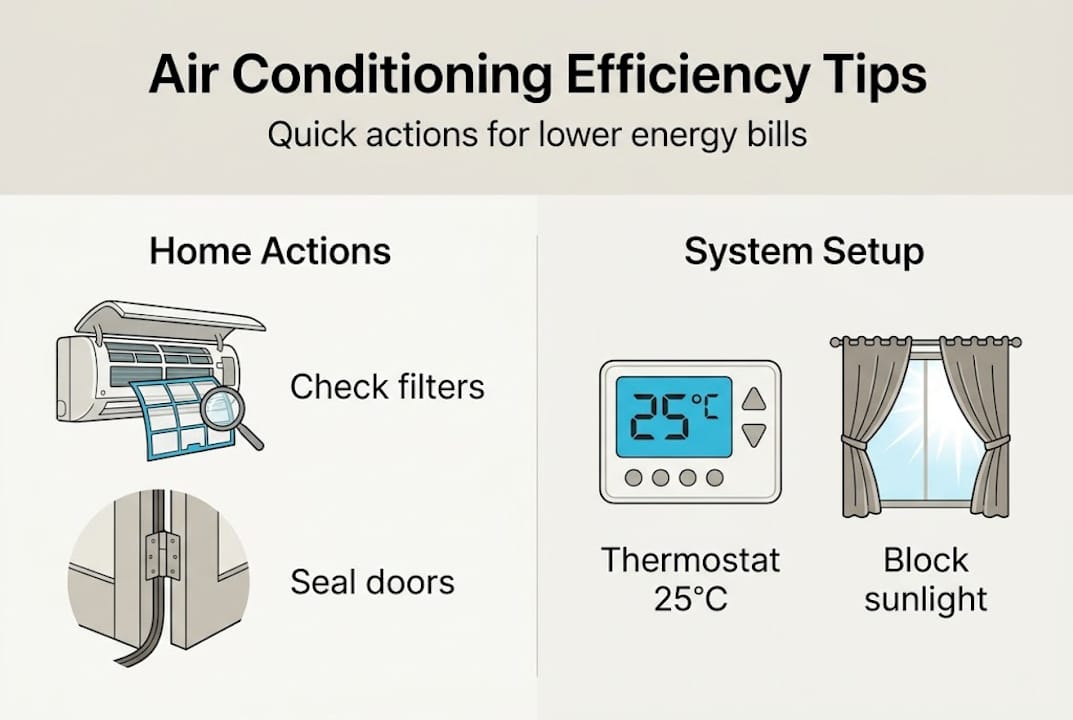
- Replace or clean filters monthly during the cooling season
- Clean the evaporator and condenser coils at least once a year
- Check that vents and registers are unobstructed by furniture or curtains
- Inspect refrigerant lines for signs of wear or ice build-up
- Seal any gaps around the unit to prevent warm air infiltration
For home cooling maintenance, consistency matters more than any single big effort. Small, regular actions keep the system running at its rated efficiency all season.
On thermostats, the evidence is clear. The optimal setting for efficiency is around 78°F (approximately 25.5°C) when you're at home. Every degree lower increases energy consumption by 1 to 3%. Many people set their thermostat far lower than needed and then wonder why bills are high. In a Devon home on a warm summer day, 25°C with good airflow is genuinely comfortable.
Insulation is the silent multiplier. Improving insulation can cut cooling costs by around 15%, even in the British summer. Draught-proofing windows and doors, fitting reflective blinds on south-facing windows, and ensuring loft insulation is adequate all reduce the load on your AC before it even switches on.
Pro Tip: Set a calendar reminder at the start of each cooling season to check your filter and book a coil clean. It takes 20 minutes and can save you hundreds of pounds over the life of the unit.
Why most advice on air conditioning misses the UK homeowner's reality
Much of the guidance available online is written for climates where air conditioning runs for six months of the year and homes are built with that in mind. Texas and Spain have different problems to a Cornish bungalow or a Victorian terrace in Exeter. Advice calibrated for those conditions, such as oversized units, aggressive cooling targets, or complex multi-zone systems, often backfires here.
In our experience working across Devon and Cornwall, the biggest efficiency gains come from three things: choosing a correctly sized inverter mini-split, ensuring the install is done to a high standard by F-gas certified engineers, and addressing insulation before spending money on technology. Homeowners who skip the insulation step and go straight to a premium unit often see disappointing results because the house simply leaks the cool air out.
The South West's mild, humid summers mean that humidity control matters as much as raw cooling power. An inverter system running steadily at part-load handles this far better than an oversized unit short-cycling. Local knowledge genuinely changes the recommendation.
Ready to make your air conditioning truly efficient?
If you want personalised help making your AC as efficient and comfortable as possible, here's how to get started.
At Frost Air Conditioning, we understand that homes across Devon and Cornwall have their own quirks, from solid-walled cottages to modern new builds, and we tailor every recommendation accordingly. We're F-gas certified, offer same-day installs, and provide 0% finance options so that upgrading doesn't have to mean a large upfront cost.

Whether you need advice on the right unit for your home, a proper heat load calculation, or a full installation, our local AC efficiency experts are ready to help. Take the first step and get your free efficiency quote today. Real savings start with the right advice from people who know your climate.
Frequently asked questions
What is the best thermostat setting for energy savings in the UK?
Set your thermostat to around 25.5°C (78°F) while at home, as each degree lower increases energy use by 1 to 3%. Raising the set point when you're out saves even more.
How often should air conditioning filters be changed?
Monthly filter cleaning or replacement is recommended during the cooling season, or follow your manufacturer's guidance for your specific model.
What's the quick way to check if my air conditioner is oversized?
If it cycles on and off in under 10 minutes repeatedly, it's almost certainly oversized and losing efficiency through short cycling.
Should I upgrade my old air conditioner or just maintain it?
If your unit is over 10 years old, upgrading to a modern inverter model can deliver 20 to 40% savings on running costs; for newer units, consistent maintenance has the greatest impact.
Does insulation really make a difference for air conditioning?
Absolutely. Improving insulation can reduce cooling costs by around 15%, making it one of the most cost-effective steps before or alongside any AC upgrade.