

You've spent money on a new air conditioning unit, but your lounge still feels stuffy on a warm July afternoon, or your bedroom is Arctic cold within minutes while the system rattles away using electricity you can almost see on your bill. This frustrating experience is almost always caused by one thing: the wrong size unit for the space. Getting AC sizing right is not guesswork, and it is not something you should leave entirely to chance. This guide walks you through exactly how to size an air conditioner for your home in Devon or Cornwall, what the calculations involve, and why the right approach saves you money and discomfort for years to come.
Table of Contents
- Why getting your air conditioner size right matters
- How to estimate air conditioner size: First steps
- The detailed approach: Professional load calculations
- Understanding cooling capacity and efficiency ratings
- The one mistake most homeowners make with AC sizing
- Next steps: Getting expert sizing and installation
- Frequently asked questions
Key Takeaways
| Point | Details |
|---|---|
| Start with a UK-based estimate | Use a quick room area calculation with UK-specific multipliers, but always adjust for insulation and sun exposure. |
| Professional calculations are vital | For best comfort and cost, opt for a thorough load assessment rather than relying only on rule-of-thumb charts. |
| Size and efficiency both matter | Choose air conditioners with the right cooling capacity and good SEER2 ratings for maximum value. |
| Avoid common sizing errors | Oversized or undersized units reduce comfort and drive up your energy bills. |
Why getting your air conditioner size right matters
The consequences of choosing the wrong size unit are felt every single day the system runs. It is not just an inconvenience. It affects your comfort, your energy bills, and how long the equipment lasts before needing repair or replacement.
An undersized air conditioner will run almost continuously, struggling to reach the temperature you have set. On a warm Devon summer day when the humidity rolls in off the coast, that unit will be working flat out and still leaving you uncomfortable. An oversized system has the opposite problem. It cools the air so rapidly that it shuts off before it has had time to remove moisture from the air, leaving rooms feeling cold and clammy rather than genuinely comfortable.
Undersizing and oversizing both reduce comfort and efficiency: undersized systems may struggle to reach setpoints, while oversized systems can waste energy and may fail to dehumidify adequately. In a region like Devon and Cornwall, where Atlantic weather brings higher-than-average humidity even on warm days, the dehumidification failure of an oversized system is particularly noticeable.
There are several specific pitfalls that crop up repeatedly in this region:
- Older stone and cob properties with thick walls that retain heat differently to modern brick-built homes
- Single-glazed windows common in period cottages that let heat flood in from south-facing aspects
- Loft conversions and top floor rooms in Victorian terraces that superheat during sunny spells
- Newer builds with excellent insulation that change the calculation entirely compared to older stock
Understanding Devon and Cornwall AC needs means recognising that the local housing stock is extraordinarily varied. A flat near Exeter city centre and a granite farmhouse on Dartmoor are completely different sizing challenges, even if both have a 20m² living room. There are genuine pros and cons in your region to weigh up before committing to a system, and sizing sits right at the heart of that decision.
"Getting the size wrong is the single biggest driver of complaints we see after installation. The unit itself is rarely the problem. The calculation is."
For those in new build AC solutions, modern construction standards mean buildings retain heat more effectively, which often means a smaller unit than you might expect will do the job extremely well.
How to estimate air conditioner size: First steps
With the consequences clear, let us walk through the basic steps used for initial AC sizing. These methods give you a useful starting point before moving to more detailed calculations.

The most common starting point is floor area. In UK conditions, a useful rule of thumb is to allow roughly 0.10 to 0.15 kilowatts (kW) of cooling capacity per square metre of floor space. So a 20m² bedroom would need somewhere between 2.0 and 3.0 kW of cooling output as a starting estimate. Rule-of-thumb BTU sizing approaches exist, such as approximately 20 BTU per square foot, but these should always be treated as baselines before a detailed load calculation is done.
Here is a simple reference table for typical rooms in Devon and Cornwall homes:
| Room type | Typical floor area | Estimated cooling need |
|---|---|---|
| Single bedroom | 10–14 m² | 1.0–1.8 kW |
| Double bedroom | 14–20 m² | 1.8–2.8 kW |
| Lounge or dining room | 20–35 m² | 2.5–4.5 kW |
| Open-plan kitchen-diner | 30–50 m² | 3.5–6.5 kW |
| Loft conversion room | 15–25 m² | 2.5–4.5 kW (higher due to heat gain) |
Notice that the loft conversion carries a higher estimate despite similar floor area. That is because heat rises and roof spaces absorb enormous amounts of solar energy.
Common rule-of-thumb sizing methods start from floor area and then adjust for factors like insulation, windows, sun exposure, and ceiling height. These are approximations for UK conditions, not precise figures.
The adjustment process works as follows:
- Start with your base estimate using floor area and the 0.10–0.15 kW/m² multiplier.
- Add 10% for south or west-facing rooms that receive significant afternoon sun.
- Add 10–15% for rooms with poor insulation or single glazing, common in older Devon and Cornwall properties.
- Add 10% for ceiling heights above 2.7 metres, such as Victorian rooms with high ceilings.
- Subtract 10% for well-insulated, modern new builds with double or triple glazing.
- Consider the number of regular occupants since each person adds roughly 70–80W of heat load.
Pro Tip: If your room has a large south-facing conservatory attached to it, treat the combined space as a single large room and add at least 20% to the estimate for the extra solar gain that glass roof will deliver.
Knowing best AC types for UK homes also helps at this stage, because wall-mounted split systems, multi-split systems, and portable units all have different real-world efficiency profiles that affect which capacity you need. Your choosing home AC decision and the sizing decision are deeply interlinked.
The detailed approach: Professional load calculations
While quick methods are handy for a rough idea, the gold standard for AC sizing is a professional load calculation. This is the approach that separates a system that works brilliantly from one that merely works.
A professional sizing approach uses a heat-load calculation rather than only a square-footage rule of thumb. The difference is significant. A rule of thumb gives you a single number based on area. A load calculation gives you a number based on the actual physical behaviour of your specific home under local weather conditions.
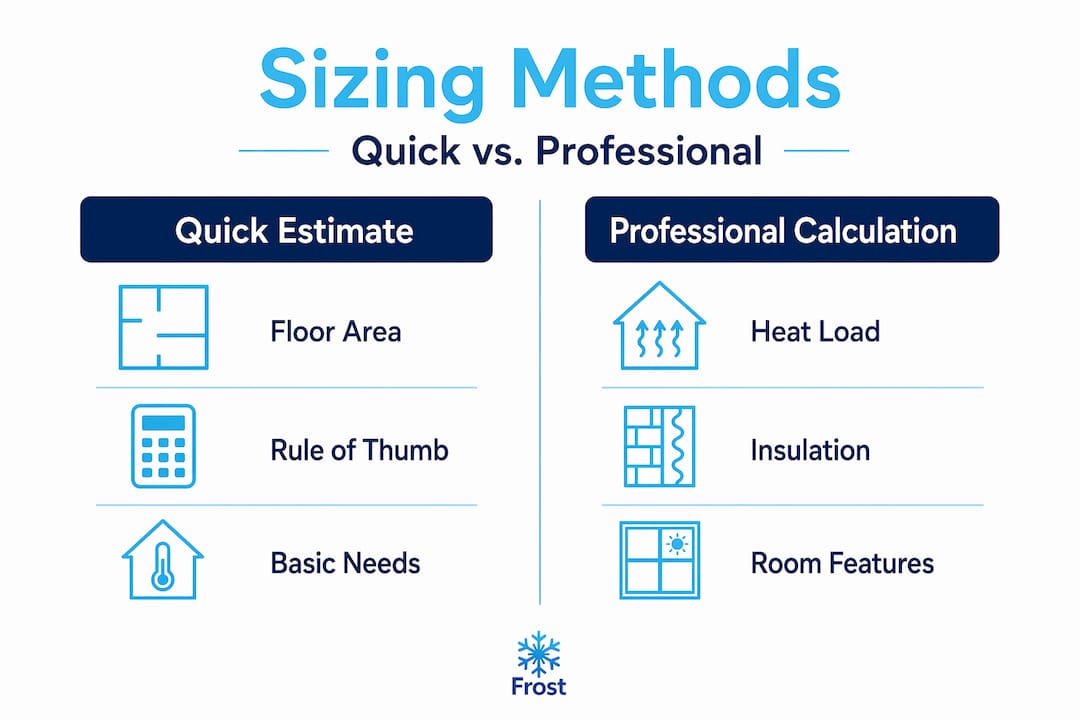
| Feature | Rule of thumb | Professional load calculation |
|---|---|---|
| Based on floor area only | Yes | No |
| Accounts for insulation quality | No | Yes |
| Considers local climate data | No | Yes |
| Room-by-room accuracy | No | Yes |
| Accounts for glazing type and orientation | No | Yes |
| Suitable for older Devon and Cornwall properties | Risky | Yes |
| Gives bankable accuracy | No | Yes |
Professional and standardised load calculation approaches used by HVAC designers include room-by-room, data-gathering methods. The gold standard is a detailed calculation based on standards such as BS EN 12831 and a fabric heat-loss and heat-gain approach. BS EN 12831 is the European standard that governs how heating and cooling loads are calculated for buildings, and any reputable installer in the south west should be working to this framework.
What does a professional assessment actually involve? Here is the process in order:
- Room measurements: Floor area, ceiling height, and the dimensions of every wall, window, and door.
- Construction data: Wall type (solid stone, cavity brick, timber frame), roof construction, floor type, and insulation levels where known.
- Glazing assessment: Window size, orientation, glazing type (single, double, triple), and any shading from trees or neighbouring buildings.
- Occupancy patterns: How many people regularly use the space, and at what times.
- Internal heat sources: Computers, televisions, kitchen appliances, and lighting all contribute to the heat load.
- Local climate data: Peak summer temperatures and humidity levels for your specific part of Devon or Cornwall.
- Calculation and output: A precise kW figure per room, on which the system specification is based.
This matters enormously for zoning by room size. A multi-room installation needs each indoor unit sized correctly for its own space. Getting bedroom sizing right, for example, has a direct and measurable impact on sleep quality and overnight running costs.
Pro Tip: Always ask your installer whether they are working to BS EN 12831 or an equivalent standard. If they cannot answer that question clearly, it is worth seeking a second opinion. Climate-led AC choices in the south west genuinely require this level of rigour.
Understanding cooling capacity and efficiency ratings
Whether you are reading a product brochure or reviewing a quote from an installer, you will see two categories of figures: cooling capacity and efficiency ratings. Both matter, but they are measuring entirely different things.
Cooling capacity is expressed in kilowatts (kW) or BTU/h (British Thermal Units per hour). One kilowatt of cooling capacity equals approximately 3,412 BTU/h. This is the figure that tells you how much heat the system can remove from a space per hour. Getting this right is the sizing question this entire guide addresses.
Efficiency ratings tell you how much electricity the unit consumes to deliver that cooling capacity. The current standard in the UK and Europe is SEER2 (Seasonal Energy Efficiency Ratio 2, the updated calculation method). A higher SEER2 number means the unit extracts more cooling from every unit of electricity it uses.
AC size should be chosen by required cooling capacity expressed in BTU/h or kW, and energy efficiency by ratings such as SEER2, rather than by the outdoor unit's physical dimensions. This distinction catches a lot of homeowners out. Buying a high-SEER2 unit that is the wrong size for your room will still leave you uncomfortable.
Key points to keep in mind:
- A well-sized unit with a moderate SEER2 rating will outperform a badly sized unit with an excellent SEER2 rating every time.
- Inverter technology, now standard in most quality systems, allows the compressor to run at variable speeds. This means a correctly sized inverter unit will modulate rather than switch on and off abruptly, dramatically improving both comfort and efficiency.
- In Devon and Cornwall, where summer temperatures rarely reach the extremes seen further south in Europe, a correctly sized inverter unit running at partial load for most of the season is far more efficient than an oversized unit cycling constantly.
- SEER2 ratings above 6.0 represent genuinely excellent seasonal performance. Many modern systems sold for UK residential use sit between 6.5 and 9.0.
Boosting AC efficiency is not just about buying the highest-rated unit. It begins with correct sizing and is supported by the right efficiency rating for your usage pattern. You can explore efficiency and comfort options in detail, and if you want to get to grips with the numbers themselves, understanding SEER2 and BTU is a great next step.
The one mistake most homeowners make with AC sizing
Here is our honest view after years of working across Devon and Cornwall's extraordinarily varied housing stock: the single biggest mistake is accepting a sizing recommendation based on what worked for a neighbour, or what an online chart suggested, without insisting on a room-specific calculation.
We understand why it happens. A neighbour in the same street has a similar house and got a 3.5 kW unit fitted. They are delighted. So you ask for the same. But their house faces north and yours faces south-west. Their lounge ceiling is 2.4 metres and yours is 2.8 metres with a large bay window. Their walls were re-plastered with insulated board and yours are original Edwardian plasterwork over solid brick. These differences are not minor. They can shift your actual load requirement by 30 to 40 per cent in either direction.
In our experience, Devon and Cornwall homes throw up more sizing surprises than almost anywhere else in the south west. Granite farmhouses with walls a metre thick behave completely differently to 1970s cavity-wall bungalows. Converted holiday lets near the coast face unique challenges from high humidity and frequent ventilation. Even within Exeter itself, the difference between a shaded north-facing flat and a top-floor flat with a south-facing Velux window can be dramatic.
The comfort and efficiency principles that underpin good AC installations always lead back to the same place: a calculation specific to your home. The investment in a proper survey is modest. The cost of living with a wrongly sized system for ten years, both in discomfort and wasted energy, is significant.
If an installer tells you they can size your system accurately without visiting the property and taking measurements, treat that as a warning sign. A genuinely good installer wants to get it right because their reputation depends on the system performing well. Our complete AC guide covers the full decision process if you want to read further before committing.
Next steps: Getting expert sizing and installation
If you are ready to avoid the comfort and efficiency traps of incorrect AC sizing, the right move is to get a professional assessment from someone who knows south west homes inside out.

At Frost Air Conditioning, we carry out detailed sizing surveys for homeowners across Devon and Cornwall, working to proper load calculation standards so your system is right first time. We are F-Gas certified, offer same-day installations where schedules allow, and provide 0% finance options so the cost of a properly specified system does not have to come out of your pocket all at once. Whether you are cooling a single bedroom or planning a whole-house multi-split installation, we size every unit individually for your specific property. Request a free quote today and let us take the guesswork out of your AC installation.
Frequently asked questions
How do I calculate the air conditioner size for my lounge or bedroom?
Multiply the room's floor area in square metres by 0.10–0.15 kW and adjust for ceiling height, poor insulation, and sun exposure, as recommended for UK homes. These figures are starting estimates, not final specifications.
What is BTU and how does it relate to AC units?
BTU stands for British Thermal Unit and measures the cooling capacity of an air conditioner per hour. AC size is chosen by cooling capacity expressed in BTU/h or kW, not by the physical size of the outdoor unit.
Do I need a professional to size my air conditioner?
For most homes in Devon and Cornwall, yes. A professional heat-load calculation accounts for your home's specific insulation, glazing, orientation, and local climate rather than relying on area alone.
What happens if my air conditioner is too big or small?
Both create problems. Oversized and undersized systems reduce comfort and efficiency: undersized units struggle to cool adequately, while oversized units waste energy and leave rooms feeling damp rather than pleasantly cool.