
Most people assume a brand-new home comes ready for air conditioning. In reality, the opposite is true. Building Regulations Part L and Part O have fundamentally changed how new UK homes manage temperature, prioritising passive design and heat pumps over energy-hungry cooling systems. If you're planning a new build in Devon or Cornwall and wondering whether to install air conditioning, the answer is more nuanced than a simple yes or no. This guide cuts through the confusion and shows you exactly what your options are, what the regulations actually mean for you, and which modern solutions deliver genuine comfort without compromising your energy rating.
Table of Contents
- Why traditional air conditioning is rare in new UK homes
- The rise of heat pumps and passive alternatives
- Planning permission and installation considerations
- Overheating risks and advanced strategies for new build homes
- Our take: Why UK new builds need smarter cooling, not more AC
- Get energy-efficient comfort for your new build
- Frequently asked questions
Key Takeaways
| Point | Details |
|---|---|
| Traditional AC discouraged | Modern UK building regulations prioritise efficiency and passive design over standard air conditioning. |
| Heat pumps lead the way | Air source heat pumps offer efficient heating, hot water, and reversible cooling for new builds. |
| Permitted development helps | Most small-scale AC and heat pump units do not require formal planning permission. |
| Design for overheating prevention | Choosing the right glazing, orientation, and insulation is crucial for managing overheating risks in new homes. |
Why traditional air conditioning is rare in new UK homes
There's a common assumption that a modern, well-built home should have air conditioning as standard. Walk around any new development in Exeter or Truro, though, and you'll rarely spot an external AC unit. That's not an oversight. It's the direct result of how UK building regulations have evolved.
Part L and Part O work together to set strict energy efficiency and overheating prevention standards for all new residential properties. Part L governs how much energy a home is permitted to consume, while Part O specifically addresses overheating risk. Together, they push developers and self-builders towards passive solutions first and mechanical cooling as a genuine last resort.
Part O introduced specific limits on glazing. South, east, and west-facing windows are typically capped at around 25 to 35 per cent of floor area, depending on the calculation method used. The logic is straightforward: limit solar gain before it becomes a problem, rather than installing energy-intensive equipment to fix it afterwards.
Here's what makes traditional AC particularly problematic under current rules:
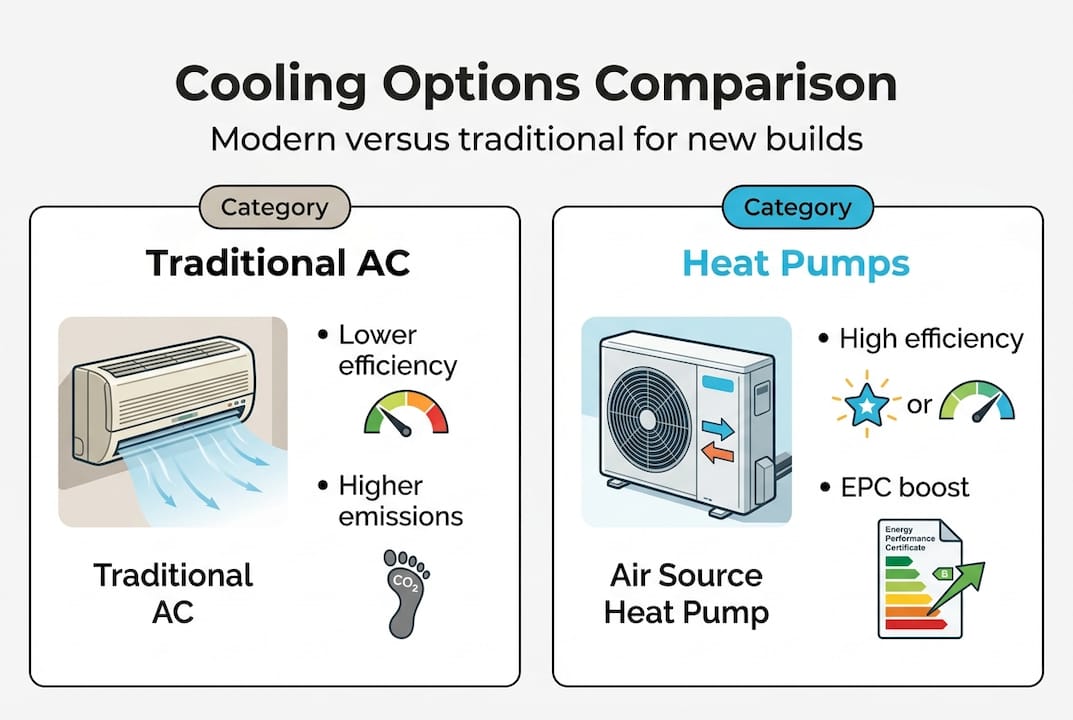
- SAP and EPC penalties: Traditional air conditioning systems consume significant electricity, which drags down your home's Standard Assessment Procedure (SAP) score and therefore its Energy Performance Certificate (EPC) rating.
- Regulatory hierarchy: Regulations require passive measures to be exhausted before mechanical cooling is even considered.
- Carbon targets: New builds must meet increasingly tight carbon emission limits, and conventional AC works against those targets.
- Developer liability: Housebuilders face compliance checks, so they avoid specifying systems that create regulatory risk.
"Part O introduces overheating prevention measures that make passive design the foundation of any new build, with mechanical cooling treated as a supplementary option rather than a primary solution."
For homeowners in the South West, this matters because Cornwall and Devon properties often feature large glazed areas to capture sea views and natural light. That glazing, combined with the region's increasingly warm summers, creates real overheating pressure. Understanding the regulatory framework helps you make smarter choices from the outset rather than retrofitting solutions later at greater cost.
The good news is that energy-efficient air conditioning technology has advanced considerably, and there are compliant, effective options available if you know where to look.
The rise of heat pumps and passive alternatives
With traditional AC discouraged by regulation, the industry has moved decisively towards air source heat pumps (ASHPs) and integrated passive design. For new build homeowners in Devon and Cornwall, this shift is actually excellent news.
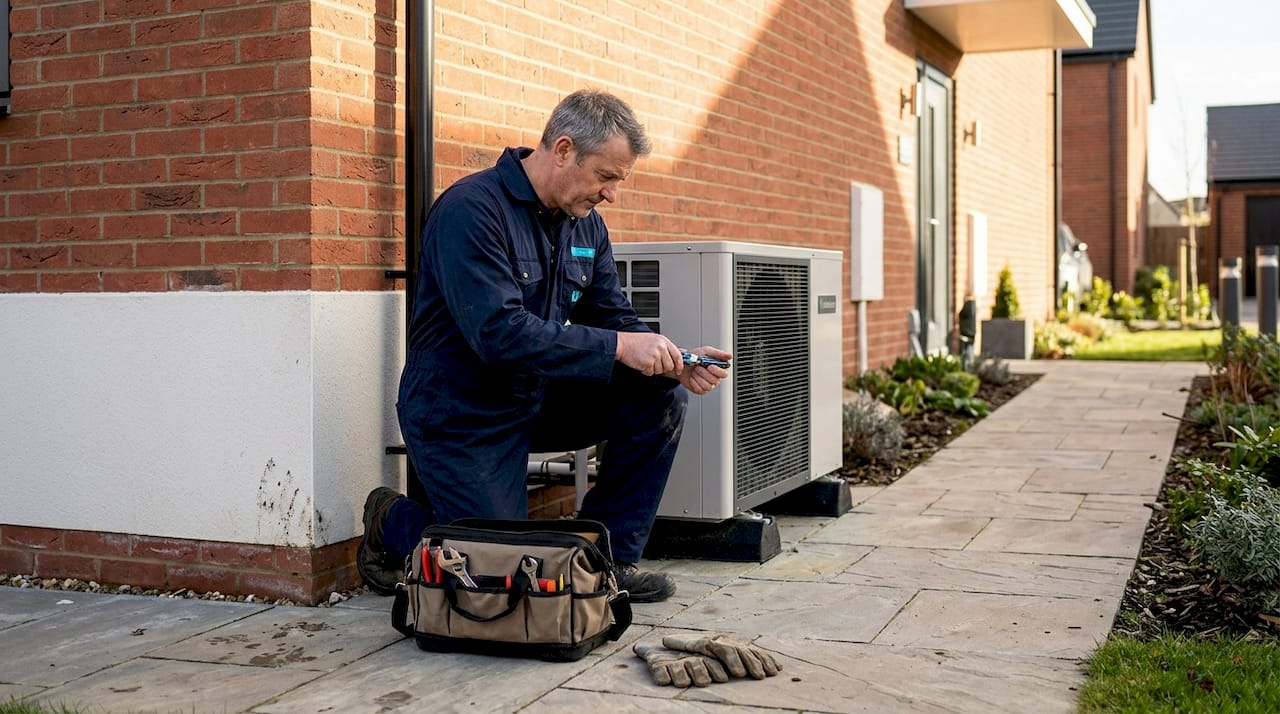
An ASHP is a single system that provides heating, hot water, and reversible cooling. In summer, it runs in reverse to extract heat from your home and expel it outside, functioning as an air conditioning system. In winter, it extracts heat from outdoor air and brings it inside. One unit, year-round comfort.
ASHPs in new builds are eligible for the Boiler Upgrade Scheme grant of £7,500, which significantly reduces the upfront cost. Annual heating costs for a typical three-bedroom home run at approximately £590, compared to considerably more for gas-heated equivalents.
Key advantages of ASHPs over traditional AC:
- Coefficient of Performance (COP) of 3 or higher: For every unit of electricity consumed, an ASHP delivers three or more units of heating or cooling energy.
- Dual function: Heating and cooling from one system, reducing installation complexity.
- Underfloor heating compatibility: ASHPs work particularly well with underfloor heating (UFH), which is common in new builds.
- Grant eligibility: The £7,500 Boiler Upgrade Scheme grant applies in 2026, making the economics far more attractive.
- EPC benefits: ASHPs improve rather than damage your home's energy rating.
| System | Typical efficiency | EPC impact | Grant available |
|---|---|---|---|
| Traditional AC | SEER 3 to 5 | Negative | No |
| Air source heat pump | COP 3 to 4.5 | Positive | Yes (£7,500) |
| Passive design only | N/A | Very positive | N/A |
Passive solutions should always come first. Cross ventilation (positioning windows on opposite sides of a room), external shading such as brise soleil or deep overhangs, and high-quality insulation can reduce internal temperatures by several degrees without any running costs at all. In Devon and Cornwall's climate, a well-designed passive strategy handles the majority of warm days comfortably.
Pro Tip: If you're specifying your new build from scratch, ask your architect to run an overheating assessment using Part L efficiency standards before finalising window sizes. Catching solar gain issues at design stage costs nothing. Fixing them after completion costs a great deal.
For those who want the best of both worlds, modern cooling solutions that combine passive design with a reversible ASHP deliver superior comfort, lower bills, and full regulatory compliance.
Planning permission and installation considerations
Once you've chosen your system, the practical question is how to install it correctly. The good news for most homeowners is that the planning rules are more straightforward than many expect.
Most domestic AC and heat pump units do not require planning permission, provided they fall within permitted development limits. The key criteria are:
- Unit volume: The external unit must not exceed 0.6 cubic metres for AC or 1.5 cubic metres for heat pumps.
- Boundary distance: The unit must be positioned more than one metre from any property boundary.
- Not on a wall or roof facing a highway: Units visible from the street may require permission.
- Listed buildings and conservation areas: These require separate consent regardless of size.
- Flats: Permitted development rights often do not apply to flats, so check with your local planning authority before proceeding.
Beyond planning, you also need to consider installation legal requirements under Part P (electrical safety) and Part L (energy efficiency). Any electrical work must be carried out by a qualified electrician or notified to your local building control authority. Refrigerant handling requires an F-Gas certified engineer, which is a legal requirement, not a recommendation.
Pro Tip: For new builds specifically, coordinate your AC or heat pump installation with the main contractor during the build phase rather than after completion. Running pipework and electrical cabling during construction is significantly cheaper and less disruptive than cutting into finished walls.
For houses in Devon and Cornwall, the process is generally smooth. Flats, particularly in coastal developments, require more careful planning. Always check whether your development has any additional covenants or management company rules that restrict external equipment.
Our installation guidance covers the full process from site survey to commissioning, ensuring your system is compliant and optimised from day one.
Overheating risks and advanced strategies for new build homes
Not all new builds face the same overheating risk. Understanding which properties are most vulnerable helps you prioritise the right solutions.
West-facing glazing, single-aspect flats, and highly insulated designs carry the highest overheating risk. The irony is that the features that make a new build energy-efficient in winter, such as high levels of insulation and airtightness, also trap heat in summer. A well-insulated home that warms up slowly in spring can become uncomfortably hot by July and struggle to cool down overnight.
Properties most at risk:
- Single-aspect flats: No cross ventilation possible, heat accumulates rapidly.
- West-facing living rooms: Afternoon sun creates intense solar gain during the hottest part of the day.
- Top-floor apartments: Heat rises, roof absorbs solar radiation, and there's no upstairs neighbour to buffer the effect.
- Highly airtight homes: Excellent for winter efficiency but can trap heat without mechanical ventilation assistance.
| Property type | Overheating risk | Recommended strategy |
|---|---|---|
| Detached house, mixed aspect | Low to medium | Passive design, ASHP cooling |
| Single-aspect flat, west-facing | High | Mechanical ventilation, ASHP |
| Top-floor apartment | High | External shading, ASHP essential |
| Semi-detached, south-facing | Medium | Shading, cross ventilation, ASHP |
Advanced strategies for high-risk properties include mechanical ventilation with heat recovery (MVHR), which provides controlled air exchange without opening windows, and phase-change materials in walls that absorb heat during the day and release it at night.
"Traditional AC installed without addressing the root cause of solar gain simply moves the problem rather than solving it, and at significant ongoing energy cost."
For overheating risk management in your specific property, a professional assessment is worth every penny. Getting it right at the design stage avoids expensive remedial work later.
Our take: Why UK new builds need smarter cooling, not more AC
We install air conditioning systems across Devon and Cornwall every week, and we'll be honest with you: the biggest mistake we see is homeowners copying what they've seen abroad. A villa in Spain or an apartment in Florida runs AC continuously because the climate and building standards demand it. A new build in Exeter or Falmouth is a fundamentally different proposition.
UK new builds are built to trap heat in winter. That same quality becomes a liability in summer if you haven't addressed solar gain at the design stage. Installing a powerful AC unit to compensate for poor passive design is expensive, energy-wasteful, and increasingly penalised by regulations.
The smarter approach combines thoughtful passive design with a reversible ASHP for the days when passive measures aren't enough. This delivers genuine comfort, keeps your EPC rating strong, and positions your home well for future energy standards that will only tighten further.
We've also seen homeowners over-specify AC systems, paying for capacity they'll use on perhaps ten days a year. A well-designed balanced climate control strategy costs less upfront, costs less to run, and delivers better results across the full year.
Get energy-efficient comfort for your new build
Planning climate control for a new build in Devon or Cornwall doesn't have to be complicated. At Frost Air Conditioning, we specialise in regulation-compliant, energy-efficient solutions for new build homeowners across the South West. We're F-Gas certified, offer 0% finance options, and can arrange same-day installations when your schedule demands it.

Whether you need a reversible heat pump system, a discreet split AC unit, or simply want expert advice on what your new build actually needs, we're ready to help. Our team understands the local planning landscape and the specific overheating challenges that Devon and Cornwall properties face. Explore our air conditioning services or request a free quote today and get a solution built around your home, not a generic one-size-fits-all package.
Frequently asked questions
Do I need planning permission for air conditioning in a new build?
Most domestic air conditioning or heat pump units do not need planning permission if they meet size and distance requirements. Units under permitted development must be under 0.6 to 1.5 cubic metres and positioned more than one metre from the boundary.
Are traditional air conditioning units allowed in new UK homes?
Traditional AC is not banned but is actively discouraged by regulations and can lower your home's EPC rating. Part O regulations treat mechanical cooling as a last resort, meaning passive solutions must be considered first.
What is the most efficient way to cool a new build home?
A combination of passive design and a reversible air source heat pump is the most efficient and regulation-friendly method. ASHPs outperform traditional AC in efficiency and work alongside passive measures for the best results.
How much does installing air conditioning or a heat pump in a new build cost?
A full ASHP system typically costs £8,000 to £14,000 before grant deductions, with running costs around 35% lower than gas heating. The Boiler Upgrade Scheme provides a £7,500 grant, bringing annual heating costs for a three-bedroom home to approximately £590.