
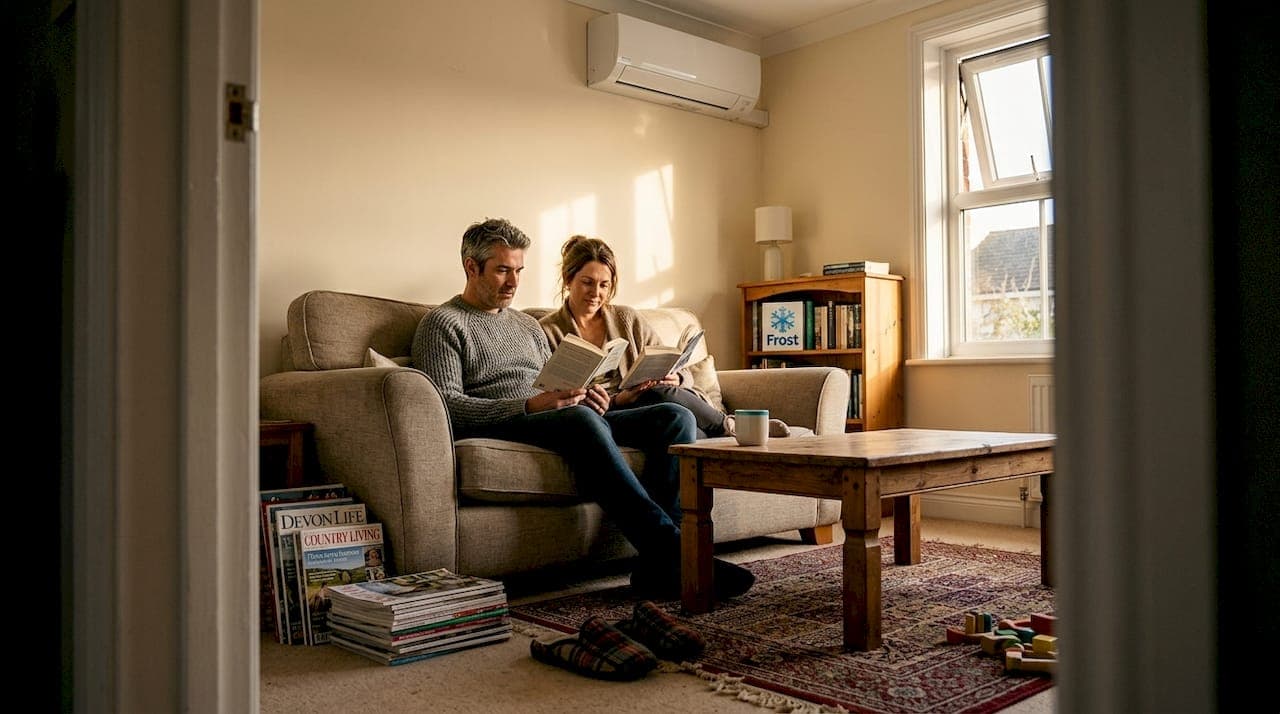
Summer in Devon and Cornwall is getting warmer. The Met Office confirms that UK temperatures are rising, and homeowners across the South West are feeling it. Yet many still assume domestic air conditioning is only for hot countries or commercial buildings. That assumption is costing people comfort, sleep, and money. This article cuts through the confusion and gives you a clear picture of what domestic air conditioning involves, which systems suit South West homes, what it costs to install, how to finance it, and how it stacks up against traditional heating. Whether you are sweating through August or struggling to heat a draughty cottage in January, there is a practical solution worth knowing about.
Table of Contents
- The basics of domestic air conditioning
- Types of domestic air conditioning systems for UK homes
- Installation and running costs in Devon and Cornwall
- Financing and grants for domestic air conditioning
- Comparing domestic air conditioning to traditional heating
- A fresh perspective: what most homeowners miss about domestic air conditioning
- Discover air conditioning solutions for your home
- Frequently asked questions
Key Takeaways
| Point | Details |
|---|---|
| Split systems are best | Wall-mounted split AC units offer the highest efficiency and comfort for UK homes. |
| Local grants possible | Reversible systems may qualify for grants in Devon and Cornwall, reducing upfront costs. |
| Professional installation required | Always use certified installers to ensure safety, performance, and warranty protection. |
| Running costs vary | Air conditioning uses more electricity than gas heating but is ideal for comfort and zoned use. |
| Climate trend driving demand | Rising UK temperatures are making domestic air conditioning increasingly attractive. |
The basics of domestic air conditioning
Domestic air conditioning has come a long way since its early days. The first residential system was installed in 1914, and the technology has been refined ever since into something genuinely suited to British homes. At its core, domestic air conditioning refers to residential systems that cool and often heat indoor spaces by removing heat and humidity using a refrigeration cycle.
Here is the part most people do not realise: modern AC does not just cool. Most domestic systems work as reversible heat pumps, meaning they can warm your home in winter just as efficiently as they cool it in summer. That makes them a year-round comfort tool, not a seasonal luxury.
Why is AC growing in the UK? Several factors are combining at once:
- Summers in Devon and Cornwall are regularly hitting 28°C or higher
- Older homes were built without ventilation for heat management
- Energy-efficient systems now cost far less to run than older models
- Reversible systems can replace or supplement gas boilers
- Remote-controlled and smart systems make management simple
"Domestic air conditioning is no longer a novelty in British homes. Climate change and rising comfort expectations mean it is fast becoming a practical necessity, especially in regions like the South West."
For Devon and Cornwall homeowners, the appeal is obvious. The region's combination of mild winters and increasingly hot summers makes a reversible AC system genuinely useful across twelve months, not just in a heatwave. Understanding the basics gives you the foundation to make a confident choice about the right system for your property.
Types of domestic air conditioning systems for UK homes
Choosing the right type of system matters more than most people think. The wrong choice can mean excessive noise, poor efficiency, or a unit that simply cannot handle the size of your rooms. Here is a clear comparison of the main options:
| System type | Best for | Noise level | Typical installed cost |
|---|---|---|---|
| Wall-mounted split | Single rooms, most homes | Very quiet (20-40dB) | £1,800 to £3,500 |
| Multi-split | Multiple rooms, one outdoor unit | Quiet (25-45dB) | £3,000 to £6,000 |
| Portable unit | Small rooms, rented properties | Louder (50-60dB) | £300 to £700 |
| Ducted system | Whole-home, hidden installation | Very quiet | £6,000 to £15,000 |
Common types in British homes include wall-mounted split systems, multi-split systems, portable units, and ducted setups. Among these, split systems are most popular because they balance efficiency, noise, and cost effectively.
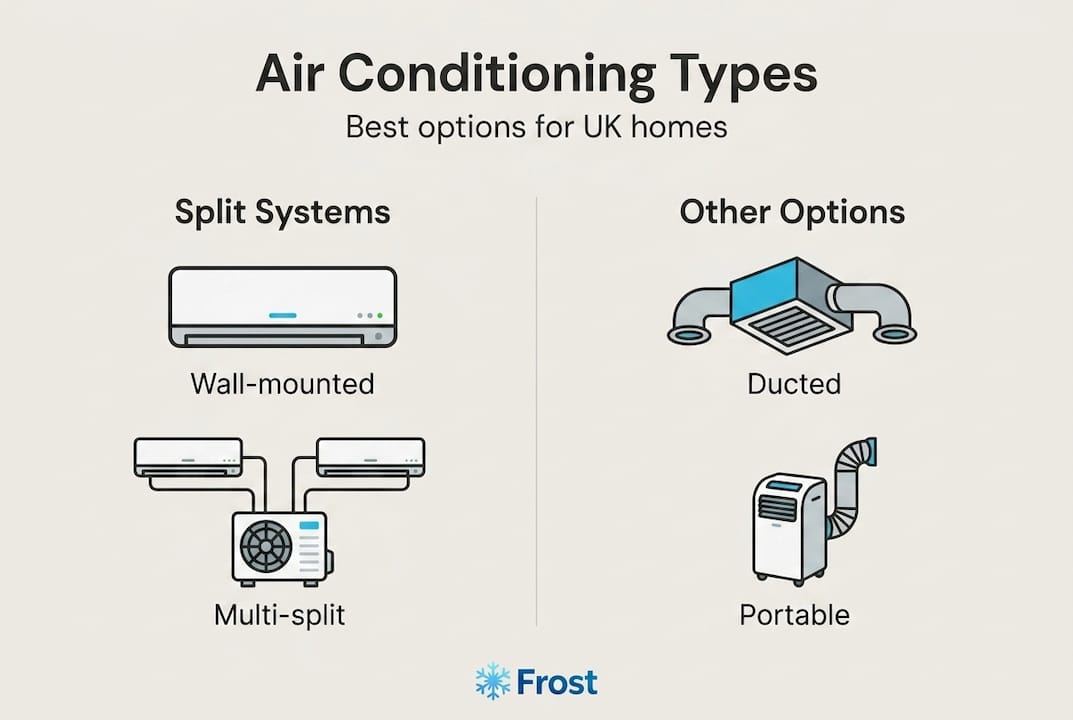
For most Devon and Cornwall homes, a wall-mounted split system is the standout choice. It consists of one indoor unit and one outdoor unit, connected by refrigerant pipework. The indoor unit is whisper-quiet, the outdoor unit is compact, and the system qualifies for several financing options. If you want to condition multiple rooms, a multi-split system uses one outdoor unit connected to several indoor units, keeping external clutter to a minimum.
Portable units are sometimes tempting because of their lower upfront price, but they come with real drawbacks. They are significantly louder, less efficient, and require an exhaust hose vented through a window or wall. They work for a small bedroom or study, but struggle in anything larger.
Ducted systems hide all pipework and vents inside your walls and ceiling, giving a seamless finish. They are fantastic but involve significant installation work and a higher budget. They suit new builds or major renovations better than a typical terraced home in Exeter or a cottage near Padstow.
- Split systems: best efficiency-to-cost ratio for most homes
- Multi-split: ideal if you want multiple rooms served by one outdoor unit
- Portable: acceptable for rooms up to 30m², but noisy
- Ducted: premium whole-home solution requiring more disruption
Pro Tip: If you are financing your install through available financing schemes, a wall-mounted split system will give you the lowest monthly cost relative to the comfort gain. It is the smart starting point for most South West homes.
Installation and running costs in Devon and Cornwall
Knowing your system type is only half the picture. You also need to understand what installation actually involves and what it will cost to run over time.
First, a critical point: any engineer who installs, services, or removes refrigerant-based equipment in the UK must hold an F-Gas certification. This is a legal requirement, not an optional credential. Always confirm your installer is certified before agreeing to any work.
Installation costs for a single split system in the UK typically range from £1,800 to £4,500, including the unit and labour. The variation depends on the brand, the complexity of the install, wall thickness, and how far the indoor and outdoor units need to be apart. In Devon and Cornwall, pricing is broadly in line with national averages, though rural locations may incur a small additional travel charge.
| Cost component | Typical range |
|---|---|
| Indoor and outdoor unit | £600 to £2,000 |
| Installation labour | £400 to £800 |
| Pipework and fittings | £200 to £500 |
| Electrical connection | £150 to £400 |
| Total single split | £1,800 to £4,500 |
Running costs depend heavily on the system's energy efficiency rating and how often you use it. A well-rated split system cooling a 20m² room typically costs around £0.10 to £0.15 per hour to run, making it far cheaper than running a fan heater in reverse.
Here is how to arrange an installation with Devon and Cornwall AC installers:
- Identify the rooms you want to condition and measure them
- Decide between a single split or multi-split system based on your needs
- Get a qualified, F-Gas certified engineer to survey your property
- Review the quote including unit cost, labour, pipework, and electrical work
- Confirm the installation date, noting that same-day installs are often available
- After installation, register your unit warranty and keep your F-Gas certificate
Same-day installation is genuinely possible for straightforward single-room splits, which means you could go from enquiry to cool air in your living room within 24 hours.
Financing and grants for domestic air conditioning
The upfront cost of AC puts some homeowners off. That is understandable, but there are real options available to spread or reduce the cost significantly.
On the grants side, there is no specific government grant exclusively for air conditioning. However, reversible systems, those that both heat and cool, can qualify under broader energy efficiency schemes:
- Boiler Upgrade Scheme: Offers £7,500 towards an air source heat pump. If your reversible AC system qualifies as a heat pump under the scheme's criteria, this is a significant saving
- Warm Homes Local Grant: Available in Devon for households with an income below a set threshold and an EPC rating of D or below. It covers air source heat pumps and insulation improvements
- ECO4 scheme: For low-income households, this can fund heat pump installation alongside insulation measures
- 0% finance: Some installers offer interest-free credit, meaning you pay for your system monthly with no added interest
Current grant options include the Boiler Upgrade Scheme at £7,500 for eligible heat pumps and the Warm Homes Local Grant for low-income EPC D or below homes, covering heat pumps and insulation. Neither grant is automatic, so eligibility must be checked carefully.
Pro Tip: Many homeowners miss out on the Warm Homes Local Grant simply because they assume they will not qualify. If your property has an EPC rating of D or lower and your household income is below the threshold, you may well be eligible. Check financing options for AC with your installer before assuming grants are out of reach.
For homeowners who do not qualify for grants, 0% finance makes the investment accessible without straining your savings. Spreading £2,500 over 24 months interest-free is far more manageable than paying upfront.
Comparing domestic air conditioning to traditional heating
Many Devon and Cornwall homeowners already have a gas boiler or are considering an air-to-water heat pump. How does domestic air conditioning compare?
Air-to-air heat pumps, which is what most reversible split systems effectively are, produce lower carbon emissions than gas boilers and cause far less installation disruption than air-to-water systems, which require radiators or underfloor heating to be replaced or upgraded.
Here is how the options stack up:
- Gas boiler: Familiar, cheap to install, but carbon-heavy and dependent on gas prices
- Air-to-water heat pump: Low carbon but requires significant plumbing work and higher upfront cost
- Reversible air-to-air AC: Low carbon, fast to install, provides both heating and cooling, but does not replace radiators
- Portable AC: Convenient but noisy, inefficient, and unsuitable for larger rooms
On efficiency, a modern split system can deliver three units of heat for every one unit of electricity it consumes. That efficiency ratio, known as the coefficient of performance (COP), makes it far cheaper to heat a room with a reversible split than with an electric panel heater.
"Air-to-air heat pumps offer a compelling combination of low carbon output and fast installation, making them one of the more practical upgrades for UK homes that are not suited to air-to-water systems."
For homes in Devon and Cornwall with solid walls, older radiator systems, or limited outdoor space, the reversible split system is often the most realistic low-carbon upgrade available right now.
A fresh perspective: what most homeowners miss about domestic air conditioning
Here is what we see time and again from installs across Devon and Cornwall: homeowners focus almost entirely on price and forget about noise ratings. A unit with a slightly higher price but a noise output of 20dB will serve you far better than a budget model running at 45dB in your bedroom. Quietness is not a luxury feature. It is fundamental to whether you actually use the system.
We also see homeowners dismiss reversible systems because they already have a boiler. That thinking costs them money. A reversible split used for heating in shoulder seasons (spring and autumn) can cut your gas usage noticeably because it is so efficient at mild outdoor temperatures.
As UK AC adoption grows alongside climate change, portable units are becoming the most commonly regretted purchase. They are loud, inefficient, and awkward to use. We have never had a customer switch from a split system to a portable. It always goes the other way.
On grants, the eligibility confusion is real. Many people assume the Boiler Upgrade Scheme is only for boiler replacements. It is not. Speak to a certified local installer before writing off grant support entirely.
Discover air conditioning solutions for your home
If this article has helped you understand your options, the next step is getting a clear picture of what a system would cost and look like in your specific home.
As AC installation experts based in Exeter, we cover the whole of Devon and Cornwall with F-Gas certified engineers, same-day installations, and 0% finance options that make quality air conditioning genuinely accessible. Whether you want a single split for your living room or a multi-split for your whole home, we can survey, advise, and install quickly. Get a quote today and find out exactly what a professionally installed system would cost for your property.
Frequently asked questions
What is the most efficient domestic air conditioning system for UK homes?
Split systems are preferred for efficiency and quietness, making them the best choice for the majority of British homes, including properties in Devon and Cornwall.
Can I get a grant to install domestic air conditioning in Devon or Cornwall?
There is no grant specifically for air conditioning, but reversible systems may qualify under the Boiler Upgrade Scheme at £7,500 or the Warm Homes Local Grant for eligible low-income households with EPC ratings of D or below.
Are portable air conditioners good for larger rooms?
Portable units are best suited to rooms up to 30m² and are notably louder and less efficient than wall-mounted split systems.
What is the typical installation cost for domestic AC in Devon?
A single split installation typically costs between £1,800 and £4,500, covering the unit, labour, pipework, and electrical connection.
Does air conditioning also heat my home?
Yes. Most modern domestic AC systems include a reversible cycle, meaning they can heat your home in winter and cool it in summer using the same unit.