
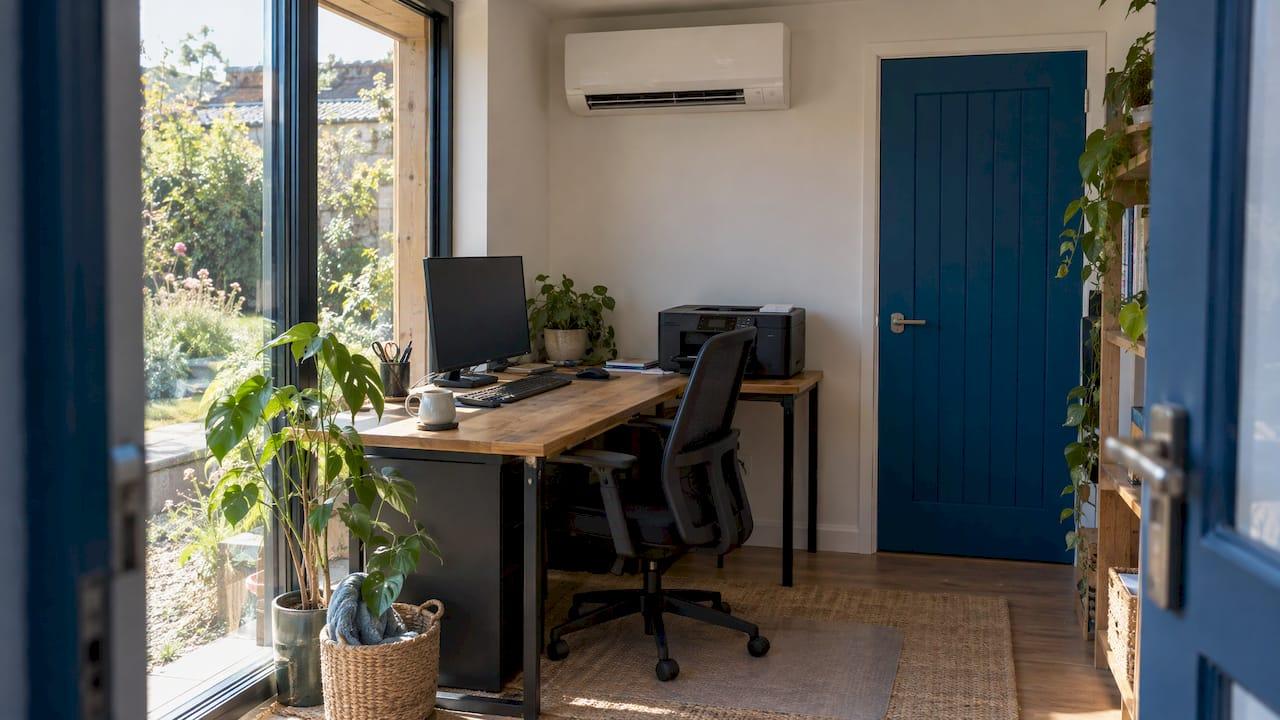
For a small office or a home office, the most dependable way to cool the room is a fitted wall-mounted split air conditioning system, sized to the room and installed by an F-Gas certified engineer. It cools quietly, costs less per hour to run than a plug-in unit, and can heat the room in winter too. We install these systems across Devon, Cornwall and the wider South West, and this guide explains what to check, what it costs and how the job goes, so you can decide with the facts in front of you.
TL;DR
- A fitted split system is the long-term answer for a small office: quiet, efficient and installed once, with no hose or window kit.
- Selectra's 2026 guide puts a fitted single split at £1,500 to £3,000 installed, and about 15p to 20p an hour to run.
- Getting the capacity right matters: too small and the unit never catches up, too large and it cycles on and off and leaves the air clammy.
- Shading the windows and setting the thermostat sensibly lets the system do its job with less effort.
- We offer free surveys, 0% finance and same-day or next-day installs where available, with local engineers and no subcontractors.
Table of Contents
- Why small offices get so hot
- What a split system does in a small office
- What it costs to install and run
- Getting the size right
- Cut the heat coming in, so the system works less
- What to check before you install in Devon or Cornwall
- How the job goes with us
- Home office or commercial unit?
- Ready to cool your office
- Our view: install once, get it right
- FAQ
- Sources
Why small offices get so hot
A small office is usually a small room with a lot going on in it. Sun comes through the glass, a computer, monitor and printer add heat, and one or two people add more. In a spare bedroom, loft conversion or garden room, the roof and large windows make it worse.
The comfort numbers are worth knowing. CIBSE, the professional body for building services engineers, notes in its workplace temperature guidance that indoor temperatures above 28°C for long periods increase dissatisfaction and reduce productivity. That is the kind of afternoon a south-facing room in Exeter or Truro can reach in a hot spell, and it is when a fan stops being enough and a proper cooling system earns its place.
The government's Energy Efficiency for Businesses campaign suggests setting cooling at 24°C or higher. That is a useful target for a working room: cool enough to concentrate, without running the system harder than it needs to.
What a split system does in a small office
A split system has two parts. An indoor unit, usually wall-mounted, sits in the office. A slim outdoor unit sits outside, joined to it by a small pipe run through the wall. There is no hose to vent out of a window and no tank to empty.
An air conditioner is a heat pump. Selectra explains that it moves roughly three units of heat for every unit of electricity it uses, which is why a fitted split costs about half as much per hour to run as a plug-in portable doing the same job. A portable fights its own warm exhaust, while a split moves the heat outside through the wall.
There are three practical benefits for a small office:
- Quiet running. The compressor is outdoors, so the noise in the room is low enough for calls and video meetings.
- Nothing on the floor or in the window. The indoor unit is on the wall, so your desk space and your window stay your own.
- Winter heating. A split also works as a heat pump in cold weather, so the same system heats the room as well as cooling it, as the Selectra guide notes.
If you would like the longer case for this type of system, our article on the advantages of split AC systems for UK homes goes through it in detail.
What it costs to install and run
Here are the published ranges for a single room, from an independent UK energy guide:
| Fitted split system | |
|---|---|
| Installed cost, single room | £1,500 to £3,000 |
| Typical running cost | About 15p to 20p per hour |
| Heating in winter | Yes, it works as a heat pump |
These figures come from Selectra's June 2026 guide. Your own price depends on the brand, the capacity, how far the outdoor unit sits from the indoor one, and how easy the wall and electrics are to work with. We give a firm figure after a free survey, and we offer 0% finance so the cost can be spread rather than paid in one go.
A running cost per hour is a guide, not a bill. Electricity prices change on a schedule, and the real cost depends on how many hours you use the system and the temperature you set. Our guide to air conditioner running costs shows how to estimate your own figure from the unit's power use and your tariff, and how to bring it down. If your main question is whether the outlay is sensible, is air conditioning expensive? sets out what to budget.
For a home office used for work, the room is often occupied for eight or nine hours on the hottest days, which is exactly when the efficiency of a split matters most. The same is true of a small commercial office, though if you are fitting out several rooms or a larger floor, the budgets are different. For that, see our piece on commercial air conditioning costs.
Getting the size right
Capacity is the part most people guess, and it is where a survey pays for itself. Selectra's sizing guidance makes the basic point plainly: an undersized unit runs flat out and never gets the room cool, while an oversized one switches on and off in short bursts and leaves the air feeling clammy. It also adds roughly 10% to the figure for a sunny room.
Floor area is only the starting point. What actually decides the right unit for a small office is:
- Sun. A west-facing room with a large window gains far more heat than a north-facing one of the same size.
- Equipment. Two monitors, a desktop computer, a printer and a server cabinet all give off heat.
- People. A one-person home office and a four-desk studio are very different jobs.
- Room type. A garden room or loft conversion with thin insulation heats faster than a brick-walled spare room.
- Glazing. CIBSE's TM59 lead author has pointed to large areas of glazing as a key cause of solar heat gain, as reported in CIBSE Journal.
We look at all of these on a free survey, which is a better basis for choosing a unit than a rule of thumb. If your office is part of a larger premises, our guide to office air conditioning design by area covers how systems are laid out as the space grows.
Cut the heat coming in, so the system works less
A good cooling system works best in a room that is not being baked by the sun. Shading is the easiest way to help it. The RIBA Journal's retrofit guidance states that shading is by far the most effective passive way to reduce overheating, and that external shading is significantly more effective than internal.

CIBSE's heatwave advice is to close blinds on south-, east- and west-facing windows during the hottest periods. Doing this before the room warms up means the air conditioner starts from a lower point and holds the temperature with less effort.
Two habits go well with a split system:
- Close the blinds on the sunny side before the room heats up, then leave the system to hold a steady temperature.
- Keep doors and windows closed while the system is running, so you are not cooling the outdoors.
Our article on natural ventilation and air conditioning together explains how to combine both through the year, opening windows on mild days and using the system on the hottest ones.
What to check before you install in Devon or Cornwall
Here is a short list for a small office at home or in a small commercial unit in the South West.
1. Where the outdoor unit will go. It needs a clear spot on an outside wall or on a bracket, with room for airflow and a short route for the pipework to the indoor unit. A shorter pipe run generally means a simpler job. In terraced streets and tight Exeter courtyards, think about how close it will sit to a neighbour's window.
2. Whether you own the building. If you rent the property or the office is in a flat or a shared building, you will need the landlord's or freeholder's agreement before anything is fixed to a wall. Listed buildings and conservation areas, which are common across Devon and Cornwall's older towns and villages, can have extra rules about external changes, so check with your local council first.
3. Planning for a home installation. In England, permitted development rules for air source heat pumps on homes set limits on the number of units, their size and where they can go. The rules in Class G of the General Permitted Development Order apply to units that are not used solely for cooling, and they include limits on compressor volume and a ban on pitched-roof mounting. Your local planning authority can tell you how they apply to your home. Cornwall Council and Devon's district councils each handle this for their own areas.
4. The electrical supply. The system needs a suitable supply and protection. This is part of the installation, and it is far easier to plan at survey stage than to discover on the day.
5. Who is doing the work. Air conditioning contains refrigerant gas, and handling it legally requires F-Gas certification. We are F-Gas certified and REFCOM registered, and our engineers are local with no subcontractors, so the person who surveys your room is the same kind of engineer who fits the system.
6. What happens after. Filters need cleaning and the system benefits from regular servicing. An annual service contract keeps it running well, and if something does go wrong in a heatwave, emergency breakdown response matters. We cover both on our service and maintenance page.
How the job goes with us
For a small office the process is short.
- Free survey. We look at the room, the sun, the equipment, the wall and the best position for both units.
- Design and quote. We recommend a system from Samsung, Mitsubishi, Toshiba or Daikin to suit the room, and give you the price for it, with 0% finance available.
- Installation. Installs are typically completed within one to two days, and same-day or next-day installation is available where the schedule allows.
- Handover and servicing. We set you up to use the system, and you can add an annual service contract so it stays in good order.
For most home offices, that is a single visit to survey and one or two days on site, which is a good deal less disruption than most people expect.
Home office or commercial unit?
The right route depends on the room. If the office is in your house, a domestic installation is usually what you need, and our home office air conditioning guide for remote workers covers single-room systems in detail. If it is a small shop, studio or business premises, the commercial route makes more sense. Our article on the role of AC in offices explains how workplaces use it, and for a small room in a modest home, air conditioning for small homes shows which sizes tend to suit.
Ready to cool your office
If you work from a spare room, garden room or small unit in Devon or Cornwall, the next step is a free survey. We will look at the space, recommend a system and give you a clear quote, with 0% finance if you would rather spread the cost. Our domestic installation page covers homes and home offices, and shop fitting and commercial covers business premises. Our engineers are F-Gas certified and REFCOM registered.
We also fit systems from Samsung, Mitsubishi, Toshiba and Daikin, and you can see the range on our main site.
Our view: install once, get it right
Most of the small offices we are asked about have the same story. The room was fine in spring, then a warm week arrived and the desk became unbearable by lunchtime. The sensible answer is a fitted system that is sized for that exact room.
We believe in a proper survey first, because the right unit depends on the window, the equipment and the people in the room, not just the floor area. A split system installed by local, F-Gas certified engineers is quiet, efficient and works year-round as both cooling and heating.
Our installs are typically done in one to two days, with no subcontractors, so the engineer who surveys is the engineer who knows the job. With 0% finance and same-day or next-day installs where available, there is little reason to spend another summer struggling in a hot room.
James
FAQ
How much does it cost to cool a small office with air conditioning?
Selectra's 2026 guide puts a fitted single-room split system at £1,500 to £3,000 installed. Your own quote depends on the brand, capacity and the pipe route. We give a firm price after a free survey, and 0% finance is available.
Can one split system heat the office as well as cool it?
Yes. A split system works as a heat pump, so the same unit can cool in summer and warm the room in winter. That makes it useful all year for a home office rather than only on hot days.
What temperature should I set a small office to?
The government's Energy Efficiency for Businesses campaign suggests setting cooling at 24°C or higher. A steady setting with the blinds closed on sunny windows is easier on the system than repeatedly dropping the temperature by large amounts.
Does air conditioning need regular servicing?
Yes, filters need cleaning and the system works best when it is serviced regularly. We offer annual service contracts and emergency breakdown response across Devon, Cornwall and the South West.
Who can legally install air conditioning?
Anyone handling refrigerant gas must hold F-Gas certification. Our engineers are F-Gas certified and REFCOM registered, and we use local engineers rather than subcontractors.
Sources
- Selectra: Air Conditioning Units UK 2026
- CIBSE Top Tips 8: Temperature in Indoor Workplaces
- Energy Efficiency for Businesses campaign
- CIBSE Journal: TM59, stress testing homes for overheating
- RIBA Journal: Retrofit your building to combat overheating
- CIBSE: How to keep your space cool during a heatwave
- Town and Country Planning (General Permitted Development) Order, Class G