

Typical domestic air conditioner running costs sit between roughly 17p and £1.23 per hour, depending on unit size and your electricity tariff. That wide range narrows fast once you know three numbers: your unit's rated wattage, its duty cycle, and what you pay per kWh. The formula is simple:
Running cost equals power in kW times duty cycle times hours used, multiplied by your tariff in pence per kWh
A 1.5 kW wall-mounted split running at a 60% duty cycle for 6 hours costs roughly (1.5 × 0.6 × 6) × 24p = about one pound and thirty pence per day, or roughly thirty to forty pounds per month at that usage. Heatable's UK-focused guide puts the hourly range at 17p for a small unit up to £1.23 for a larger system, using Ofgem-referenced rates. The Ofgem energy price cap sets the unit rate most households pay, so your actual bill may differ if you're on a fixed or time-of-use tariff.
- Typical small split units cost a few pence to a quarter of a pound per hour
- Mid-size splits cost between about thirty and fifty pence per hour
- Larger or portable units cost more, up to about one pound per hour
- Duty cycle for a well-matched unit is generally between half and four-fifths of rated load in real use
Key takeaways
Running costs for a domestic air conditioner depend far more on duty cycle, setpoint, and maintenance than on the unit's rated wattage alone.
| Point | Details |
|---|---|
| Use the formula | Running cost = kW × duty cycle × hours × p/kWh; apply your actual tariff, not a national average. |
| Duty cycle dominates | Real-world costs are typically 30%–50% lower than full-load wattage suggests, because the compressor runs at partial load most of the time. |
| Setpoint is the easiest saving | Raising the setpoint from 20°C to 24°C can reduce monthly costs by £12–£18 with no equipment change. |
| Annual servicing preserves efficiency | A blocked coil or low refrigerant charge can add 10%–20% to running costs; a yearly service prevents this. |
| Frostairconditioning | Offers free site surveys, F-Gas certified installation, and annual service contracts across Exeter and the South West. |
Table of Contents
- How to calculate air conditioner running costs for your specific unit
- Typical costs by unit size and realistic usage patterns
- What actually drives your AC running costs up or down
- Portable, split and whole-house systems: which costs less to run?
- Is it cheaper to leave the AC on or switch it off?
- How to reduce your AC running costs: a practical action list
- Purchase, installation and total cost of ownership
- What Frostairconditioning sees on real installations
- The real cost of AC is mostly about how you use it
- Frostairconditioning: domestic installation, servicing and free site surveys
- Sources
How to calculate air conditioner running costs for your specific unit
You need four pieces of information before the maths makes sense. Get them from your unit's nameplate, spec sheet, or the manufacturer's product page.
- Rated input power in watts (W) or kilowatts (kW). This is the electrical power the compressor draws, not the cooling output. A 3.5 kW cooling-capacity split might draw only 1.0–1.2 kW of electricity. If your spec sheet only shows BTU and SEER, use step 3 below.
- Estimated duty cycle. This is the fraction of time the compressor actually runs. A fixed-speed unit cycles on and off; an inverter unit modulates. In mild UK conditions, 50%–70% is a reasonable starting estimate. VoltCalcs' duty-cycle sensitivity tables show how sharply costs change when this figure shifts.
- Convert BTU + SEER to watts if needed. Divide the BTU/h cooling output by the SEER rating to get watts of electrical input. A 12,000 BTU unit with a SEER of 14 draws roughly 857 W (12,000 ÷ 14 = 857).
- Your pence per kWh. Check a recent electricity bill rather than using a national average. Tariffs vary considerably by supplier and contract, and Ofgem's research on tariff choices confirms that consumers on different deals can pay materially different unit rates for the same electricity.
Worked example — a 1.5 kW input split system:
| Step | Calculation | Result |
|---|---|---|
| Input power | 1,500 W = 1.5 kW | 1.5 kW |
| Apply duty cycle (60%) | 1.5 × 0.6 | 1.5 kW input |
| Cost per hour at 24p/kWh | 1.5 × 0.6 × 24p | 17p to 50p per hour |
| 8-hour overnight run | 0.9 × 8 × 24p | £1.73/night |
| 30-day month at 6 hrs/day | 0.9 × 6 × 30 × 24p | £38.88/month |
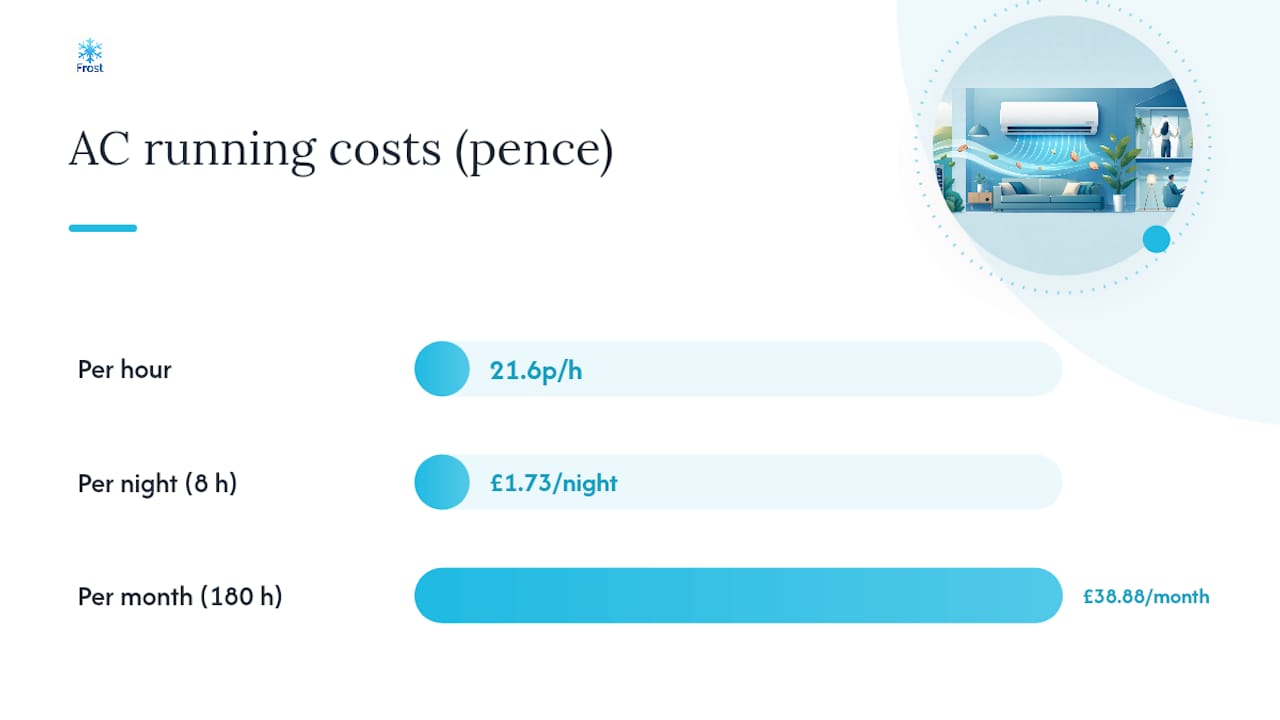
The CalculatorSphere AC running cost calculator uses this same step sequence and lets you plug in your own figures directly if you want to skip the arithmetic.
Typical costs by unit size and realistic usage patterns
The table below uses a 24p/kWh rate and realistic duty cycles. Treat these as illustrative starting points, not guarantees: your actual costs depend on room size, insulation, outdoor temperature, and how you set the thermostat.
Appliancerunningcost corroborates these ranges and shows how quickly costs compound with longer daily runtimes.
Three realistic usage scenarios:
- Evenings only (4 hrs/day, 20 days/month): A mid-size split costs roughly £13–£16 per month. This is the most common UK pattern and keeps bills modest.
- Heatwave week (12 hrs/day, 7 days): The same unit costs £13–£17 for that week alone. A larger unit cooling multiple rooms could reach £35–£50 for the same period.
- Occasional weekend use (8 hrs/weekend, 4 weekends/month): Around £8–£12 per month for a mid-size split. At this frequency, the running cost is almost negligible compared with the comfort benefit.
Adjust the table figures by changing the duty cycle upward if your room has poor insulation or large south-facing glazing, or downward if the unit is well-matched to a small, shaded room.
What actually drives your AC running costs up or down
Duty cycle: the number most people ignore
Duty cycle is the single biggest variable in real-world cost estimates, and most homeowners never think about it. A unit running at 100% load all the time is almost always undersized or fighting a poorly insulated room. A well-matched system in a reasonably insulated UK home will cycle or modulate well below full power for most of its runtime.

Efficiency ratings and inverter technology
SEER (Seasonal Energy Efficiency Ratio) and EER (Energy Efficiency Ratio) measure how much cooling you get per watt of electricity. A higher SEER means lower running costs for the same cooling output. Modern inverter compressors go further: rather than switching fully on and off, they modulate speed to match the room's actual heat load. That reduces cycling losses and keeps the room at a steadier temperature. An A+++ rated inverter split can use 30%–40% less electricity than an older fixed-speed unit of the same cooling capacity. Refrigerant type also plays a role: newer refrigerants such as R-32 have better thermodynamic properties than the R-410A they replaced, which contributes to the efficiency gains in current-generation equipment.
Building fabric and solar gain
Poor insulation and large unshaded south-facing windows can force even a high-efficiency unit to operate near full power, eroding the savings the spec sheet promises. A room that gains heat quickly needs the compressor running more of the time, which pushes the effective duty cycle toward 80%–100%. External shading, loft insulation, and double or triple glazing all reduce the cooling load before the unit even switches on. For a more detailed look at how building fabric affects energy use, the house rendering and insulation options guide from AJC & Son Builders covers external wall treatments that cut heat ingress.
Electricity tariff and time-of-use pricing
The unit rate you pay per kWh has a direct, linear effect on running cost. Time-of-use tariffs (such as Economy 7 or smart tariffs with off-peak windows) can cut overnight cooling costs significantly if you pre-cool the room during cheap-rate hours. Always use your actual bill rate rather than a national average when estimating costs.
Pro Tip: The most overlooked factor is the mismatch between unit size and room load. An oversized fixed-speed unit short-cycles (switches on and off rapidly), which wastes energy and wears the compressor faster. An undersized unit runs continuously at full load. Neither is efficient. Getting the sizing right at installation is worth more than chasing an extra SEER point.
Portable, split and whole-house systems: which costs less to run?
Portable units are the most expensive to run per unit of cooling. Their coefficient of performance (COP) is lower because the exhaust hose leaks warm air back into the room and the single-hose design creates negative pressure. For occasional use, the convenience outweighs the cost. For regular summer use, the running-cost penalty adds up quickly.
Wall-mounted splits are the most cost-effective option for cooling one or two rooms. A well-sized inverter split can deliver 4–5 units of cooling for every unit of electricity consumed. If you only need to cool a bedroom and a living room, two single-zone splits will almost always cost less to run than a whole-house ducted system running at partial load.
Whole-house or ducted systems make sense when you need to condition most of the property simultaneously. Running a ducted system to cool one room is wasteful; the fan energy and duct losses make it inefficient at partial load. The advantages of split AC systems for UK homes covers this trade-off in more detail.
- Portable: highest running cost, lowest upfront cost, no installation required
- Split (single-zone): lowest running cost per room, moderate upfront, professional installation needed
- Multi-zone split: efficient for 2–4 rooms, one outdoor unit, higher upfront
- Ducted: efficient only when most zones are in use simultaneously
Is it cheaper to leave the AC on or switch it off?
The short answer: switch it off when you're away for more than about 30–45 minutes, unless it's an inverter unit in a very poorly insulated room during a heatwave.
The reasoning is straightforward. A fixed-speed unit uses full power every time it restarts to pull the room temperature down. If the room heats up significantly while you're out, the restart cost is high. But leaving it running continuously at a low setpoint also costs money. For most UK homes, where outdoor temperatures rarely stay extreme for long, switching off when you leave the room saves money in the majority of cases.
Inverter units change the calculation slightly. Because they modulate rather than restart at full power, the energy penalty of maintaining a cool room is lower. In a heatwave, with a well-insulated room, running an inverter unit at a modest setpoint (say 24°C) continuously can be cheaper than letting the room heat to 30°C and then pulling it back down.
Practical guidance by scenario:
- Overnight/sleep mode: Set to 24°C–26°C and let the unit run through the night. Sleep mode on most modern units reduces fan speed and raises the setpoint slightly after a set period, cutting overnight costs by 10%–20%.
- Daytime, home all day: Use a schedule or smart thermostat to pre-cool the room before the hottest part of the afternoon (typically 2 PM–5 PM), then let the setpoint rise slightly. This uses off-peak energy and reduces peak-hour runtime.
- Away for the day: Switch off. The energy to re-cool on return is almost always less than the cost of running all day.
- Holiday: Switch off entirely. Even standby draw adds up over two weeks, and there's no comfort benefit.
Pro Tip: Most installers recommend setting the thermostat at 24°C rather than 18°C. The setpoint is the easiest free saving available.
For a full breakdown of scheduling and setback strategies, the best practices for AC use guide covers timed programmes and smart controls in detail.
How to reduce your AC running costs: a practical action list
These are ranked roughly by ease and impact. The first few cost nothing; the later ones involve some outlay but pay back over time.
- Raise the setpoint to 24°C–26°C. Setting 18°C when 24°C would be comfortable is one of the most common and costly mistakes. Each degree lower adds 6%–8% to the compressor's workload.
- Use ceiling or desk fans alongside the AC. Moving air feels cooler at the same temperature, so you can raise the setpoint by 2°C–3°C without losing comfort. Fans use 15–75 W versus 600–1,500 W for the compressor.
- Close blinds and curtains on south- and west-facing windows during peak sun hours. External shading is more effective than internal blinds, but either reduces solar gain and cuts the cooling load meaningfully.
- Clean or replace filters every 4–6 weeks during heavy use. A clogged filter forces the fan to work harder and reduces airflow across the evaporator, dropping efficiency. This is a five-minute job that costs nothing. Boosting AC energy efficiency at home walks through the full maintenance routine.
- Keep the outdoor unit clear. Leaves, garden furniture, or overgrown shrubs within 30–50 cm of the condenser coil restrict airflow and raise the condensing temperature, which increases power draw. Clear the area and hose the coil down once a season.
- Book an annual service. A certified engineer will check refrigerant charge, clean the coil, inspect electrical connections, and verify the system is operating at rated efficiency. A system running with low refrigerant can use 10%–20% more electricity to achieve the same cooling. Frostairconditioning's service and maintenance contracts cover this as a scheduled annual visit.
- Install a smart thermostat or use the unit's built-in scheduling. Programming the unit to switch off when the house is empty and pre-cool before you return can cut monthly running costs by 15%–25% compared with manual operation.
- Consider upgrading an old fixed-speed unit to an inverter model. If your existing unit is more than 10–12 years old, a modern A++ or A+++ inverter split will use substantially less electricity for the same cooling output. The payback period depends on how often you run it, but for regular summer use the running-cost savings are real.
Raising the setpoint from 20°C to 24°C on a mid-size split running 6 hours per day for a month can reduce the monthly electricity cost by £12–£18 at current rates — a saving that requires no equipment and no expenditure.
Purchase, installation and total cost of ownership
Running costs are only part of the picture. The upfront price of the unit and installation determines whether a higher-efficiency system actually saves money over its lifetime.
Typical installed price bands for domestic systems:
- Small single-zone split (2.0–2.5 kW cooling): £1,200–£1,800 installed
- Mid-size single-zone split (3.5–5.0 kW cooling): £1,500–£2,500 installed
- Multi-zone split (2–3 indoor units): £2,500–£4,500 installed
- Ducted/whole-house system: £4,000–£10,000+ depending on property size and ductwork
These figures cover the unit, refrigerant pipework, electrical connection, commissioning, and a standard installation. Factors that push cost upward include long pipe runs, difficult access for the outdoor unit, three-phase electrical supply requirements, and condensate drainage work.
| Cost component | Typical range |
|---|---|
| Indoor and outdoor unit | £500–£2,500 |
| Labour (installation) | £400–£900 |
| Refrigerant pipework and fittings | £150–£400 |
| Electrical connection | £100–£300 |
| Commissioning and F-Gas certification | £50–£150 |
| Optional condensate pump/drain | £80–£200 |
Payback logic: A standard-efficiency unit at £1,400 installed versus a high-efficiency model at £1,800 installed. If the high-efficiency unit saves £60 per year in running costs (plausible for a unit running 4–5 months per year), the £400 premium pays back in roughly 6–7 years. Over a 12–15 year system life, the total saving is meaningful. The calculation shifts in favour of the higher-efficiency unit the more you use it. For occasional use (a few weeks per year), the payback period stretches and the cheaper unit may be the rational choice.
For a fuller guide to system selection and sizing, the complete air conditioning buying guide covers the decision in detail.
What Frostairconditioning sees on real installations
A few patterns come up repeatedly on domestic jobs across Devon and the South West.
Undersized units working too hard. A common finding is a portable or small fixed-speed unit that was bought as a stopgap and is now running continuously at full load in a room it cannot adequately cool. The unit draws full power all day, the room stays uncomfortably warm, and the electricity bill is high. Replacing it with a correctly sized inverter split typically halves the running cost and doubles the comfort.
Blocked outdoor units. On service calls, it is not unusual to find the condenser coil partially blocked by garden debris or positioned too close to a fence or wall. Restricted airflow raises the condensing pressure, which forces the compressor to work harder. The unit may still cool the room, but it is doing so inefficiently. Clearing the obstruction and cleaning the coil is a quick fix with an immediate efficiency benefit.
No annual service in 5+ years. Many homeowners assume that if the unit is still blowing cold air, it is fine. In practice, refrigerant charge drifts, coils accumulate grime, and electrical connections can degrade. A system running with even a modest refrigerant shortfall can use noticeably more electricity to achieve the same cooling output. Annual servicing by an F-Gas certified engineer catches these issues before they compound.

The most common homeowner mistake that raises running costs is setting the thermostat too low and leaving it there. On a significant proportion of service visits, units are found set to 18°C–20°C in rooms where 24°C would be perfectly comfortable. The compressor runs harder and longer than it needs to, and the occupants often report the room feeling "too cold" at times. A simple setpoint adjustment costs nothing and saves money immediately.

The real cost of AC is mostly about how you use it
Most articles about air conditioner running costs focus on the unit's SEER rating or the price of electricity, as if those are the two levers that matter. They matter, but they are not where most homeowners lose money.
The bigger issue is behaviour: a poorly set thermostat, a filter that hasn't been cleaned since installation, an outdoor unit buried behind a hedge, and a unit that's either too large or too small for the room it's cooling. These four things, taken together, can easily double what a unit costs to run compared with the same unit managed well.
The other thing worth saying plainly: for most UK homes, air conditioning is not running for eight months of the year. The total annual running cost for a well-managed mid-size split used on warm evenings and during the occasional heatwave is genuinely modest, often less than £100–£150 per year. The anxiety about electricity bills is understandable, but the numbers, when you actually run them, are rarely as alarming as people fear. What tends to be alarming is the bill from a unit that's been left running at 18°C all day in a room nobody is sitting in.
Frostairconditioning: domestic installation, servicing and free site surveys
Knowing your running costs is one thing. Getting the right unit, correctly sized and properly installed, is what makes those numbers hold in practice.

Frostairconditioning installs and services domestic air conditioning systems across Exeter and the South West, with REFCOM and F-Gas certified engineers on every job. The team handles everything from a single bedroom split to multi-zone systems for larger homes, with same-day and next-day installation slots available.
The process starts with a free site survey: an engineer visits, assesses the room or rooms, recommends the right system size and type, and provides a written quote. There's no obligation. For homeowners who want to keep running costs as low as possible long-term, an annual service contract keeps the system at rated efficiency year after year.
Request a free quote or find out more about domestic installation options to get started.
Sources
- Ofgem
- Ofgem
- How much does air conditioning cost to run? — Heatable
- AC running cost calculator — VoltCalcs
- Appliancerunningcost
This article is general information, not a substitute for advice from a qualified financial advisor. Consult a qualified financial professional about your own circumstances before acting on anything here.