
Air conditioning in the UK is not cheap, but it is not as expensive as most people assume. A single-room split system typically costs £1,500–£3,500 fully installed. A multi-room setup runs £3,500–£7,000, and a whole-house ducted system can reach £5,000–£10,000 or more, according to Heatable's UK cost guide. Running costs for a modern split unit sit at roughly 10–17p per hour. The main cost drivers are how many rooms you want to cool, how efficient the unit is, and how many hours a day you actually run it.
Quick headline ranges at a glance:
- Portable unit: £300–£800 to buy; higher running costs than a split system
- Single-room split (installed): £1,500–£3,500
- Multi-room split (installed): £3,500–£7,000
- Ducted or whole-house system: £5,000–£10,000+
The BBC's home air conditioning guide confirms these bands and notes that installation complexity, not the unit itself, is usually what pushes a quote toward the top of any range.
Key takeaways
Air conditioning in the UK costs £1,500–£3,500 installed for a single room, with running costs of around 10–17p per hour for a modern split unit, making it affordable for most homeowners when budgeted correctly.
| Point | Details |
|---|---|
| Installed cost ranges | Single split: £1,500–£3,500; multi-split: £3,500–£7,000; ducted: £5,000–£10,000+. |
| Running cost estimate | A modern split unit draws 0.3–0.5 kWh/hour, costing roughly 10–17p per hour at typical UK tariffs. |
| Hidden costs to budget | Electrical work, condensate drainage, annual servicing (£70–£150/unit), and filter maintenance add to the headline price. |
| Installer trust signals | Verify F-Gas/REFCOM certification, confirm manufacturer warranty registration, and insist on an itemised fixed-price quote. |
| Frostairconditioning | F-Gas certified, 0% finance available, installs Daikin, Mitsubishi, Samsung and Toshiba across Devon, Cornwall and the South West. |
Table of Contents
- How much does air conditioning cost by system type?
- How to estimate your running costs
- What drives installation costs up or down?
- Extras homeowners often miss when budgeting
- Is air conditioning worth it in the UK?
- How to compare quotes and choose the right installer
- Three realistic UK budget scenarios
- What does air conditioning maintenance actually cost?
- A note from Frost Air Conditioning
- Frost Air Conditioning: certified installation across the South West
- Sources
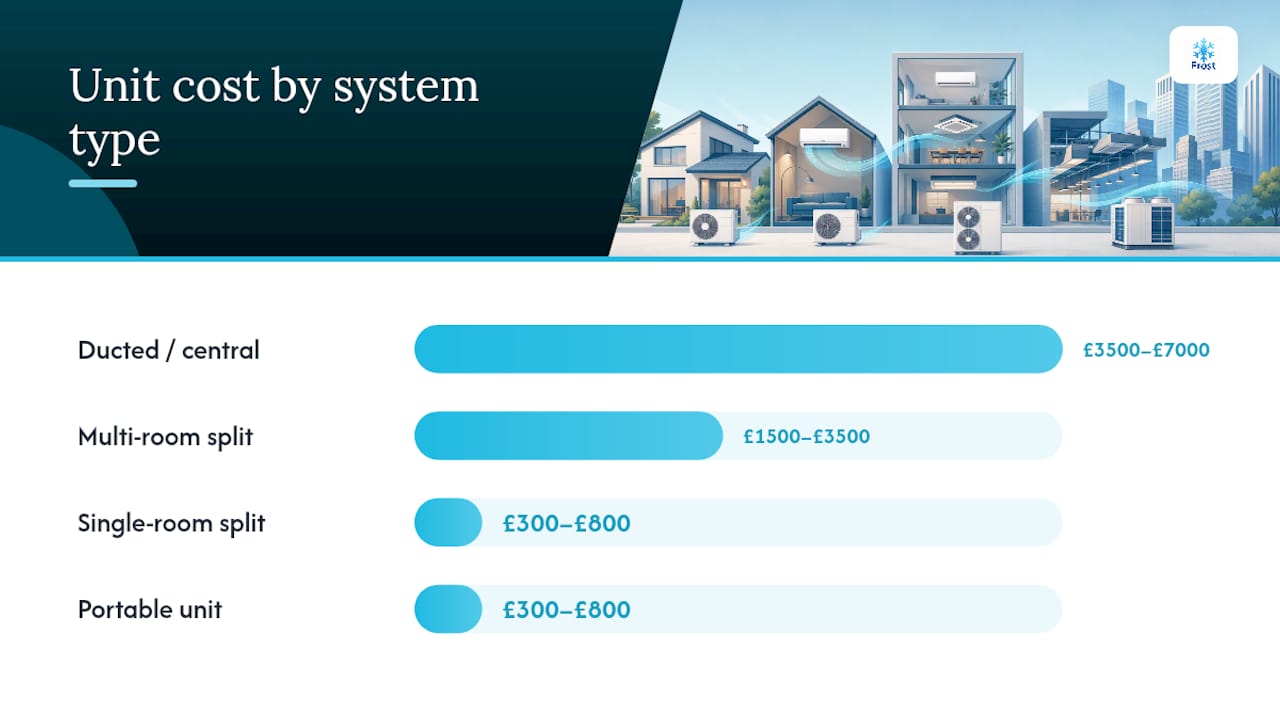
How much does air conditioning cost by system type?
The system type you choose shapes your budget more than any other single decision. Here is how the main options compare for UK homes.
| System type | Unit cost (approx.) | Installed cost (approx.) | Best for | Installation complexity |
|---|---|---|---|---|
| Portable unit | £300–£800 | No install needed | Single room, temporary use | None |
| Single-room split | £300–£800 | £1,500–£3,500 | One bedroom or living room | Low–moderate |
| Multi-room split | £1,500–£3,500 | £3,500–£7,000 | 2–4 rooms | Moderate |
| Ducted / central | £3,500–£7,000 | £5,000–£10,000+ | Whole house or new build | High |
Portable units look attractive on price, but they are noisier, less efficient, and typically more expensive to run than a properly installed portable air conditioner doing the same cooling job. The BBC's reporting on home air conditioning makes this point clearly: the upfront saving often disappears within a couple of summers. For a complete overview of system types and when each suits a UK home, it is worth reading through the options before committing.
Single-room splits are the most common choice for UK homeowners. They are wall-mounted, relatively quick to install (often a day's work), and the efficiency ratings on brands such as Daikin, Mitsubishi, Samsung, and Toshiba are genuinely impressive. Multi-room splits share one outdoor unit across several indoor heads, which keeps the outdoor footprint small and reduces the per-room cost once you go beyond two rooms. Ducted systems are the premium option: invisible, quiet, and capable of conditioning an entire house, but they require ceiling void space and are far more disruptive to retrofit into an existing property.
How to estimate your running costs
The calculation is straightforward. Take the unit's power draw in kilowatts, multiply by the electricity tariff in pence per kilowatt-hour, then multiply by the hours you run it.
Formula: kW × p/kWh ÷ 100 = cost per hour (in pence)
A modern split unit with a strong SEER (Seasonal Energy Efficiency Ratio) rating typically draws 0.3–0.5 kWh per hour. At a tariff of around 24p/kWh, that works out to roughly 7–12p per hour. Heatable's running-cost analysis puts the range at 10–17p per hour depending on unit size and tariff, which aligns with typical UK electricity pricing.
Two worked examples:
- Small bedroom unit (0.35 kWh draw, 24p/kWh tariff): 0.35 × 24 = 8.4p per hour. Run it for 4 hours an evening across a 90-day summer: roughly £15 for the season. That is less than most people expect.
- Larger living-room split (0.7 kWh draw, 24p/kWh tariff): 0.7 × 24 = 16.8p per hour. Eight hours a day for 60 days: approximately £81 for the summer. Still manageable, and far less than running a portable unit at equivalent output.
Higher SEER ratings reduce the kWh draw for the same cooling output. A unit rated SEER 8 uses noticeably more electricity than one rated SEER 14 on an identical job. Paying more upfront for a higher-efficiency model from Daikin, Mitsubishi, or Samsung typically pays back within a few seasons of regular use. For practical ways to boost air conditioning energy efficiency at home, small habits around thermostat settings and overnight scheduling make a real difference to the annual bill.
Pro Tip: If you are on a time-of-use tariff such as Octopus Go, running your air conditioning during off-peak hours (typically overnight) can cut the per-hour cost significantly compared with peak afternoon rates.
What drives installation costs up or down?
Two quotes for what looks like the same job can differ by £1,000 or more. The reasons are almost always in the detail of the property, not the unit itself.
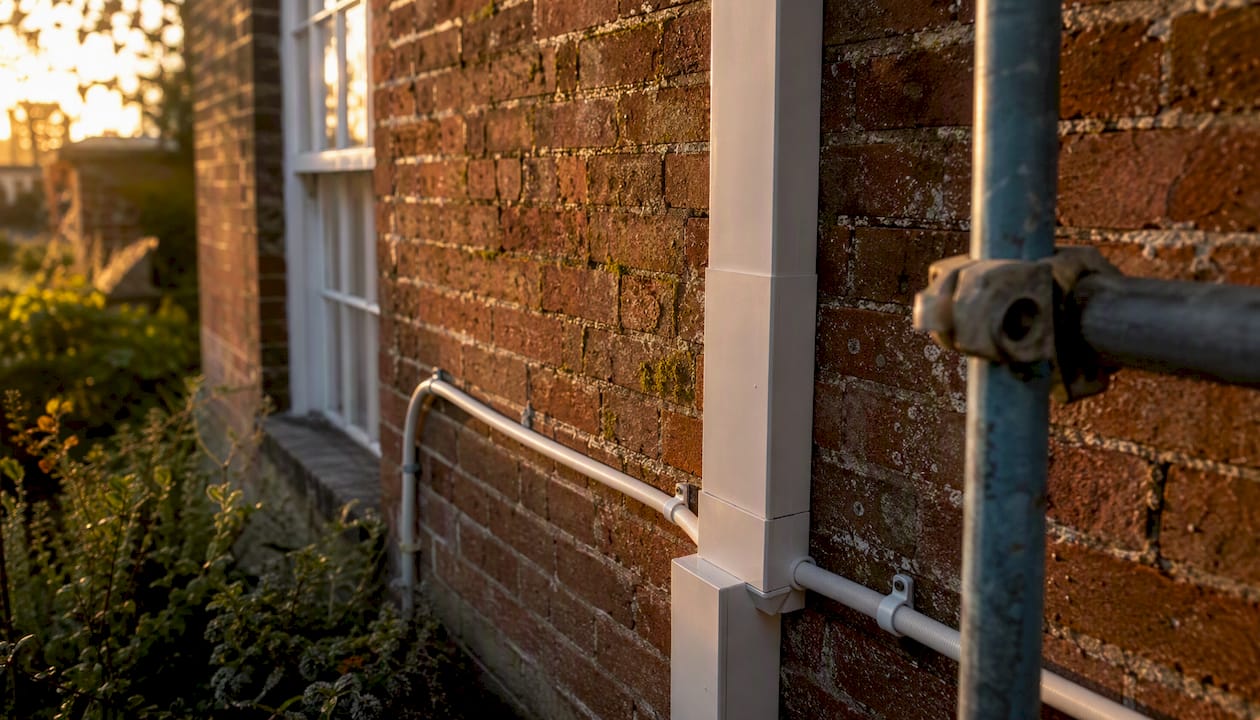
Property factors are the biggest variable. A top-floor flat with a south-facing roof and no loft void is harder to work in than a ground-floor extension with easy external wall access. Listed buildings or properties in conservation areas may need planning consent before any external unit can be fitted, which adds time and cost. Older UK homes with solid walls rather than cavity walls take longer to core-drill for refrigerant pipework, and hiding that pipework neatly inside trunking or boxing adds labour hours. OVO's 2026 installation cost guide notes that installation complexity is consistently the biggest driver of cost variation across UK quotes.
Technical factors include the length of refrigerant pipe runs between the indoor and outdoor units. Every extra metre adds material and labour cost. If the outdoor unit needs to be sited on a roof or high wall rather than at ground level, expect a scaffold or cherry-picker charge. Electrical work is another variable: some properties need a dedicated circuit or a consumer unit upgrade before an air conditioning system can be safely connected.
Logistical factors matter too. Installers in London and the South East typically charge higher day rates than those in other regions. Booking during peak summer demand (June–August) often means longer lead times and occasionally a small premium. A thorough site survey before any quote is issued is the single best way to avoid surprises: it is how a good installer identifies all of these variables before committing to a price. The BBC's guide to home air conditioning highlights that retrofitting older UK homes causes the largest cost variance of all, because hiding pipework in period properties often requires bespoke building work that cannot be priced reliably without a physical visit.
Extras homeowners often miss when budgeting
The headline installed cost is rarely the whole story. Several additional items can add hundreds of pounds to a final invoice if they are not scoped at survey stage.
- Electrical work: A dedicated spur or new circuit for the indoor unit typically costs £150–£300. If the consumer unit is old or at capacity, a full upgrade can run to £500–£1,500 depending on the board and the electrician's rates.
- Condensate drainage: The indoor unit produces condensate water that needs to drain somewhere. If a gravity drain is not available, a condensate pump is needed, adding roughly £50–£150 to the job.
- Planning permission: External units on listed buildings or in conservation areas may require a planning application. Fees and timescales vary by local authority, but budget at least 8 weeks and the application fee.
- Structural concealment: Trunking and boxing to hide pipework is sometimes included in quotes and sometimes not. Confirm this explicitly before signing.
- Annual servicing: A one-off annual service typically costs around £70–£150 per unit. Skipping this voids most manufacturer warranties and shortens system life.
- Filter replacements: Most split systems have washable filters, but some require replacement pads every 1–2 years. Budget £20–£50 per year.
- Refrigerant leak repairs: Rare on a well-installed system, but a refrigerant top-up or leak repair can cost £150–£400 if it does occur.
Is air conditioning worth it in the UK?
For most UK homeowners, the honest answer is: it depends on the room, the property, and how you use it. But the case is getting stronger every year.
LSE's Grantham Institute research on the UK's record 40°C heat events makes the point that the UK is still underprepared for extreme heat, and that preparedness affects the value calculation for homeowners. Top-floor flats, south-facing bedrooms, and home offices without adequate ventilation are the spaces where air conditioning delivers the clearest return. Poor sleep and lost productivity during a two-week heat event are real costs that fans cannot fully address.
Resale value is a secondary but genuine factor. In city flats and newer builds, buyers increasingly expect cooling as standard. A well-installed, branded system from Mitsubishi, Daikin, Samsung, or Toshiba is a selling point in a way that a portable unit in the corner never is.
The alternatives are worth considering honestly. A good pedestal fan costs £50–£150 and handles mild warm spells adequately. A portable air conditioner sits in the £300–£800 range and cools a single room, but it is louder, less efficient, and needs a window vent. Heat pumps are the most capable alternative for year-round use; they heat in winter and cool in summer, and their running costs are competitive with gas boilers on heating. The upfront cost is higher, but government incentives such as the Boiler Upgrade Scheme can offset part of it. For homeowners who want to understand the reasons to invest in air conditioning as a long-term home improvement, the comfort and resale arguments are increasingly persuasive.
One environmental note: Our World in Data's analysis of air conditioning's contribution to greenhouse-gas emissions underlines why choosing a high-efficiency unit matters beyond the electricity bill. A SEER 14 system does the same cooling job as a SEER 7 unit at roughly half the energy, which is better for both your running costs and the grid.
Pro Tip: If you are weighing AC against a heat pump, ask your installer to model both options for your property. In a well-insulated home, a heat pump often delivers better year-round value, while a split AC system wins on upfront cost for cooling-only needs.
How to compare quotes and choose the right installer
Getting three quotes is the standard advice. Getting three comparable quotes is what actually matters.
What every quote should include:
- Equipment make, model number, and SEER/EER rating
- Itemised labour cost (survey, installation day, commissioning)
- Condensate drainage solution
- Electrical work scope (and whether a separate electrician is needed)
- Warranty terms: manufacturer warranty (typically 2–7 years depending on brand and registration) and installer workmanship guarantee
- Whether annual servicing is included or available as a contract
- A fixed price, not an estimate subject to revision
Questions to ask on the survey:
- Where exactly will the outdoor unit be sited, and is planning consent needed?
- How will the refrigerant pipework be routed and concealed?
- Is electrical work included, and will a separate electrician be required?
- What is the commissioning process, and will I receive a handover document?
- What does the warranty cover, and what voids it?
Trust signals to verify before signing:
- F-Gas / REFCOM certification: Any engineer handling refrigerants in the UK must be F-Gas certified. Ask for the certificate number and verify it on the REFCOM register. This is a legal requirement, not a nice-to-have.
- Manufacturer warranty: Daikin, Mitsubishi, Samsung, and Toshiba all offer extended warranties (sometimes up to 5–7 years) when the system is installed by an approved installer and registered at commissioning. Confirm this is part of the quote.
- References and reviews: Ask for two recent local references and check independent review platforms.
- Fixed-price breakdown: A quote that lists only a single total figure without itemisation is a red flag. You cannot compare it fairly against a detailed competitor quote.
Pro Tip: When comparing quotes, ask each installer to specify the SEER rating of the unit they are proposing. A cheaper quote built around a lower-efficiency unit can cost more over five years than a higher upfront quote with a premium system.
Low-ball quotes that omit commissioning or use unbranded units are a known risk in this market. Commissioning, where the engineer pressure-tests the refrigerant circuit and verifies performance, is not optional: skipping it typically voids the manufacturer warranty and can cause early system failure. For a full checklist on why professional AC installation matters, the detail on what a proper handover should include is worth reviewing before you accept any quote.
Three realistic UK budget scenarios
These rounded totals are illustrative budgets based on typical UK cost ranges. Your actual quote will depend on the site survey.
Scenario A: Small flat, single room A one-bedroom flat in Exeter wants cooling in the main bedroom. A single-room split system from a brand such as Samsung or Toshiba, professionally installed with a short pipe run and a new dedicated spur, comes to roughly £1,800–£2,200 all-in. That includes the unit, a day's labour, commissioning, and basic electrical work. Annual servicing adds around £80–£100 per year.
Scenario B: Three-bedroom semi-detached A family home in Devon wants cooling in the living room and two bedrooms. A three-head multi-split system with one outdoor unit, moderate pipe runs, and some trunking to conceal the pipework typically lands at £4,500–£6,500. The OVO cost guide corroborates this band for multi-room installations. Electrical work for a dedicated circuit adds £200–£400. Annual servicing for a multi-head system runs £150–£250.
Scenario C: New build or whole-house ducted system A new-build property in Cornwall integrating a ducted system during construction, or a larger detached home retrofitting a ducted heat-pump hybrid, sits at £7,000–£12,000+. The premium reflects the complexity of ductwork, zoning controls, and the higher-capacity equipment required. Heatable's cost data places ducted systems at £5,000–£10,000+, with bespoke or heat-pump hybrid installations pushing beyond that range. For new builds specifically, the installation considerations are quite different from a retrofit, and the cost per room is usually lower when the system is designed in from the start.
The key figure: a single-room split system installed by a certified engineer typically costs £1,500–£3,500 in the UK, with running costs of around 10–17p per hour for a modern, high-efficiency unit.
What does air conditioning maintenance actually cost?
A split system is not a fit-and-forget installation. Regular servicing keeps it running efficiently, protects the warranty, and extends the working life of the equipment.
Recommended servicing schedule:
- Annual service by a qualified engineer: covers refrigerant pressure checks, electrical connections, coil cleaning, condensate drain clearance, and a performance test
- Filter cleaning: every 4–6 weeks during active use (most split systems have washable filters the homeowner can clean themselves)
- Outdoor unit inspection: clear debris from the coil fins before and after summer; check for vegetation growth around the unit
Typical annual costs:
- One-off annual service: approximately £70–£150 per indoor unit
- Multi-head system service (3 heads): £150–£250 for a combined visit
- Filter replacement pads (where applicable): £20–£50 per year
- Condensate pump replacement (if fitted): £80–£150 every 5–8 years
A well-maintained split system from a quality manufacturer such as Daikin or Mitsubishi typically lasts 15–20 years. Ducted systems have a similar lifespan when serviced regularly, though ductwork itself can last longer. Signs that replacement is becoming necessary include refrigerant leaks that recur despite repair, compressor noise that was not present when new, and a noticeable drop in cooling performance despite a clean filter and full refrigerant charge. Frostairconditioning offers annual maintenance contracts that cover scheduled servicing and give priority response for any breakdown, which is worth considering when you factor in the long-term cost of ownership.
A note from Frost Air Conditioning
The question we hear most often on a survey visit is not "how much will it cost?" but "will it actually make a difference?" The honest answer is that it depends entirely on the room and how the system is sized. An undersized unit running flat-out all day costs more to run and never quite gets the room comfortable. An oversized unit short-cycles, wears out faster, and wastes energy. Getting the sizing right is the single most important thing a survey achieves, and it is why we never quote from a floor plan alone.
Frost Air Conditioning: certified installation across the South West
Frostairconditioning installs premium split and multi-room systems from Daikin, Mitsubishi, Samsung, and Toshiba across Devon, Cornwall, and the wider South West. Every engineer is F-Gas / REFCOM certified, and all installations are commissioned to manufacturer specification so the full warranty applies from day one.

Survey to installation typically takes 1–2 weeks for a standard domestic job, with same-day and next-day slots available for urgent requirements. Annual maintenance contracts cover scheduled servicing and priority breakdown response, protecting your investment for the long term.
Request a free quote or find out more about domestic installation services to get a fixed-price breakdown for your home.
Sources
- How can you get air conditioning in your home and how much does it cost? — BBC
- Is air conditioning worth it in the UK? — Heatable
- Air Conditioning Installation Cost UK 2026 — OVO / Solar & Heating
- Air conditioning causes around greenhouse-gas emissions — Our World in Data
- One year on from record-breaking 40°C heat in the UK — LSE Grantham Institute