
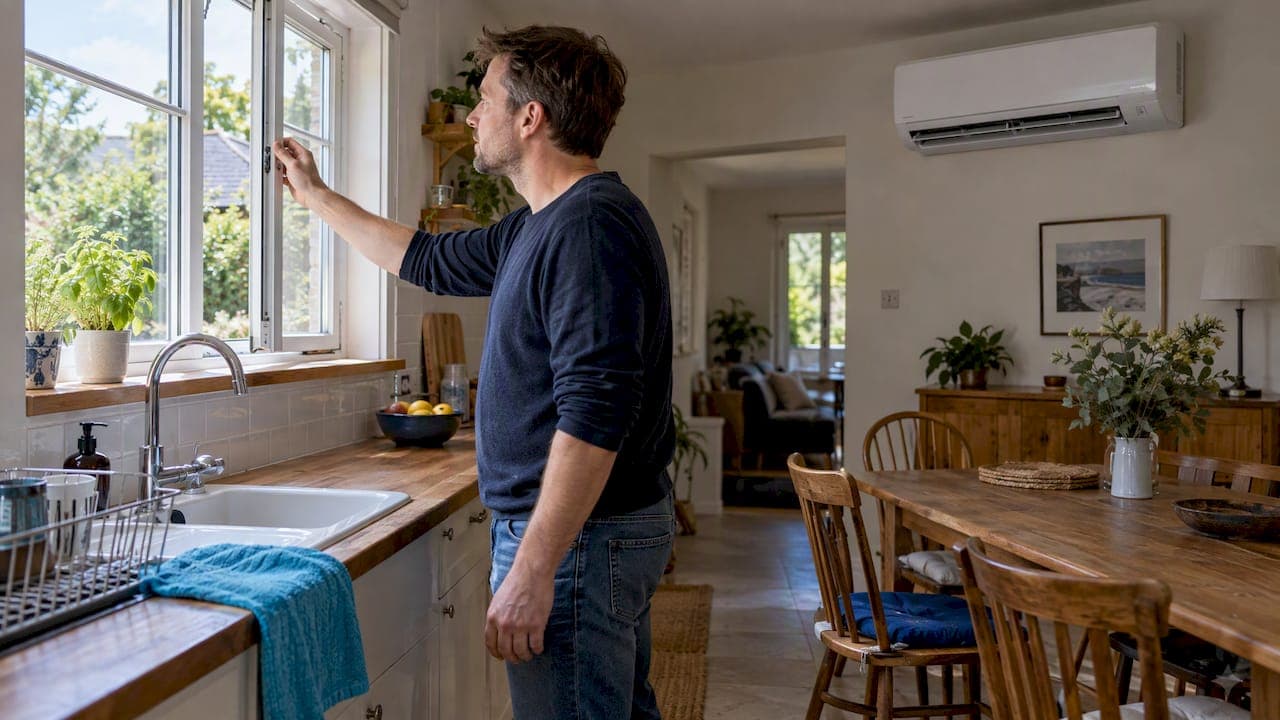
Natural ventilation suits mild, dry climates and buildings where occupants can control windows and airflow, while air conditioning is the better route when humidity, pollution or high internal heat gains make passive cooling unreliable. Most homes and offices end up needing a mix of both. The next sections explain how each system works and why hybrid, or mixed-mode, design is usually the practical answer.
TL;DR:
- Natural ventilation relies on wind and buoyancy, but is limited by outdoor pollution, noise, and high humidity that can trap moisture in airtight homes.
- Air conditioning provides predictable temperature control, removes humidity, and is essential for spaces with high internal heat gains or equipment loads.
- Hybrid systems combine both methods and operate automatically based on indoor conditions, but require proper commissioning and clear occupant instructions to perform optimally.
- Using windows while running air conditioning increases energy use significantly, often by more than 1.06 times in summer or winter.
- A proper survey by certified professionals helps determine whether a home needs full air conditioning, hybrid ventilation, or improved natural airflow.
Table of Contents
- How natural ventilation and air conditioning actually work
- The benefits of natural ventilation
- Why air conditioning still earns its place
- Where each approach falls short
- Hybrid and mixed-mode ventilation: the practical middle ground
- Choosing and operating the right system for your space
- What UK standards say about ventilation choices
- Frost Air Conditioning's practical view
- Our recommendation for most homes
- Getting the right setup for your property
- FAQ
- Sources
How natural ventilation and air conditioning actually work
Natural ventilation relies on two forces: wind pushing air through a building and buoyancy, where warm air rises and escapes through high openings while cooler air is drawn in lower down. Operable windows, trickle vents, stacks and roof lights are the architectural tools that make this work, and their effectiveness depends heavily on building layout and how much control occupants actually have over them.
Air conditioning works differently. A refrigeration cycle extracts heat from indoor air and rejects it outside, cooling the air (a sensible effect) and, in most systems, pulling moisture out of it too (the latent effect). Homes typically use split or multi-split units, while larger buildings may use VRF (variable refrigerant flow) systems that serve several zones from one outdoor unit.
- Wind and buoyancy drive natural airflow; mechanical fans and refrigerant drive air conditioning.
- Air conditioning actively removes humidity; natural ventilation only exchanges air, humid or not.
- Airtight, modern buildings often need mechanical help because natural draughts cannot get in or out easily.
The benefits of natural ventilation
In the right climate, natural ventilation does more than keep energy bills down. It tends to broaden how occupants perceive comfort, since people in naturally ventilated spaces generally tolerate a wider temperature range and have fewer sick-building-syndrome symptoms than those in some fully air-conditioned buildings, likely because personal control over windows and airflow matters as much as the temperature itself.
- Lower running costs: no compressor, no refrigerant, minimal moving parts.
- Night cooling flushes out heat stored in walls and floors, cutting the next day's cooling demand.
- Shading and thermal mass work alongside natural airflow to smooth out temperature swings.
- Fewer mechanical parts means less routine maintenance.
In favourable climates, natural ventilation can cut 10 to 30% of total building energy use, a saving that comes purely from avoiding mechanical cooling and its associated fan and pump energy.
Why air conditioning still earns its place
Air conditioning solves problems natural ventilation cannot touch. It gives predictable, consistent indoor temperatures regardless of what is happening outside, which matters in offices, shops, server rooms or any space with heavy equipment load. Crucially, it removes moisture from the air, something open windows simply cannot do in a humid spell.
- Predictable temperature and humidity control, independent of outdoor conditions.
- Better indoor air quality when systems include fresh-air intake, filtration or heat recovery.
- Essential where occupancy, equipment or climate create high internal heat loads.
- Heat pump systems reverse the cycle to provide heating too, covering both seasons from one installation.
Modern inverter air conditioners adjust compressor speed to match demand rather than cycling on and off, which improves efficiency compared with older fixed-speed units, a point worth checking when comparing system types for homes.
Where each approach falls short
Natural ventilation struggles when outdoor air itself is the problem: pollution, pollen, traffic noise or high humidity all come straight through an open window. In airtight modern homes, relying on windows alone can leave rooms under-ventilated, trapping moisture and pollutants rather than clearing them.
Air conditioning has its own weak points. It uses meaningful amounts of energy, depends on regulated refrigerants that need qualified handling, and can recirculate stale air if the system lacks proper fresh-air intake.
- Outdoor pollution, noise and humidity limit when windows can usefully be opened.
- Airtight construction can trap moisture if ventilation is not properly designed.
- Air conditioning recirculates air rather than freshening it unless designed with outdoor intake.
Running windows open alongside air conditioning does not split the difference. Simulations show it can push summer cooling loads up to 1.06 to 1.75 times higher, and winter heating loads rise substantially too, because the AC is fighting a constant leak of conditioned air.
Hybrid and mixed-mode ventilation: the practical middle ground
Mixed-mode design accepts that neither approach wins outright and builds switching logic into the building itself. There are three common patterns:
- Concurrent mode: natural ventilation and mechanical cooling run at the same time in different zones, each serving the space best suited to it.
- Change-over mode: the building switches entirely between natural ventilation (mild weather) and air conditioning (hot, humid or polluted spells).
- Zoned mode: some areas rely on natural ventilation permanently while others, such as server rooms or south-facing glazed offices, stay mechanically cooled.
Controls typically trigger on indoor temperature, outdoor humidity or CO2 levels, switching modes automatically rather than leaving it to guesswork. CIBSE AM13 is clear that these systems only deliver their promised energy and comfort gains when they are properly commissioned and handed over with clear instructions, since poor commissioning is the most common reason hybrid projects underperform.
Pro Tip: Fit simple, visible labels or app controls that tell occupants exactly when to open windows and when to leave the system alone, since unclear instructions are what usually defeat a well-designed hybrid system.

Choosing and operating the right system for your space
The right choice depends on a handful of practical factors rather than personal preference alone.
- Local climate and typical humidity levels through the cooling season.
- How airtight the building already is, since tightly sealed homes trap moisture without mechanical help.
- Occupancy patterns: a home used all day needs different handling from one empty from 9 to 5.
- Outdoor noise and air quality, which decide whether windows are a realistic option.
- Existing shading and thermal mass, which extend how long natural ventilation stays comfortable.
As an operating rule, ventilate naturally during cool mornings and evenings, seal up and run air conditioning through the hottest part of the day, and use night purging to flush heat out before the cycle repeats. This combination, covered in more detail in guidance on cooling your home efficiently, avoids the energy penalty of running both systems against each other.
Pro Tip: Never leave windows open while the AC is running near full load. It is the single most common mistake that inflates energy bills without improving comfort.
Call a professional for a proper survey when you are uncertain, particularly before installing mechanical ventilation with heat recovery or specifying an AC system for a new build, where airtightness and ventilation design need to be worked out together.
What UK standards say about ventilation choices
Approved Document F (Part F) accepts natural, mechanical and hybrid ventilation as valid routes, but it requires extract ventilation wherever moisture or pollutants are produced, such as kitchens and bathrooms, and a minimum supply of outdoor air throughout. For highly airtight dwellings, it points towards mechanical ventilation unless the design has been assessed by a specialist.
- Part F sets minimum outdoor air provision and mandatory extract points regardless of ventilation strategy.
- CIBSE AM10 and AM13 stress 'adaptive opportunity', meaning occupants need real control over windows and local settings for natural ventilation to work as intended.
- Complex or unusual layouts often warrant CFD modelling or a blower-door test before finalising a design.
Frost Air Conditioning's practical view
This trade-off is a common consideration across homes and businesses in the south west. Most domestic clients do best with a hybrid approach: natural ventilation for spring and autumn, air conditioning for the humid or high-load periods when windows alone cannot keep up.
- Installation teams are F-Gas and REFCOM certified, and installs are often completed within 1 to 2 days without subcontractors.
- Some providers offer 0% finance and same-day response for urgent breakdowns.
- Surveys can help determine whether a space needs full air conditioning, a targeted zoned system or simple ventilation improvements.
For shops and commercial units with heavier internal loads, our shop fitting and commercial service covers bespoke design alongside installation.
Our recommendation for most homes
For most homes, we would try natural ventilation first in spring and autumn, then bring in air conditioning for the hot, humid stretches. Set clear house rules on windows and the system avoids working against itself.
— James
Getting the right setup for your property
Working out whether your home needs full air conditioning, a hybrid design or better natural ventilation usually comes down to a proper survey rather than guesswork. Free surveys may be available across Exeter and the wider south west, and F-Gas certified engineers can recommend systems sized to actual heat gains and humidity rather than generic estimates.

Start with a domestic installation survey and get a design built around how your home actually performs.
FAQ
What are the disadvantages of natural ventilation?
Natural ventilation cannot control humidity and lets in whatever is outside, including pollution, pollen and noise. In airtight modern homes it can also leave rooms under-ventilated, which risks trapped moisture and condensation problems if windows and vents are not managed carefully.
What is the most efficient type of natural ventilation?
There is no single most efficient design; it depends on building shape, climate and openings. Stack ventilation, which uses rising warm air to draw fresh air in low and push stale air out high, tends to work well in taller spaces, while cross ventilation suits narrower, single-storey layouts with windows on opposite sides.
How do I naturally cool my house?
Open windows during cooler mornings and evenings to flush out stored heat, then close up and use shading or blinds during the hottest part of the day to keep that cool air in. Night purging, combined with thermal mass like masonry or concrete floors, reduces next-day cooling demand without any mechanical input.
Does air conditioning improve ventilation?
Air conditioning on its own mainly recirculates indoor air rather than bringing in fresh air, unless the system is specifically designed with outdoor air intake or heat recovery. Running windows open at the same time as air conditioning does not improve ventilation meaningfully and can raise cooling loads by 1.06 to 1.75 times in summer.
Sources
- Natural ventilation | Whole Building Design Guide
- Effect of ventilation patterns on indoor thermal comfort and air-conditioning cooling and heating load using simulation (Springer)
- Natural vs. mechanical ventilation and cooling (eScholarship review)
- CIBSE AM13: Mixed-mode ventilation systems
- Approved Document F: Ventilation (2026)