

Air conditioning does more than cool a room. In an office setting, it directly shapes how well your people think, how often they fall ill, and how much your energy bills cost at the end of the quarter. Get it right and you have a workspace where concentration comes easily and equipment runs without overheating. Get it wrong and you are looking at sluggish staff, rising absenteeism, and a system that costs more to run than it should.
Here is what the research and UK standards tell us about the role of AC in offices:
- Temperature control keeps the working environment within the comfort zone recommended by ASHRAE Standard 55, broadly 22°C–24°C for sedentary office work.
- Humidity regulation prevents the dry air and condensation problems that trigger respiratory complaints and damage sensitive IT equipment.
- Air quality management filters out particulates, allergens, and volatile compounds that accumulate in sealed buildings.
- Productivity protection is crucial, as a 2°C deviation from optimal temperature in an office of 200 people results in about 4% annual productivity loss, according to research (source).
- Equipment protection keeps server rooms and AV infrastructure within safe operating temperatures, reducing hardware failure rates.
What are the real benefits of AC in office workplaces?
The most direct benefit is cognitive. When office temperatures drift above the comfort zone, concentration drops, error rates climb, and decision-making slows. A 2°C deviation in a 200-person office translates to roughly 4% annual productivity loss. For a business paying £2 million a year in salaries, that is £80,000 in lost output from a thermostat problem.
Stable humidity matters just as much as temperature. Air that is too dry irritates mucous membranes and eyes, while excessive moisture encourages mould growth and dust mite proliferation. Both outcomes feed directly into Sick Building Syndrome (SBS), a cluster of symptoms including headaches, fatigue, and respiratory irritation that affects occupants of air-conditioned buildings at higher rates than those in naturally ventilated spaces, particularly where maintenance is poor.
Beyond the human side, a well-designed HVAC system protects your physical assets. Server rooms and comms cupboards need consistent cooling regardless of season. A system that zones these spaces separately from open-plan areas avoids the common mistake of overcooling the whole floor to keep one rack of equipment happy.
Pro Tip: Most temperature complaints in offices are not actually thermostat problems. Draft discomfort typically results from airflow velocity exceeding 0.2 m/s at desk level, caused by poorly positioned diffusers or return air grilles. Before adjusting the setpoint, check the airflow design first.
Energy management is the other operational win. Modern systems with inverter-driven compressors modulate output rather than cycling on and off at full power, which cuts electricity consumption and extends component life. Pairing that with occupancy-based controls means you are not cooling an empty boardroom on a Friday afternoon.
Which AC systems work best in UK office settings?
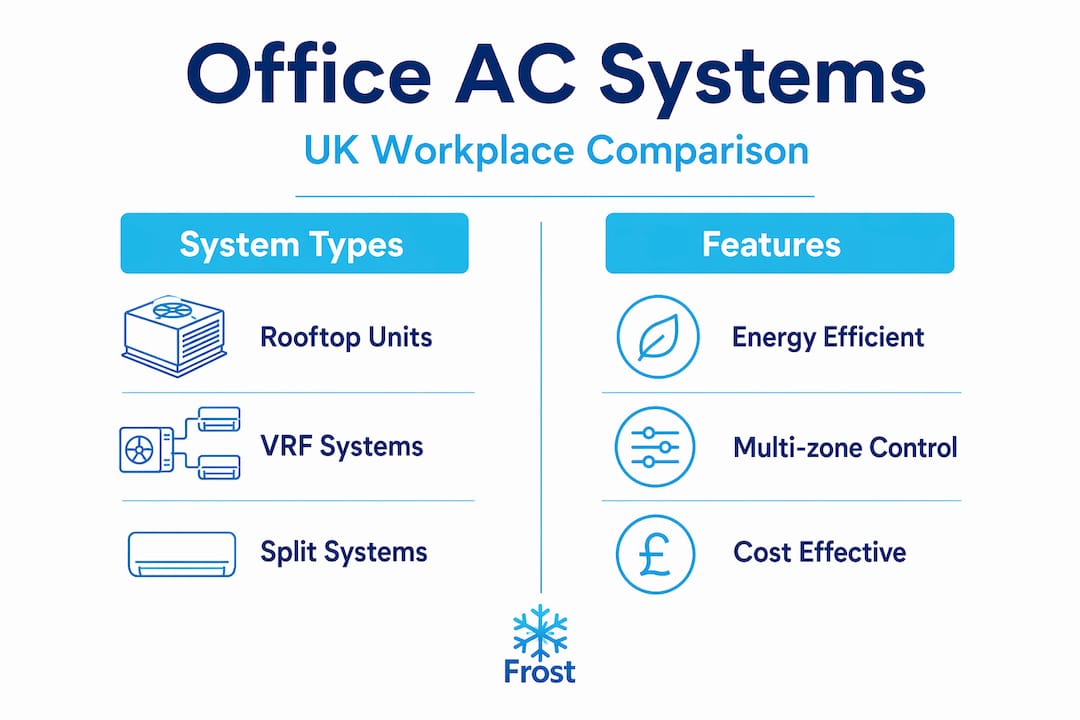
The right system depends on your building's age, layout, and how many distinct zones you need to control independently. Four system types dominate UK commercial installations.
| System type | Best suited for | Energy efficiency | Typical cost range | UK-specific notes |
|---|---|---|---|---|
| Rooftop packaged unit | Large open-plan floors, single-zone buildings | Moderate | — | Requires roof access and structural assessment |
| VRF (variable refrigerant flow) | Multi-zone offices, mixed-use floors | High | — | Simultaneous heating and cooling per zone |
| Split system (single) | Small offices, server rooms | Good | — | Simple install, limited to one zone |
| Multi-split system | Small to medium offices, 2–8 zones | Good | — | One outdoor unit serves multiple indoor heads |
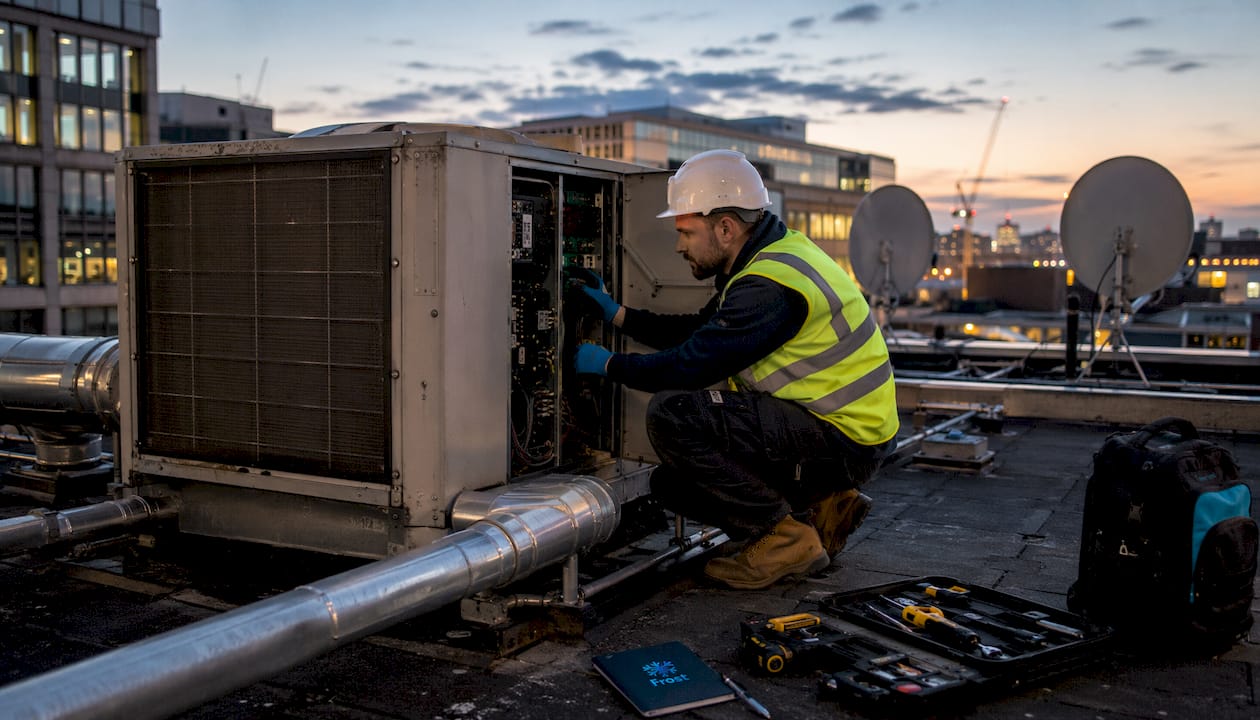
Rooftop packaged units suit large, single-tenancy buildings where ductwork can be run through a suspended ceiling. They centralise the mechanical plant, which simplifies servicing, but they offer limited zoning flexibility without additional VAV (variable air volume) controls.
VRF systems are the preferred choice for multi-zone offices. Modern VRF technology allows simultaneous heating and cooling in different zones, so a south-facing meeting room can be cooled while a north-facing open-plan area is heated. That flexibility pays back in energy savings across variable-occupancy environments.
Split and multi-split systems are the practical choice for smaller offices or where a full VRF installation is not justified by the building size. A multi-split serving four or five zones covers most small-to-medium office layouts without the capital outlay of a VRF.
UK regulations require that systems above certain cooling capacities include outdoor air economy cycles, allowing free cooling when external conditions permit. This is not optional; it is a compliance requirement under current building services standards. Any reputable installer will factor this into the design from the outset.
Pro Tip: Zoning controls planned before drywall installation cost a fraction of what post-construction modifications do. If you are fitting out a new space, lock in your zone boundaries before the builder closes the ceiling.
How to choose and maintain office AC effectively
Choosing the right system
Sizing is the single most common mistake in commercial AC installation. An oversized unit short-cycles, meaning it reaches setpoint quickly, shuts off, and then restarts repeatedly. Short-cycling fails to dehumidify the air properly, drives up energy consumption, and accelerates compressor wear. Manual N load calculations carried out by a qualified engineer account for occupancy density, solar gain, equipment heat loads, and building fabric before any system is specified.
Beyond sizing, consider these selection factors:
- Zoning requirements: identify server rooms, meeting rooms, open-plan areas, and reception zones separately. Each has a different heat load and occupancy pattern.
- Energy efficiency ratings: look for systems with a high SEER (seasonal energy efficiency ratio) or SCOP (seasonal coefficient of performance) rating. Higher-rated systems cost more upfront but reduce running costs over a 10–15 year lifespan.
- Noise levels: indoor units in quiet offices should operate below 35 dB(A). Check the manufacturer's published noise data, not just the headline figure.
- Refrigerant type: F-Gas regulations in the UK restrict the use of high-GWP refrigerants. Specify systems using R-32 or R-410A where compliant, and confirm your installer holds F-Gas certification.
Maintaining the system you have
Biannual HVAC inspections are the baseline standard: one before the cooling season (typically april or may) and one before the heating season (september or october). Each visit should cover refrigerant level checks, coil cleaning, filter replacement, thermostat calibration, and a check of electrical connections.
Filters are the most neglected component. A clogged filter restricts airflow, forces the fan motor to work harder, and allows particulates to bypass filtration and coat the evaporator coil. In a busy office, filters typically need checking every 6–8 weeks, not just at the biannual service.
Statistic callout: A 2°C temperature deviation in a 200-person office causes approximately 4% annual productivity loss. Neglected maintenance is one of the most common causes of temperature drift.
Noise control deserves a mention. Sound blankets are effective only on specific modern system models and offer little benefit on older equipment. If noise is a complaint, the solution is usually vibration isolation mounts, duct lining, or system replacement rather than a generic acoustic wrap.
For offices planning a new install or a system upgrade, understanding the office aircon install workflow helps you plan around business hours and avoid unnecessary disruption.

What does the research say about temperature, health, and office performance?
The evidence on optimal office temperature points consistently to a narrow band. Productivity begins to decline at roughly 1% per degree above 23.9°C. The Maximum Adaptability Model, which underpins much of the thermal comfort guidance in CIBSE Guide A, suggests that performance remains broadly stable across a comfort range of around 21°C–25°C, with sharper declines outside that band in either direction.
Overcooling is a real problem, not just an inconvenience. Research on office environments shows that setting AC below 25°C can reduce work performance rather than improve it, particularly for tasks requiring sustained concentration. The instinct to "blast the AC" on a hot day often produces a workspace that is too cold for productive work by mid-morning.
The health picture is more nuanced. Occupants in air-conditioned buildings report higher rates of SBS symptoms than those in naturally ventilated spaces, including dry eyes, nasal irritation, headaches, and fatigue. The mechanism is not the cooling itself but the quality of maintenance. Poorly cleaned coils, blocked drains, and inadequate fresh air supply create conditions where contaminants accumulate and circulate. Regular servicing and adequate outdoor air rates address the root cause directly.
Statistic callout: Sickness absenteeism among workers in air-conditioned offices was measurably higher than among those in naturally ventilated buildings in a published study, with symptoms including respiratory complaints and fatigue cited as the primary drivers.
The HSE does not set a maximum workplace temperature in law, but its guidance places a clear duty on employers to maintain a reasonable working temperature. For sedentary office work, 16°C is the minimum recommended, and most occupational health guidance points to 21°C–23°C as the practical target for comfort and performance. Addressing common air conditioning problems early, before they affect air quality or temperature consistency, keeps you on the right side of both the HSE guidance and your staff's wellbeing.
Ready to get your office AC right?

Frostairconditioning installs and services commercial air conditioning systems across the South West, with F-Gas certified engineers and same-day installs available. Whether you need a new multi-split for a growing office or a planned maintenance contract to keep an existing system running at peak efficiency, the team can advise on the right solution for your building and budget. Finance at 0% is available on qualifying installations. Get a quote and find out what a properly specified system costs for your space.
Key takeaways
Properly specified and maintained office air conditioning is one of the highest-return investments a facility manager can make, directly protecting both employee output and operational costs.
| Point | Details |
|---|---|
| Productivity and temperature | A 2°C deviation above the comfort zone causes roughly 4% annual productivity loss in a 200-person office. |
| Health risk from poor maintenance | Air-conditioned offices show higher SBS rates than naturally ventilated ones when systems are not regularly cleaned and serviced. |
| System sizing matters | Manual N load calculations prevent short-cycling, humidity imbalance, and excess energy use in commercial installations. |
| Biannual servicing is the standard | Refrigerant checks, coil cleaning, and filter replacement twice a year maintain efficiency and prevent costly breakdowns. |
| Overcooling reduces performance | Setting office AC below 25°C can reduce concentration and output, not improve it. |