
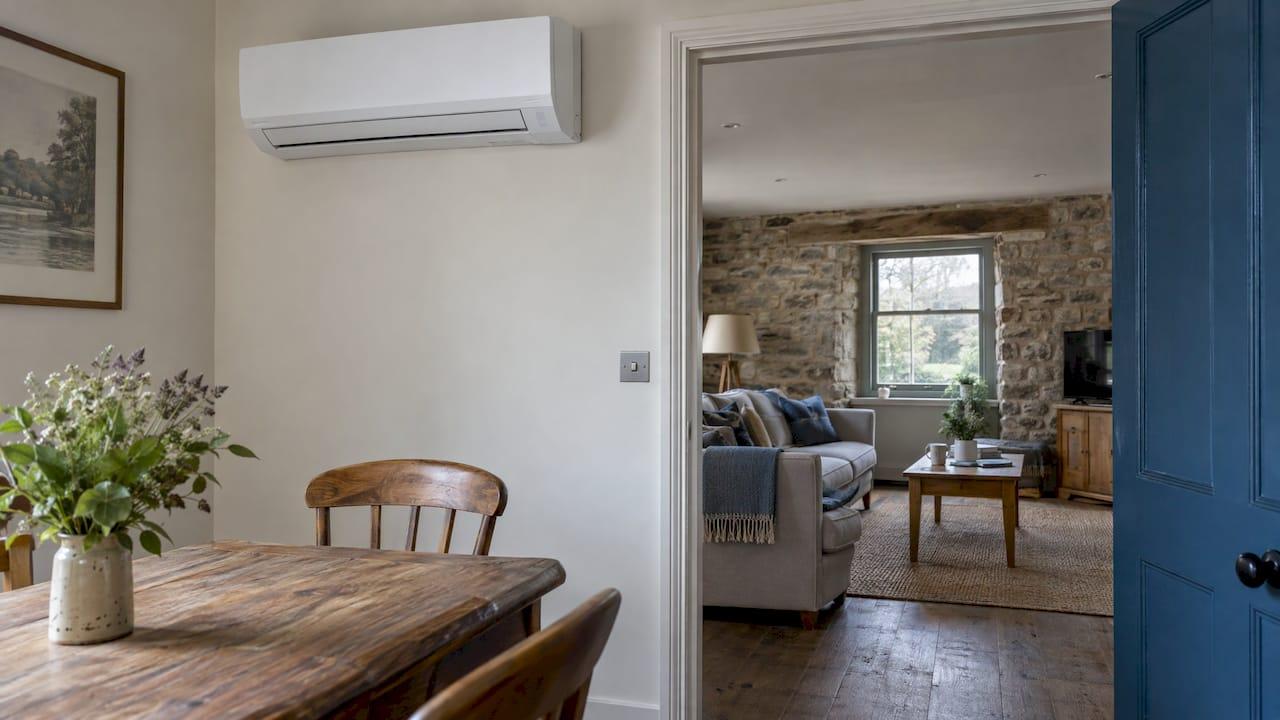
Air conditioning in a holiday let is usually a ducted-free, wall-mounted split system (or a multi-split for several rooms) fitted by an F-Gas certified installer. It rarely needs planning permission, but it does need the right outdoor unit position, a noise check and a maintenance routine that suits guest changeovers. Done well, it also heats in the shoulder months, which makes it earn its keep beyond a few hot weeks.
This guide is for owners of cottages, lodges, flats and larger houses in Devon, Cornwall and across the UK. It covers which system suits which property, what drives the cost, which rules apply and how to keep the system running through a busy season.
TL;DR
- A single-room split suits a studio or a main living space; a multi-split suits a cottage with several bedrooms. Cost depends on the number of rooms, pipe runs, brand and access.
- Most domestic installations avoid planning permission if the outdoor unit stays within size and position limits, but listed buildings, conservation areas and flats need checking first.
- Installing air conditioning is notifiable work under the Building Regulations, and the refrigerant work must be done by a certified engineer.
- Systems over 12 kW need an inspection by an accredited energy assessor at least every five years.
- Plan servicing between changeovers and know who to call out if a unit fails mid-booking.
Table of Contents
- Why owners fit air conditioning in holiday lets
- Choosing the right system for your property
- What installation and running costs depend on
- Planning permission and where the outdoor unit goes
- Safety, Building Regulations and energy rules
- Looking after the system between guests
- Beyond lets: cooling a school classroom
- Our perspective
- Plan your holiday let installation with us
- FAQ
- Sources
Why owners fit air conditioning in holiday lets
Guests increasingly look for air conditioning as a filter when they search. The top results for this topic are booking sites where "Air Con" sits next to hot tub, parking and pet-friendly as a search filter. That tells you how guests think about it: as an amenity they tick, not a technical feature they read about.
There are three practical reasons owners fit it:
- Comfort in warm spells. Top-floor rooms, converted barns and roof-light lodges can get stuffy, and guests rarely tolerate that on a paid week away.
- Heating as well as cooling. Most modern split systems are reversible heat pumps, so the same unit takes the chill off a damp October weekend.
- Fewer complaints and better reviews. A room that stays comfortable avoids the review that mentions temperature.
If you want the bigger picture before choosing, our complete buying guide to air conditioning in the UK explains how the technology works.
Choosing the right system for your property
The right system follows the layout of the property and how guests use it. Here is how the common options compare.
| System | Best for | Things to know |
|---|---|---|
| Single split (one indoor unit, one outdoor unit) | Studios, one-bedroom lets, a single living area | Simplest and most economical to fit; one outdoor unit per indoor unit |
| Multi-split (several indoor units, one outdoor unit) | Cottages and houses with two to five rooms | One outdoor unit keeps the exterior tidy; each room can be set separately |
| Ducted or concealed system | Larger properties, high-end lets, new builds or refurbishments | Hidden indoor equipment, but more building work and a bigger budget |
| Systems without an outdoor unit | Flats where an external unit is not allowed | Suited to leasehold or listed situations; see our guide to air conditioning for flats without an outdoor unit |
For smaller lets, our article on the best air conditioning for small homes is a useful starting point, and basic air conditioning systems explained covers how the parts fit together.
Which rooms to cool first
You do not have to cool the whole property. Most owners start with the spaces guests judge hardest:
- The main bedroom, because sleep drives reviews.
- The open-plan living area, where guests spend the day.
- Any room under a roof or with large south-facing glazing.
A multi-split lets you add rooms later, as long as the outdoor unit and its capacity are specified with that in mind. Tell your installer your plans at survey stage so the system is sized sensibly.
Brands and quality
Reliability matters more in a let than in a home, because a failure lands in the middle of someone's holiday. We install systems from Samsung, Mitsubishi, Toshiba and Daikin, and fit them with a view to a long service life under repeated use.
What installation and running costs depend on
No honest installer can give a figure without seeing the property, but the drivers are consistent:
- Number of rooms and indoor units. Each additional room adds equipment and labour.
- Distance between indoor and outdoor units. Longer pipe, condensate and cable runs cost more and can reduce efficiency.
- Wall construction and access. Stone cottage walls, high elevations and difficult ground take longer.
- Brand and capacity. Higher-specification systems cost more upfront and are often quieter and more efficient.
- Electrical supply. Some properties need a dedicated supply or consumer unit work.
For a rough benchmark, one published cost guide puts single-room split systems at around £1,500 to £3,000 installed, multi-room systems at £2,800 to £7,000, and whole-home ducted installs from £6,000 to £15,000 or more. Treat that as a general UK range, not a quote. Your own figure depends on the factors above, which is why we offer free surveys, and we can spread the cost with 0% finance.
Running costs
Running cost depends on how large the room is, how well it is insulated, the efficiency rating of the unit and how guests use it. Two habits keep bills down, whoever pays them:
- Set sensible temperature limits on the remote or controller, rather than leaving the range open.
- Use auto mode and, where you can, a schedule so the system is not running in an empty property.
If your lets include energy in the price, ask your installer about controllers that limit the setpoint range, so a guest cannot run the unit at its extremes all week.
Planning permission and where the outdoor unit goes
Most owners worry about planning first. The good news is that most domestic installations do not need planning permission when the outdoor unit stays under 1.5 m³ for a house or 0.6 m³ for a flat, is not on a pitched roof and sits at least 1 metre from the edge of a flat roof. In protected areas, the unit must not be on a wall or roof that fronts a highway.
That last point matters in Devon and Cornwall, where many holiday lets sit in conservation areas, national landscapes, harbours and historic villages. Before you book, check whether your property is listed, in a conservation area, or subject to a lease or covenant. Our permitted development checklist walks through the questions, and our guide to home aircon regulations covers the wider picture.
A holiday let is often a commercial use in the eyes of the planning system and your insurer, so tell your insurer and, if you are a leaseholder, your freeholder before work starts.

Noise and neighbours
Holiday lets in terraces, courtyards and small villages sit close to neighbours, so noise matters. Some councils quote a benchmark for heat pumps, for example 42 dB at 1 metre from the centre of a neighbour's habitable-room window. That is one council's published figure for air source heat pumps, so ask your own local authority what applies to you.
Practical steps to keep noise down:
- Place the outdoor unit away from bedroom windows, yours and your neighbours'.
- Avoid enclosed corners that bounce sound back.
- Use anti-vibration mounts and a stable base.
- Choose a model with a low sound rating for the capacity you need.
Our guides on outdoor unit placement and the 1 metre rule and avoiding noise complaints go into more detail.
Safety, Building Regulations and energy rules
A holiday let carries more duties than a private home because paying guests are using it. For air conditioning, these are the ones to know.
Building Regulations and F-Gas
Under the Building Regulations 2010, installing a mechanical ventilation or air conditioning system is listed as notifiable work, and there is a specific category for a system in a dwelling that does not involve shared systems. That applies in England and Wales, and your installer should explain how the notification or competent-person route is handled on your job.
The refrigerant circuit must be handled by a certified engineer. Our engineers are F-Gas certified and REFCOM registered, and we use our own engineers rather than subcontractors. Our article on why professional installation matters explains the risks of the alternative.

Inspections for larger systems
Most holiday lets use small systems, but a large house, a lodge park building or a multi-unit conversion might not. Air conditioning systems with an effective rated output greater than 12 kW must be inspected by an accredited energy assessor no more than five years apart, under the Energy Performance of Buildings Regulations for England and Wales. Add the rated outputs of systems in the same building when you check, and ask your installer to confirm the total.
Energy performance certificates
EPC rules for holiday lets depend on how you let. An EPC is required for a furnished holiday let only where it is occupied on short-term lets of 31 days or less per tenant, is let for a combined total of four months or more in any 12-month period, and the occupier pays the energy costs. Many owners include energy in the rate, so check where you fall. A heat pump based system can help the heating side of the picture, but it does not replace the certificate where one is required. Rules in this area change, so confirm the current position on GOV.UK or with your local trading standards team.
Looking after the system between guests
A holiday let system works harder and gets used by people who do not know it. That makes routine care the difference between a trouble-free season and a call at 9pm on a Saturday.
A simple routine
- Filters: have them cleaned regularly, and between busy changeovers if guests have been heavy users.
- Remotes: keep a laminated one-page guide in the property, with a spare set of batteries.
- Condensate drains: check they are clear, as blocked drains cause leaks that stain ceilings.
- Annual service: book it in the quietest part of your year, so it does not clash with bookings.
Our seasonal service checklist and F-Gas rules explains what each visit covers. We offer annual service contracts and an emergency breakdown response, so a fault does not become a refund. If you manage several properties, tools such as maintenance coordination by text can help you log guest-reported faults and keep a record of each visit.
What to put in your guest guide
Guests who understand the system use it well. Cover these points:
- Keep doors and windows closed while it runs.
- A sensible temperature is a few degrees below the outside heat, not the lowest setting.
- Who to call if it stops working, and what to check first (power, batteries, mode).
Beyond lets: cooling a school classroom
Some readers arrive here after searching for school classroom cooling, so a short note. UK schools face overheating more often, and the issue is both comfort and air quality. The DfE has said there is no maximum temperature limit for UK workplaces including schools, but it is considering proposals from the Climate Change Committee, according to the BBC.
Any cooling solution in a classroom has to sit alongside ventilation. The DfE's BB101 guidance says that where mechanical ventilation is used in teaching spaces, enough outdoor air should keep the daily average CO2 below 1000 ppm, with the maximum not exceeding 1500 ppm for more than 20 consecutive minutes a day. A commercial installer should design cooling around those targets. We cover commercial work through our shop fitting and commercial service.
Our perspective
We install a lot of air conditioning for people who earn from their property, and the pattern is clear. The owners who are happiest a few summers later made three decisions early: they chose a quality system, they put the outdoor unit somewhere sensible, and they set up a service plan before anything went wrong.
A holiday let is a hard environment for equipment. Different guests, short stays, units left on or off at random. That is why we favour premium systems from Samsung, Mitsubishi, Toshiba and Daikin and a proper survey, rather than the cheapest box that can be fitted in a day.
Our engineers are local, F-Gas certified and REFCOM registered, and we do not use subcontractors. Most installations are completed in one to two days, which means little disruption to your booking calendar. Where the diary is tight, same-day and next-day installs can be possible.
If you are considering air conditioning, get it surveyed, get the placement and noise right, and put servicing in place from day one. The rest follows.
James
Plan your holiday let installation with us
We design and install air conditioning for homes and holiday lets across Exeter, Devon, Cornwall and the wider South West. You get a free survey, a system matched to your property and a fixed plan for timing around your bookings. We offer 0% finance, so you can spread the cost.
Start with our domestic installation service to book a survey, or look at our service plans to keep the system reliable between guests. If something stops working, use our fault report page.
FAQ
Do I need planning permission for air conditioning in a holiday let?
Usually not, if the outdoor unit stays within the permitted development limits for size and position. Listed buildings, conservation areas, flats and leasehold properties need extra checks. Speak to your local planning authority, or ask us to confirm at survey stage.
Can the same system heat the holiday let?
Most modern split systems are reversible, so they cool in summer and heat in cooler months. That makes them useful for spring and autumn lets. Your installer can confirm the heating output of the exact model you choose.
How long does installation take?
Our installations are typically completed within one to two days. Larger multi-room or ducted projects take longer, and we confirm timing at survey. Same-day and next-day installs can be available, subject to the job.
Who should service the system?
A certified engineer should do it, particularly because the refrigerant circuit is involved. An annual service contract gives you a set routine and a quick route to help if there is a fault. Ask about timing the visit outside your peak weeks.
Sources
- How Much Does Air Conditioner Installation Cost? (Airtasker)
- 7 UK Planning Permission Rules for Air Conditioning
- Permitted Development, Cotswold District Council
- The Building Regulations 2010, legislation.gov.uk
- Air conditioning inspections for buildings, GOV.UK
- Energy Performance Certificates, Business Companion
- Are hot schools putting pupils and teachers at risk? BBC News
- BB101: Guidelines on ventilation, thermal comfort and indoor air quality in schools