
Air conditioning moves heat from inside a space to outside it, using a refrigerant cycle to cool, dehumidify, and circulate air. The Cambridge Dictionary draws a useful distinction: "air conditioning" refers to the process or system, while "air conditioner" is the machine that delivers it. In everyday British usage, both terms and the shorthand "air con" mean the same thing.
If your home or business regularly hits uncomfortable temperatures, suffers from poor air quality, or needs year-round climate control, a properly sized and installed system is the right answer. Fans and open windows manage mild days; they cannot reliably cool a room above 28°C or control humidity. Before you request quotes, do three things:
- Measure each room you want to cool (length × width × ceiling height in metres).
- Decide whether you need cooling only or heating and cooling combined.
- Confirm that any installer you approach holds F-Gas/REFCOM certification — refrigerant handling is a legal requirement, not a preference.
Table of Contents
- What types of air conditioning system suit UK homes and businesses?
- How do you choose the right air conditioner for your home?
- Sizing, typical UK costs and realistic installation timelines
- What are the UK legal requirements for air conditioning installation?
- How much does air conditioning cost to run, and what maintenance does it need?
- Common faults, quick checks and when to call a professional
- Why does professional system design matter so much?
- Key takeaways
- What installers wish UK homeowners understood
- Frostairconditioning: certified installation across Exeter and the South West
- Useful sources for further reading
What types of air conditioning system suit UK homes and businesses?
The system type you choose shapes everything: installation cost, disruption, running cost, and whether the unit can heat as well as cool. Here is how the main options stack up in a UK context.
Portable units require no installation at all. You position them, vent the exhaust hose through a window, and plug them in. They suit renters, listed buildings where external works are prohibited, or anyone who needs temporary cooling in a single room. The trade-off is noise (typically 50–60 dB), lower efficiency, and the fact that they cool only the room they are in.
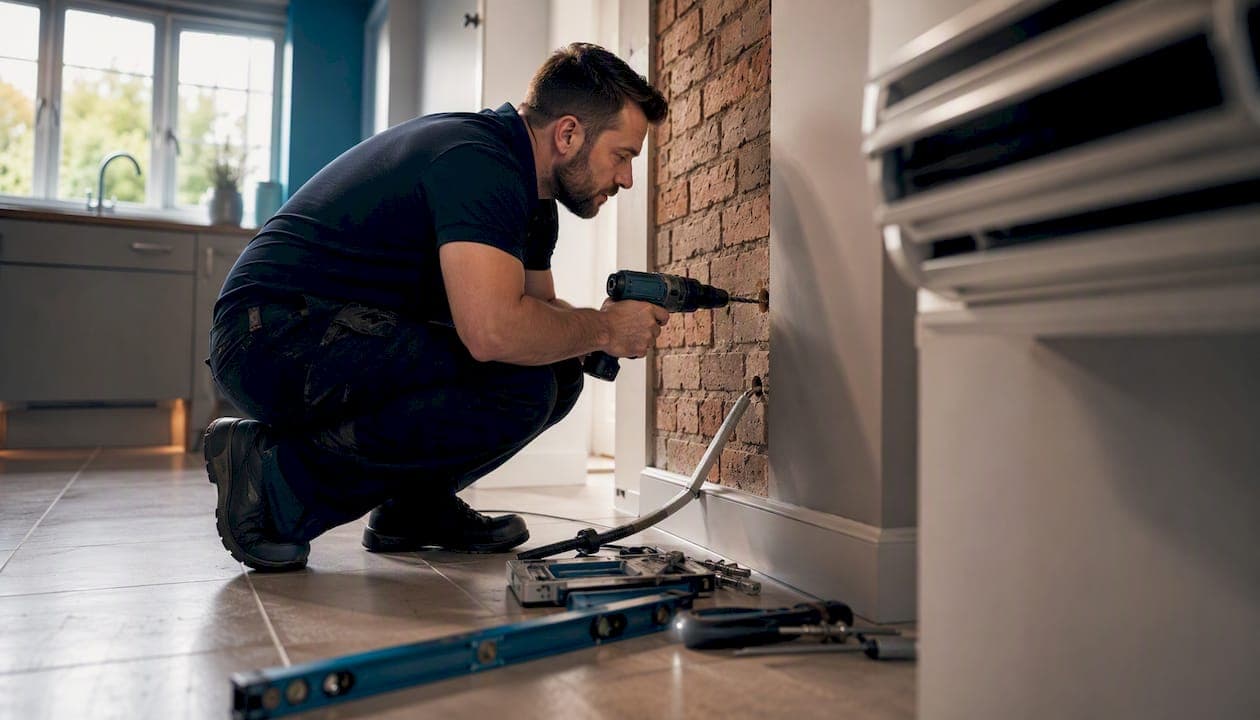
Wall-mounted split systems (also called mini-splits or single splits) are the most popular choice for UK homes. One indoor unit pairs with one outdoor compressor. They are quiet, efficient, and can heat as well as cool when specified as reverse-cycle units. Installation is relatively straightforward: the engineer drills a small core hole for the refrigerant lines and cables, mounts both units, and commissions the system. A single room or open-plan space is the natural fit.
Multi-split systems extend the same principle: one outdoor unit serves two to five indoor units in different rooms. This avoids multiple outdoor compressors on the building facade, which matters for planning and aesthetics. The upfront cost is higher, but the per-room running cost tends to be lower than running separate single splits.
Cassette units sit flush in a suspended ceiling and distribute air in four directions simultaneously. They are the standard choice for offices, retail units, and commercial spaces where wall space is limited or aesthetics matter. Installation requires ceiling access and is more involved than a wall-mounted split.
Ducted systems (sometimes called central air in American usage) distribute conditioned air through concealed ductwork to grilles in each room. They are invisible once installed and suit new builds or major renovations where duct runs can be planned from the outset. Retrofitting ductwork into an existing UK property is expensive and disruptive; in most cases, a multi-split is a more practical alternative.
Floor-standing units work like wall-mounted splits but sit on the floor. They suit rooms where wall mounting is impractical, such as spaces with full-height glazing or low ceilings.
Air-source heat pumps with cooling capability are worth considering if you are also replacing or supplementing a heating system. They operate on the same refrigerant cycle as a split system but are sized and designed for whole-home heating loads. The US Department of Energy notes that correct sizing and efficiency ratings significantly influence running costs, and this is especially true for heat pumps operating across a wide temperature range.
System comparison at a glance
| System type | Best for | Typical capacity | Installation | Heating capability | Approx. cost band (unit + install) |
|---|---|---|---|---|---|
| Portable unit | Temporary / rental / listed buildings | 7,000 BTU | DIY | No (most models) | — |
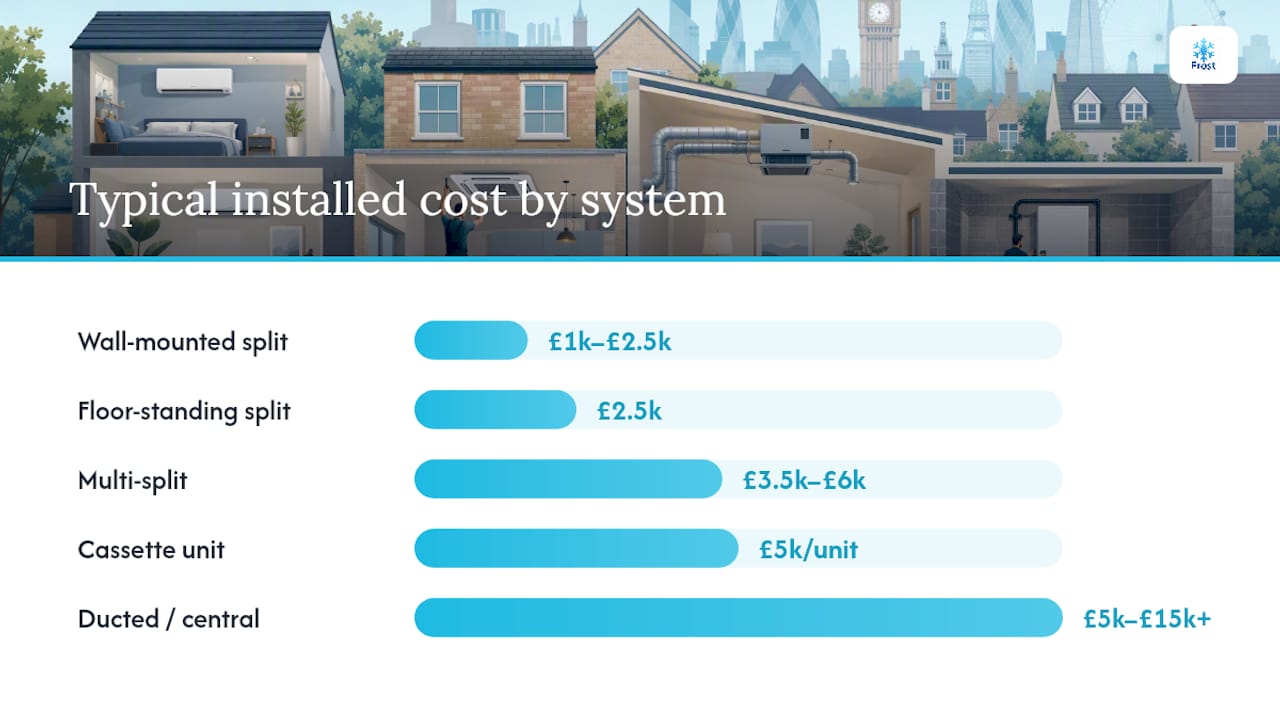
| Wall-mounted split | Single rooms, flats, home offices | 5,000 BTU | Professional | Yes (reverse-cycle) | £1,000–£2,500 |
| Multi-split | Multi-room homes, small offices | — | Professional | Yes | £3,500–£6,000 |
| Cassette | Commercial, retail, open-plan offices | — | Professional | Yes | £5,000 per unit |
| Ducted / central | New builds, whole-house | — | Professional (major works) | Yes | £5,000–£15,000+ |
| Floor-standing split | Rooms with limited wall space | 9,000 BTU | Professional | Yes | £2,500 |
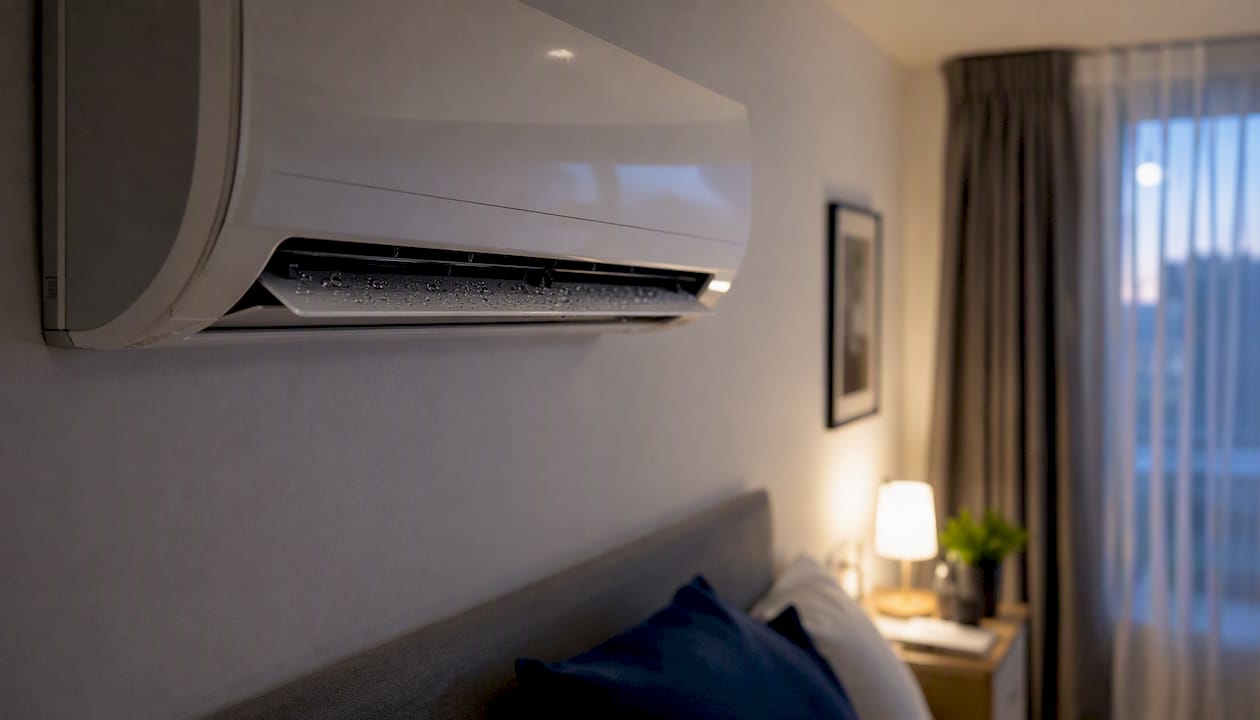
Pro Tip: Humidity control is often overlooked when comparing systems. A correctly sized split system dehumidifies as it cools; an oversized unit short-cycles (switches off before completing a full cooling run) and leaves the air feeling clammy even at the right temperature. Portable units dehumidify less effectively than split systems at equivalent BTU ratings. If your space has a damp problem, factor this into your choice — air conditioning can meaningfully improve indoor air quality when the system is correctly matched to the space.
How do you choose the right air conditioner for your home?
Three criteria matter more than anything else: correct sizing, installer competence, and efficiency rating. Get all three right and you will have a system that performs well for 15 years or more. Get one wrong and you will spend that time managing problems.
The three non-negotiables
-
Correct sizing. A unit that is too small runs constantly and never reaches the set temperature. One that is too large short-cycles, wastes energy, and leaves humidity uncontrolled. Neither is acceptable. A proper load calculation (following CIBSE guidance or the equivalent of ASHRAE's Manual J method) accounts for room volume, glazing, insulation, occupancy, and local climate — not just floor area.
-
Installer competence. The installer's F-Gas/REFCOM certification is the baseline. Beyond that, ask whether they carry out a site survey before quoting, whether they provide written commissioning records, and whether they can supply references from comparable projects.
-
Efficiency rating. The ErP energy label (used across the UK and EU) rates units on a scale from A+++ to D for cooling and heating. The SEER (Seasonal Energy Efficiency Ratio) figure tells you how efficiently the unit cools across a full season; a higher SEER means lower electricity bills. The Department of Energy recommends prioritising efficiency ratings when comparing models, as they directly determine running costs over the system's lifetime.
Questions to ask any installer before you sign
- Can you provide a written load calculation for my space?
- What refrigerant does the unit use, and what is its Global Warming Potential (GWP)?
- What warranty does the manufacturer offer, and does your installation come with a workmanship guarantee?
- Are you REFCOM-registered, and can I see your F-Gas certificate?
- Will you provide written commissioning and test records on completion?
- Do you carry out the electrical work yourselves, or will I need a separate electrician?
When does a reverse-cycle (heat pump) unit make sense?
If you currently heat with electric panel heaters or storage heaters, a reverse-cycle split system almost always delivers the same heat output for less electricity, because it moves heat rather than generating it. For homes with gas central heating, the case is more nuanced and depends on your tariff and usage patterns. A guide to choosing the right system can help you work through the trade-offs before you speak to an installer.
Typical cost ranges to set expectations: a single wall-mounted split system including supply and installation runs from roughly £1,000 to £2,500 for most UK homes. A multi-split serving three rooms typically falls between £3,500 and £6,000. Ducted whole-house systems start at around £5,000 and can reach £15,000 or more depending on the property.
Sizing, typical UK costs and realistic installation timelines
Always commission a professional load calculation before buying. Rules of thumb can provide rough estimates but ignoring factors like ceiling height, glazing, insulation, and climate can lead to significant oversizing or undersizing of systems.
Quick sizing reference
| Room size (approx.) | Indicative capacity needed | Typical system |
|---|---|---|
| Small bedroom | Small system suitable for small rooms | |
| Medium living room | Medium capacity system for average living spaces | |
| Large open-plan | Larger units or multi-zone systems suitable for open-plan areas | |
| Whole house | Systems designed for multiple rooms or whole-house coverage |
These figures assume standard UK ceiling heights (2.4 m) and average insulation. A south-facing room with large glazing may need 20–30% more capacity.
Typical UK installation cost bands
| Scope | Unit cost (approx.) | Installation cost (approx.) | Total range |
|---|---|---|---|
| Single wall-mounted split | — | — | £1,000–£2,500 |
| Multi-split (3 indoor units) | — | — | £3,500–£6,000 |
| Ducted whole-house | — | — | £5,000–£15,000+ |
How long does installation take?
A single wall-mounted split system is typically a one-day job for an experienced engineer. A professional installation involving a multi-split or ducted system usually takes one to three days depending on the number of indoor units and the complexity of the pipework runs. Whole-house ducted replacements can take longer if electrical upgrades or structural works are involved.
Additional costs to budget for: electrical circuit upgrades (if the existing consumer unit cannot support the load), scaffolding for high outdoor unit positions, condensate drain runs, and line-set insulation. None of these is unusual; a thorough site survey will identify them before work begins.
What are the UK legal requirements for air conditioning installation?
The short answer: refrigerant handling and full system installation require F-Gas/REFCOM-qualified technicians. Attempting this work without certification is illegal under UK F-Gas regulations, risks significant fines, and almost always voids the manufacturer's warranty.
UK F-Gas regulations require that anyone who handles fluorinated greenhouse gases (the refrigerants used in virtually all modern air conditioning systems) holds a recognised qualification and works for a company registered with an approved certification body. REFCOM is the UK's primary certification scheme for refrigeration and air conditioning contractors. Membership means the company has demonstrated competence in safe refrigerant handling, recovery, and charging.
What this means for homeowners and landlords
- You cannot legally purchase refrigerant yourself or ask an unqualified person to top up or recover it.
- If a system is installed without certified refrigerant handling, the manufacturer's warranty is void from day one.
- Landlords have additional obligations: if a property has a system with an effective rated output above 12 kW, regular air conditioning inspections are required under UK building regulations.
- Any installer who cannot produce a current F-Gas certificate and REFCOM registration number should be declined.
Before work begins: a compliance checklist
- Confirm the installer's REFCOM registration number (verifiable on the REFCOM website).
- Check whether permitted development rights cover the outdoor unit position, or whether planning consent is needed (relevant for listed buildings, conservation areas, and some flats).
- Confirm that electrical works will be carried out by a Part P-registered electrician or notified to building control.
- Ask for written commissioning records and a refrigerant charge certificate on completion.
- Keep all paperwork: you will need it for warranty claims and, if you are a landlord, for compliance records.
Pro Tip: Verifying REFCOM registration takes under two minutes at the REFCOM website. Search by company name or registration number. If a contractor cannot provide their number before you sign anything, that is a clear signal to look elsewhere.
Improper installation is one of the leading causes of early system failure and inflated energy bills. Refrigerant undercharge, incorrect pipe sizing, and poor electrical connections are all common consequences of unqualified work — and none of them show up immediately.
How much does air conditioning cost to run, and what maintenance does it need?
Planned maintenance and efficient operation cut running costs and extend system life. The baseline is an annual professional service before the cooling season, combined with regular filter care throughout the year.
Homeowner maintenance checklist
- Filters: clean or replace every four to six weeks during heavy use. Blocked filters reduce airflow, force the compressor to work harder, and can cause the evaporator coil to ice over. This is the single most impactful thing a homeowner can do between service visits. A practical cleaning guide covers the steps safely.
- Outdoor unit: keep the area around the condenser clear of vegetation, debris, and garden furniture. Restricted airflow over the condenser coil reduces efficiency noticeably.
- Condensate drain: check that the drain line is clear and flowing freely. A blocked drain causes water to back up into the unit and can result in ceiling or wall damage. A properly sloped drain with a safety float switch prevents overflow, but the drain still needs periodic clearing.
- Line-set insulation: inspect the insulation on the refrigerant pipes annually. UV degradation causes the insulation to crack and crumble, allowing heat to enter the suction line and reducing efficiency quietly over time. Replacement insulation is inexpensive.
ENERGY STAR recommends that contractors carry out a pre-season checkup each year, covering refrigerant level, electrical connections, coil condition, and thermostat calibration. This aligns with UK government guidance on air conditioning inspections, which emphasises that neglected systems lose efficiency and carry a higher risk of failure.
Running cost: what to expect
Running cost depends on the unit's SEER rating, how many hours per day it operates, and your electricity tariff. A rough calculation: a 3.5 kW (12,000 BTU) split system with a SEER of 6 (a reasonable mid-range figure for an older or budget unit) draws around 0.58 kW of electricity per hour of cooling. At a typical UK unit rate of around 24p per kWh, that is roughly 14p per hour. A modern A+++ unit with a SEER above 8 would draw considerably less for the same cooling output. Running it eight hours a day across a three-month summer season adds up to a meaningful difference over the system's lifetime.
For practical tips on reducing that figure further, boosting energy efficiency at home covers thermostat settings, zoning, and reducing solar heat gain through shading and glazing treatment.
When to book a service visit rather than self-maintain
Call an engineer if: the unit is not reaching the set temperature despite clean filters; you notice ice forming on the indoor unit; the system trips the RCD; or you can smell anything unusual near the indoor or outdoor unit. These are not homeowner-fixable issues.
Common faults, quick checks and when to call a professional
Simple checks resolve many common problems. Stop and call an engineer for refrigerant leaks, electrical faults, or water overflow.
Red flags that require immediate professional attention
- Smell of refrigerant (a faint chemical or sweet smell near the indoor unit).
- Visible oil staining on refrigerant line connections or the outdoor unit.
- RCD tripping when the unit starts.
- Sparking or burning smell from any component.
- Water overflow from the indoor unit that the drain cannot explain.
When reporting a fault for a warranty claim, photograph the unit, the outdoor connections, and any visible damage or staining before the engineer arrives. Written records of when the fault appeared and what you observed support the claim considerably.
Why does professional system design matter so much?
Professional design and commissioning reduce failures, improve humidity control, and cut long-term costs more reliably than simply buying a higher-rated unit. This is the finding that CIBSE and ASHRAE consistently emphasise: correct airflow, refrigerant charge, and commissioning determine real-world performance, not the specification sheet.
The consequences of getting design wrong are specific and predictable. An oversized unit short-cycles: it reaches the set temperature quickly, switches off, and the room reheats before humidity has been adequately removed. The result is a space that feels cool but clammy. An undersized unit runs continuously, never reaches the set temperature on hot days, and wears the compressor out prematurely. Poor airflow design creates hot and cold spots, forces the system to work harder than necessary, and accelerates coil fouling.
None of these problems are fixed by buying a better unit. They are fixed by getting the design right before installation begins.
Frostairconditioning's engineers carry out a full site survey before every installation, producing a load calculation that accounts for the specific characteristics of your property. F-Gas certification and REFCOM registration mean that refrigerant handling meets UK legal standards, and written commissioning records are provided on completion of every job. For homeowners and businesses in Exeter and across the South West, that combination of local knowledge and certified competence is what separates a system that performs for 15 years from one that causes problems within the first two.
Key takeaways
A correctly sized, professionally installed, and annually serviced air conditioning system is the most reliable way to achieve comfortable temperatures and controlled humidity in a UK home or business.
| Point | Details |
|---|---|
| Measure before you buy | Calculate room volume (length × width × height) and share it with your installer for a proper load calculation. |
| Match system type to your building | Split systems suit most UK homes; multi-splits serve several rooms; cassettes and ducted systems suit commercial spaces. |
| Certification is non-negotiable | Verify REFCOM registration before signing any contract — refrigerant work without F-Gas certification is illegal. |
| Annual service preserves efficiency | Book a professional pre-season service each year and clean filters every four to six weeks during use. |
| Frostairconditioning covers the South West | F-Gas certified, REFCOM-registered, with same-day installs available and 0% finance for eligible customers in Devon, Cornwall, and the wider South West. |
What installers wish UK homeowners understood
Most of the problems I see on site trace back to decisions made before the engineer arrived. A homeowner chose a unit online because it was on offer, had it fitted by someone who quoted cheapest, and is now calling us because the room is still hot in August or the system trips the electrics every few days.
The unit brand matters less than people think. Daikin, Mitsubishi Electric, Samsung, LG, Toshiba, and De'Longhi all make reliable equipment when it is correctly specified and installed. The difference between a system that works brilliantly and one that disappoints almost always comes down to the load calculation, the refrigerant charge, and the quality of the electrical connection. Those are installer decisions, not manufacturer decisions.
The other thing I would tell every homeowner: do not wait until July to book. Pre-season installs in April and May go smoothly; emergency calls in a heatwave mean longer waits, higher stress, and sometimes a compromise on the unit available. Book early, get the survey done properly, and the installation itself is straightforward.
Frostairconditioning: certified installation across Exeter and the South West
If you have read this far and you are ready to move from research to action, Frostairconditioning offers something most online quotes cannot: a certified engineer at your door, often the same day, with the paperwork to prove it.

Frostairconditioning installs and maintains air conditioning systems for homes and businesses across Devon, Cornwall, and the wider South West. Every engineer holds F-Gas certification and REFCOM registration. The team supplies and fits systems from Daikin, Mitsubishi Electric, Samsung, and Toshiba, with 0% finance available for eligible customers so the upfront cost does not have to be a barrier. Annual maintenance contracts and emergency breakdown cover are available alongside new installations, and commercial clients can enquire about bespoke shop-fitting packages for retail and hospitality spaces.
To get a quote or book a site survey, visit the domestic installation page or request a quote directly. Same-day and next-day appointments are available subject to engineer availability.
Useful sources for further reading
A short list of primary sources worth bookmarking if you want to verify regulatory points or dig deeper into efficiency guidance:
- AIR CONDITIONING | English meaning - Cambridge Dictionary
- Fluorinated gas (F‑gas) guidance for users, producers and traders - GOV.UK
- A guide to air conditioning inspections in buildings - GOV.UK
- Chartered Institution of Building Services Engineers (CIBSE)
- Top ten things consumers should know about air conditioning - ASHRAE
- Air Conditioning | Department of Energy
- AC installation guide - Bryant
- Maintenance checklist | ENERGY STAR
For site-specific guidance, always consult a REFCOM-registered installer. Keep copies of all commissioning paperwork: you will need them for warranty claims, landlord compliance records, and any future inspection.