
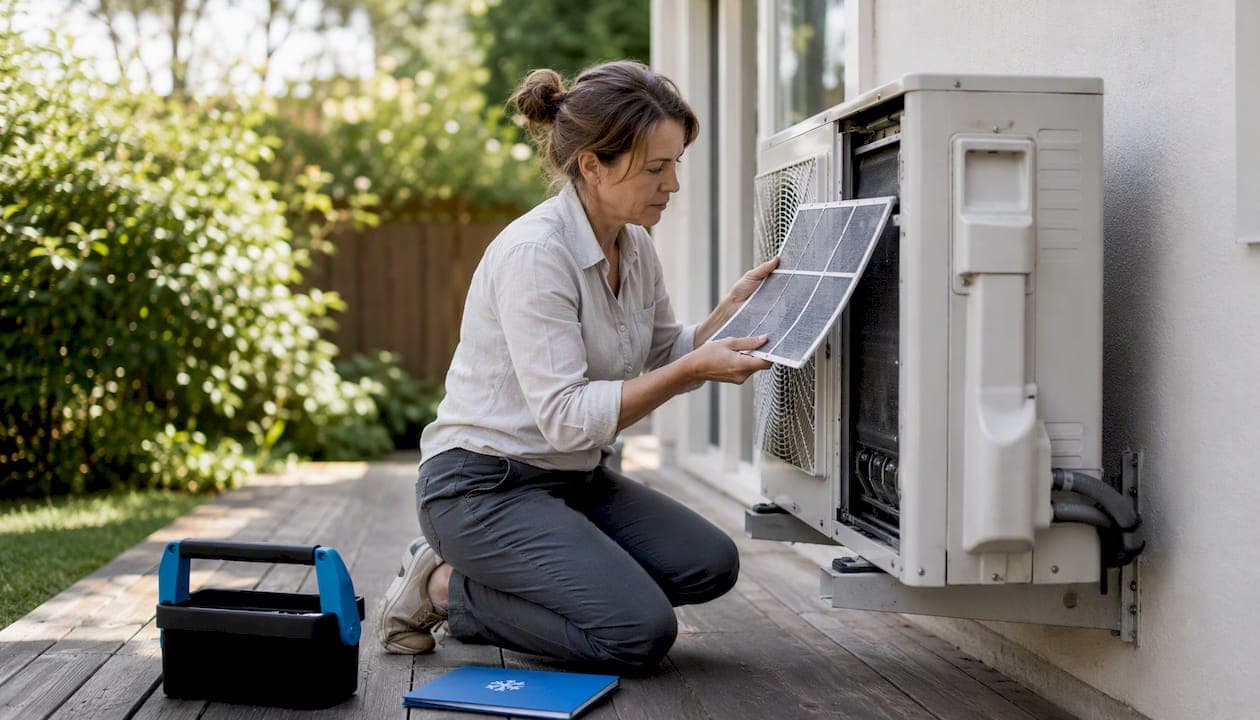
A basic air conditioning system does not create cold air. It moves heat and humidity out of your home using a refrigerant that loops continuously through four components: the evaporator, the compressor, the condenser, and the expansion valve. That loop is the refrigeration cycle, and understanding it is all you need to make sense of how your system behaves, why it fails, and what you can do about it.
The four main components at a glance:
- Evaporator — the indoor coil that absorbs heat from your room air
- Compressor — the pump that pressurises the refrigerant and drives it around the circuit
- Condenser — the outdoor coil that releases the heat to outside air
- Expansion valve — the control that drops refrigerant pressure so it can absorb heat again
One thing to remember above everything else: check your filters regularly and book a professional service once a year. Those two habits prevent the vast majority of problems homeowners encounter.
Table of Contents
- What does each part of an AC system actually do?
- How the refrigeration cycle works, step by step
- What types of air conditioning systems are common in UK homes?
- How AC affects humidity, ventilation, and indoor air quality
- What drives running costs, and how do you keep them down?
- Routine maintenance you can do yourself, and when to call an engineer
- Common problems and how to triage them
- Signs it might be time to replace your system
- Why annual professional maintenance matters more than most people realise
- Key takeaways
- What installers see that homeowners miss
- Frostairconditioning: professional installation and servicing across the South West
- Useful sources and further reading
What does each part of an AC system actually do?
Understanding the components individually makes air conditioning basics far less mysterious. Each part has a specific job, a specific location, and a specific way of failing.
Evaporator coil
The evaporator sits inside your home, usually within the indoor unit of a split system or inside the air handler of a ducted setup. Warm room air passes over the cold coil, the refrigerant inside absorbs that heat, and the air leaving the coil is noticeably cooler. Moisture in the air condenses on the coil surface at the same time, which is how AC dehumidifies. Your filters sit just upstream of the evaporator, protecting it from dust and debris.
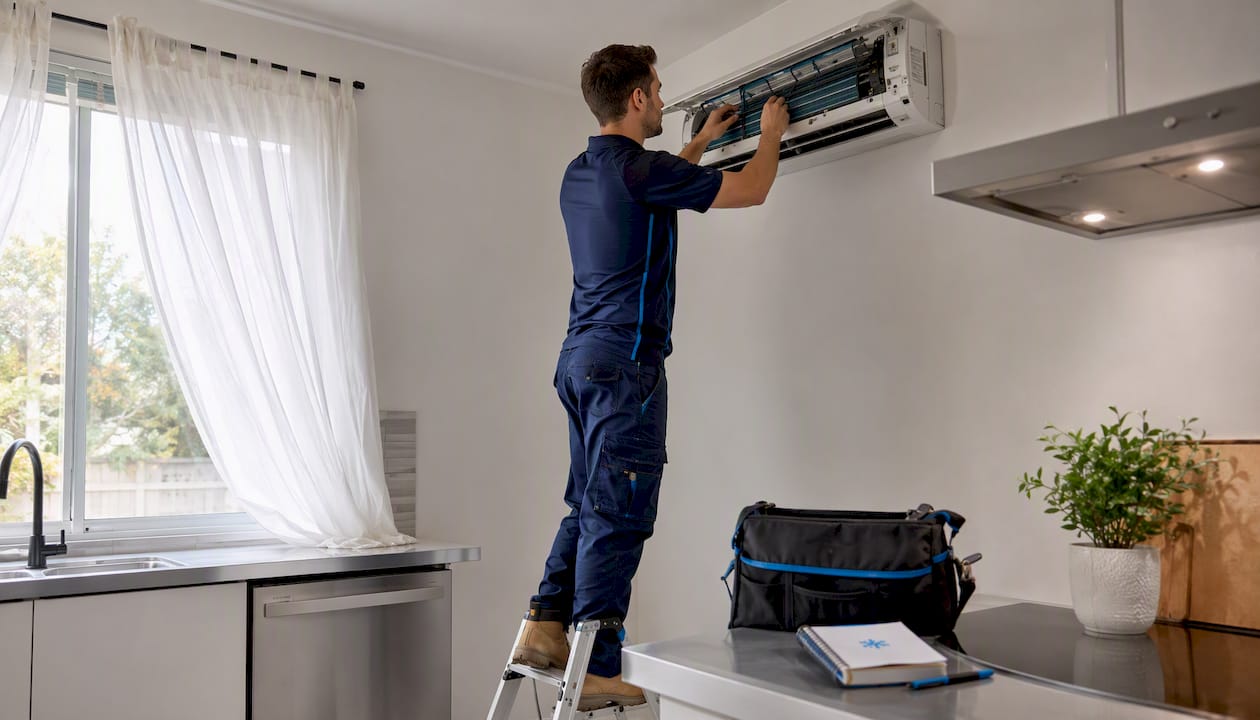
When it fails: a frozen coil (ice visible on the indoor unit) usually points to restricted airflow from a blocked filter, or to low refrigerant. A dripping indoor unit often means the condensate drain is blocked rather than the coil itself being faulty.
Compressor
The compressor is the heart of the system and lives in the outdoor unit. It takes the low-pressure refrigerant gas from the evaporator and squeezes it to a high pressure and high temperature so it can release heat outdoors. Think of it as the pump that keeps the whole cycle moving.
When it fails: a loud grinding or rattling from the outdoor unit, or a unit that runs but produces no cooling, often points to compressor trouble. Compressor replacement is expensive, which is why catching refrigerant leaks and dirty coils early matters so much.
Condenser coil and fan
Also in the outdoor unit, the condenser coil is where the hot, high-pressure refrigerant gives up its heat to the outside air. The fan draws air across the coil to speed that process up. On a warm day you can feel the warm air blowing out of the top or side of your outdoor unit — that is the heat your system has removed from your home.
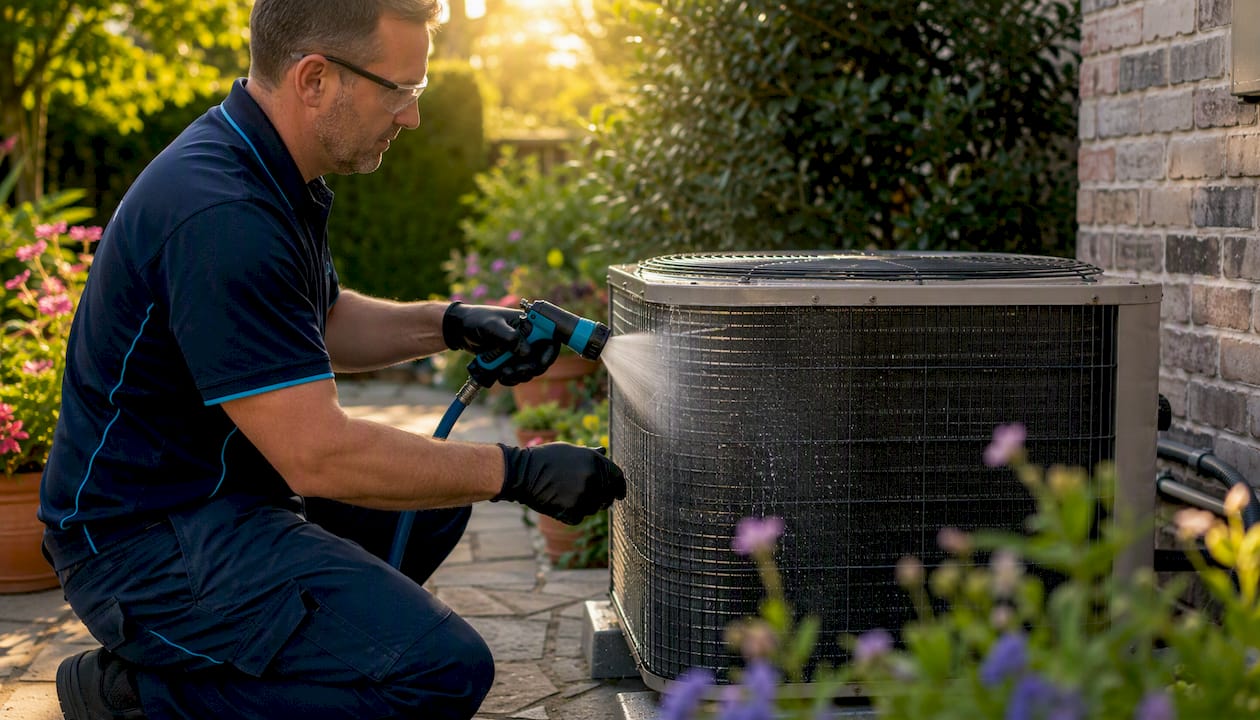
When it fails: a blocked or dirty condenser (leaves, debris, overgrown plants) forces the compressor to work harder and raises running costs. Reduced airflow from the outdoor fan produces similar symptoms.
Expansion valve (or capillary tube)
The expansion valve sits between the condenser and the evaporator. It reduces the refrigerant pressure sharply, which drops its temperature so it arrives at the evaporator ready to absorb heat again. Older or simpler systems use a fixed capillary tube instead of a variable valve, but the principle is identical.
When it fails: symptoms are often subtle — inconsistent cooling, icing on the evaporator, or the system short-cycling. This is a job for a qualified engineer.
Supporting components
- Thermostat — the control centre; HVAC instructors describe it as the system's brain, and understanding its settings makes basic diagnosis much easier
- Blower fan — circulates indoor air across the evaporator coil
- Refrigerant lines — insulated copper pipes connecting the indoor and outdoor units
- Ductwork — in central systems, the network of channels that distributes conditioned air throughout the building
How the refrigeration cycle works, step by step
The refrigeration cycle runs continuously whenever your system is on. Picture it as two sides: a cold indoor side and a hot outdoor side, with refrigerant shuttling heat from one to the other.
Step 1 — Evaporation (cold side, indoors) Liquid refrigerant enters the evaporator coil at low pressure and low temperature. Warm room air passes over the coil; the refrigerant absorbs that heat and boils into a low-pressure gas. The air leaving the coil is cooler and drier. What you notice: cool air from the vents, and a trickle of water from the condensate drain outside.
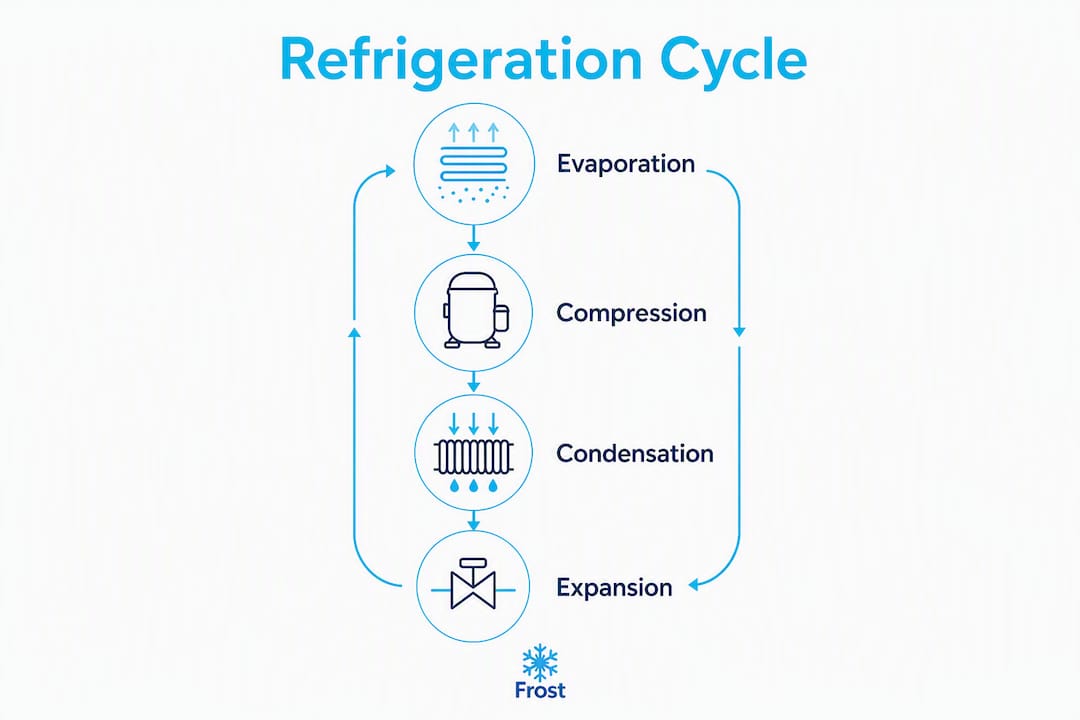
Step 2 — Compression The low-pressure gas travels to the compressor, which squeezes it to a much higher pressure. Compressing the gas also raises its temperature significantly — the refrigerant is now a hot, high-pressure gas. What you notice: the outdoor unit starts running; you can hear the compressor cycle on and off as the thermostat calls for cooling.
Step 3 — Condensation (hot side, outdoors) The hot gas moves to the condenser coil. The outdoor fan blows air across it, the refrigerant releases its heat to the outside air, and it condenses back into a warm liquid. What you notice: warm air blowing from the outdoor unit — perfectly normal.
Step 4 — Expansion The warm liquid passes through the expansion valve, which drops its pressure and temperature sharply. It arrives back at the evaporator as a cold, low-pressure liquid ready to absorb heat again, and the cycle repeats. What you notice: a brief hissing sound near the indoor unit as the valve opens is normal on some systems.
The cycle pauses when the thermostat is satisfied and restarts when the room temperature rises again. That on/off pattern is called cycling, and short, frequent cycles often indicate an oversized system or a refrigerant issue.
What types of air conditioning systems are common in UK homes?
The types of air conditioning systems available in the UK vary considerably in cost, complexity, and suitability. Here is a plain-English guide to the main options.
Split (wall-mounted) systems
A single indoor wall unit paired with one outdoor condenser. This is the most common type installed in UK homes and small offices. Installation requires drilling a small hole through the wall for the refrigerant lines and a cable.
- Pros: quiet, efficient, no ductwork needed, cools a single room well
- Cons: one unit per room (unless you upgrade to multi-split), visible wall unit indoors
- Best for: bedrooms, living rooms, home offices
Ducted (central) systems
An air handler in the loft or a cupboard distributes conditioned air through ducts to every room via ceiling or floor registers. Common in larger homes and commercial buildings.
- Pros: whole-home comfort, no visible indoor units, can integrate with heating
- Cons: higher installation cost, duct leakage can waste 20–40% of conditioned air in poorly sealed systems, requires loft or ceiling space
- Best for: new builds or properties with existing ductwork
Multi-split and VRF-style systems
Multiple indoor units (two, three, or more) connected to a single outdoor condenser. Each indoor unit operates independently, so you can cool the bedroom while leaving the living room off.
- Pros: flexible zoning, one outdoor unit for multiple rooms, efficient at part load
- Cons: higher upfront cost, more complex installation
- Best for: homes or small businesses needing cooling in several rooms without ductwork
Heat-pump variants
Most modern split and multi-split systems are reversible heat pumps — they can heat in winter and cool in summer by reversing the refrigerant flow. Given the UK's mild winters, a heat pump can cover both seasonal needs from a single system, which makes it an increasingly popular choice.
Portable and window units
Portable units require no installation beyond a window vent kit, and window units sit in a standard window frame. Both are affordable entry points.
- Pros: no installation required, low upfront cost
- Cons: noisier, less efficient, limited cooling capacity, the exhaust hose reduces window security
- Best for: renters, temporary cooling, or rooms where a permanent install is not possible
Quick selection checklist:
- Room size and ceiling height (determines the output needed in BTU or kW)
- Insulation quality (a poorly insulated room needs more capacity)
- Whether existing ductwork is present
- Planning permission: external condenser units in listed buildings or conservation areas may need consent
How AC affects humidity, ventilation, and indoor air quality
Air conditioning does more than cool. According to ASHRAE, it also manages humidity, supports ventilation, and can help filter indoor air — three things homeowners often overlook.
Humidity removal
When warm, humid air passes over the cold evaporator coil, moisture condenses on the coil surface, just as it does on a cold glass on a summer day. That water drains away through the condensate line. The result is air that feels cooler and more comfortable even at the same temperature. On a humid British summer day, this dehumidification effect is often what makes the biggest difference to comfort.
Filters and air quality
The filter sits upstream of the evaporator and catches dust, pollen, pet dander, and other airborne particles before they coat the coil. A clean filter protects the coil and keeps airflow strong. A blocked one does the opposite: it restricts airflow, reduces cooling, and can cause the coil to ice over.
Filters are rated by their ability to catch fine particles. Domestic AC filters are typically basic panel filters; higher-grade options (equivalent to MERV 8–11 in US terms) catch finer particles and are worth considering if anyone in the household has allergies or asthma. Check your filter every four to six weeks during heavy use and replace or clean it as needed. For more detail on how AC affects indoor air quality, the link covers it thoroughly.
Ventilation vs recirculation
Most AC systems recirculate indoor air — they do not bring in fresh air from outside. Ventilation is a separate function. If your home feels stuffy despite the AC running, the answer is not a bigger unit; it is opening a window periodically or installing a dedicated mechanical ventilation system.
When to consider additional measures:
- Persistent condensation on walls or windows (mould risk)
- Cooking smells or bathroom humidity that the AC does not clear
- Household members with respiratory conditions or severe allergies
- Kitchens and bathrooms, where moisture loads are high and dedicated extract fans are more appropriate than AC alone
What drives running costs, and how do you keep them down?
Running costs depend on a handful of factors, most of which you can influence. ASHRAE's consumer guidance frames correct sizing and duct integrity as the two biggest levers for efficiency.
Sizing
A system that is too large short-cycles (turns on and off frequently), which wastes energy and leaves the air humid. One that is too small runs constantly without reaching the set temperature. Correct sizing requires a proper heat-load calculation based on room dimensions, insulation, window area, and orientation. A qualified installer will do this before specifying a system.
As a reference point: one "ton" of cooling equals 12,000 BTU per hour. A typical UK bedroom might need 5,000–9,000 BTU; a large open-plan living space might need 12,000–18,000 BTU. These are starting points, not substitutes for a proper assessment.
Energy ratings
UK systems are rated on an A-to-G energy label. A-rated systems use significantly less electricity for the same cooling output. The SEER (Seasonal Energy Efficiency Ratio) figure on the label tells you how efficiently the system performs across a full season — a higher number means lower bills.
Practical cost-reduction measures
- Set the thermostat to 24–26°C rather than the lowest possible setting; each degree lower adds meaningfully to running costs
- Use curtains or blinds to reduce solar gain on south-facing windows
- Replace filters on schedule — a dirty filter can raise energy use noticeably
- Keep the outdoor unit clear of vegetation and debris
- Have coils professionally cleaned annually; dirty coils reduce heat transfer efficiency
Duct leakage
For ducted systems, duct leakage is a major hidden cost. Poorly sealed ducts passing through unconditioned spaces (lofts, wall cavities) can waste 20–40% of conditioned air before it reaches the room. Sealing and insulating ductwork is often the single most effective efficiency improvement for whole-home systems.
| Factor | Typical impact | Homeowner action |
|---|---|---|
| Dirty filter | Reduced airflow, higher energy use | Replace every 60–90 days |
| Duct leakage | 20–40% conditioned air lost | Professional duct sealing |
| Incorrect sizing | Short-cycling or constant running | Professional load calculation |
| Dirty coils | Reduced heat transfer, higher bills | Annual professional clean |
| Thermostat setting | Each degree lower raises costs | Set 24–26°C for comfort |
Routine maintenance you can do yourself, and when to call an engineer
Most homeowners can handle a handful of straightforward tasks. Everything involving refrigerant, electrical components, or coil chemicals requires a qualified engineer.
DIY maintenance tasks
- Check and replace filters every 60–90 days during active use, or monthly in dusty environments
- Clear debris from around the outdoor condenser — leaves, grass clippings, and overgrown plants restrict airflow
- Clean vents and registers with a damp cloth to prevent dust build-up
- Test the thermostat at the start of the cooling season to confirm it calls for cooling correctly
- Flush the condensate drain line with a diluted bleach solution or warm water to prevent algae blockages
When rinsing the outdoor condenser yourself, use a gentle garden hose spray from the inside out. Carrier's maintenance guidance is clear on this: high-pressure washers bend the aluminium fins and reduce airflow. A soft brush and low-pressure rinse is all that is needed.
Pro Tip: A blocked condensate drain often triggers a safety float switch that shuts the whole system down. If your unit stops working for no obvious reason, check the drain tray for standing water before calling an engineer.
Professional tasks (annual service)
- Refrigerant level and leak inspection
- Evaporator and condenser coil cleaning
- Electrical checks: connections, capacitors, contactors
- Blower performance and airflow measurement
- Condensate drain inspection and clear
Book your annual service in spring, before the summer demand spike. Industry guidance consistently recommends this timing, and in the UK, F-Gas certified engineers get booked up quickly once warm weather arrives.
UK regulatory note
Any work involving refrigerant — topping up, leak repair, or system decommissioning — must be carried out by an engineer holding F-Gas certification (REFCOM registration in the UK). This is a legal requirement under UK F-Gas regulations, not a recommendation. Never attempt to handle refrigerant yourself.
| Task | Frequency | Who does it |
|---|---|---|
| Filter check/replacement | Every 60–90 days | Homeowner |
| Condensate drain flush | Every 4 to 6 weeks | Homeowner |
| Outdoor unit clearance | Monthly in summer | Homeowner |
| Annual professional service | Once a year (spring) | F-Gas certified engineer |
| Refrigerant leak check | Annual (part of service) | F-Gas certified engineer |
| Coil cleaning | Annual (part of service) | Qualified engineer |
For a full aftercare schedule, this homeowner's aftercare guide covers seasonal tasks in detail.
Common problems and how to triage them
Most faults fall into a short list of categories. Some you can resolve yourself in five minutes; others need an engineer the same day.
Symptoms and quick checks
- Weak airflow: check the filter first. A blocked filter is the most common cause of reduced airflow. Also check that vents are open and unobstructed.
- No cooling despite the unit running: check thermostat settings (cooling mode, set point below room temperature). Check the outdoor unit is actually running. If the outdoor fan is spinning but there is no cooling, suspect low refrigerant.
- Ice on the indoor unit: turn the system off and let it defrost. Check the filter. If icing returns after the filter is clean, call an engineer — low refrigerant or a failing blower is likely.
- Loud noise from the outdoor unit: a rattling or grinding sound from the compressor is a warning sign. Turn the system off and book an engineer.
- Water dripping under the indoor unit: the condensate drain is almost certainly blocked. Flush the drain line. If the problem persists, the drain pan may be cracked.
For a more detailed symptom list, this common AC problems guide covers the full range of faults homeowners encounter.
When to call an engineer immediately
- Burning smell from the indoor unit (electrical fault)
- Compressor not running at all
- Persistent icing after the filter has been cleaned and the system has been off for two hours
- Suspected refrigerant leak (hissing sound, oily residue near connections, sudden loss of cooling)
What to tell the engineer when you book
Give the model number (usually on a label inside the indoor unit), describe the symptom clearly, and say how long it has been happening. That information lets the engineer arrive with the right parts and saves a return visit.
For Devon and Cornwall readers, there is region-specific troubleshooting advice worth reading before you call.
Signs it might be time to replace your system
Age and repair history are the two clearest indicators. A system that has been running for more than ten years, requires frequent repairs, or uses an obsolete refrigerant is usually a better candidate for replacement than another service visit.
Replacement indicators
- Frequent breakdowns: if you have called an engineer more than once in a single season, the cumulative repair cost often exceeds the value of the unit
- Inefficient cooling despite maintenance: a well-maintained system that still struggles to reach the set temperature may have a failing compressor or severely degraded coils
- Obsolete refrigerant: systems using R22 refrigerant cannot be legally recharged in the UK; R22 has been phased out under F-Gas regulations. If your system uses it, replacement is the only option
- Age over ten years: not a hard rule, but efficiency degrades over time and modern systems are substantially more efficient than those installed a decade ago
Upgrade benefits
Modern systems are quieter, more efficient, and considerably smarter than their predecessors. A current A-rated heat pump system can provide both heating and cooling from a single outdoor unit, which makes it a genuinely practical year-round solution for UK homes. Improved humidity control, better filtration options, and Wi-Fi-enabled thermostats are standard on mid-range units from brands such as Samsung, Mitsubishi, Toshiba, and Daikin.
The cost-benefit calculation is straightforward: add up the repair costs from the past two years, estimate the energy savings from a more efficient replacement, and compare that against the installation cost. In most cases, a system over eight years old with recurring faults pays back a replacement within three to five years through lower energy bills alone.
Why annual professional maintenance matters more than most people realise
There is a failure mode that homeowners almost never see coming, and it starts at installation. When refrigerant lines are connected and the system is commissioned, a vacuum pump must be used to remove all air and moisture from the circuit before refrigerant is added. If that step is skipped or rushed, air remains in the system as a non-condensable gas.
Research into non-condensable gas in refrigeration systems shows that trapped air raises the pressure in the condenser, increases the work the compressor must do, and accelerates wear. The system appears to run but cools less effectively and the compressor degrades faster than it should. This is not a fault that shows up on a basic visual check — it requires a qualified engineer with the right gauges to identify.
Annual servicing catches this and a range of other developing faults before they become expensive failures. A competent engineer's service visit should include:
- Refrigerant level and leak inspection (using electronic leak detectors)
- Evaporator and condenser coil cleaning
- Electrical checks: capacitors, contactors, wiring connections
- Blower motor performance and airflow measurement
- Condensate drain inspection and flush
- Thermostat calibration check
Pro Tip: When booking a service, ask the engineer for their F-Gas/REFCOM certification number and request a written service checklist. A professional who cannot provide either is not the right person for the job.
The value of professional servicing goes beyond the annual visit itself. Catching a small refrigerant leak early costs a fraction of what a compressor replacement costs after that leak has been running undetected for two seasons. Book in spring, before the summer rush, and you will also get a faster appointment and more flexibility on timing.
Scheduling home maintenance in spring makes sense across the board. If you are already organising seasonal checks, water heater maintenance is worth adding to the same spring checklist.
Key takeaways
A basic air conditioning system moves heat out of a room using a refrigerant that cycles through four components: evaporator, compressor, condenser, and expansion valve — and the two most important homeowner actions are checking filters regularly and booking an annual professional service.
| Point | Details |
|---|---|
| Four core components | Evaporator, compressor, condenser, and expansion valve each play a distinct role in the refrigeration cycle. |
| The cycle in four steps | Evaporation, compression, condensation, and expansion move heat continuously from indoors to outdoors. |
| Filter and service priority | Replace filters every 60–90 days and book a professional service once a year, ideally in spring. |
| F-Gas rule for refrigerant work | Any refrigerant handling in the UK must be carried out by an F-Gas/REFCOM-certified engineer — it is a legal requirement. |
| Frostairconditioning | Frostairconditioning installs and services systems across Exeter and the South West, with F-Gas certified engineers and 0% finance available. |
What installers see that homeowners miss
The most common mistake I see is a filter that has not been touched in two or three years. By that point, the evaporator coil is coated in dust, airflow is severely restricted, and the system is working twice as hard to deliver half the cooling. The fix is simple, but the damage to the coil and compressor by that stage is not always reversible.
The second is DIY coil cleaning with a pressure washer. Homeowners see a dirty outdoor unit, reach for the pressure washer, and flatten the aluminium fins in the process. The unit looks cleaner but moves less air than before. A garden hose and a soft brush take five minutes and do no damage.
The third is delayed service. A small refrigerant leak costs relatively little to find and fix. Left for a season, it becomes a compressor replacement. The gap between those two outcomes is usually one annual service visit.
What I find genuinely encouraging is how much difference correct installation makes from day one. A system that has been properly evacuated, correctly sized, and commissioned with calibrated gauges will run efficiently for fifteen years with routine maintenance. One that was rushed through installation may struggle within three. The upfront work matters enormously.
Frost Air Conditioning's installation approach reflects exactly this: the detail at commissioning stage is where long-term reliability is won or lost.
Frostairconditioning: professional installation and servicing across the South West
If you would rather have the job done properly from the start than troubleshoot problems later, Frostairconditioning offers domestic installation and service and maintenance contracts across Exeter, Devon, Cornwall, and the wider South West. Every engineer holds F-Gas/REFCOM certification, 0% finance is available on installations, and same-day or next-day installs are possible in many cases.

Systems are available from Samsung, Mitsubishi, Toshiba, and Daikin, with bespoke sizing and design for both residential and commercial properties. Whether you need a single wall-mounted unit for a bedroom, a multi-split system for a whole house, or a commercial shop-fit, the team can specify and install the right solution. Emergency breakdown cover is also available for existing customers.
To get a quote or book a service visit, contact Frostairconditioning at frostairconditioning.co.uk.
Useful sources and further reading
- Top Ten Things Consumers Should Know About Air Conditioning — ASHRAE — authoritative consumer guidance on sizing, humidity, and efficiency
- Frostairconditioning — Domestic Installation and Servicing — local contact for installation, maintenance, and emergency cover across the South West