
A proper air conditioning installation service is more than a unit on the wall. It is a free survey, a system sized to your rooms, installation by engineers with the right F-gas qualifications, testing at commissioning and paperwork handed over before the engineer leaves. We are Frost Air Conditioning, an Exeter installer covering the south west, and this guide explains each stage. It also shows what the law expects and how to tell a good quote from a thin one. We offer domestic installation with 0% finance, and installs are often completed within 1 to 2 days.
TL;DR
- A full installation covers the survey, supply of the system, pipework, wiring, drainage, commissioning and a handover with certificates.
- By law, the installing company must be certified for F-gas work and its engineers individually qualified, so ask to see both.
- Fitting a fixed air conditioning system in England may need building regulations approval, unless an installer registered with a competent person scheme does it.
- Electrical supply, long pipe runs and high-level fixings can sit outside a basic price, so ask for them to be itemised.
- Our domestic installations use Samsung, Mitsubishi, Toshiba and Daikin systems, fitted by our own F-Gas certified engineers without subcontractors.
Table of Contents
- What an air conditioning installation service includes
- Who is legally allowed to install your air conditioning
- Building regulations for a home installation
- Refrigerant rules that affect the system you buy
- The paperwork you should receive
- What can add to the price
- Devon and Cornwall: the local checks
- How to choose an installer
- Our installation service
- Our view
- After installation: servicing and everyday use
- FAQ
- Sources
What an air conditioning installation service includes
Quotes for "supplied and installed" or "supply and fit" work cover broadly the same ground. According to one 2026 installer cost guide, a standard quote typically covers:
- labour and supply of a split or multi-split system (an outdoor unit linked to one or more indoor units);
- refrigerant pipework and control cabling;
- condensate drainage, which carries away the water the indoor unit removes from the air, and any core drilling through walls;
- evacuation, vacuum testing and charging of the system with refrigerant;
- commissioning and a handover briefing;
- an installation record and manufacturer warranty registration.
In practice the job runs in a set order.
1. The survey
A good installer looks at the rooms you want cooled, the wall the outdoor unit will sit on, where the pipes and drain will run and where power is available. Room size, sun exposure, ceiling height and how the room is used all affect the capacity you need. Too small and the unit runs flat out. Too large and it cycles on and off without cooling evenly. We offer free surveys, so the system is chosen against your property rather than a price list.
2. System design and choice
A single room usually takes a single split. A living room, bedroom and home office may suit a multi-split, with one outdoor unit feeding several indoor units. We supply Samsung, Mitsubishi, Toshiba and Daikin systems and design the layout to suit the property.
3. Installation
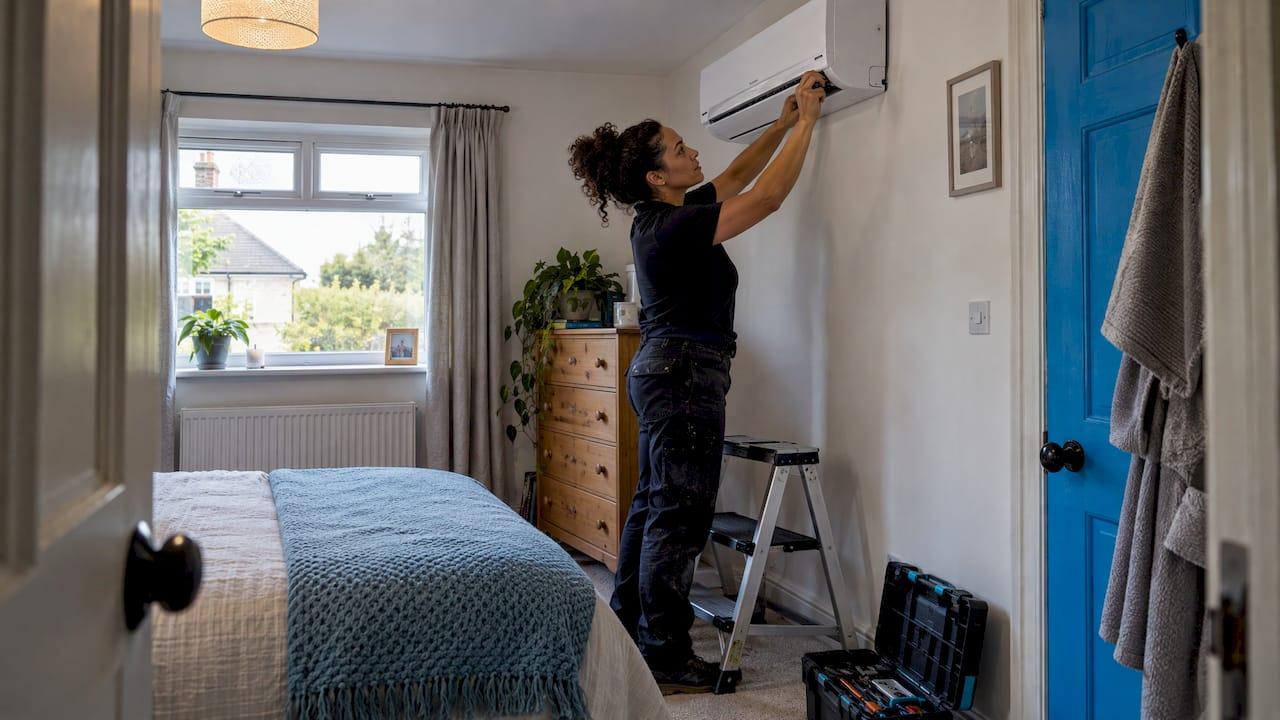
The engineers mount the indoor and outdoor units, run the refrigerant pipes and cable, fit the drain and make the connections. Many domestic jobs are completed within one to two days. Same day installs are available, which matters in a heatwave or when an old unit has failed.

4. Commissioning and handover
The pipework is pressure tested, evacuated and charged, then every indoor unit is checked running. You should be shown how to use the controls and given the paperwork. Our guide to air conditioning commissioning covers this stage in more detail.
Who is legally allowed to install your air conditioning
Air conditioning contains fluorinated gases (F-gases), refrigerants that harm the climate if they leak. Handling them is regulated, and the rules protect you as the customer.
The company. GOV.UK says a company, sole traders included, must be certified by an approved body to install, repair, maintain or decommission stationary air conditioning for others. The approved bodies are Refcom, the F-Gas Register (Quidos) and Bureau Veritas UK. The company must also hold a written F-gas handling procedure and renew its certification every 3 years.
The engineer. Individuals need F-gas qualifications as well. Category 1 covers all activities. Category 2 covers installation, maintenance, servicing and recovery on systems below 3kg of F-gas, or below 6kg if hermetically sealed, which takes in most home systems. GOV.UK states that working without the right qualifications is against the law and can bring a civil penalty.
Both layers are checked at the supply end too. Under GOV.UK rules on selling F-gas, suppliers must confirm that a buyer holds company certification and individual qualifications, and keep records for at least 5 years.
Our engineers are REFCOM/F-Gas certified and are our own, with no subcontractors. For how to check any installer yourself, see our guides to verifying F-gas certification and five F-gas compliance checks before you hire.

Building regulations for a home installation
GOV.UK states that putting in a fixed air conditioning system is work that may need building regulations approval. You do not have to arrange approval yourself if you use someone registered with a competent person scheme. A competent person scheme lets a registered installer certify their own work as compliant.
The Building Regulations 2010 spell this out. Schedule 3 exempts the installation of an air conditioning or ventilation system in a dwelling, where it does not involve systems shared with other dwellings, from the building notice or plans requirement. This applies when a person registered with one of the named bodies carries out the work. The list of current competent person schemes, updated in September 2026, includes BESCA, Blue Flame Certification, Certsure and NAPIT for domestic air conditioning work.
The Building Safety Regulator's July 2026 guide for self-certification schemes says air conditioning now sits within the mandatory technical competence framework. Scheme operators must keep a public register of certified individuals and organisations, sole traders included. This guidance applies in England, which covers Devon and Cornwall.
In short: choose an installer who is both F-gas certified and able to deal with building regulations, so the compliance side is not left for you to chase.
Refrigerant rules that affect the system you buy
Since 2025, GOV.UK says F-gases with a global warming potential (GWP) above 750 are banned in new single-split systems containing less than 3kg of refrigerant. There are exceptions for larger systems and some specialist uses. For you, that means a new single-split should arrive with a lower-GWP refrigerant. The government has also confirmed that it will not legislate in 2026 to change the HFC phasedown steps due from 1 January 2027. The supply of refrigerant continues to tighten on a published schedule, so a well-maintained modern system is the sensible choice. Our guide to air conditioner gas explains what this means in everyday terms.
The paperwork you should receive
It is easy to overlook paperwork when the cool air starts. It matters when you claim on a warranty, sell the house or need a repair.
According to a 2026 installation guide, every installation using a fluorinated refrigerant should produce an F-gas certificate that the customer receives at handover. The commissioning record should show:
- the brand, model, refrigerant type and total charge weight;
- the pipework pressure test result, method and duration;
- the charge weight and any top-up;
- suction and discharge operating pressures;
- airflow verification for each indoor unit;
- the commissioning date and the engineer's REFCOM registration number.
The same guide says this should be completed on the day and given to you before the engineer leaves. A certificate chased weeks later can leave you without a valid warranty record.
People search for an "aircon installation certificate" or "compliance certificate". In practice you are asking for three things:
- the F-gas commissioning record or certificate;
- the building regulations compliance certificate, issued through the installer's competent person scheme where it applies;
- the manufacturer's warranty registration.
Ask for all three at handover and keep them with your house documents.
What can add to the price
The installer cost guide above lists items that are generally not included unless stated:
- 20% VAT;
- electrical supply work, such as a dedicated circuit, which is notifiable electrical work;
- extended or concealed pipe runs;
- scaffolding for high-level condensers;
- planning permission where required;
- annual servicing, which can be a condition of the manufacturer's warranty.
The cheapest quote is often the one that leaves these out. Ask each installer to state in writing what is included, then compare like with like. We give free surveys so these points are settled before you commit. We can also spread the cost with 0% finance.
Devon and Cornwall: the local checks
Most homes need little more than a sensible position for the outdoor unit, but check these four points during the survey.
Planning. In many homes an air conditioning unit is a simple addition. Listed buildings, conservation areas and flats can be different, and the outdoor unit's position often decides it. Devon and Cornwall have many period cottages, town centre terraces and coastal conservation areas, so ask your local council's planning team before you book if your home is one of these.
Noise. The outdoor unit makes some noise, so avoid placing it under a neighbour's bedroom window or against a shared boundary. Your engineer can advise on a position that keeps it away from both your bedroom and the neighbours'.
Drainage. The indoor unit produces condensate water that must drain away. A wall position with a clear route to a gutter-safe or internal drain, or a condensate pump, saves problems later. Plan this at survey stage.
Electrics. Many installations need a dedicated supply. This is notifiable work, so it should be done and certified by a suitably registered electrician, and your installer should tell you at survey whether it is needed.
How to choose an installer
A 2026 homeowner guide suggests confirming F-gas qualifications with documentary proof, and asking for a realistic timeframe, a workmanship guarantee and two recent customer references. Our own guide to choosing an AC installer goes further. A short list to work from:
| Question | What a good answer looks like |
|---|---|
| Is the company F-gas certified? | A named approved body and a certificate number |
| Are the engineers qualified? | Individual F-gas qualifications, with REFCOM registration numbers on the paperwork |
| Who does the work? | The company's own engineers, not subcontractors |
| Is there a survey? | A visit to your property, ideally free |
| What is included? | A written, itemised quote |
| What do I receive at the end? | F-gas record, building regulations certificate, warranty registration |
| What happens after? | A service plan and a route for breakdowns |
Our installation service
We are an Exeter air conditioning installer covering Devon, Cornwall and the wider south west. Our engineers are F-Gas certified and REFCOM registered, and we do not use subcontractors. Systems come from Samsung, Mitsubishi, Toshiba and Daikin, and we aim to complete installations within 1 to 2 days, with same day and next day installs available. A free survey comes first and 0% finance is available.

To arrange a survey, start with our domestic installation page. If you run a shop or business premises, see shop fitting and commercial installation.
Our view
Most problems we hear about with air conditioning trace back to the first day, not the tenth year. A system that was sized by guesswork, or a handover that ended with no paperwork, causes trouble for years.
That is why we keep the process simple. Our own F-Gas certified engineers survey, install and commission, with no subcontracting in between. You deal with the same company from the first visit to the handover.
We also think the installation should not be the end of the relationship. A system looked after under an annual service contract, with an emergency breakdown service behind it, is a system you can rely on in the hottest week of the year.
If you are weighing up quotes, compare what is written in them, not just the total. A good installer is happy to explain every line.
James
After installation: servicing and everyday use
Two questions come up often once the unit is running.
The 3-minute rule. Most air conditioners should be left for around three minutes between switching off and restarting, so the compressor is not forced to start against built-up pressure. It is general good practice for any unit, and your installer can confirm the guidance for your model.
Lifespan. A well-installed, regularly serviced system can give many years of service. Regular servicing keeps the unit efficient and, as noted above, can be a condition of the manufacturer's warranty. Our guides explain when to service your aircon and offer a seasonal service checklist. We offer annual service plans and an emergency breakdown response, and you can send us a fault report if something goes wrong.
FAQ
How long does an air conditioning installation take?
That depends on the system and the property. Our installations are typically completed within 1 to 2 days, and same day installs are available. The survey comes first, so the visit is planned in advance.
Do I need building regulations approval for home air conditioning?
It may be needed in England, because GOV.UK says fixed air conditioning is work that can require approval. You do not need to arrange it yourself if the installer is registered with a competent person scheme. Ask your installer to confirm this before work starts.
What certificate should I get after installation?
You should receive an F-gas commissioning record or certificate, the building regulations certificate where it applies, and the warranty registration. These should be handed over on the day. Keep them with your home documents.
Can I spread the cost of installation?
Yes. We offer 0% finance on our installations. Speak to us when you book your free survey and we will go through the options.
Sources
- Air Conditioning Installer Cost guide, 2026
- How to Quote and Run an Air Conditioning Installation
- Qualifications to work with F gas, GOV.UK
- Company certification to work with F gas, GOV.UK
- Selling F gas in cylinders or equipment, GOV.UK
- Building regulations approval, GOV.UK
- The Building Regulations 2010, Schedule 3
- Competent person scheme: current schemes, GOV.UK
- Self-certification schemes: mandatory technical competence requirements, GOV.UK
- Bans on F gas in new products and equipment, GOV.UK
- Amending the hydrofluorocarbon phasedown schedule, GOV.UK