

Choosing the right air conditioning installer is the single biggest factor in whether your system runs efficiently for a decade or fails within two years. Poor installation causes a significant proportion of HVAC system failures, yet most homeowners focus almost entirely on equipment price. The best tips for choosing an AC installer go well beyond cost: they cover verified credentials, proper technical procedures such as Manual J load calculations, permit compliance, and written warranties. Get these right, and your investment is protected from day one.
1. Tips for choosing an AC installer: start with verified credentials
A qualified installer holds a valid contractor licence, carries liability insurance, and has active workers' compensation cover. These three items are non-negotiable. Licensing proves technical competence and gives you legal recourse if something goes wrong. Insurance protects your property and your finances.
Standard liability cover should be at least £1,000,000. That figure matters because AC installation involves electrical work, refrigerant handling, and structural penetrations. Any one of those can cause costly damage if done incorrectly.
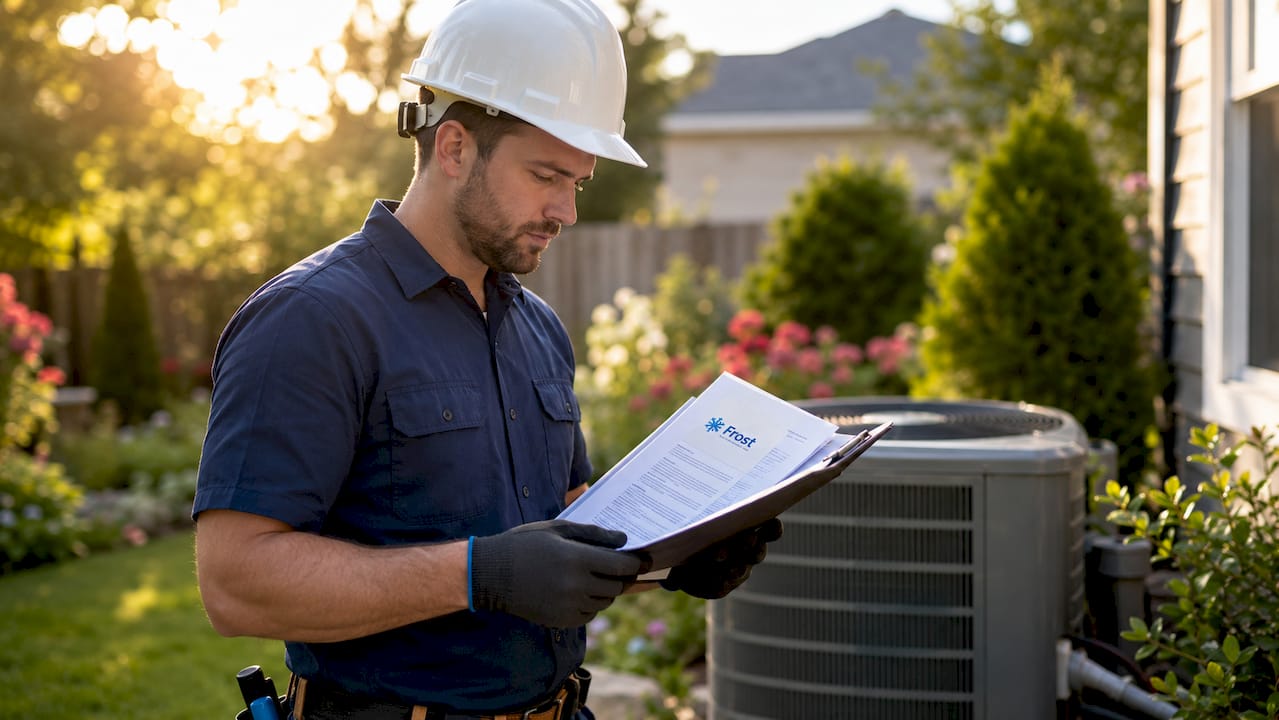
In the UK, look for F-Gas certification, which is a legal requirement for anyone handling refrigerants. Frostairconditioning holds F-Gas certification, which means every engineer on site is legally authorised to work with refrigerant gases. Ask to see certificates before any work begins.
Pro Tip: Ask the installer to email copies of their licence, insurance certificate, and F-Gas registration before you agree to anything. A professional will send these without hesitation.
2. Demand written, itemised quotes from at least three installers
A verbal quote is worthless. Always secure at least three written estimates before making a final decision. Written quotes create accountability and give you a clear basis for comparison.
Each quote must itemise the following separately:
- Equipment model and specification
- Labour costs
- Permit and inspection fees
- Refrigerant line materials and insulation
- Electrical work
- Old unit disposal (if applicable)
- Commissioning and testing
Comparing quotes that cover identical scopes is the only fair way to judge price. A quote that looks £400 cheaper may simply omit permit fees or use thinner refrigerant pipe. That saving disappears quickly when problems emerge.
Pro Tip: If a quote arrives as a single lump sum with no breakdown, treat it as a red flag. Reputable installers have nothing to hide in their pricing.
3. Ask about Manual J load calculations
Manual J is the industry standard for calculating the correct system size based on your home's actual thermal characteristics. It accounts for floor area, ceiling height, insulation levels, window orientation, and local climate. Skipping it is not a shortcut. It is a mistake.
Contractors who rely on rules of thumb instead of Manual J calculations commonly oversize systems by 30–60%. An oversized unit short-cycles, meaning it switches on and off too frequently. Short-cycling wastes energy, creates humidity problems, and wears out components faster.
Requesting a Manual J report often causes unprepared contractors to decline the job or reveal their lack of qualification. That reaction is useful information. Any installer who cannot produce this calculation is not the right person for the job.
4. Verify proper vacuum pump procedure
The vacuum pump procedure is one of the most telling signs of a good AC installer. Before refrigerant is charged into the system, a technician must use a vacuum pump to remove all moisture and air from the refrigerant lines. Proper vacuum duration should be a minimum of 30–45 minutes. Skipping this step leads to compressor failure within months.
Ask the installer directly: "Will you use a vacuum pump, and for how long?" A confident, specific answer indicates competence. A vague response or a claim that it is unnecessary is a serious warning sign.
Moisture inside refrigerant lines reacts with the refrigerant to form acid. That acid corrodes the compressor from the inside. The compressor is the most expensive component in any AC system. Protecting it costs nothing extra when the installer does the job correctly.
5. Insist on permits and code compliance
Homeowners should insist that installers pull the necessary permits and schedule inspections. Permits are not bureaucratic inconvenience. They are the mechanism by which your local authority verifies that the installation meets building regulations and safety standards.
Unpermitted work creates serious problems. It can void your equipment warranty, create complications when you sell the property, and leave you liable if the installation causes damage or injury. Contractors who refuse to pull permits or push that responsibility onto the homeowner are a clear red flag for non-compliance.
A professional installer handles permits as a standard part of the job. If an installer suggests you pull the permit yourself to "save money," walk away.
6. Understand the warranty picture fully
Warranties on AC systems have two distinct parts: the manufacturer's equipment warranty and the installer's labour warranty. Both matter, and both require attention.
Warranty registration with the manufacturer must happen within 60–90 days of installation to activate extended coverage. A professional installer handles this registration as part of their service. Confirm this in writing before work begins.
Labour warranties typically range from one to ten years. A longer labour warranty signals that the installer stands behind their workmanship. Many contractors offer one to two years as standard, with extension options available. Ask what is included and what voids the warranty before you sign anything.
- Confirm the installer registers the equipment warranty with the manufacturer
- Get the labour warranty period in writing, not just verbally
- Check whether the warranty covers call-out costs as well as parts and labour
- Ask what actions on your part could void the warranty
7. Check reviews across multiple platforms
Online reviews reveal patterns that credentials alone cannot. Reading reviews across Google, Trustpilot, and Checkatrade gives you a broader picture than any single source. Read at least 30 reviews and verify the installer's standing with relevant licensing bodies. Volume matters because a handful of reviews is easy to manipulate.
Look for reviews that mention specific technical details: whether the engineer explained the system, whether the installation was tidy, and whether the installer returned promptly to resolve any early issues. Generic five-star reviews that say only "great service" carry little weight.
Negative reviews are equally informative. One complaint about poor communication is forgivable. A pattern of complaints about incomplete work or missed follow-up visits is not.
8. Use manufacturer dealer locators and personal referrals
Manufacturer dealer locator tools identify authorised, trained installers who meet the brand's own standards for installation quality and customer satisfaction. Manufacturer designations like "Premier Dealer" are not permanent. They are reviewed regularly, which keeps installers accountable.
Personal referrals from neighbours or friends who have had AC installed recently are among the most reliable signals of quality. Ask specifically about the installation process, not just the end result. Did the engineer explain what they were doing? Was the site left clean? Did the system work perfectly from day one?
Combining a manufacturer authorisation check with a personal referral and verified reviews gives you a strong, multi-source picture of any installer's reliability. No single source is sufficient on its own.
9. Ask about same-day installation and finance options
Practical logistics matter as much as technical competence. Ask whether the installer can accommodate your schedule and whether same-day installation is available if your existing system has failed. Waiting days without cooling in a heatwave is a real problem, and not all installers can respond quickly.
Finance options also affect your decision. Frostairconditioning offers 0% finance on installations, which means you can access a quality system and certified installation without paying the full cost upfront. Spreading the cost at 0% interest is meaningfully different from a cheap installer who charges less but cuts corners on procedure.
Understanding what HVAC systems involve before you speak to installers puts you in a stronger position to ask the right questions and recognise a credible answer.
Key takeaways
Choosing a qualified AC installer requires verifying credentials, demanding written quotes, and confirming that proper technical procedures including Manual J calculations and vacuum pump evacuation are part of the job.
| Point | Details |
|---|---|
| Verify credentials first | Check F-Gas certification, liability insurance, and a valid contractor licence before agreeing to any work. |
| Get three written quotes | Itemised quotes covering equipment, labour, permits, and materials are the only fair basis for comparison. |
| Demand Manual J calculations | Installers who cannot provide a load calculation report commonly oversize systems by 30–60%, wasting energy. |
| Confirm vacuum pump procedure | A minimum 30–45 minute vacuum evacuation is mandatory to prevent compressor failure from moisture damage. |
| Secure warranties in writing | Manufacturer warranty registration must happen within 60–90 days; get the labour warranty period confirmed in writing. |
What I've learned from watching installers cut corners
I have seen the full range of installation quality over the years, and the gap between the best and the worst is genuinely alarming. The most common failure I encounter is the installer who sizes a system by walking through the house for two minutes and announcing a figure. No measurements, no insulation check, no window orientation. Just a guess dressed up as expertise.
The homeowners who fare best are the ones who ask technical questions confidently. You do not need to be an engineer to ask "Will you carry out a Manual J calculation?" or "How long will you run the vacuum pump?" Those two questions alone will filter out a significant proportion of underqualified installers. The good ones will answer without hesitation and often with enthusiasm.
Price is the wrong primary filter. Cheap installations cut critical technical corners that lead to premature system failure and higher energy bills. The saving on installation day becomes a cost on every subsequent energy bill and eventually a repair or replacement bill. Investing in a certified, thorough installation is the financially sensible choice, not the premium one.
My honest advice: treat the installer's willingness to provide documentation as your clearest signal of quality. A Manual J report, a written warranty, a permit confirmation, and a commissioning report are not extras. They are the baseline of professional work.
— James
Frostairconditioning: certified AC installation across the south west
Frostairconditioning is an F-Gas certified AC installer based in Exeter, covering the south west of the UK. Every installation includes a detailed written quotation, proper Manual J sizing, full vacuum pump procedure, and warranty registration handled on your behalf.

Same-day installations are available for homeowners who cannot wait, and 0% finance means the cost of a quality installation does not have to land all at once. Whether you are installing a new system or replacing an existing one, Frostairconditioning provides the credentials, the documentation, and the follow-up support that this article describes. Request your written installation quote today, or learn more about domestic AC installation across Devon, Cornwall, and Somerset.
FAQ
What qualifications should an AC installer have?
An AC installer should hold a valid contractor licence, F-Gas certification (required by UK law for refrigerant handling), and carry at least £1,000,000 in liability insurance. Workers' compensation cover is also required to protect you from injury claims.
How do I compare quotes from different AC installers?
Request at least three written, itemised quotes that separately list equipment, labour, permits, refrigerant materials, and electrical work. Comparing quotes with identical scopes is the only way to make a fair price judgement.
What is a Manual J calculation and why does it matter?
Manual J is the industry standard method for calculating the correct AC system size based on your home's specific thermal characteristics. Installers who skip it commonly oversize systems by 30–60%, which wastes energy and causes comfort problems.
What is the vacuum pump procedure in AC installation?
A vacuum pump removes moisture and air from refrigerant lines before the system is charged. The process should run for a minimum of 30–45 minutes. Skipping it allows moisture to form acid inside the compressor, causing early failure.
When must I register my AC warranty?
Manufacturer warranty registration must be completed within 60–90 days of installation to activate extended coverage. A professional installer handles this registration as a standard part of their service.