

Switching on a brand-new air conditioning unit and watching it run is satisfying. But here is the thing most homeowners in Devon and Cornwall don't realise: a system that turns on is not necessarily a system that works correctly. Proper commissioning is a structured, evidence-led process that goes far beyond a basic startup. It verifies that your installation is safe, efficient, and performing exactly as it should. Without it, you could be paying more on energy bills, living with uneven temperatures, or quietly running a system that is slowly degrading. This guide explains every stage of commissioning so you can hold your installer to account.
Table of Contents
- What is air conditioning commissioning?
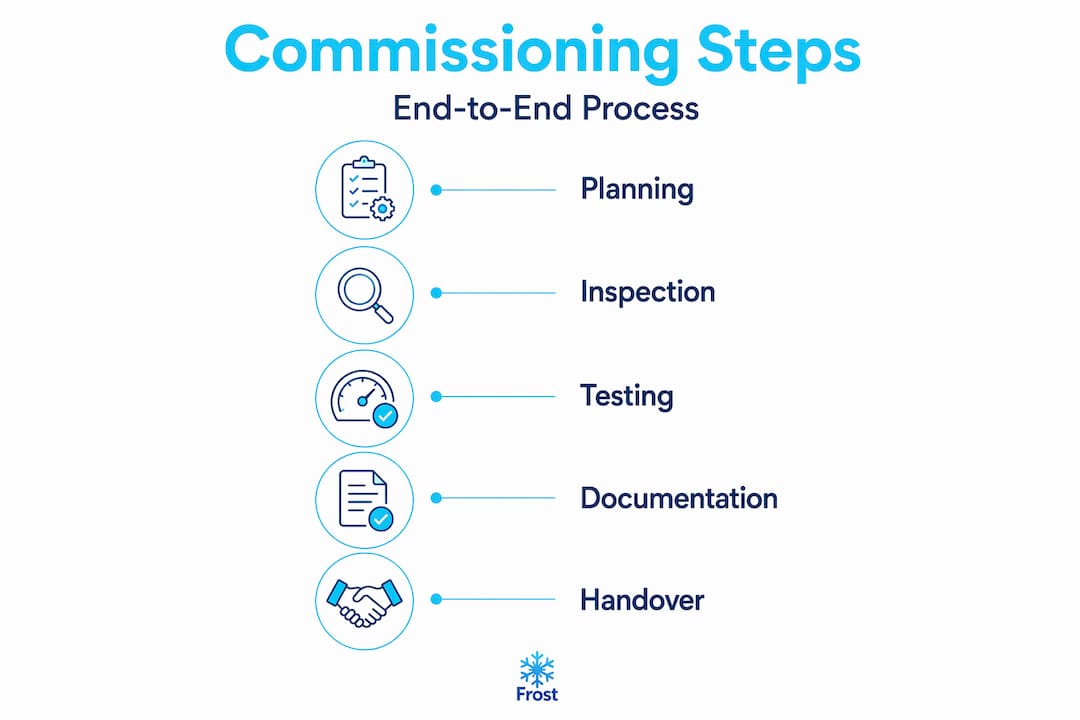
- Phases of commissioning: from planning to handover
- What functional performance testing involves
- Commissioning air distribution and documentation requirements
- Why commissioning should always be evidence-driven: a Devon and Cornwall perspective
- Get your air conditioning professionally commissioned
- Frequently asked questions
Key Takeaways
| Point | Details |
|---|---|
| More than a startup | Commissioning is a structured process covering inspection, testing, and documentation, not just switching the system on. |
| Phase-driven checks | Effective commissioning includes planning, technical tests, and homeowner handover to guarantee performance and safety. |
| Functional test essentials | Key tests verify refrigerant charge, airflow, temperature difference, and controls, spotting issues before they impact your home. |
| Evidence and documentation | Always request a commissioning report and ensure you receive clear handover and training from your installer. |
| Local expertise matters | Professional commissioning in Devon and Cornwall maximises comfort and efficiency for your home's unique needs. |
What is air conditioning commissioning?
Commissioning is one of those air conditioning terms that gets thrown around but rarely explained clearly to homeowners. It is not simply the act of turning a system on for the first time. Think of it more like the final inspection on a newly built house: a thorough, methodical process that confirms everything is safe, correct, and ready for long-term use.
A quality-assurance process that verifies a newly installed or replaced AC system is installed correctly, is safe, and performs to design intent and manufacturer specifications is the most accurate way to describe what commissioning actually means. That is a useful definition because it highlights three things that matter to you as a homeowner: correctness, safety, and performance to specification.
"Commissioning is not a single moment. It is a process with measurable stages, each designed to confirm that your system does what it is supposed to do, not just that it powers up."
Here is what a properly conducted commissioning process covers:
- Physical inspection of pipework, electrical connections, and unit positioning
- Refrigerant verification to confirm correct charge levels
- Airflow measurement across indoor and outdoor units
- Temperature performance checks to assess cooling and heating output
- Control and safety system testing to confirm every safeguard is functional
- Documentation of all results and readings
- Homeowner training so you know how to operate your system correctly
Many people assume that because their unit is running and blowing cool air, everything is fine. In reality, a system can appear to work while carrying a refrigerant undercharge, restricted airflow, or incorrectly calibrated controls. These faults do not announce themselves immediately. They show up gradually as higher bills, reduced comfort, and shortened system lifespan.
Phases of commissioning: from planning to handover
Once you understand what commissioning is, it helps to know how it unfolds in practice. A typical commissioning methodology includes distinct phases such as planning and requirements, pre-start installation checks, functional performance testing, and documentation with handover and training. Each phase builds on the last, creating a chain of evidence that proves your system is correctly installed and operating as designed.
Here is how those phases look in a domestic air conditioning context:
- Planning and requirements — Before any work begins, the installer establishes what the system is designed to achieve: the cooling or heating load, airflow targets, and manufacturer specifications for the chosen unit.
- Pre-start installation checks — With the system installed but not yet running, the engineer inspects pipework joints, insulation, electrical connections, refrigerant line lengths, and unit positioning. This is the stage where physical errors are caught before they cause operational problems.
- Functional performance testing — The system is started and put through a series of measured tests to confirm it meets design performance targets. This is the most technical phase and is covered in detail in the next section.
- Documentation and handover — All test results are recorded, and the homeowner receives a commissioning report alongside practical training on how to use the system, clean the filters, and set the controls efficiently.
The following table shows what each phase produces and why it matters to you as a homeowner:
| Phase | What happens | What you get |
|---|---|---|
| Planning | Load calculations and design targets set | Confidence the right system was chosen |
| Pre-start checks | Physical inspection of installation | Faults caught before startup |
| Functional testing | Measured performance verification | Proof the system works to specification |
| Documentation and handover | Report issued, training provided | Evidence and practical knowledge |
These air conditioning installation steps are not optional extras. They are the difference between an installation that works well for ten or more years and one that quietly underperforms from the day it is switched on.
Pro Tip: When your installation is complete, ask your installer for a copy of the commissioning report before they leave. If they cannot provide one, that is a clear signal that proper commissioning has not taken place.
What functional performance testing involves
Functional performance testing is the phase that most separates a properly commissioned system from one that has simply been switched on and left running. This is where your installer uses calibrated instruments to take real measurements and compare them against the manufacturer's specified values.

Functional performance testing for cooling commonly verifies refrigerant charge using superheat and subcooling measurements, verifies airflow through measured supply and return readings, checks the temperature difference across the evaporator coil, and confirms that controls and safety features operate correctly. Each of these checks serves a specific purpose, and together they build a complete picture of system health.
Here is what each test actually tells the engineer:
- Refrigerant charge verification — Refrigerant is the substance that carries heat in and out of your home. Too little refrigerant causes the compressor to work harder, reducing efficiency and potentially causing damage. Too much refrigerant restricts performance in a different way. Superheat and subcooling measurements confirm the charge is within the manufacturer's tolerance.
- Airflow measurement — Insufficient airflow across the indoor coil reduces the system's ability to exchange heat effectively. The engineer measures both supply air (what comes out of the unit) and return air (what gets drawn in) to confirm they match design targets.
- Temperature lift or delta T — The temperature difference between the air entering and leaving the indoor unit is one of the clearest indicators of whether the system is transferring heat effectively. A reading outside the expected range points to a refrigerant, airflow, or coil issue.
- Controls and safety checks — Every modern air conditioning unit has built-in safety features, including high-pressure cut-outs, low-pressure protection, and temperature limits. These are tested to confirm they respond correctly, protecting both the system and your home.
The table below illustrates the difference between a properly commissioned system and one that has only had a basic startup check:
| Check | Basic startup | Proper commissioning |
|---|---|---|
| Refrigerant level | Assumed correct | Measured using superheat and subcooling |
| Airflow | Not checked | Measured at supply and return grilles |
| Temperature difference | Not recorded | Measured and compared to specification |
| Safety controls | Visual check only | Functionally tested and logged |
| Documentation | None | Full commissioning report issued |
These are the kinds of faults that cause the common air conditioning problems homeowners in Devon and Cornwall contact us about: rooms that never quite reach the right temperature, units that run constantly without achieving the set point, and energy bills that seem disproportionately high. Almost all of these problems trace back to commissioning that was rushed or skipped entirely.
Commissioning air distribution and documentation requirements
Beyond testing the unit itself, proper commissioning in a UK context also addresses the way conditioned air moves through your home. If your system uses ductwork, ceiling cassettes, or multiple indoor units, each outlet needs to be checked and adjusted to ensure it delivers the right volume of air to each space.
UK commissioning standards explicitly address air distribution and airflow systems, requiring functional testing and regulation to specified tolerances, proper planning and method statements including health and safety risk assessments, and the production of documented results and evidence. This is not bureaucratic box-ticking. It reflects the fact that even a perfectly installed unit will underperform if air is not distributed correctly.
"A system that cools one room perfectly while leaving another uncomfortably warm is not a system that has been fully commissioned. Air distribution is part of commissioning, not an afterthought."
Consider what happens when airflow is unbalanced. One bedroom might receive too much conditioned air, making it uncomfortably cold, while another gets too little, leaving it warm and stuffy. The overall system efficiency drops because the unit has to work longer to compensate for poor distribution. Over time, this means higher running costs and unnecessary wear on components.
The documentation requirements that accompany proper commissioning are equally important:
- Method statements outlining how commissioning was planned and executed
- Health and safety risk assessments for the work carried out
- Test results for airflow, refrigerant charge, temperature measurements, and controls
- A commissioning certificate or report summarising all findings
- Handover records confirming that the homeowner has been trained on system operation
For homeowners thinking about their air conditioning efficiency, this documentation is genuinely valuable. It gives you a baseline record of how your system performed on day one. If performance changes over time, that record helps your maintenance engineer diagnose what has changed and why.
Pro Tip: Keep your commissioning report alongside your product warranty documents. If you ever need to make a warranty claim, that documented evidence of correct commissioning will be extremely useful and may be required by the manufacturer.
Why commissioning should always be evidence-driven: a Devon and Cornwall perspective
We have installed and commissioned air conditioning systems across Exeter, Plymouth, Truro, and the broader south west for many years. The pattern we see repeatedly is this: homeowners who had systems installed cheaply, without proper commissioning, contact us two or three years later wondering why their unit is underperforming or their energy bills are higher than expected. In many cases, the system was never right from day one.
A systems pass a basic "runs" test but can still be out of specification on refrigerant, airflow, or control sequences, leading to comfort issues or reduced efficiency later. This is the core problem with treating commissioning as optional or treating a successful startup as sufficient evidence. A unit that powers up and blows air is passing the lowest possible standard. Commissioning asks a much harder question: is it actually doing what it is designed to do, measured and proven?
Our honest view is that commissioning should be treated as non-negotiable. Not because it is a technical formality, but because it is the only way you can be certain your investment is performing as it should. Here in Devon and Cornwall, where many properties are older with unusual layouts, exposed to coastal weather, or relying on older electrical supplies, there are additional reasons to take commissioning seriously. Systems installed in these conditions without proper checks are more likely to develop problems.
The benchmark to ask for is a documented commissioning report and checklist that records measurable outcomes including refrigerant verification, airflow and delta T readings, and controls and safety checks, plus final sign-off and homeowner handover and training. If an installer cannot or will not provide this, you should question whether the work has been done to the standard you deserve.
We also strongly believe in the homeowner training element of handover. Knowing how to set your system correctly, when to clean filters, and how to read the controls properly makes a real difference to efficiency and comfort. It is part of what you are paying for, and a professional commissioning process always includes it. You can also use our troubleshooting guide for Devon and Cornwall homes to understand what to look out for between services.
Get your air conditioning professionally commissioned
Understanding what commissioning involves is the first step. The second is making sure that when your system is installed, every stage of the process is carried out properly and documented for you.

At Frost Air Conditioning, we carry out full commissioning on every system we install across Devon and Cornwall. We are F-Gas certified, which means we are legally qualified to handle refrigerants correctly, and our commissioning process covers every check described in this guide. We offer 0% finance to make a properly installed and commissioned system accessible, and same-day installs are available for eligible properties. If you want a system you can trust from day one, with the documentation to prove it, request a commissioning quote and we will talk you through the process.
Frequently asked questions
What does commissioning an air conditioning system involve?
Commissioning is a structured quality-assurance process that verifies a newly installed system is correct, safe, and performs to manufacturer specifications. It includes physical inspection, performance testing, documentation, and homeowner training.
Why is commissioning important for efficiency and comfort?
Systems can pass a basic "runs" test but still be out of specification on refrigerant, airflow, or controls, leading to comfort problems and higher running costs over time.
What documentation should I receive after commissioning?
You should receive a documented commissioning report that records test results for refrigerant charge, airflow, temperature readings, safety checks, and confirmation of homeowner handover and training.
What happens if air distribution isn't commissioned?
If air distribution is not properly tested and regulated, your AC may not reach its design performance even with correct equipment, leaving some rooms uncomfortable and the system running less efficiently than it should.