
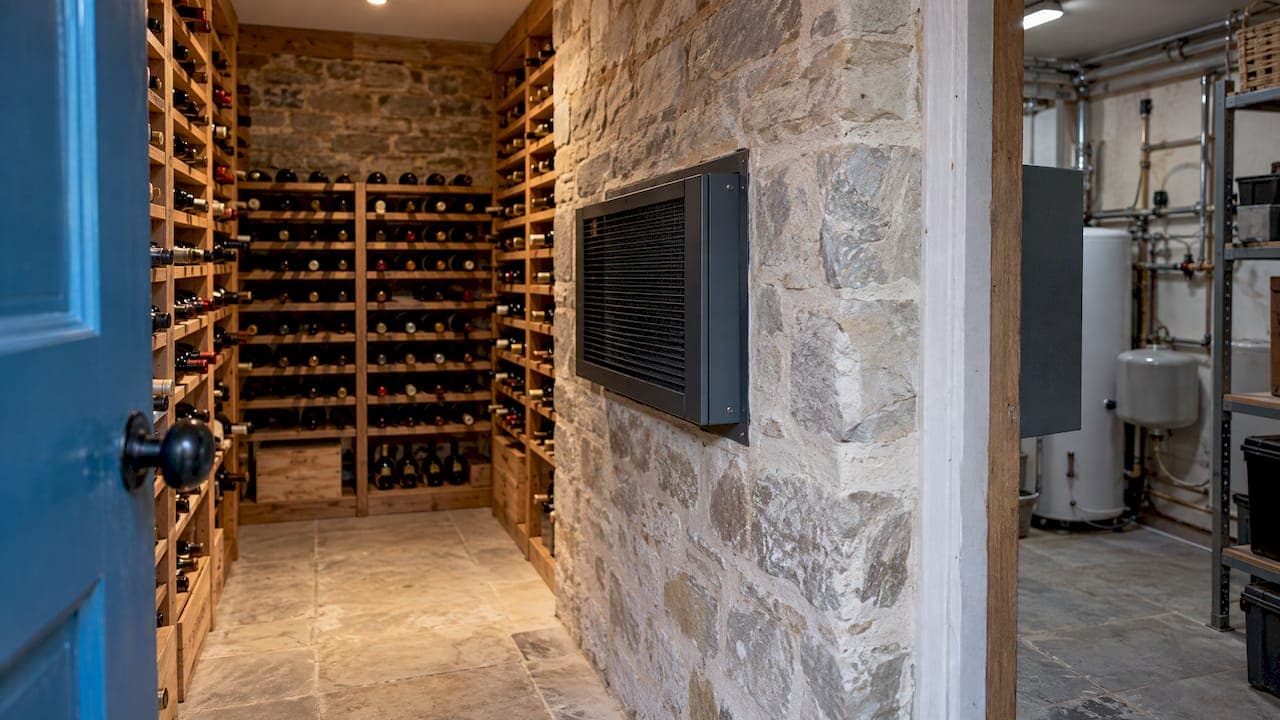
Most British cellars and wine rooms do not stay cool enough on their own. A well-chosen cooling system holds the room at a steady 10°C to 15°C all year, keeps the swings small, and is fitted and serviced by an engineer who is legally qualified to handle the refrigerant. Which system suits you depends on the size of the room, how well it is insulated, and where the outdoor unit can go. This guide covers the temperatures to aim for, the four main ways to cool a cellar, the legal checks that apply in the UK, and what to ask before you hire anyone.
TL;DR
- Aim for a stable temperature of roughly 10°C to 15°C. Steadiness matters more than hitting one exact number.
- The main options are a through-the-wall self-contained unit, a split system, a ducted split system and a standalone wine cabinet. Room size and insulation decide between them.
- Cooling only works in a properly insulated room with a vapour barrier and a sealed door. Fix the room first, then size the unit.
- Anyone working on the refrigerant circuit must hold F-Gas qualifications. Ask to see them before work starts.
- Get a survey before you buy. Quotes without one are guesses.
Table of Contents
- What temperature should a wine cellar be?
- Why a UK cellar still needs cooling
- The four main ways to cool a wine cellar
- Prepare the room before you buy any equipment
- Why not use ordinary air conditioning?
- What the F-Gas rules mean for you
- Running costs, noise and maintenance
- Our perspective on cellar cooling
- Hiring someone: what to ask
- Cooling a wine room with us
- FAQ
- Sources
What temperature should a wine cellar be?
There is no single magic figure, but the sources agree on a range and on one principle: avoid swings.
The Oxford Companion to Wine, as quoted by Decanter, says dramatic temperature swings should be avoided and an average somewhere between 10°C and 15°C is suitable for long-term maturation. EuroCave advises a stable 10°C to 14°C whatever the outside temperature does, and points out that the warmer the wine, the faster it develops. Sudden fluctuations can shorten a wine's cellaring life.
The upper limit is worth knowing. Jancis Robinson warns that as temperatures approach 27°C you risk cooking off subtle flavours and expanding the wine enough to compromise the cork or screwcap seal.
In practice, most UK domestic cellars aim for around 12°C to 13°C. Humidity is the second variable. Many cellar specialists suggest roughly 60% to 70% relative humidity. Too dry and corks may shrink. Too damp and labels peel and mould grows. A cheap digital thermo-hygrometer on the wall tells you which problem you have.

Why a UK cellar still needs cooling
The idea that Britain is cool enough not to need cellar cooling is only half true. A traditional underground cellar with thick walls and an earth floor can hold a steady temperature without help. Plenty of modern wine storage is not like that:
- Converted basements next to boilers, hot water cylinders or underfloor heating pipework.
- Under-stairs cupboards and utility rooms that follow the temperature of the house.
- Garage or outbuilding conversions that swing with the seasons.
- Restaurant, bar and shop storage rooms with doors opening all day.
- Ground-floor wine rooms with glazed walls, which are now popular in extensions.
Summers are also getting hotter. Rooms that were comfortably cool a decade ago can sit well above 18°C for weeks. The slow, steady rise is the problem, as much as any single hot day.
The four main ways to cool a wine cellar
Self-contained (through-the-wall) units
These put the whole refrigeration system in one box, set into an opening in the cellar wall. Cold air goes into the cellar, warm air is expelled on the other side. They suit small to medium rooms that have one wall with a ventilated space behind it, such as a utility room or garage.
The trade-offs: they take up wall space, they make some noise on the warm side, and the warm side needs enough ventilation to work properly. They are usually the simplest to install.
Split systems
A split system separates the unit into two parts. The indoor evaporator sits in the cellar. The compressor and condenser sit outdoors, joined by a small bore pipe run. Because the noisy parts are outside, the cellar stays quiet and the indoor unit can be compact. It can sometimes be hidden behind a removable rack front.
Splits suit rooms where an outside wall is available and where you want the cooling to be quiet and efficient. The pipe run needs a neat, sealed route through the wall. That is refrigerant pipework, so it is F-Gas work.
Ducted split systems
In a ducted system the cooling unit sits outside the cellar, in a loft, plant cupboard or adjacent room, and cold air is moved to the cellar through insulated ducts. Nothing is visible in the cellar except small grilles. This is the usual choice for show cellars, glass-walled wine rooms and larger projects where appearance matters.
It takes more design work: duct routes, grille positions, condensate drainage and how the air returns to the unit. It is where a proper survey earns its keep.
Wine cabinets and standalone coolers
For a few dozen to a few hundred bottles, a freestanding wine cabinet is often enough and needs no installation. It is not cellar cooling, but it is the honest answer for many households. If you have more bottles than a cabinet holds, or a room you want to dedicate to wine, the options above become worth the investment.
Comparing the options
| Option | Best for | Noise in the cellar | Installation |
|---|---|---|---|
| Self-contained through-the-wall | Small to medium rooms with a ventilated outer side | Moderate | Simplest, wall opening needed |
| Split system | Medium rooms with an outside wall | Low | Pipe run through the wall, F-Gas work |
| Ducted split | Large or show cellars, glass wine rooms | Very low | Most design work, hidden plant |
| Standalone cabinet | Collections up to a few hundred bottles | Low | None, plug in |
Prepare the room before you buy any equipment
The most common reason cellar cooling disappoints is that the room cannot hold the cold. A cooling unit fights the heat that gets in, and every leak makes it work harder and cost more to run.
Before a survey, check the following:
- Insulation. Walls, ceiling and floor should be insulated. Specialists commonly use rigid foam boards. The thicker and more continuous it is, the smaller the unit you need.
- Vapour barrier. On the warm side of the insulation, a sealed barrier stops moist air reaching cold surfaces and condensing inside the structure.
- Door. An insulated, sealed door, ideally with a draught strip at the foot. A standard internal door leaks air all day.
- Glass. Glazing loses cold fast. Double or triple-glazed units help, and so does keeping direct sun off them.
- Heat sources. Pipework, lighting and anything else in the room adds load. LED lighting on a timer is much kinder than hot downlighters.
- Condensate. Cooling produces water. It needs a route out, by gravity or a small pump.
A realistic survey measures the room, notes the insulation and the outside conditions, and sizes the unit to the heat load, not just the floor area.
Why not use ordinary air conditioning?
Many people ask whether a standard home air conditioner will do. Usually it cannot. A comfort air conditioner is built to cool a room to around 20°C to 24°C, and many are not designed to run reliably at low setpoints, especially in cold outdoor conditions. Some simply stop. They also dry the air, which is the opposite of what a wine room wants at the higher humidity end.
The lesson is not that one brand is better than another. It is that the equipment must be selected for the temperature you need, and checked against the manufacturer's stated operating range. If a supplier cannot tell you the minimum setpoint and the outdoor temperature range a model is rated for, ask again or find someone who can.
For the basics of how cooling and refrigeration work, our guide to how air conditioners and refrigeration systems work explains the cycle in plain terms.
What the F-Gas rules mean for you
Every refrigeration or air conditioning system, including a cellar cooler, contains refrigerant. In the UK many of these are F gases, and the law controls who can handle them.
According to GOV.UK, you must have your own qualifications to work on equipment containing F gas, even when you are employed by someone else, and working without them is against the law and can lead to a civil penalty. That applies to installation, servicing, leak checking and recovery of gas.
Two practical points follow for a cellar owner:
- Ask to see the certificate. Any engineer touching the pipework should hold an F-Gas qualification, and the company should be able to show its own certification. Our guides on verifying UK F-Gas certification and the company register and five checks before you hire walk through exactly what to look for.
- Know about leak checks. Under the Government's practical guidance for stationary refrigeration and air conditioning, systems holding 3 kg or more of F gas (6 kg if hermetically sealed and labelled) need regular leak tests, with frequency depending on the charge. Most domestic cellar systems hold far less than that, but a large commercial wine room or restaurant installation might not. Your installer should tell you which side of the line you are on.
Gas choice also matters for the long term. The Government has set bans on certain F gases in new products and equipment, so ask which refrigerant a unit uses and whether it is a sensible choice for the years ahead. Our overview of air conditioner gas for UK homeowners covers the basics.
If the cellar is part of a business, the wider rules on larger systems and inspections also apply. Our guide to UK commercial aircon compliance sets them out for property managers and owners.
Running costs, noise and maintenance
A cellar cooler runs for long hours, so efficiency matters more than the purchase price alone. Three things drive your bills: the quality of the insulation, how often the door is opened, and how hard the unit has to work in a hot summer. A well-insulated room with a correctly sized unit cycles on and off gently. An undersized unit in a leaky room runs flat out and still drifts warm.
Noise is mostly a question of where the compressor lives. Splits and ducted systems keep it outside the room. Self-contained units put it in the wall, so think about the room on the other side, especially if it is a kitchen or a bedroom.
Maintenance is not optional. Coils clog with dust, condensate drains block and refrigerant can slowly leak, and each of those shows up as a cellar that slowly gets warmer. A yearly service with a leak check catches the problem before it costs you bottles. Our guide on how often UK owners should service their aircon explains what a service covers and why it is cheaper than a breakdown. If you want a second layer of protection, a temperature alarm that texts you when the room goes out of range is inexpensive and worth fitting.
Our perspective on cellar cooling
We are an air conditioning installer based in Exeter, working across Devon, Cornwall and the wider South West. Here is how we would approach a wine room.
First, we would start with a free survey, because the room matters as much as the machine. We would look at insulation, the door, any glazing, where the outdoor unit could go and where condensate can drain. The right system follows from that, not the other way round.
Second, we would put steady temperature ahead of a headline figure. A cellar that sits at 13°C all year serves a collection better than one that touches 11°C in January and 19°C in August.

Third, we would choose equipment for the job. We supply systems from Samsung, Mitsubishi, Toshiba and Daikin, and offer bespoke system design, so we would check each manufacturer's stated operating range against the temperature you need, and tell you plainly when a standard comfort system is not the right tool.
Finally, we would use our own F-Gas certified engineers, with no subcontractors, so the person who fits the system is the person accountable for it afterwards. That is why we also push annual servicing: a cooling system that nobody looks at is a risk to what is inside the cellar.
— James
Hiring someone: what to ask
Whether you choose us or anyone else, put these questions to every installer:
- Can I see your F-Gas certification and your engineers' qualifications? Do not accept a vague yes.
- Will you survey the room first? A quote without a visit cannot account for insulation, glazing or pipe runs.
- What temperature range is this unit rated for? You need the minimum setpoint and the outdoor operating range in writing.
- Which refrigerant does it use? And what does that mean for future servicing?
- Where will the outdoor unit and condensate go? Ask about noise, planning or landlord consent if relevant.
- What happens if it fails at the weekend? A breakdown in July can ruin a collection within days. Ask about emergency response and any service contract.
- Is monitoring included? Even a simple alarm is worth having.
On cost, be wary of any figure quoted without seeing the room. Prices vary widely with the type of system, the size of the cellar and the length of pipe or duct run, and we do not publish fixed prices because every project differs. A survey gives you a real number.
Cooling a wine room with us
If you have a cellar or wine room in Devon, Cornwall or elsewhere in the South West and want it cooled properly, we can survey it, design the system and install it, often within one to two days of the go-ahead. We offer 0% finance, and our engineers are REFCOM and F-Gas certified. For a home project, start with our domestic installation service. If the wine storage is part of a bar, restaurant or shop, see our commercial and shop fitting work. Once the system is in, our service and maintenance plans include annual contracts and emergency breakdown response.
FAQ
What is the best temperature for a wine cellar?
For long-term storage, aim for a stable temperature between about 10°C and 15°C, as Decanter reports from The Oxford Companion to Wine. Around 12°C to 13°C is a common target. Consistency matters more than the exact figure, because sudden swings are what harm wine most.
Can I use a normal air conditioner to cool a wine cellar?
Usually not. Comfort air conditioners are designed for room temperatures well above cellar levels, and many are not rated to run at low setpoints or in cold outdoor weather. Ask the manufacturer or installer for the minimum setpoint of any unit before you buy.
Does a wine cellar cooling unit need an F-Gas engineer?
Yes, if the work involves the refrigerant circuit, which includes installing split systems, running pipework, servicing and leak checks. GOV.UK states that it is against the law to work on F gas equipment without the correct qualifications. Ask to see the certificates before work begins.
How much does wine cellar cooling cost in the UK?
It depends on the system type, the size and insulation of the room, and the distance between the indoor and outdoor parts. Ducted systems for large rooms cost more than a simple through-the-wall unit. A survey is the only reliable way to get a real figure, and we offer one free, with 0% finance available on installations.
Do I need to insulate the cellar first?
Yes, for the best results. Insulation, a vapour barrier and a sealed door let a smaller unit hold temperature with less running time. Cooling an uninsulated room usually means a larger unit, higher bills and a less stable temperature.
Sources
- Keeping cool: Wine storage, Decanter
- Six pieces of advice for storing wine, EuroCave
- How and where to store wine, Jancis Robinson
- Qualifications to work with F gas, GOV.UK
- Guidance for Stationary Refrigeration and Air-Conditioning, GOV.UK
- Bans on F gas in new products and equipment, GOV.UK