

Air conditioning and refrigeration are the same technology doing different jobs. Both move heat from one place to another using the vapour-compression cycle; the difference is where they move it, how precisely they control temperature, and whether they manage humidity and ventilation for occupants. ASHRAE defines air conditioning as the control of temperature, humidity, air cleanliness, and ventilation together, which is why a fridge and a split-system air conditioner share a compressor and refrigerant but are designed for entirely different outcomes.
- Core similarity: both systems use the vapour-compression cycle to absorb heat in one location and release it in another.
- Primary difference: refrigeration holds a small, insulated space at a fixed low temperature; air conditioning manages comfort conditions (temperature, humidity, air quality) in larger, occupied spaces.
UK F-gas regulations govern who can legally handle the refrigerant in either system. Only an F-gas-certified engineer may recover, recharge, or work on refrigerant circuits, whether that is a commercial chiller or a domestic split-system.
Table of Contents
- How do refrigeration and air conditioning differ?
- What are the rules around refrigerants in the UK?
- Why does correct sizing matter so much?
- How do you spot a refrigerant leak and what should you do?
- Practical installer tips from Frostairconditioning
- Key takeaways
- What most people get wrong about air conditioning
- Frostairconditioning: professional installation and maintenance in the South West
- Useful sources and further reading
How do refrigeration and air conditioning differ?
The cycle is identical; the application shapes everything else about the design.
- Humidity control — Air conditioning systems dehumidify as a by-product of cooling: moisture in the air condenses on the cold evaporator coil and drains away. ASHRAE's guidance frames humidity control as one of the four core functions of air conditioning alongside temperature, air cleanliness, and ventilation. Refrigeration equipment is not designed to manage room humidity.
Use-case examples: a domestic fridge, a supermarket chiller cabinet, and a wine cellar are all refrigeration applications. A home split-system, an office VRF system, and a retail shop installation are air conditioning. The types of air conditioning available for UK homes range from wall-mounted splits to ducted systems, each suited to different building layouts and occupancy patterns.
The design consequence of these differences is that refrigeration controls tend to be simpler (on/off or basic modulation) while air conditioning systems increasingly use inverter-driven compressors and sophisticated controls to manage the four-factor comfort equation continuously.
What are the rules around refrigerants in the UK?
Refrigerant choice has become one of the most practically significant decisions in system specification, both for environmental reasons and because UK regulations directly affect what engineers can legally do.
UK F-gas rules and what they mean for owners
The UK F-gas regulation (retained from EU Regulation 517/2014 and updated post-Brexit) restricts the handling of fluorinated greenhouse gases to certified personnel. In practice:
- Only an engineer holding an F-gas qualification (such as City & Guilds 2079 or equivalent) may recover, recharge, or leak-test a refrigerant circuit.
- Attempting to top up a system yourself is illegal, regardless of whether you can source the refrigerant.
- Engineers must keep records of refrigerant quantities added and recovered. Owners should ask for a copy of this paperwork after every service.
When an F-gas-certified engineer attends, expect them to perform a leak check, record the refrigerant type and quantity, and use certified recovery equipment before opening any part of the circuit. Frostairconditioning's engineers are REFCOM/F-gas certified, which means every service visit includes proper refrigerant handling and documentation.
Regulatory note: the UK F-gas phase-down is tightening the availability of high-GWP refrigerants over time. If your system runs on R410A, ask your installer about the long-term servicing picture at your next annual check.
Why does correct sizing matter so much?
Bigger is not better with air conditioning. An oversized system cools a space quickly, then switches off before it has run long enough to remove moisture from the air. This is called short-cycling, and it leaves rooms feeling cold but clammy.

ASHRAE's consumer guidance is explicit: correct sizing is critical to both comfort and dehumidification. A system that short-cycles also accumulates more compressor start-stop cycles, which accelerates wear. Undersized systems have the opposite problem: they run continuously, struggle to reach the set temperature on hot days, and drive up electricity bills.
Efficiency ratings help you compare running costs between units. SEER (Seasonal Energy Efficiency Ratio) measures cooling output over a season relative to energy input; EER (Energy Efficiency Ratio) is the same ratio at a fixed test condition. A higher number means less electricity per unit of cooling. But installation quality determines whether a unit achieves its rated efficiency in practice. Research from Energy Upgrade California indicates that combined efficiency measures, including correct sizing, duct sealing, and insulation, can cut air conditioning energy use by 20–50%.
Practical steps to improve efficiency in a UK home or shop:
- Seal gaps around windows, doors, and pipe penetrations to reduce the cooling load.
- Keep filters clean; a blocked filter can reduce airflow enough to ice up the evaporator coil.
- Clear the outdoor unit of vegetation and debris.
- Use a programmable or smart thermostat to avoid cooling unoccupied spaces.
- Insulate any ductwork that runs through unconditioned spaces (lofts, voids).
ENERGY STAR's guidance on heating and cooling efficiency notes that sealing and insulating ducts can improve HVAC efficiency by around 20% or more, which is a larger gain than most unit upgrades deliver. For more on boosting air conditioning energy efficiency at home, the Frostairconditioning blog covers practical steps specific to UK homes.
Pro Tip: Prioritise a proper heat-load survey and commissioning check over simply buying the highest-rated unit. A well-commissioned mid-range system will outperform a high-efficiency unit that was never correctly set up.
How do you spot a refrigerant leak and what should you do?
Refrigerant leaks are the most common serious fault in air conditioning and refrigeration systems. Catching them early limits damage to the compressor and keeps you on the right side of F-gas law.
Signs to watch for:
- Hissing or bubbling sounds from the indoor or outdoor unit, particularly near pipe connections.
- Ice forming on the indoor unit or on the refrigerant pipework outside. Ice on the evaporator coil usually means the refrigerant charge is low or airflow is severely restricted.
- Rapid loss of cooling performance over days or weeks, with the system running but not reaching the set temperature.
- Higher electricity bills without a change in usage, because the compressor runs longer trying to compensate.
- Visible oil staining around pipe joints or the outdoor unit, since refrigerant oil travels with leaking refrigerant.
If you suspect a leak:
- Switch the system off at the isolator.
- Do not attempt to open any refrigerant connections or add refrigerant yourself.
- Contact an F-gas-certified engineer. They will locate the leak, repair it, and recharge the system with the correct quantity of refrigerant.
- Keep the service record the engineer provides; it is a legal requirement under UK F-gas rules.
For a broader list of common AC problems and what they indicate, the Frostairconditioning blog covers the most frequent faults seen in Devon and Cornwall homes and businesses.
Routine maintenance homeowners can do safely:
- Clean or replace filters every four to eight weeks during heavy use.
- Clear leaves, grass, and debris from around the outdoor unit.
- Check that the condensate drain is not blocked (a blocked drain causes water to back up into the indoor unit).
- Wipe down the indoor unit casing with a damp cloth.
Annual professional servicing should include refrigerant leak checks, electrical connection inspection, coil cleaning, condensate drain flushing, and a check of refrigerant charge. Book it before the summer season, not during it.
Pro Tip: Set a calendar reminder for March each year. Getting an engineer in before the warm weather arrives means you avoid the peak-season wait and catch any winter-related issues before they become summer emergencies.
Practical installer tips from Frostairconditioning
One pattern that comes up repeatedly in the South West is systems that were sized by guesswork rather than by a proper heat-load calculation. A recent example: a retail unit in Exeter had a system installed by a previous contractor that was nearly double the required capacity. The result was a shop that felt cold and damp in spring and autumn, with the system short-cycling every few minutes. Replacing it with a correctly sized unit, matched to the actual floor area, glazing, and occupancy, resolved both the comfort problem and cut the electricity bill noticeably.
The commissioning checklist that Frostairconditioning engineers use at every installation includes:
- Airflow measurement at each indoor unit to confirm design figures are met.
- Refrigerant charge verification using manufacturer superheat and subcooling targets.
- Condensate drainage test to confirm free flow to drain.
- Electrical checks: supply voltage, current draw, and earth continuity.
- Controls commissioning: thermostat calibration, timer settings, and remote handset pairing.
For troubleshooting guidance specific to Devon and Cornwall, the Frostairconditioning blog covers local climate factors, including the South West's relatively mild but humid winters, which affect dehumidification loads differently from drier inland regions.
The UK climate point matters more than most people expect. Because the South West rarely gets extreme summer heat, many homeowners underestimate how much of an air conditioning system's work is dehumidification rather than temperature reduction. A system that is correctly sized for humidity removal will feel more comfortable at 22°C than an oversized one set to 20°C.
Pro Tip: When choosing a maintenance contract, ask three questions: Is the engineer F-gas certified? Does the contract include a refrigerant leak check? And what is the callout response time for breakdowns? A contract that skips leak checks is not a full-service agreement.
Key takeaways
Air conditioning and refrigeration share the same vapour-compression cycle but differ fundamentally in purpose: refrigeration holds a fixed low temperature in an insulated space, while air conditioning manages temperature, humidity, air quality, and ventilation for occupants.
| Point | Details |
|---|---|
| Same cycle, different purpose | Both use vapour-compression to move heat; refrigeration targets fixed low temperatures, air conditioning manages occupant comfort. |
| F-gas certification is mandatory | Only a certified engineer may legally handle, recover, or recharge refrigerant in the UK. |
| Correct sizing prevents short-cycling | An oversized system short-cycles, leaving rooms cold and damp; always base sizing on a heat-load survey. |
| Maintenance priorities | Clean filters regularly during use, clear the outdoor unit, and book an annual professional service before summer. |
| Frostairconditioning | REFCOM/F-gas certified engineers covering Exeter and the South West, offering domestic installation and service maintenance contracts. |
What most people get wrong about air conditioning
The technology is straightforward once you see it clearly, but two misunderstandings keep coming up. The first is treating air conditioning as purely a temperature device. ASHRAE's framing is more useful: it is a system managing four things simultaneously, and humidity is often the one that determines whether a space actually feels comfortable. A room at 24°C and 70% relative humidity feels worse than one at 26°C and 45%. Getting that balance right depends entirely on correct sizing and commissioning, not on the thermostat setting.
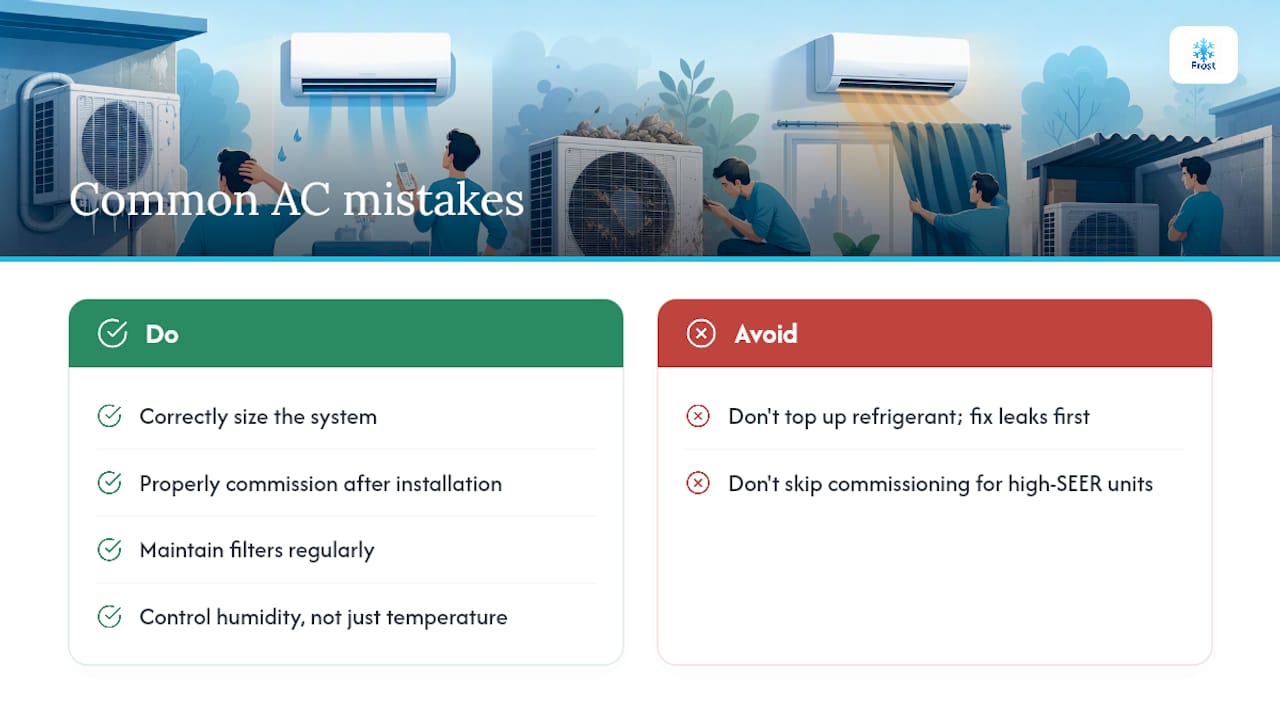
The second misunderstanding is about refrigerant. People assume it depletes like fuel and needs periodic topping up. It does not. A system that needs refrigerant has a leak, and that leak needs fixing before any recharge makes sense. Ignoring this costs money twice: once for the refrigerant, and again when the compressor fails from running undercharged.
The practical takeaway is that the biggest gains in comfort and efficiency come from getting the basics right: correct sizing, proper commissioning, and regular filter maintenance. Chasing the highest SEER-rated unit while skipping the commissioning check is a common and expensive mistake.
Frostairconditioning: professional installation and maintenance in the South West
For homeowners and business owners in Devon and Cornwall who want a correctly specified, properly commissioned system, Frostairconditioning offers something straightforward: REFCOM/F-gas certified engineers, a genuine heat-load survey before any equipment is specified, and same-day or next-day installation where the job allows.

The difference from a generic supplier is in the detail. Every installation includes a full commissioning check, refrigerant charge verification, and condensate drainage test. Maintenance contracts cover annual servicing with refrigerant leak checks included, so the F-gas paperwork is handled correctly every time. Finance at 0% is available for domestic installations, and the team covers Exeter, Devon, Cornwall, and the wider South West.
For a domestic installation survey, visit the Frostairconditioning domestic installation page. For retail and commercial premises, the shop fitting service covers bespoke system design and installation for South West businesses. To book a service maintenance contract, get in touch directly and ask about annual service plans with F-gas compliance included.
Useful sources and further reading
The following sources informed this guide and are worth consulting directly for deeper reading.
- Air Conditioning System | AHRI
- Top Ten Things Consumers Should Know About Air Conditioning
- Heat & Cool Efficiently | ENERGY STAR
- Energy-efficient Air Conditioners & Home Cooling: Tips & Upgrades | Energy Upgrade California
- Air conditioning
On F-gas paperwork: after every service involving refrigerant, ask your engineer for a written record showing the refrigerant type, quantity added or recovered, and the result of the leak check. Keep these records for the life of the system. If an engineer cannot or will not provide them, that is a compliance problem, not a paperwork preference.