

Switching to an energy-efficient cooling system is the single most practical step a UK homeowner can take to cut electricity bills, reduce carbon emissions, and stay comfortable through increasingly warm British summers. Replacing an older unit with a modern, high-efficiency system can reduce monthly cooling costs by 20–44%, depending on how often you run it and your current electricity tariff. The range is conservative and assumes a like-for-like replacement in a typical home.
Three benefits stand out immediately:
- Lower running costs from the first month of operation
- More consistent comfort with steadier temperatures and better humidity control
- Longer equipment life because modern systems work less hard to maintain the same output
If your current system is more than ten years old, the most useful thing you can do right now is check its age and efficiency rating, then ask a certified installer for a survey and quote.
Table of Contents
- What are the real benefits of energy efficient cooling for homeowners?
- How do energy-efficient cooling systems actually deliver results?
- What savings and payback can UK homeowners realistically expect?
- What should you look for when choosing a system and installer?
- What happens during installation, and how do you keep the system efficient?
- What UK regulations affect your cooling system choice?
- Key takeaways
- Frostairconditioning: domestic cooling for South West homes
What are the real benefits of energy efficient cooling for homeowners?
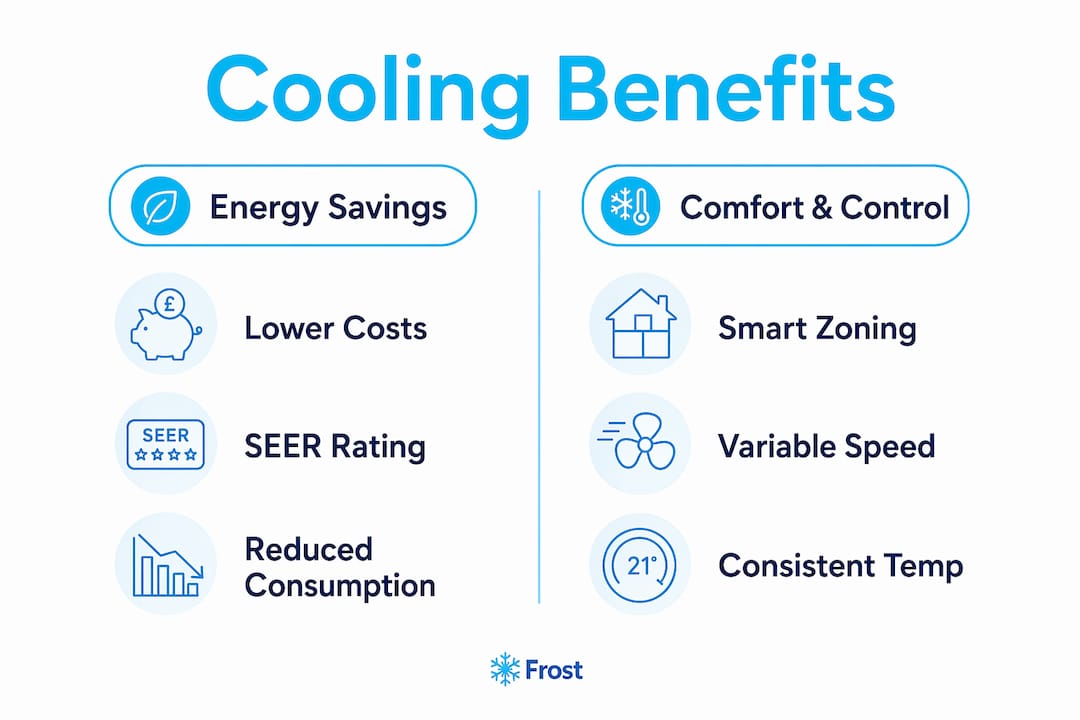
The financial case is the most straightforward. Modern systems with inverter compressors and high SEER (Seasonal Energy Efficiency Ratio) ratings consume significantly less electricity for the same cooling output. In UK homes, where air conditioning runs for fewer hours than in hotter climates, the percentage saving per unit of use is still meaningful, and it compounds across every warm spell.
Running cost savings are the headline, but the comfort improvements are what homeowners notice day to day. Variable-speed systems maintain temperature within ±0.5°C rather than cycling between too warm and too cold. That steadiness also improves dehumidification. When a system removes moisture more effectively, the air feels cooler at a higher thermostat setting, which means you run it less.
Pro Tip: If your home feels clammy even with the AC on, that is usually a sign of an oversized or single-speed unit. A correctly sized inverter system running at lower speed removes far more moisture than a large unit that short-cycles.
Beyond comfort, there are several benefits homeowners often overlook:
- Noise reduction. Inverter units running at partial load are noticeably quieter than older fixed-speed compressors cycling on and off.
- Fewer breakdowns. A system that modulates its output rather than hammering on and off at full power experiences less mechanical stress, which translates to fewer call-outs and a longer service life.
- Better indoor air quality. Replacing an ageing unit improves indoor air quality and reduces humidity-related issues such as condensation and mould risk.
- Property value. A professionally installed, energy-rated system is increasingly listed as a selling point in UK estate agent particulars, particularly as buyers pay closer attention to running costs.
- Carbon reduction. Combined efficiency improvements and refrigerant phase-down could reduce sector emissions by 130–260 GtCO2e by 2050, with three-quarters of that mitigation coming from efficiency gains alone.
How do energy-efficient cooling systems actually deliver results?
The efficiency gains come from a handful of specific technologies. Understanding them helps you compare quotes and avoid paying for features you do not need, or missing ones you do.
Inverter compressors
A conventional fixed-speed compressor is either fully on or fully off. An inverter compressor adjusts its speed continuously to match the actual cooling demand. Because compressor start-up draws 3–5 times normal operating power, reducing the number of start cycles cuts energy use substantially. On a mild British summer day, an inverter unit may run at 30–40% of its maximum speed for hours, consuming very little electricity while keeping the room at a steady temperature.

SEER and EER ratings
SEER measures seasonal efficiency across a range of conditions; EER measures efficiency at peak load. Variable-speed systems improve both dehumidification and energy use by running longer at lower power rather than blasting at full capacity. When comparing quotes, a higher SEER rating means lower running costs over the season. For UK conditions, where peak demand is relatively short, SEER is the more relevant figure.
Heat pumps and air-source systems
An air-source heat pump moves heat rather than generating it, which makes it inherently more efficient than resistive electric cooling. Many modern split systems sold in the UK operate as heat pumps in both directions, providing cooling in summer and heating in winter from a single unit. That dual function changes the payback calculation significantly.
Smart controls and zoning
Smart thermostats learn your schedule and use geofencing to avoid cooling an empty house. Zoning, where separate indoor units serve different rooms independently, means you only condition the space you are actually using. Both features reduce running hours without reducing comfort.
Sizing and installation quality
An oversized unit cools the air before it can remove humidity, leaving the room feeling damp. An undersized inverter unit runs flat out continuously, losing all its efficiency advantage. Correct sizing, based on a proper heat-load calculation, is arguably the single biggest factor in real-world efficiency. For homeowners planning a renovation or extension, timing the installation during building works can reduce disruption and cost.
Feature checklist when comparing quotes:
- Inverter or variable-speed compressor confirmed in the spec sheet
- SEER rating clearly stated (higher is better)
- Correct capacity based on a heat-load calculation, not a rough room-size estimate
- Compatibility with smart thermostat or home automation
- Low-GWP refrigerant (R-32 or R-290 preferred over older R-410A)
- Warranty covering both parts and labour
What savings and payback can UK homeowners realistically expect?
The published savings range of 20–44% applies to replacing an older, low-efficiency system with a modern high-efficiency unit. In the UK, actual savings typically fall within the 20–44% range, with most homes seeing notable reductions even at the lower end of that spectrum.
- Annual cooling electricity use before upgrade: 600 kWh
- UK electricity price: approximately 24p per kWh (check your current tariff)
- Annual cooling cost before: £144
- Saving at 25%: £36 per year
- Saving at 40%: £58 per year
Payback period depends heavily on the gap between your old system's efficiency and the new one, how many hours you run it, your electricity tariff, and whether you qualify for any grant support. A home that runs cooling for longer periods, or that is replacing a very old fixed-speed unit, will see payback faster.
Factors that change payback:
- Age and efficiency of the unit being replaced (older = bigger gap = faster payback)
- Annual cooling hours (more hours = faster payback)
- Electricity tariff (higher unit rate = larger absolute saving)
- SEER rating of the new system (higher = more efficient)
- Insulation and shading quality of the building (better fabric = system works less)
- Available grants or incentives (see Section 7)
Typical savings by scenario:
| Old system type | New system SEER | Estimated saving |
|---|---|---|
| Older fixed-speed | SEER 14 | 20–44% |
| Older fixed-speed | SEER 16 | 20–44% |
| Older fixed-speed | SEER 20+ | 20–44% |
| 2015 mid-efficiency | SEER 16 | 20–44% |
For a deeper look at upgrading an older unit, including what to check before you commit to a replacement, the step-by-step guide covers the full process.
What should you look for when choosing a system and installer?
Choosing the right system matters, but choosing the right installer matters just as much. A poorly commissioned system will underperform regardless of its rated efficiency.
Checklist for the system:
- Inverter compressor technology confirmed
- SEER rating appropriate for your usage pattern
- Correct capacity from a heat-load calculation
- Low-GWP refrigerant (R-32 is now standard on most quality units)
- Smart control compatibility
- Manufacturer warranty of at least five years on the compressor
Questions to ask every installer:
- Are you F-Gas certified and REFCOM registered? (Ask to see the certificate.)
- Will you carry out a full heat-load calculation before specifying the system?
- What commissioning documentation will you provide?
- Which refrigerant does the proposed system use, and what is its GWP?
- What does the maintenance plan cover, and how often is a service recommended?
- Can you provide references or examples of similar installations locally?
Trust signals to require in writing:
- Written heat-load calculation with assumptions stated
- Commissioning certificate signed by the engineer
- REFCOM/F-Gas registration number
- Manufacturer warranty details (not just a verbal assurance)
- Clear breakdown of what the quote includes and excludes
On financing, a number of reputable installers now offer 0% finance on domestic installations, which spreads the upfront cost without adding to it. Ask whether this is available and confirm the credit terms before signing. For a broader comparison of system types suited to UK homes, reviewing the options before your first installer conversation will help you ask better questions.
What happens during installation, and how do you keep the system efficient?
A professional installation follows a clear sequence, and knowing what to expect helps you spot corners being cut.
Typical installation timeline:
- Site survey (30–60 minutes): the engineer assesses the room, measures dimensions, checks wall construction, identifies the best indoor and outdoor unit positions, and confirms electrical supply.
- System design and quote (1–3 days): a written proposal with the specified unit, capacity, refrigerant type, and price.
- Installation day (typically 4–8 hours for a single split system): pipework run, indoor and outdoor units mounted, electrical connection made, condensate drainage fitted.
- Commissioning (final 30–60 minutes): refrigerant charge verified, system run through all modes, temperatures and pressures logged, and a commissioning report handed over.
On the day itself, check that the model installed matches the one on the quote, that pipework is neatly clipped and insulated, that the condensate drain runs to a suitable outlet, and that you receive a commissioning report before the engineer leaves.
Maintenance schedule to preserve efficiency:
- Monthly (homeowner): clean or rinse the indoor unit's filter
- Seasonally (homeowner): check the outdoor unit is clear of debris and vegetation
- Annually (engineer): full service including refrigerant leak check, electrical inspection, coil clean, and performance test
- Every 3–5 years: ductwork inspection if applicable
Pro Tip: Book your annual service in early spring, before the first warm spell. Engineers are far easier to schedule in March than in July, and a serviced system is ready to perform when you actually need it.
What UK regulations affect your cooling system choice?
F-Gas regulations require that any work involving refrigerants, including installation, servicing, and decommissioning, is carried out by a certified engineer. This is not optional. An uncertified engineer handling refrigerant is breaking UK law, and any warranty tied to the refrigerant circuit will be void.
What this means for homeowners:
- Always ask for the installer's F-Gas certificate and REFCOM registration before work begins
- Refrigerant top-ups and leak repairs must be logged by the engineer
- When a system reaches end of life, the refrigerant must be recovered by a certified engineer, not vented
- You are responsible for ensuring correct disposal; the engineer should provide documentation confirming refrigerant recovery
The Kigali Amendment to the Montreal Protocol drives the phase-down of high-GWP refrigerants such as R-410A. Systems using R-32 or R-290 are better positioned for long-term regulatory compliance and carry a lower indirect carbon footprint. Pairing refrigerant phase-down with efficiency improvements multiplies the climate benefit compared with either action alone.
For official UK guidance, the Energy Saving Trust and gov.uk publish current information on F-Gas obligations, energy efficiency standards, and any available grant schemes. The Boiler Upgrade Scheme (BUS), administered through Ofgem, currently supports air-source heat pump installations in England and Wales; eligibility and grant values are subject to change, so check gov.uk for the current position before budgeting.
End-of-life responsibilities:
- Arrange refrigerant recovery with a REFCOM-certified engineer
- Retain the recovery certificate for your records
- Dispose of the unit through an approved WEEE recycling route
What Frostairconditioning sees in South West homes
Across Devon and Cornwall, the most common scenario is a home built between 2000 and 2015 with either no cooling at all or a portable unit that costs a disproportionate amount to run. When a properly sized inverter split system replaces a portable unit or a pre-2012 fixed-speed system, the efficiency difference is substantial.
Frostairconditioning's credentials:
- F-Gas certified and REFCOM registered engineers
- Premium systems from Samsung, Mitsubishi, Daikin, and Toshiba
- 0% finance available on domestic installations
- Same-day and next-day installations available across the South West
- Annual maintenance contracts with documented service reports
Frostairconditioning covers Devon, Cornwall, and the wider South West, offering domestic installation, commissioning, and ongoing maintenance from a single local team.
Key takeaways
Energy-efficient cooling reduces running costs by 20–44% when replacing an older system, with the biggest gains coming from inverter technology, correct sizing, and professional commissioning.
| Point | Details |
|---|---|
| Savings range | Replacing an old fixed-speed unit with a SEER 16+ system typically cuts cooling costs by 20–44%. |
| Inverter technology | Inverter compressors adjust speed continuously, reducing start-up energy spikes and improving comfort. |
| Correct sizing matters | An oversized unit short-cycles and fails to dehumidify; always request a heat-load calculation. |
| F-Gas certification | Only REFCOM/F-Gas certified engineers may legally handle refrigerants in the UK. |
| Frostairconditioning | Offers F-Gas certified domestic installation across the South West, with 0% finance and same-day availability. |
Get a free survey and quote to find out exactly how much a modern system could save in your home.
The case for efficient cooling, plainly stated
Most of the homeowners who contact us have been putting off the decision for a year or two, usually because the upfront cost feels significant. What they tend to underestimate is how much the running cost gap widens every year they keep an old system going. An inefficient unit does not just cost more to run; it costs more to maintain, breaks down more often, and does a worse job of the thing it is supposed to do.
The technology argument is settled. Inverter compressors, low-GWP refrigerants, and smart controls are not premium add-ons; they are the standard in any quality system sold today. The real variable is installation quality, and that comes down to the engineer. F-Gas certification and REFCOM registration are the baseline. A commissioning report is non-negotiable. Everything else follows from those two things.
Frostairconditioning: domestic cooling for South West homes
Lower running costs, better comfort, and a system that lasts: that is what a properly installed, high-efficiency split system delivers for a UK home. Frostairconditioning installs premium inverter systems from Samsung, Mitsubishi, Daikin, and Toshiba across Devon, Cornwall, and the South West, with F-Gas certified engineers handling everything from the initial survey to commissioning and handover.

0% finance is available on domestic installations, spreading the cost without adding to it. Annual service and maintenance contracts keep your system running at peak efficiency year after year. Same-day and next-day installations are available for homeowners who cannot wait.
Request a free quote and a Frostairconditioning engineer will survey your home, specify the right system, and give you a clear, written price with no obligation.
Useful sources and further reading
- Energy Saving Trust — UK-focused guidance on home energy efficiency, heat pumps, and available grants
- gov.uk: Boiler Upgrade Scheme — current eligibility and grant values for air-source heat pumps in England and Wales
- ENERGY STAR: Variable speed room air conditioners — technical explanation of inverter and variable-speed technology benefits
- CCAC: Assessment of climate and development benefits of efficient cooling — global evidence on efficiency and refrigerant phase-down combined benefits
- UNEP/CCC: Cooling emissions and policy synthesis report — policy context and Kigali Amendment background
- Consumer Reports: Inverter air conditioners — practical consumer-level evidence on inverter efficiency and comfort
- Trane: Energy-efficient air conditioner guide — SEER/EER ratings, smart controls, and commissioning guidance
- REFCOM — UK register of F-Gas certified engineers; use to verify installer credentials