
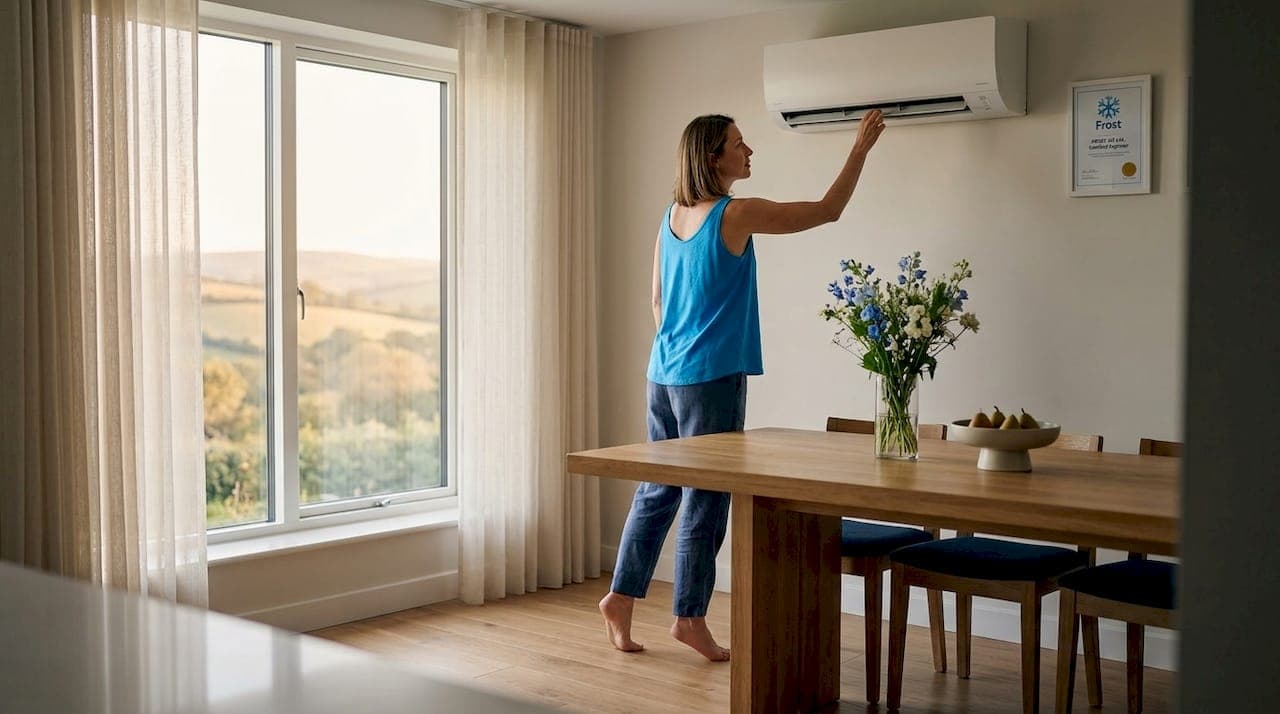
Choosing the right air conditioning system is one of the more consequential decisions you can make as a homeowner, yet most people approach it with very little to go on beyond price and brand name. Understanding the top air conditioning features before you buy means you can properly evaluate what each unit actually delivers, rather than discovering its limitations on the first hot day in August. Whether you are cooling a terraced cottage in Truro or a new-build in Exeter, the features you prioritise will directly shape how comfortable, efficient, and cost-effective your system turns out to be.
Table of Contents
- Top air conditioning features: smart controls for convenience and efficiency
- Choosing the right cooling capacity for your space
- Efficiency and performance: inverter and variable-speed technology
- Indoor air quality features: filtration and dehumidification
- Convenience and reliability features for peace of mind
- Comparing key features across popular unit types
- Why installer expertise matters beyond top features
- Find the best air conditioning solutions for your Devon or Cornwall home
- Frequently asked questions
Key Takeaways
| Point | Details |
|---|---|
| Smart controls enhance convenience | Wi-Fi and app control let you manage your air conditioner remotely and save energy with schedules. |
| Match cooling capacity | Select a unit with a BTU rating suited to your room size to maintain comfort and efficiency. |
| Inverter technology improves performance | Variable-speed compressors reduce noise and energy use while keeping temperatures steady. |
| High-grade filtration matters | True HEPA filters and activated carbon improve indoor air quality and reduce allergens. |
| Professional installation is crucial | Correct installation and commissioning ensure your system delivers on comfort and efficiency. |
Top air conditioning features: smart controls for convenience and efficiency
Smart controls have shifted from being a premium novelty to a near-essential feature in modern systems. The ability to adjust your temperature from your phone while you are still at the beach in Newquay, or to schedule your system to cool down the house before you return from work, makes a real and practical difference to daily life.
Key smart features worth looking for include:
- Wi-Fi connectivity for remote temperature and power control via a smartphone app
- Scheduling to run cooling only when needed, avoiding unnecessary energy use on cooler Devon and Cornwall evenings
- Voice control compatibility with Alexa, Google Assistant, and Siri for hands-free adjustments
- Energy use reporting so you can see exactly how much your system is consuming and where savings are possible
Smart ACs typically require built-in Wi-Fi for remote control and scheduling, with voice control now common across mid-range and premium units. These features go well beyond convenience. A properly scheduled system can reduce energy consumption significantly compared with one left running at a fixed setting all day.
Understanding the smart air conditioning benefits for your home goes beyond just the novelty of app control. Energy reporting, for instance, allows you to identify patterns and genuinely reduce your bills over time.
Pro Tip: Look for units that allow geofencing via their app. This means the system can automatically switch off when your phone leaves a set location and switch back on when you return, without you touching a thing.
Choosing the right cooling capacity for your space
No feature list matters if the unit is the wrong size for the room. Undersized units run constantly without reaching your target temperature. Oversized units cool too quickly, switch off, and leave the air humid and clammy. Neither outcome is comfortable.
BTU (British Thermal Unit) ratings indicate cooling power. As a starting point, approximately 20 BTUs per square foot is the widely used benchmark, though room height, sun exposure, and occupancy all affect the final figure.
Here is a practical reference table for typical room sizes:
| Room size (sq ft) | Room size (sq m) | Recommended BTU range |
|---|---|---|
| Up to 150 sq ft | Up to 14 sq m | 5,000 to 6,000 BTU |
| 150 to 250 sq ft | 14 to 23 sq m | 6,000 to 8,000 BTU |
| 250 to 350 sq ft | 23 to 33 sq m | 8,000 to 10,000 BTU |
| 350 to 500 sq ft | 33 to 46 sq m | 10,000 to 12,000 BTU |
| 500 to 700 sq ft | 46 to 65 sq m | 14,000 to 18,000 BTU |
Selecting the correct capacity prevents short cycling, which is when a unit reaches the target temperature so quickly that it switches off before properly circulating or dehumidifying the air. This causes temperature swings and places unnecessary wear on components.
For a deeper look at which unit types suit different room configurations, the guide to types of air conditioning for UK homes is worth reading before committing to a purchase.
Efficiency and performance: inverter and variable-speed technology
Once you have the right capacity, the next question is how the unit delivers that cooling. This is where inverter technology becomes one of the most important best AC features to understand.
A traditional fixed-speed compressor has one setting: fully on. It runs at maximum power until the target temperature is reached, then shuts off completely. An inverter compressor works like a dimmer switch rather than a light switch, modulating its output to match what the room actually needs at any given moment.
The practical benefits of inverter and variable-speed systems include:
- Steadier temperatures without the noticeable on-off cycling of older units
- Better humidity control, because the system runs longer at lower intensity rather than blasting and switching off
- Lower running costs, since the compressor is not repeatedly starting from zero at full power
- Quieter operation, as reduced cycling noise makes a real difference in bedrooms and home offices
Inverter and variable-speed systems modulate output to match demand, reducing cycling noise and energy use while maintaining steady temperatures. For a coastal climate like Cornwall's, where summer humidity can make warmth feel much worse than the thermometer suggests, this steadier humidity management is particularly valuable.
Pro Tip: When comparing efficiency ratings, look for units with a high SEER2 (Seasonal Energy Efficiency Ratio) score. The higher the number, the less energy the unit uses to deliver the same amount of cooling. Pairing this with our guide to boosting AC energy efficiency at home can help you squeeze even more from your system.
Indoor air quality features: filtration and dehumidification
The best air conditioning benefits go beyond temperature. Modern units can actively improve the air you breathe, which matters considerably in Devon and Cornwall homes where pollen from moorland, coastal humidity, and older building stock can contribute to poor indoor air quality.

When evaluating air filter types, watch out for vague marketing language. The term "HEPA-style" means very little. What you want is a unit with a verified standard behind its claims.
Key air quality features to look for:
- True HEPA filters rated H13 or H14 to the EN 1822 standard. These capture 99.95% of particles at 0.3 microns, including dust mite debris, pollen, and mould spores
- Activated carbon filters to absorb odours, volatile organic compounds (VOCs), and gases that particle filters alone cannot tackle
- PM2.5 and PM10 filtration for fine particulate matter, particularly relevant near busy roads or in homes with gas cooking
- Built-in dehumidification as a dedicated mode, not just a side effect of cooling, which is especially useful during Devon and Cornwall's damp shoulder seasons
For homeowners with allergies or asthma, these are not optional extras. They are the features that will most directly affect daily wellbeing. More detail on air quality in Devon homes is available if you want to explore this further.
Convenience and reliability features for peace of mind
The features that make a system easy to live with day-to-day are often the ones that get overlooked when comparing spec sheets. Yet they are frequently the difference between a system you love and one you find mildly irritating to use.
Practical features worth checking before you buy:
- Auto Restart restores all your settings automatically after a power cut, without you needing to reprogram the unit
- 24-hour timers let you set cooling to start before you wake or arrive home, so you never walk into a hot room
- Sleep mode gradually adjusts temperature through the night to match your body's natural cooling, preventing you from waking up cold at 3am
- Whisper-quiet operation, measured in decibels (dB). Anything below 30 dB is genuinely quiet for a bedroom. Some units are rated lower still
- Remote control air conditioning via physical remote or app, giving you flexible control without needing to approach the unit
Modern room units often include Auto Restart, 24-hour timers, and sleep modes as standard comfort features. If you are installing a unit in a bedroom, these features should be non-negotiable. The guidance on bedroom AC comfort features covers this in more detail, including advice on positioning for quieter night-time use.
Comparing key features across popular unit types
To help you make a direct comparison, here is how the main unit types stack up against the features covered in this article:
| Feature | Window unit | Portable AC | Inverter split system |
|---|---|---|---|
| Smart controls / Wi-Fi | Available on some models | Available on some models | Standard on most models |
| Cooling capacity range | 5,000 to 25,000 BTU | 8,000 to 14,000 BTU | 7,000 to 36,000+ BTU |
| Inverter technology | Rare | Very rare | Standard |
| True HEPA filtration | Limited | Limited | Available on premium models |
| Dehumidification mode | Basic | Basic | Advanced |
| Sleep mode / timers | Common | Common | Standard |
| Auto Restart | Uncommon | Uncommon | Standard |
| Noise level (indoor) | 50 to 70 dB typical | 50 to 60 dB typical | 19 to 35 dB typical |
| Installation complexity | Moderate | None (self-install) | Requires F-Gas engineer |
| Energy efficiency | Moderate | Poor to moderate | Excellent |
Key takeaways from this comparison:
- Portable units offer the easiest setup but deliver the worst efficiency and the highest noise levels. They are best reserved for temporary or supplementary cooling
- Window units suit properties where a split system is not practical, though they are less common in UK housing stock
- Inverter split systems outperform both alternatives across almost every metric, particularly for efficiency, noise, and air quality features
Pro Tip: If you are looking at an inverter split system, check that the installer is F-Gas certified before anyone touches the refrigerant. This is a legal requirement in the UK, not just a quality badge. Our home air conditioning guide covers what to ask your installer before work begins.
Why installer expertise matters beyond top features
Here is something the feature comparison tables never tell you: a well-installed average unit will outperform a poorly installed premium one, every single time. After years of working with homeowners across Devon and Cornwall, this is the pattern that repeats itself more than any other.
The reason is that inverter technology and smart thermostat options only deliver their promised efficiency when the installation behind them is done correctly. Installer choices such as refrigerant charge, pipe sizing, and commissioning determine comfort and efficiency more than the unit features alone. An incorrectly charged system will cycle more frequently, consume more energy, and fail to maintain the steady temperatures that inverter technology is specifically designed to provide.
There are a few questions worth asking any installer before they start:
- What refrigerant type is the unit using, and is it future-proofed against phase-out regulations?
- Will you provide commissioning documentation after installation?
- How do you account for the specific humidity levels common to coastal properties?
These are not trick questions. A good installer will answer them without hesitation. If they cannot, that tells you something important.
The other consideration for Devon and Cornwall specifically is humidity management. Coastal air behaves differently from inland air, and a system set up for a dry inland climate will struggle to maintain comfort by the sea. Proper commissioning accounts for this. Our perspective on professional installation and system design explains why this matters more than most homeowners realise.
Choose your features carefully, but choose your installer just as carefully.
Find the best air conditioning solutions for your Devon or Cornwall home
If this article has given you a clearer picture of what to look for, the next step is talking to someone who knows your local conditions and can translate those features into a real system designed for your home.
Frost Air Conditioning is based in Exeter and covers Devon and Cornwall with same-day installations available and 0% finance options to spread the cost. As F-Gas certified engineers, we handle everything from sizing and feature selection through to commissioning and aftercare. Whether you are cooling a single bedroom or a whole property, we can help you get a quote for air conditioning that fits your home, your budget, and your lifestyle. Request a personalised quote today and we will take care of the rest.
Frequently asked questions
What is the most important feature to look for in a new air conditioning system?
For most Devon and Cornwall homeowners, smart control features such as Wi-Fi connectivity and scheduling make the most practical difference to daily use and energy bills. Smart ACs require built-in Wi-Fi for remote control and scheduling, which are now standard expectations rather than luxury additions.
How do I know what cooling capacity I need for a room?
Use the general guideline of approximately 20 BTUs per square foot as your starting point, then adjust for ceiling height, sun exposure, and how many people regularly use the room. Window and room ACs are specified by BTUs and cooling area, so matching capacity correctly avoids the efficiency problems that come with oversizing or undersizing.
Are inverter air conditioners better than traditional units?
Yes, consistently. Inverter systems modulate output to match cooling demand rather than switching fully on and off, which delivers lower energy use, quieter operation, and more stable temperatures throughout the day.
Do air conditioners improve indoor air quality?
Many modern units do, particularly those fitted with verified filtration. True HEPA H13 or H14 filters capture 99.95% of airborne particles, and units with added activated carbon also tackle odours and VOCs, which is particularly useful in older Devon and Cornwall properties.
Why is professional installation important for advanced AC systems?
Because the features the unit promises can only be delivered if the system is set up correctly. Installer choices impact refrigerant charge, pipe sizing, and commissioning, all of which directly determine whether an inverter system runs efficiently or wastes energy through poor cycling and inadequate humidity control.