
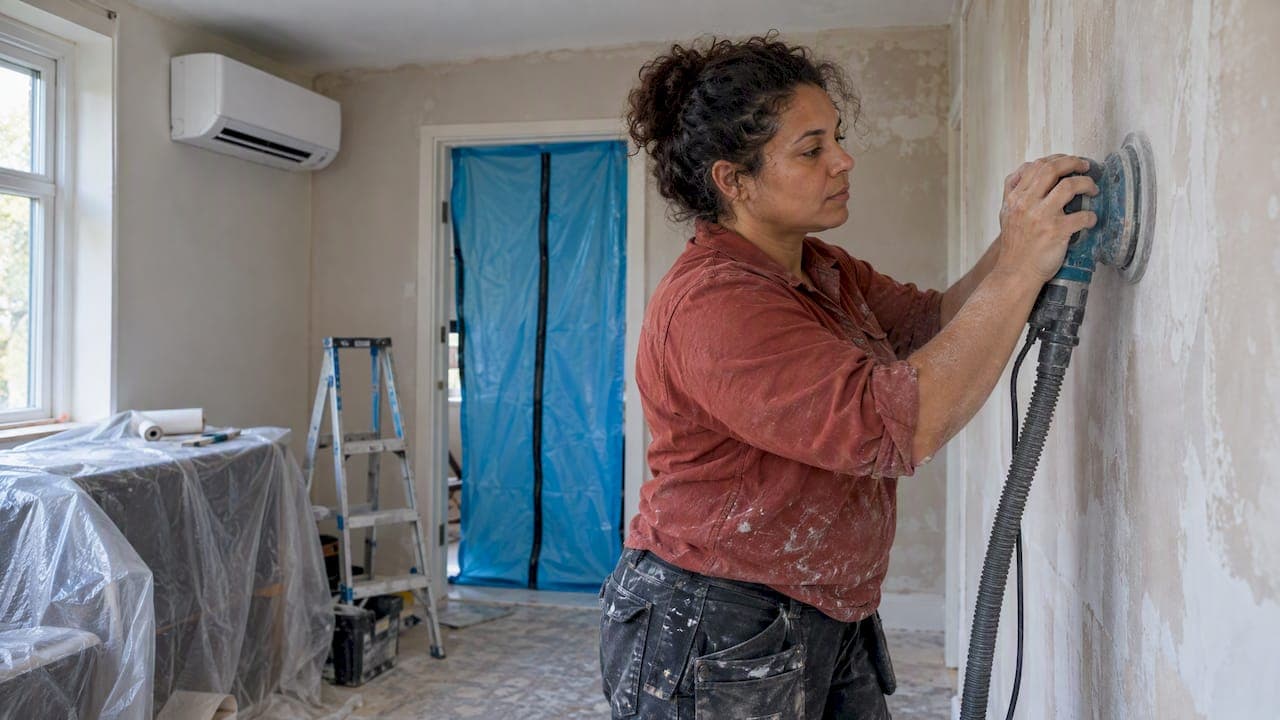
Renovation dust and air conditioning do not mix. Plaster, brick and plasterboard dust is far finer and more abrasive than ordinary household dust, and a running unit will pull it in, circulate it and clog the coils and fan. The fix is simple in principle: stop the dust at its source, switch the unit off and cover it while the work is dusty, then have it checked by a certified engineer before you rely on it again.
This guide is for homeowners in Devon, Cornwall and the wider South West who have a unit already fitted, or who are planning an extension, kitchen or loft job and want to fit air conditioning at the right moment. It covers what to do before, during and after the work, what you should never do yourself, and how to spot trouble.
TL;DR
- Switch the indoor unit off, and keep it off, while dusty work is going on nearby. Cover it loosely and seal the room off from the work area.
- An air conditioner is not a dust extractor. Its filters are made for everyday household dust, not construction dust, so control the dust at the source instead.
- Wipe and wet-clean surfaces rather than dry sweeping, and open windows to purge the air while the work is being done.
- Do not open up the unit or touch the refrigerant circuit yourself. Only F-Gas certified engineers can legally work on it.
- Book a professional check after the work finishes, and ideally fit new units once the messy stage is over.
Table of Contents
- Why renovation dust is a problem for air conditioning
- Do not use your aircon to clean the air
- Before the work starts: a protection plan
- During the work: ventilation, wet cleaning and what not to do
- When the work is finished: the aftercare routine
- Signs the dust has got into your system
- Health: renovation dust is not just a unit problem
- Perspective: what we see after renovations
- Planning a renovation and new air conditioning together
- Protecting the unit if you must keep it on
- Our air conditioning services across the South West
- FAQ
- Sources
Why renovation dust is a problem for air conditioning
A split system works by drawing room air across a filter and a cold evaporator coil, then blowing it back into the room. In normal life that air carries skin flakes, fibres and light dust. During a renovation it carries something quite different.
The HSE explains that high-energy tools such as cut-off saws, grinders and wall chasers create a lot of dust in a very short time, and that dust builds up more in enclosed spaces. Plastering sanding, cutting blockwork and chasing walls for cables all fall into that category. The dust from these jobs can contain silica or gypsum, and it is fine enough to stay airborne and drift through a house.
It does not stay in one room either. It moves along hallways and up stairs, and it is drawn straight into any appliance that moves air. An air conditioner is exactly that.
What happens inside the unit:
- Filters clog quickly. Airflow drops, the unit works harder and cools less well.
- Fine dust passes the filter. It coats the evaporator coil and fan blades, where it mixes with condensation to form a paste.
- Drainage can block. That paste can find its way into the condensate tray and pipe, which can lead to water leaks from the indoor unit.
- The fan can go out of balance. A caked fan wheel is noisier and wears its bearings faster.
In the HSE's guidance on soft strip demolition, the emphasis is on controlling dust where it is made. The same logic applies at home: filtration is the last line of defence, not the first.
Do not use your aircon to clean the air
A common instinct is to leave the unit running to "clear the air". Please do not. A domestic split unit's filter is designed for standard household dust. Construction dust is heavier in volume and more abrasive, and it gets past the mesh and into the coil and fan, where it can do lasting damage.

The NICE guidance on indoor air quality at home asks for a balanced approach to ventilation, insulation and heating. In a renovation that means dealing with ventilation deliberately, not leaning on the air conditioner.
The point of the unit is comfort. Treat it as you would a delicate piece of kit that you wouldn't leave running in a workshop.
Before the work starts: a protection plan
Talk to your builder before they pick up a tool. A few minutes of planning will save you a service call.
1. Agree where the dust is made
Ask the builder to cut, sand and mix outside or in one contained area where possible. The HSE recommends looking at ways to limit the dust before work starts, for example by using the right-sized materials so less cutting is needed, or using a less powerful tool.
2. Ask for extraction at the tool
Tools with on-tool dust extraction and a suitable vacuum catch dust where it is created. This is worth far more than any amount of cleaning afterwards.
3. Switch the unit off at the isolator
Turn the system off using the remote, then at the wall isolator or fused spur if you have one. This avoids a unit starting up automatically on a timer or schedule and pulling in dust. Always cut the power before touching or covering a unit.
4. Cover the indoor unit loosely
A light dust sheet or polythene taped to the wall around (not tightly over) the unit stops settling dust. Do not push anything into the vents or grille. Covering the outdoor unit is rarely needed unless there is cutting or sanding directly beside it, and if so, never block its air flow while it is running.
5. Seal off the work area
Close doors, and use zip-up dust barriers or taped sheeting across openings. Close doors between the work and rooms that have a unit in them.
During the work: ventilation, wet cleaning and what not to do
Ventilate properly
The 2026 edition of Approved Document F sets out the ventilation strategy for homes in England, which relies on a combination of extract ventilation, background ventilation and purge ventilation. In practical terms, keep trickle vents open and unblocked, and when dusty tasks are underway, open windows widely to purge the air intermittently, preferably in the room where the work is being done and away from the rooms you are living in.
If you are in Wales, Scotland or Northern Ireland, different building regulations apply, so check with your local authority.
Wet-wipe, do not dry sweep
The HSE notes that dry sweeping can make a lot of dust compared with vacuuming or wet brushing. For day-to-day tidying during the job, that means:
- damp cloths on surfaces, rinsed often
- wet brushing or a suitable vacuum for floors, not a dry brush
- no ordinary household vacuum on fine plaster dust, as the exhaust can throw the finest particles back into the air
If you hire professionals for the final clean, a checklist that follows HSE-style dust controls is worth having. This after-builders cleaning checklist sets out the order to work in and the controls to expect.
Do not clean the inside of the unit yourself
It is tempting to take the front off and hoover the coil. Don't. Manufacturers say the same: one Samsung-style user manual tells users to cut the power and wait for the fan to stop, and not to clean the inside of the air conditioner by themselves. Bent fins, wet electronics and damaged drainage can void a warranty.
When the work is finished: the aftercare routine
Once the last of the plastering and sanding is done, and not before, bring the system back gently.
- Finish the deep clean of the room first. Wipe the wall around the unit, the top of the casing and the remote.
- Check and wash the filters. Slide out the filters (your manual shows how), inspect them for grey or white dust, tap them outside, rinse in lukewarm water and dry fully before refitting. Our homeowner's guide to cleaning your air conditioner covers this step by step.
- Run it on fan mode for a short while. Listen for rattles, scraping or a change in noise, and check that air flows evenly.
- Look for leaks. Water dripping from the indoor unit may point to blocked drainage.
- Book a professional check if anything seems off, or if the work was heavy. If the job involved demolition, sanding a whole room, or a lot of chasing, treat a check as part of the project cost.
Servicing is not the same as cleaning
Cleaning filters is your job. Servicing the internal components is not. A service covers coil condition, drainage, electrical connections and refrigerant checks, and it is a separate task from wiping filters.
The law adds a layer. The government's guidance says a company must be certified by an approved body to service stationary equipment containing F gas operated by others, and that this includes air conditioning. Engineers also need personal qualifications to install, service, check for leaks and recover gases. If you own the equipment, you are the one responsible for getting it checked for F gas leaks.
Our own guides on when UK owners should service their aircon and on verifying F-Gas certification go into the details of frequency and how to check an engineer's credentials.
Signs the dust has got into your system
| Symptom | Likely cause | What to do |
|---|---|---|
| Weak airflow | Clogged filter or coated coil | Clean filters; book a service if it persists |
| Musty or chalky smell | Dust and moisture on coil or in tray | Stop using; call an engineer |
| Water dripping indoors | Blocked condensate drain | Switch off; call an engineer |
| New rattle or whirr | Dust on the fan wheel | Switch off; call an engineer |
| Visible grey streaks from the vents | Dust on the coil or fan | Switch off at once; call an engineer |
| Unit won't cool as before | Restricted airflow, or a refrigerant issue | Do not top up gas yourself; call a certified engineer |
Our list of common AC problems can help you tell dust problems from other faults.
Health: renovation dust is not just a unit problem
The dust is a concern for people as well as machines. The HSE's guidance, EH44, says never to assume any dust is safe, and that uncontrolled dry, dusty work in an enclosed environment is likely to be hazardous. Silica in particular is a serious workplace health risk, and your builder has legal duties to control it. For household exposure, GOV.UK has information on indoor airborne allergens, which can aggravate asthma and other respiratory conditions.
If anyone in your home has asthma, a lung condition or allergies, speak to your GP or practice nurse about the best way to manage the weeks of building work. Consider staying elsewhere for the dustiest days.
Perspective: what we see after renovations
We work across Devon, Cornwall and the wider South West, and the pattern is familiar. A homeowner has the extension finished, the plaster is dry, and a few weeks later they call because the unit smells odd or isn't cooling. Nearly always the unit was left on during sanding, or the dust sheet was never put up.

Our advice is plain. If you are going to renovate, do not run the air conditioning in the affected part of the house, and do not expect it to clear the air. If you are planning a renovation and air conditioning together, book the installation for the end of the project, once plastering and sanding are done. Installing into a clean, finished space protects the new system and means we are not working around wet trades.
We also see people try to rescue a dusty unit with a hose and a screwdriver. Please call us instead. Our engineers are F-Gas certified and REFCOM registered, we don't use subcontractors, and a check after a renovation is far cheaper than a replaced fan motor or coil.
— James
Planning a renovation and new air conditioning together
There is a good case for timing. If your project involves new rooms, a loft conversion or a refit, then the pipework and cable routes are easier to plan while walls are open. The messy part, however, is the part that damages a unit.
A sensible sequence looks like this:
- Design stage: have a survey early so pipe runs, condensate routes and outdoor unit positions are agreed with your builder.
- First fix: pipe sleeves and cabling can be installed while the walls are open, if your engineer agrees the route.
- Plastering, sanding, decorating: the dusty stage, with no indoor units fitted or running.
- Installation: units go on the wall once the room is finished.
- Commissioning: the engineer tests and commissions the system and shows you how to look after it.
The government's guide on ventilation is a handy reminder that ventilation exchanges stale indoor air with fresh outdoor air. Air conditioning cools recirculated air, it does not usually ventilate, so keep your trickle vents and extract fans working in the rooms that have a unit.
Protecting the unit if you must keep it on
Some households can't switch off for weeks, especially in summer or if someone works from home. If that is you, then:
- keep the unit in a room well separated from the work, with the door closed
- check the filters weekly and wash them as soon as they look grey
- avoid running it while anyone is sanding, cutting or chasing
- do not tape over the outdoor unit while it runs
- book an engineer's check at the end of the job
This is a compromise, not a recommendation. Where it is possible, switching off wins every time.
Our air conditioning services across the South West
If you want your system checked after building work, or you are planning new units for a finished room, we can help. We offer service and maintenance, including annual service contracts and emergency breakdown response, and you can look at our service plans. For a new system, see our domestic installation page. We fit systems from Samsung, Mitsubishi, Toshiba and Daikin, offer free surveys and 0% finance, and often complete installations within one to two days. Same day installs are available.
If you run a shop or office that is being refitted, our shop fitting and commercial team handles air conditioning in that setting too.
For more reading, our guides on seasonal aircon service checklists and aircon aftercare cover the routine care that keeps a unit healthy long after the builders have left.
FAQ
How do I deal with dust from a renovation?
Stop it at the source: use tools with extraction, cut outside where possible and seal doors with sheeting. Wet-wipe surfaces instead of dry sweeping, and open windows to purge the air while dusty tasks are underway. If anyone at home has asthma or a lung condition, ask your GP for advice.
Can I leave my air conditioning on during building work?
We advise against it. Construction dust is much finer and more abrasive than normal household dust, and it can get past the filter onto the coil and fan. Switch the unit off at the isolator, cover the indoor unit loosely and have it checked once the work is done.
How often should air conditioning units be serviced in the UK?
At least once a year is the usual professional recommendation for a home unit, and more often after heavy building work. Servicing must be done by F-Gas certified engineers, and owners of stationary air conditioning equipment are responsible for leak checks. Our service frequency guide explains the details.
Can I clean the inside of my aircon after a renovation?
You can wash the filters and wipe the outside of the casing. You should not open the unit, spray the coil or touch the refrigerant circuit. Work involving F gas must be done by a certified company, and DIY internal cleaning can damage the unit or void the warranty.
Sources
- Dust - HSE
- Construction dust: Soft strip demolition - HSE
- Dust in the workplace: General principles of protection, EH44 - HSE
- Indoor air quality at home - NICE
- Approved Document F: Ventilation - GOV.UK
- Company certification to work with F gas - GOV.UK
- Qualifications to work with F gas - GOV.UK
- Checking F gas equipment for leaks - GOV.UK
- Indoor airborne allergens - GOV.UK
- Existing home ventilation guide - GOV.UK
- Air conditioner user manual