

Modern air conditioning can meaningfully reduce everyday condensation in your home by removing moisture from the air as a by-product of cooling. The short answer is yes, but with a clear limit: AC tackles humidity-driven condensation well; it cannot fix structural damp, cold bridges, or interstitial condensation in walls.
Three things to do right now:
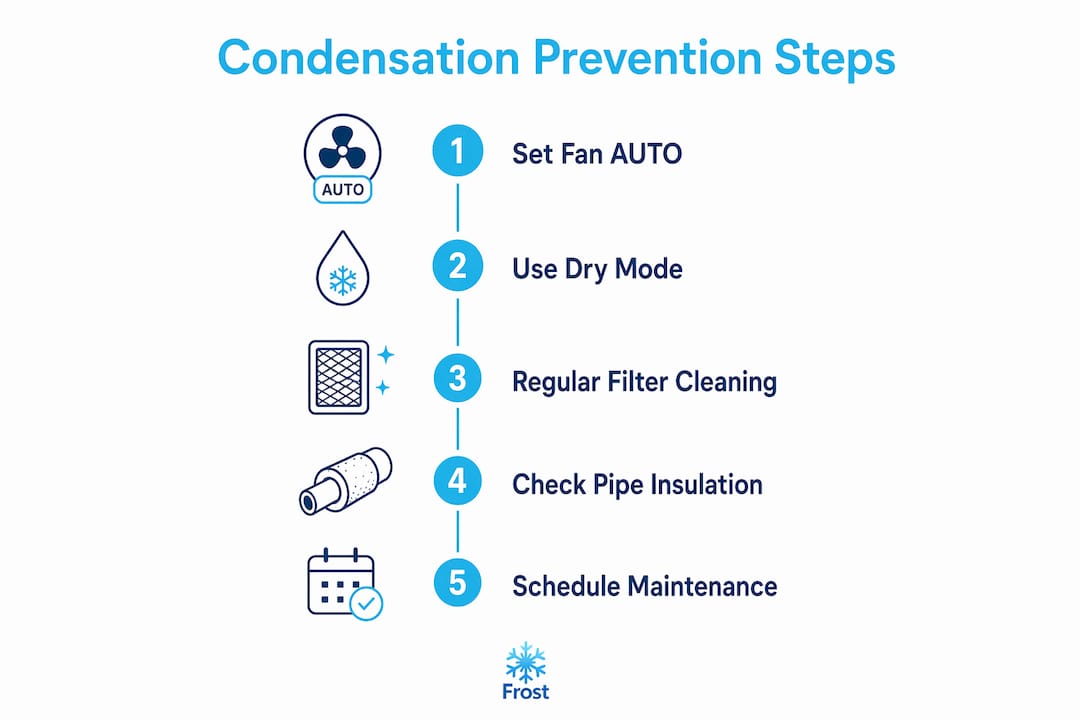
- Switch your fan setting from ON to AUTO so the blower only runs during active cooling cycles, preventing re-evaporation of moisture from wet coils.
- Run Dry Mode in short bursts after high-moisture activities such as cooking or showering.
- Check and clean your filter. A clogged filter is the single most common cause of frozen coils, which overflow when they thaw.
If you are seeing persistent damp patches, mould on walls, or water staining that does not clear after a week of adjusted settings, those are signs of a structural issue. At that point, call a certified installer rather than turning the thermostat down further.
Table of Contents
- How your aircon actually removes moisture from the air
- Condensation prevention with aircon: diagnosing what is going wrong
- Practical settings and daily habits that keep humidity under control
- The maintenance checklist every homeowner should follow
- When aircon alone is not enough
- What a certified installer checks on a condensation service visit
- Key takeaways
- The mistake most homeowners make with AC and damp
- Frostairconditioning: certified help for South West homeowners
- Useful sources and further reading
How your aircon actually removes moisture from the air
Warm indoor air carries water vapour. When your AC draws that air across the cold evaporator coil, the coil surface chills the air below its dew point and water droplets form on the metal, exactly as they do on a cold glass on a warm day. That condensate drips into a collection pan and drains away through the condensate pipe. The air returned to the room is cooler and drier.
The key variable is coil temperature relative to the room's dew point. If the coil is not cold enough, or if airflow across it is too fast, moisture passes straight through without condensing. That is why fan speed matters for dehumidification: a slower fan gives air more contact time with the coil surface.
Setting your fan to AUTO rather than ON is one of the simplest and most effective changes you can make. When the fan stays ON continuously, it keeps blowing air across the coil even after the compressor stops. The coil warms up, and any moisture sitting on it evaporates straight back into the room. AUTO stops the blower when the compressor stops, so the condensate drains away rather than returning to your air.
Dry Mode works on the same principle but goes further. It runs the compressor and fan at settings that maximise the time air spends across the evaporator coil, prioritising moisture extraction while limiting additional cooling. It is particularly useful in mild UK weather when you want drier air without dropping the room temperature significantly.
Pro Tip: Use Dry Mode in 20–30 minute bursts after cooking, bathing, or drying laundry rather than leaving it running all day. Short cycles are efficient; prolonged use in cool weather can make a room uncomfortably cold.
Condensation prevention with aircon: diagnosing what is going wrong
Not all AC-related moisture problems are the same. Some are caused by the system failing to remove humidity; others are caused by the system itself creating condensation on surfaces it chills. Knowing which you are dealing with saves time and money.
Common symptoms and what they usually mean:
- Water pooling under the indoor unit: most likely a blocked condensate drain. Turn the unit off and call a technician.
- Ice visible on the indoor unit or refrigerant pipes: frozen evaporator coil, usually caused by a dirty filter or low refrigerant. Turn off, let it thaw, clean the filter, and restart. If it freezes again, call a pro.
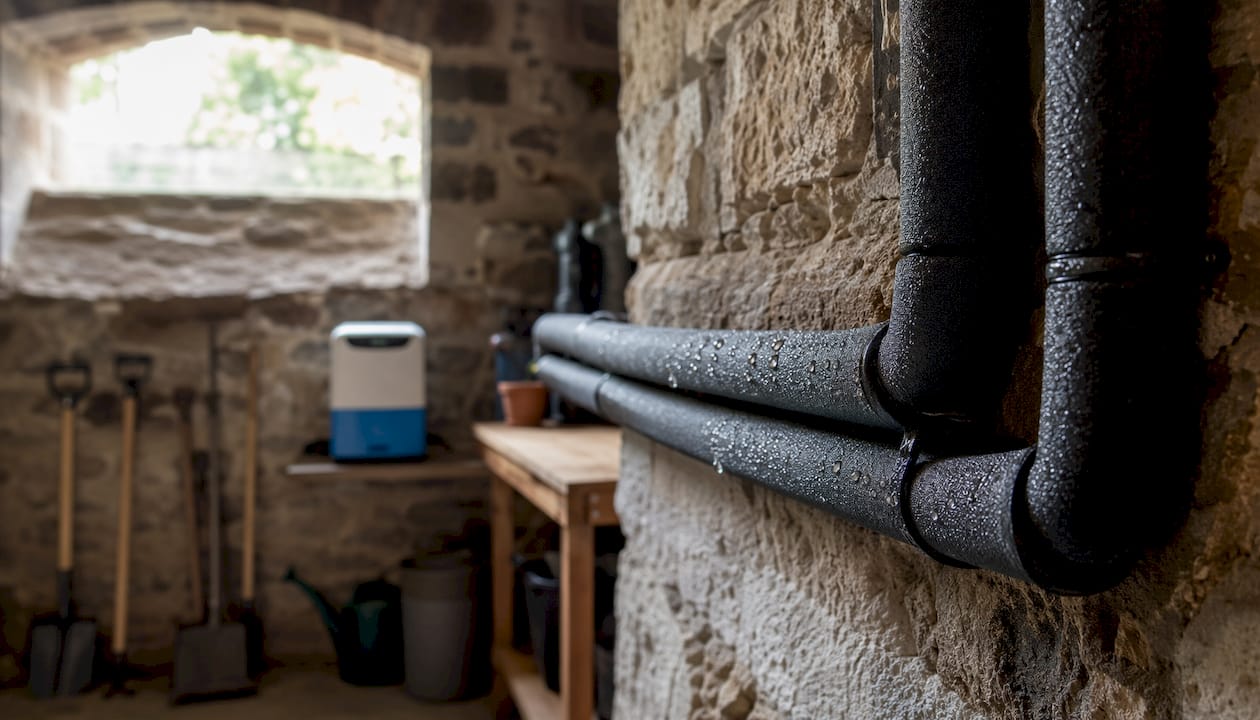
- Trunking or pipe casings dripping or sweating: degraded pipe insulation. The factory insulation around refrigerant pipes can compress or deteriorate over time, allowing the cold pipe surface to chill the surrounding air below its dew point. Professional reinsulation is the standard fix.
- Damp patches on walls near the unit: possible airflow problem or structural condensation unrelated to the AC.
| Symptom | Probable cause | Short-term action | Call a technician? |
|---|---|---|---|
| Water under indoor unit | Blocked condensate drain | Switch off unit | Yes |
| Ice on coil or pipes | Dirty filter or low refrigerant | Clean filter, let thaw | If it recurs |
| Sweating trunking | Degraded pipe insulation | Wipe dry, monitor | Yes, for reinsulation |
| Reduced cooling, high humidity | Clogged filter or low airflow | Clean or replace filter | If cleaning does not help |
| Mould on walls | Structural condensation | Improve ventilation | Yes, and consider a survey |
The frozen coil cycle is worth understanding. A clogged filter restricts airflow across the evaporator, causing the coil to drop well below its normal operating temperature and ice over. When the system eventually defrosts, the volume of meltwater can overwhelm the condensate pan and drain, producing the puddle you find on the floor. Cleaning the filter monthly breaks this cycle before it starts.
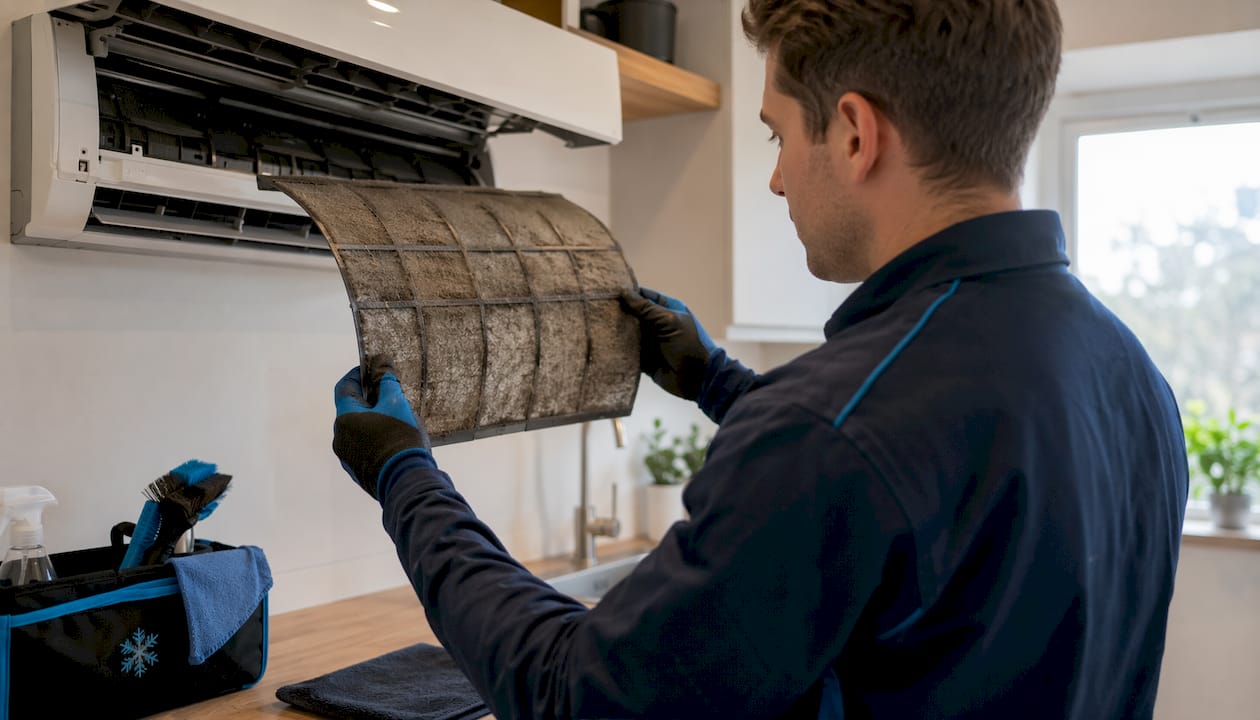
Sweating trunking is a frequently overlooked problem. The refrigerant pipes running from your outdoor unit to the indoor unit are cold. If the foam insulation around them has compressed or cracked, the pipe surface contacts warm room air and sweats. This is not a fault with the AC itself but with the installation or the age of the insulation.
Practical settings and daily habits that keep humidity under control
Keeping indoor relative humidity between 40% and 60% is the target for most UK homes. Below 40% the air feels dry and uncomfortable; above 60%, condensation risk rises and mould becomes a real concern. A basic hygrometer from a hardware shop costs a few pounds and tells you exactly where you stand.
Settings to use, and when:
- AUTO fan mode, always. As explained above, ON mode re-evaporates moisture. AUTO is the default for effective aircon moisture control.
- Dry Mode after moisture-producing activities. Run it for 20–30 minutes after cooking, showering, or drying clothes. It removes the spike in humidity before it settles on cold surfaces.
- Cool Mode at a moderate temperature. Setting the thermostat very low does not dehumidify faster; it risks freezing the coil. A setting of 20–22°C is usually sufficient for both comfort and moisture removal in a UK summer.
- Heating mode in winter. Warming the air raises its capacity to hold moisture, which reduces relative humidity and lowers condensation risk on cold windows and walls. Modern inverter-driven AC units are worth using year-round for this reason, not only in summer.
- Brief ventilation before starting the AC. Opening windows for two to three minutes before switching on removes the bulk of stale, humid air, giving the AC less work to do. This is especially useful in kitchens and bathrooms.
Behavioural habits that make a real difference:
- Always run the kitchen extractor fan when cooking and the bathroom extractor when showering.
- Never dry laundry in a closed room without running the AC or a dehumidifier simultaneously.
- Seal gaps around windows and doors to stop humid outside air infiltrating, particularly in autumn and winter.
- Keep internal doors open when running AC to allow air circulation across the whole floor.
Pro Tip: A best-practice AC usage guide can help you build a simple daily routine around these settings so they become second nature rather than something you have to remember.
The maintenance checklist every homeowner should follow
Most AC condensation problems are preventable with a consistent maintenance routine. The costs of neglecting servicing are almost always higher than the cost of the service itself.
Monthly tasks (you can do these yourself):
- Clean or replace the air filter. A blocked filter is the root cause of frozen coils and overflow. Monthly filter cleaning is the single most impactful thing you can do.
- Visually inspect the indoor unit for signs of moisture, ice, or unusual dripping.
- Check visible sections of trunking and pipe casings for sweating or damp patches.
- Confirm the condensate drain outlet (usually outside or into a waste pipe) is clear and dripping normally during operation.
Twice-yearly professional service tasks:
- Flush the condensate drain line and treat the pan with algaecide tablets to prevent blockages from algae build-up.
- Clean the evaporator and condenser coils.
- Check refrigerant levels and inspect for leaks.
- Inspect and renew pipe insulation where degraded or compressed.
- Assess overall airflow and ventilation.
Pro Tip: When checking pipe insulation yourself, look for sections that feel hard or thin rather than soft and springy. Compressed insulation has lost most of its thermal resistance and will sweat even in mild weather. A technician can re-wrap exposed sections quickly and inexpensively.
Algae is a surprisingly common cause of blocked condensate drains in UK homes, particularly in systems that run through summer. Pan tablets dissolve slowly and keep the drain clear between service visits. Ask your engineer to fit them at each biannual service.
If you are seeing recurring symptoms after cleaning the filter and checking the drain, that is the signal to book a certified engineer rather than continuing to troubleshoot alone.
When aircon alone is not enough
AC is effective at reducing humidity-driven condensation, but there are situations where it cannot solve the problem on its own.
Signs that you need more than AC adjustments:
- Condensation appears on walls, not just windows, and persists even when indoor humidity is within range.
- Mould returns within weeks of cleaning, suggesting moisture is coming from within the building fabric.
- The property has single-glazed windows, uninsulated walls, or a flat roof with no vapour control layer.
- Condensation is worst in rooms the AC does not serve.
In these cases, the issue is likely interstitial condensation or cold bridging, where moisture migrates through the building structure and condenses within or on the surface of walls. Building guidance confirms that mechanical cooling can lower surface temperatures and actually increase localised condensation risk unless thermal resistance and vapour control are adequate. Running the AC harder in this scenario can make things worse.
The decision flow:
- Humidity above 60% and condensation on windows: start with AC settings and Dry Mode.
- Humidity within range but condensation persists: add a dedicated dehumidifier or improve ventilation.
- Condensation on walls or within the building fabric: consult a surveyor and consider insulation upgrades or mechanical ventilation with heat recovery (MVHR).
Dedicated dehumidifiers specify their capacity in litres per 24 hours and are more energy-efficient than running AC purely for dehumidification in mild weather. For a persistently damp room, running both together is often the most practical solution: the AC manages temperature and removes the bulk of moisture during warmer periods, while the dehumidifier handles residual humidity when the AC is off. You can explore the full range of home cooling and humidity options to find the right combination for your property.
What a certified installer checks on a condensation service visit
A professional visit focused on condensation goes well beyond a basic service. Here is what to expect and what to ask for.
Tasks a qualified engineer should carry out:
- Clear and flush the condensate drain line, fit algaecide pan tablets.
- Clean evaporator and condenser coils and check for corrosion.
- Test refrigerant pressure and inspect for leaks.
- Inspect and renew pipe insulation where degraded.
- Assess ventilation in the room and around the outdoor unit.
- Check airflow across the indoor unit and clean the blower wheel if needed.
Credentials to request before booking:
- F-Gas certification: legally required in the UK for anyone handling refrigerants.
- REFCOM registration: the industry register for F-Gas certified businesses. You can verify a company's status on the REFCOM website.
- Public liability insurance.
- References or case studies for domestic condensation work.
For a full breakdown of what these industry standards mean in practice, it is worth reading before you book. A good engineer will also provide a written service report noting any insulation work recommended, whether a dehumidifier would help, and whether a building survey is warranted. Understanding what commissioning and handover checks involve helps you ask the right questions and know whether the visit has been thorough.
Frostairconditioning's engineers are F-Gas and REFCOM certified and cover Exeter and the wider South West. A domestic service and maintenance contract includes biannual visits covering all the checks above.
Key takeaways
Condensation prevention with aircon works best when correct settings, consistent monthly maintenance, and twice-yearly professional servicing are combined.
| Point | Details |
|---|---|
| Fan to AUTO | Switching from ON to AUTO stops moisture re-evaporating from the coil back into the room. |
| Dry Mode in short bursts | Use Dry Mode for 20–30 minutes after cooking or showering to remove humidity spikes efficiently. |
| Monthly filter cleaning | A clean filter prevents frozen coils and the overflow that causes most indoor puddles. |
| Target 40–60% humidity | Keep relative humidity in this range; above 60% condensation risk rises and mould becomes likely. |
| Frostairconditioning | F-Gas and REFCOM certified engineers covering Exeter and the South West, offering biannual service contracts and same-day visits. |
The mistake most homeowners make with AC and damp
Most people treat their air conditioning as a summer appliance and ignore it from October to April. That is exactly when UK homes are most vulnerable to condensation. Cold outdoor temperatures, poor ventilation habits, and the habit of sealing every window tight create the perfect conditions for moisture to build up on cold surfaces.
The other common mistake is running the fan on ON continuously, believing that more airflow means more drying. It does the opposite. And then there is the over-reliance on AC for what is actually a structural problem. If your walls are poorly insulated or your windows are single-glazed, no amount of AC adjustment will stop condensation forming on those cold surfaces. The AC is one tool in a toolkit that also includes ventilation, insulation, and sometimes building works.
What actually works is treating the system as a year-round humidity management tool: AUTO fan, Dry Mode when needed, monthly filter checks, and a professional service twice a year. That combination handles the vast majority of condensation problems in UK homes without expensive remediation. Where it does not, the right next step is a proper diagnosis, not a lower thermostat setting.
Frostairconditioning: certified help for South West homeowners
Persistent condensation after adjusting your settings is a clear signal that the system needs a professional eye. Frostairconditioning offers exactly that for homeowners across Exeter, Devon, Cornwall, and the wider South West: F-Gas and REFCOM certified engineers who carry out condensation-focused service visits, clear blocked drains, renew degraded pipe insulation, and give you a written report on what needs attention.

0% finance is available on new installations, and same-day visits are possible for urgent issues. Whether you need a one-off diagnostic visit or an annual service maintenance contract that covers biannual checks, the process starts with a quick quote. If you are ready to stop guessing and get a clear answer on what is causing your condensation, request a quote and a certified engineer will assess your home and recommend the right solution.
Useful sources and further reading
- NCC 2025 Condensation in Buildings Handbook — technical guidance on surface condensation, dew point, and vapour control used as a reference throughout this article.
- Daikin: How do I stop HVAC condensation? — manufacturer guidance on causes, diagnostics, and long-term prevention.
- Mitsubishi Electric: Dehumidifier vs Air Conditioner — clear comparison of AC and dedicated dehumidifiers for moisture control.
- Aircon Dry Mode explained — how Dry Mode works and when to use it.
- AC tips for reducing humidity indoors — HVAC practitioner guidance on fan settings and net dehumidification.
- Frostairconditioning blog: air conditioning aftercare — homeowner maintenance routines from the Frost Air team.
- Frostairconditioning blog: how to clean your air conditioner — step-by-step filter and unit cleaning guide.