
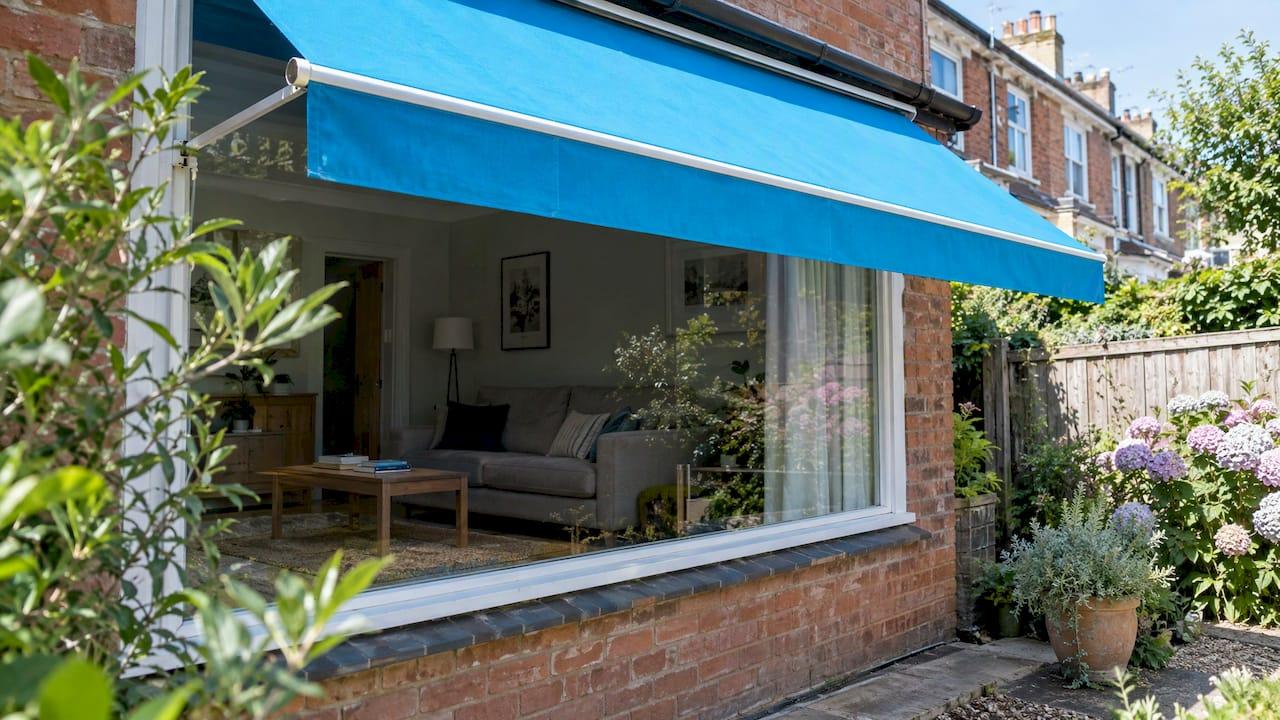
To cool a home in a UK heatwave, keep the sun out before it gets in, let cool air through at night, cut the heat you make indoors, and use fans for comfort. Where those steps are not enough, a properly installed fixed air conditioning system is the dependable way to hold a room at a comfortable temperature. This guide covers each step in the order that works best, with running costs and the health advice that matters when the temperature climbs.
TL;DR
- Shade windows from the outside where you can. External shading keeps far more heat out than internal blinds or curtains.
- Open windows only when it is cooler outside than in, usually late evening, overnight and early morning. Close them before the day heats up.
- A fan makes you feel cooler but does not lower the room temperature. GOV.UK advises using fans only below 35°C.
- Fixed air conditioning is the next step when simple measures fall short, particularly for bedrooms, home offices and anyone vulnerable to heat. A free survey tells you what size and type suits your home.
- Know the signs of heat exhaustion and heatstroke, and check on people at higher risk.
Table of Contents
- Why UK homes overheat
- Step 1: Keep the sun out during the day
- Step 2: Ventilate at the right time
- Step 3: Stop making heat indoors
- Step 4: Use fans properly
- Step 5: Sleep cooler
- Health: know the signs
- When simple measures are not enough
- Fixed air conditioning: what to know before you decide
- Perspective: why we install before the heatwave, not during
- Get a cooler home with Frost Air Conditioning
- FAQ
- Sources
Why UK homes overheat
Most British homes were built to hold heat in, not shed it. Sun streaming through glazing, poor ventilation, warmth stored in walls and roofs, and heat from appliances all add up. Once a house has soaked up heat for a few days, it can stay uncomfortable well after the outside air has cooled.
The University of Exeter's Professor Tim Taylor told the BBC in its June 2026 heatwave report that UK homes need better ventilation and other adaptation measures. The same report notes that shading and planting can help. That is the sensible starting point, and it shapes the order below: reduce the heat getting in, flush out what has built up, then add cooling where you need it.
For homeowners in Devon and Cornwall, the picture is the same. Coastal breezes help, but south-facing rooms, loft conversions, conservatories and top-floor bedrooms still heat up quickly in a prolonged hot spell.
Step 1: Keep the sun out during the day
The cheapest cooling is the heat that never enters the house. GOV.UK's keep-cool checklist recommends shading or covering windows, whether with internal curtains or blinds, or with external shutters, roller blinds or awnings.
External versus internal shading
The type of shading makes a real difference. The Centre for Sustainable Energy explains that curtains and internal blinds help, but external shading is more effective because internal shading still lets most heat through the glass. Cornwall Council's summer guidance agrees: external shutters or shades are very effective, internal blinds or curtains less so, and dark curtains or metal blinds can absorb heat.
CIBSE, the professional body for building services engineers, adds that curtains and blinds matter most on south, east and west-facing windows in the hottest periods.
What to do this weekend
- Close curtains or blinds on sun-facing windows before the room warms up, not after.
- Choose light-coloured, lined curtains over dark or metal options.
- Consider external awnings, shutters or external blinds for the worst-affected windows.
- Add planting or climbers where they shade walls and windows. Plymouth Energy Community also recommends external shading and switching off unnecessary lights and appliances.
If you are insulating or refurbishing, GOV.UK suggests asking your installer about overheating, so the work does not trap heat in.
Step 2: Ventilate at the right time
Opening a window is only helpful when the air outside is cooler than the air inside. The Centre for Sustainable Energy advises opening windows late in the evening, overnight and in the early morning, then closing them before outdoor temperatures rise.
Cross-ventilation
When it is safe, open windows on opposite sides of the house, or at low and high levels. Cool air comes in and warm air leaves. Plymouth Energy Community gives a practical example: an upstairs front window and a downstairs rear window, again only when outside is cooler.
CIBSE says leaving windows open overnight, where safe and secure, can purge accumulated heat and pre-cool the building. If you have a ventilation system with a summer mode, GOV.UK says to use it.
Security and noise
Many people hesitate to leave windows open overnight. Window restrictors, a ground-floor window left closed with the upstairs ones open, or opening a landing window can help. Only open what you can safely leave open.
If you cook outside in summer, you also keep oven heat out of the house. If you are considering a garden cooking space, outdoor kitchen canopy ideas for UK gardens show how a covered area can work through the year.
Step 3: Stop making heat indoors
Every appliance in your home gives off heat. The Centre for Sustainable Energy points out that dishwashers and washing machines release heat as well as ovens and hobs. Its advice:
- Avoid ovens and hobs during the day.
- Run washing machines and dishwashers in the evening or overnight.
- Heat food in the microwave rather than the oven.
- Switch off unused equipment and lights. GOV.UK includes turning off heating and unused equipment in its checklist.
These habits cost nothing and take a noticeable edge off the heat in a small flat or open-plan kitchen.
Step 4: Use fans properly
Fans are the most common heatwave purchase, and they do help, with one caveat. CIBSE explains that fans do not lower room temperature. They make you feel cooler by moving air over your skin. Ceiling fans are generally the most effective where ceiling height permits, and portable fans help where natural ventilation is limited.
Where to put them
- At night: place a fan in or by an open window, facing inwards, to draw cooler outside air into the room.
- During the day: put it on the floor and point it upwards, as CIBSE suggests.
- Safety: GOV.UK permits electric fans when air temperature is below 35°C and advises not to aim them directly at your body, as this can lead to dehydration.
What fans cost
Fans are cheap to run. National Energy Action gives illustrative figures based on electricity at 25.7p/kWh: a 20W desk fan costs 0.5p an hour, a 50W pedestal fan 1.3p and a 75W large fan 1.9p. For a deeper comparison with cooling systems, see our guide to air conditioning versus fans.

Step 5: Sleep cooler
Bedrooms are where a heatwave hurts most, because upstairs rooms collect the warm air and you cannot shade or ventilate easily when you are asleep. Keep the bedroom curtains drawn during the day, ventilate it at night where safe, and use a fan by the window.
What you sleep on matters too. Breathable fabrics such as linen, percale and Tencel suit hot sleepers, and this guide to summer bedding materials compares them.
Health: know the signs
A cool home is about comfort, but in a heatwave it is also about safety. GOV.UK's hot weather advice says to:
- Drink fluids regularly and limit alcohol.
- Avoid direct sun, especially between 11am and 3pm.
- Exercise in cooler parts of the day.
- Check on people who may be at risk, and keep rooms cool.
Heat exhaustion can bring weakness, faintness, headache, cramps, nausea, heavy sweating and intense thirst. Cool the person down and call NHS 111 if you are concerned. If you suspect heatstroke, call 999 and cool the person immediately.
GOV.UK lists babies and young children, pregnant women, people taking certain medicines and people with serious mental-health problems among those at higher risk. Cornwall Council's public health advice also highlights older people and those with existing conditions. If someone in your household is in one of these groups, a reliably cool room matters more than a low bill, and that is the point at which many families look at fixed cooling.
When simple measures are not enough
CIBSE recommends a passive-first sequence: keep heat out, remove accumulated heat through ventilation, then use mechanical cooling where those measures are not sufficient, particularly for vulnerable occupants. We agree with that order, and it is how we approach every survey. It is also where air conditioning earns its place.
Typical situations where it makes sense:
- A south-facing loft room or top-floor bedroom that stays hot after sundown.
- A home office where you work all day and cannot open windows or run a noisy setup.
- A conservatory or extension with a lot of glass. Our guide on how to stop a hot conservatory explains the options.
- Homes where someone is elderly, unwell or pregnant, or where there are babies.
- Rooms where security, noise or pollen make open windows impractical.
Mixing approaches is often the best answer, using natural ventilation when the air is cool and cooling on the hottest days. We cover this in mixed mode cooling for UK homes.
Fixed air conditioning: what to know before you decide
Fixed systems and portable units
The Independent's August 2026 cost report explains that a fixed split system has an outdoor condenser and an indoor unit linked by pipework. Portable units are meant for smaller spaces, tend to be less efficient, and must exhaust heat outside without leaving an open window gap.

The Centre for Sustainable Energy says portable units use 30 to 50% more electricity than fixed systems and lose efficiency if not vented properly outside. It also notes that an air-to-air heat pump can be switched to its cool setting, so one installation can serve you in summer and winter.
We design systems to suit the room and the home. If you want to understand the range, our complete guide to the best air conditioning for your home and home cooling solutions list are good places to start.
Running costs
Costs depend on the size of the unit, how long you use it and your tariff. As illustrations only:
| Item | Illustrative running cost | Source |
|---|---|---|
| Desk fan (20W) | 0.5p an hour | National Energy Action |
| Large fan (75W) | 1.9p an hour | National Energy Action |
| Typical portable air conditioner (1,000 to 1,500W) | around 26p to 39p an hour | National Energy Action |
| Indoor unit of about 2kW, drawing about 600W | about 15.4p an hour at 24.50p/kWh | Homebuilding |
Homebuilding also reports supplier examples for a multi-split system serving five habitable areas: about £900 a year at six hours a day, seven days a week, or around £600 a year at four hours a day in a well-insulated house. Most households cool one or two rooms for a few hours rather than the whole house, so your own figure depends on how you use it. Our guide to cooling your home efficiently shows how to keep that use sensible.
Installation
The Independent reports that whole-house installation in an existing UK home is likely to cost more than £6,000, with pipework potentially requiring wall work and later redecoration. A single-room system costs a good deal less, and a survey is how you find out which you need. This is also why a professional installation matters: the pipework route, the outdoor unit position and the refrigerant work all affect how well a system runs. Our article on how certified installation works walks through the steps, and we explain why we do not recommend a DIY air conditioner setup in place of a certified one.
If your home is older, Historic England advises designing overheating measures around the building's construction. Its guidance on keeping cool in an older home is worth reading first, and a survey can take the age and layout of the property into account.
Perspective: why we install before the heatwave, not during
Every summer we hear the same thing from Devon and Cornwall homeowners: they waited until the hottest week, then discovered everyone else had the same idea. Blinds, night ventilation and fans are the right first steps, and we tell customers so. But a bedroom under a south-facing roof, or a room where someone vulnerable spends the day, needs cooling you can rely on.
That is why we design systems around the room, not around a catalogue. Our engineers are F-Gas certified and REFCOM registered, we do not use subcontractors, and we install premium systems from Samsung, Mitsubishi, Toshiba and Daikin. Many installations are completed within one to two days, and a free survey comes first.
Our advice is simple: use the passive measures now, book your survey outside the peak, and have cooling that also heats in winter if you want it to earn its keep all year. We offer 0% finance, so spreading the cost does not have to hold you back.
James
Get a cooler home with Frost Air Conditioning
We are an Exeter-based installer covering the South West, with F-Gas certified engineers and REFCOM registration. Our domestic installation service covers a free survey, system design for your home and installation, with same day or next day installs available. 0% finance is available, and we fit systems from Samsung, Mitsubishi, Toshiba and Daikin.

If you already have a system, our service and maintenance plans include annual contracts and emergency breakdown response, so it is ready before the next hot spell. Running a shop or business premises? See our shop fitting and commercial service.
FAQ
What is the quickest way to cool a room in a heatwave?
Close curtains or blinds on sun-facing windows before the room heats up, and open windows only if the air outside is cooler. Add a fan facing inwards at an open window at night. For a room that stays hot regardless, fixed air conditioning is the most reliable fix.
Do fans actually cool a room?
Not in the sense of lowering the temperature. CIBSE explains that they make you feel cooler by moving air across your skin. GOV.UK advises using them below 35°C and not pointing them directly at your body.
Is air conditioning expensive to run in the UK?
It depends on the unit, your tariff and how long you run it. Homebuilding's illustration is about 15.4p an hour for a typical 2kW indoor unit at 24.50p/kWh. Cooling only the rooms you use, for the hours you need, keeps bills in check.
Can I use air conditioning in winter too?
Often yes. The Centre for Sustainable Energy notes that an air-to-air heat pump can be switched to its cool setting, so the same equipment can heat and cool. Ask us at your survey which models suit your home.
When should I call 999 in a heatwave?
If you suspect heatstroke, call 999 and cool the person immediately, according to GOV.UK. For heat exhaustion, cool the person down and call NHS 111 if you are worried.
Sources
- Heatwave ends but experts warn of more heat to come, BBC News
- Beat the heat: keep cool at home checklist, GOV.UK
- Beat the heat: staying safe in hot weather, GOV.UK
- How to keep your home cool in hot weather, Centre for Sustainable Energy
- Stay Safe this Summer, Cornwall Council
- How to keep your space cool during a heatwave, CIBSE
- Keep your home cool, Plymouth Energy Community
- Tips to keep your home cool, National Energy Action
- Air conditioning costs explained, Homebuilding
- The average cost to install air conditioning in your home, The Independent
- How to Keep Cool in Summer in an Older Home, Historic England