
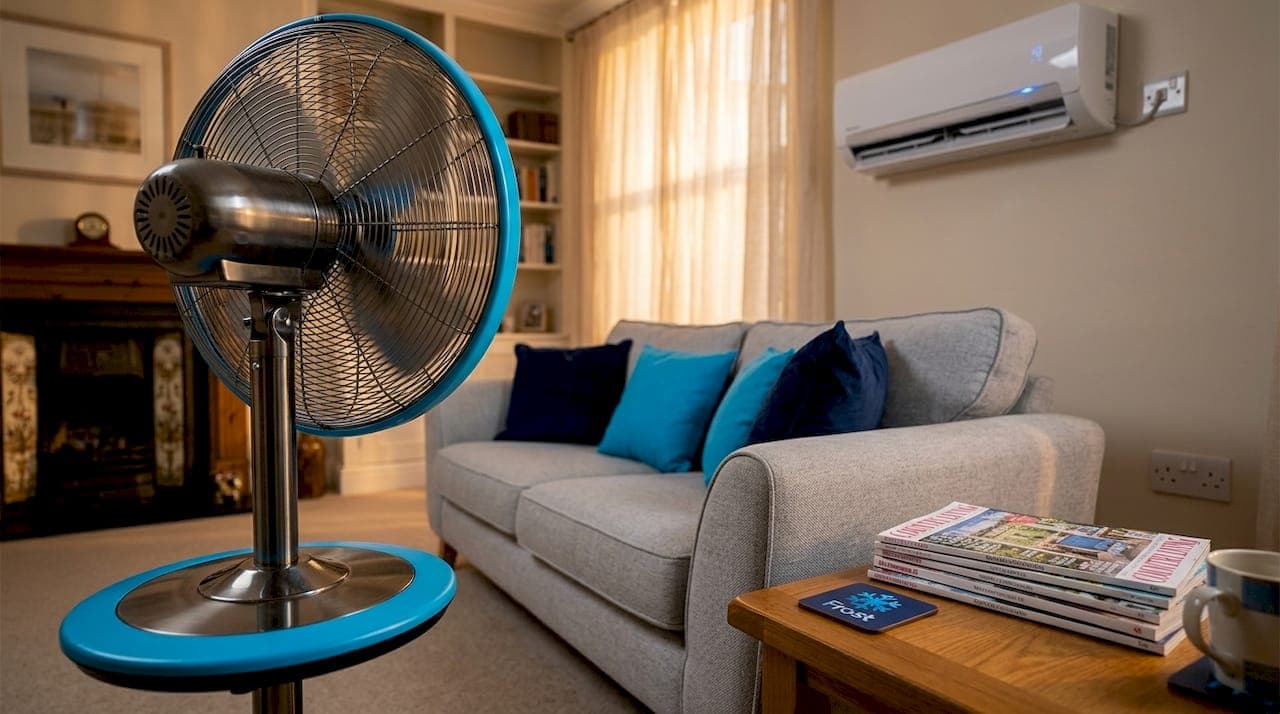
Air conditioning removes heat and moisture from indoor air using a mechanical refrigeration process, while a fan simply moves air around a room to create a cooling sensation on your skin. That single distinction shapes everything: cost, comfort, effectiveness in humidity, and how much you spend running them. Explaining air conditioning vs fans properly means going beyond "one is colder than the other." This article covers how each system works, what it costs to run, and when each option genuinely makes sense for a UK home.
How air conditioning and fans actually cool differently
Air conditioners mechanically remove heat and moisture from indoor air using a vapour-compression cycle involving a compressor, condenser, and evaporator coils. The result is air that is physically cooler and drier than it was before. That is a fundamentally different process from anything a fan can do.
Fans create a wind-chill effect by moving air across your skin, which speeds up sweat evaporation and makes you feel cooler. The room temperature does not drop by a single degree. If the air is already 30°C, a fan circulates 30°C air. You feel more comfortable, but the thermometer does not move.
This matters enormously in humid conditions. When the air is already saturated with moisture, sweat cannot evaporate efficiently, so the wind-chill benefit of a fan shrinks. Air conditioning, by contrast, dehumidifies as it cools, which is why a room at 22°C with AC running feels far more comfortable than a room at 22°C with a fan on a muggy August afternoon in Exeter.
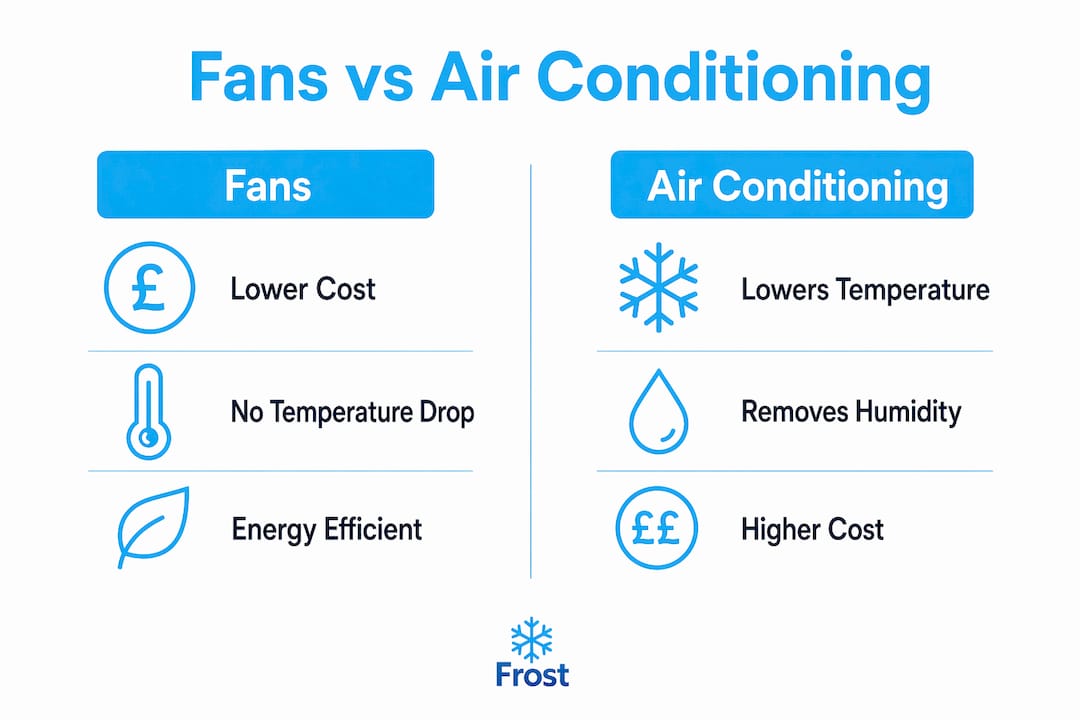
- Air conditioning: lowers actual air temperature, removes humidity, works in any climate
- Fans: enhance evaporative cooling on skin, no effect on room temperature, less effective in high humidity
- Energy draw: a standard ceiling or desk fan uses roughly 15 to 75 watts; a split-system AC unit typically draws 900 to 3,500 watts
Pro Tip: Run a fan and your AC together. The fan distributes the cooled air more evenly, so you can raise the thermostat by a degree or two without noticing a difference in comfort. That small adjustment adds up on your electricity bill.
What does it cost to run: fans vs air conditioning?
Cost is where the two options diverge most sharply, and it is worth being specific rather than vague about the numbers.
Window fans cost between £40 and £80 upfront and consume electricity comparable to a light bulb. A portable or tower fan sits in a similar range. A window or portable AC unit, by comparison, costs considerably more to buy and adds meaningfully to your monthly electricity bill. The gap in running costs is significant over a full summer.
| Factor | Fan | Air conditioning |
|---|---|---|
| Upfront cost | £20 to £80 | £500 to £2,500+ installed |
| Monthly running cost | Pence per day | Several pounds per day depending on use |
| Installation required | No | Yes, F-Gas certified engineer |
| Lifespan | 5 to 10 years | 10 to 20 years with servicing |
| Humidity control | None | Yes, dehumidifies as it cools |
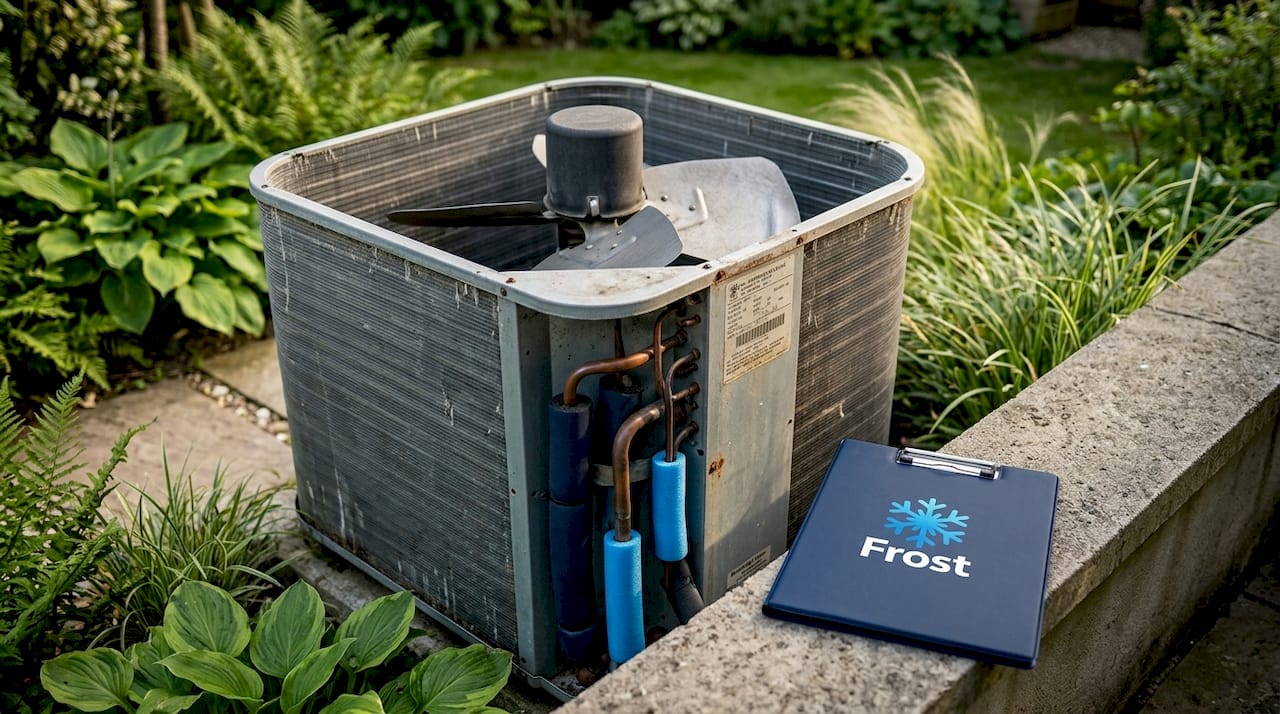
A split-system AC unit installed by a certified engineer, such as those fitted by Frostairconditioning across Exeter and the South West, carries a higher upfront cost but lasts significantly longer and delivers consistent performance regardless of outdoor conditions. The running cost difference is real, but so is the comfort gap during a heatwave.
UK energy prices have risen sharply in recent years, which makes efficiency a genuine priority rather than an afterthought. Raising your thermostat setpoint and using passive cooling can cut AC energy use by up to 30%, which meaningfully reduces the cost advantage fans appear to hold on paper.
Pro Tip: If you are renting and cannot install a fixed AC unit, a portable air conditioner is a reasonable middle ground. It costs more to run than a split system but delivers genuine temperature reduction, unlike a fan.
When should you use a fan, and when do you need air conditioning?
The honest answer is that both have a place, and the right choice depends on your climate, your home, and the people living in it.
-
Use a fan when temperatures are moderate and humidity is low. On a dry 24°C day with good airflow through your home, a fan provides genuine comfort at minimal cost. Fans are most effective in dry climates where evaporative cooling works efficiently. Open windows on opposite sides of the house and position a fan to draw cooler evening air through.
-
Switch to air conditioning when humidity rises or temperatures exceed around 28°C. At that point, a fan moves hot, sticky air around the room without providing meaningful relief. AC removes the moisture that makes heat feel oppressive, not just the heat itself.
-
Prioritise air conditioning for vulnerable household members. A Harvard study found that heat impairs cognitive performance, with participants in non-air-conditioned buildings showing 13.4% longer reaction times and 13.3% lower arithmetic scores during a heatwave. For elderly relatives, young children, or anyone with a respiratory or cardiovascular condition, reliable cooling is a health matter, not a luxury.
-
Consider your building's construction. Many UK homes with modern insulation trap heat, making mechanical cooling necessary during extreme heat even when a fan would have sufficed in an older, draughtier property. New builds in particular can become very difficult to cool passively. This is a growing issue across Devon and Cornwall as summer temperatures climb.
-
Use fans as a complement to AC, not a replacement. Running a ceiling or desk fan while the AC is on allows you to set the thermostat higher, reducing energy consumption without sacrificing comfort.
How to use fans and air conditioning efficiently in a UK home
Getting the most from either system comes down to a few consistent habits, and the savings are worth the small effort involved.
Setting your AC to 'Auto' mode rather than 'On' is one of the most impactful adjustments you can make. HVAC expert Dr Rawand Rasheed explains that 'Auto' mode allows the evaporator coil to drain properly between cycles, preventing moisture from re-evaporating back into the room. 'On' mode keeps the fan running continuously, which pushes that moisture back into your living space and makes the air feel clammy even when the temperature is low. For better humidity control, 'Auto' is the correct setting in a UK summer.
Beyond the thermostat, passive measures make a substantial difference:
- Shade your windows. External shading, such as awnings or blinds, blocks solar gain before it enters the room. Outdoor shading reduces the cooling load your AC or fan has to manage, cutting running costs noticeably.
- Insulate and seal draughts. Good insulation keeps heat out in summer as well as in during winter. Combined with shading, passive cooling measures can reduce overall cooling demand by up to 80%.
- Ventilate at night. Open windows after 10pm when outdoor temperatures drop below indoor levels. Use a fan to pull cooler air through the house and close everything up before the morning heat builds.
- Consider a Canadian well for new builds. An earth-tube heat exchanger, sometimes called a Canadian well, uses the stable temperature of subsoil to pre-cool incoming ventilation air with minimal energy input. It is a niche solution but a genuinely effective one for those building or renovating.
- Service your AC annually. A poorly maintained unit works harder, costs more to run, and cools less effectively. Annual servicing keeps refrigerant levels correct, coils clean, and filters clear.
The combination of a well-maintained split-system AC unit, external shading, and smart fan use covers the vast majority of cooling needs in a typical South West England home, even during the increasingly warm summers the region now experiences.
Key takeaways
Air conditioning is the only cooling method that physically lowers room temperature and removes humidity, making it the reliable choice for heatwaves, humid conditions, and vulnerable household members, while fans remain a cost-effective complement in moderate, dry heat.
| Point | Details |
|---|---|
| Fans do not cool rooms | Fans create a wind-chill sensation but leave room temperature unchanged. |
| AC controls humidity too | Air conditioning removes moisture as it cools, which is what makes it effective in humid UK summers. |
| Running costs differ significantly | Fans cost pence per day to run; AC costs more but delivers measurable temperature reduction. |
| Auto mode beats On mode | Setting AC to 'Auto' prevents moisture re-evaporation and keeps indoor air comfortable. |
| Passive cooling reduces demand | Shading, insulation, and night ventilation can cut cooling energy use by up to 80%. |
What I have learned installing AC across the South West
I have been fitting air conditioning systems in homes across Devon, Cornwall, and Somerset for years, and the question I hear most often is some version of: "Do I really need AC, or will a decent fan do the job?"
My honest observation is that the answer has shifted. Five years ago, a good fan and sensible ventilation habits got most people through the summer comfortably. Now, with temperatures regularly hitting the high twenties and occasionally the low thirties across the South West, that calculus has changed. The summers are longer and hotter, and the newer, better-insulated homes that were built to keep heat in during winter are now trapping it in July and August.
What I find frustrating is the assumption that AC is an extravagance. A fan is cheaper to buy and run, that is true. But a fan in a humid, 30°C room does not make you comfortable. It makes you feel like you are standing in front of a hair dryer. The people who come to us after a particularly bad summer are not buying AC because they want a luxury. They are buying it because they had a miserable few weeks and they do not want to repeat the experience.
The most sensible approach I see is layered: good external shading, night ventilation where possible, and a properly sized split-system AC unit for the rooms where you actually spend time. You do not need to cool the whole house. You need to cool the bedroom so you can sleep, and the living room so you can function. That is a manageable, affordable solution for most households, especially with 0% finance options making the upfront cost less of a barrier.
The health and comfort case for air conditioning in UK homes is only going to grow stronger. Climate experts already describe mechanical cooling as transitioning from luxury to necessity in well-insulated homes. I think that transition is already well underway here in the South West.
— James
Ready to find the right cooling solution for your home?
If you have been weighing up fans vs air conditioning and you are leaning towards a proper installation, Frostairconditioning can help. Based in Exeter and covering the South West, the team offers domestic AC installation with same-day fitting available and 0% finance options to spread the cost. Every installation is carried out by F-Gas certified engineers, so your system is fitted correctly from day one.

For existing units that are not performing as well as they should, Frostairconditioning also provides servicing and maintenance to keep your system running efficiently. If you are ready to move forward, request a quote and get a personalised assessment for your home.
FAQ
Do fans actually lower the temperature in a room?
No. Fans do not reduce room temperature. They move air to speed up evaporation on your skin, which creates a cooling sensation, but the thermometer reading stays the same.
Is air conditioning worth the cost for a UK home?
For most UK homes, particularly newer builds with good insulation, air conditioning delivers comfort during heatwaves that fans simply cannot match. With 0% finance options available from installers like Frostairconditioning, the upfront cost is more manageable than many homeowners expect.
What is the most energy-efficient way to run an air conditioner?
Set your unit to 'Auto' mode rather than 'On', use external shading to reduce solar gain, and run a fan alongside the AC so you can raise the thermostat slightly. Passive cooling combined with AC can cut energy use by up to 30%.
When is a fan enough and when do I need air conditioning?
A fan is sufficient on dry days below around 26°C with good natural ventilation. Once humidity rises or temperatures climb above 28°C, air conditioning is the more effective option, particularly for Devon and Cornwall homes during summer heatwaves.
Can I use a fan and air conditioning at the same time?
Yes, and it is recommended. Running a fan while the AC is on distributes cooled air more evenly, allowing you to set the thermostat one or two degrees higher without any loss of comfort, which reduces running costs.