
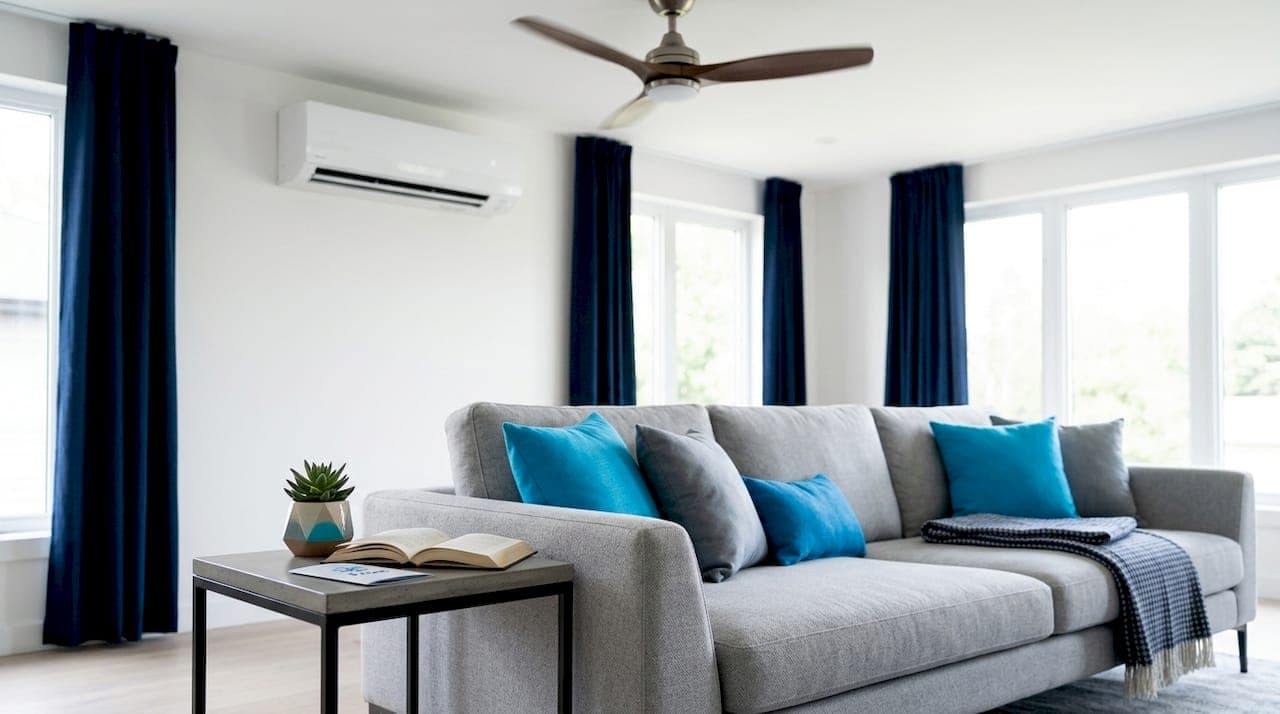
Effective home cooling is defined by a layered strategy that combines insulation, ventilation, and air conditioning to reduce heat gain and maintain comfort throughout warmer months. The DOE recommends combining fans, evaporative coolers, heat pumps, and insulation rather than relying on any single method. This home cooling solutions list covers every major option available to UK homeowners in 2026, from passive upgrades to full air conditioning installations, with clear guidance on what works, what doesn't, and what suits your home.
1. The home cooling solutions list: start with insulation and weatherisation
Insulation and air sealing are the most cost-effective upgrades on any home cooling solutions guide because they reduce the amount of heat entering your home before you spend a penny on active cooling. Proper insulation and weatherisation can reduce heating and cooling costs by 15 to 45%, with the greatest gains in older properties. That figure means a well-insulated home in Exeter could cut its summer cooling bills by nearly half compared with an unsealed equivalent.
The key areas to target are:
- Loft and attic insulation: Heat rises and escapes through the roof, but in summer the reverse is true. Mineral wool or rigid foam boards in the loft are the highest-impact upgrade.
- Wall insulation: Cavity wall fill or internal dry-lining reduces solar heat gain through external walls.
- Rim joists and floors: Often overlooked, these gaps allow warm air to infiltrate from outside.
- Window and door seals: Draught-proofing strips and secondary glazing cut air leakage significantly.
Pro Tip: Always air-seal before you insulate. Rebate programmes such as EnergySmart Colorado's scheme require a certified blower-door test confirming air leakage reduction before insulation upgrades qualify for reimbursement. UK schemes follow a similar logic: seal first, then insulate.
2. Ceiling fans and portable fans
Fans are among the most affordable room cooling ideas available, and they work best when used alongside open windows or air conditioning rather than as a standalone solution. Fans make occupants feel 3°F to 4°F cooler through the wind-chill effect, which means you can raise your thermostat setting without sacrificing comfort. That translates directly into lower energy bills.
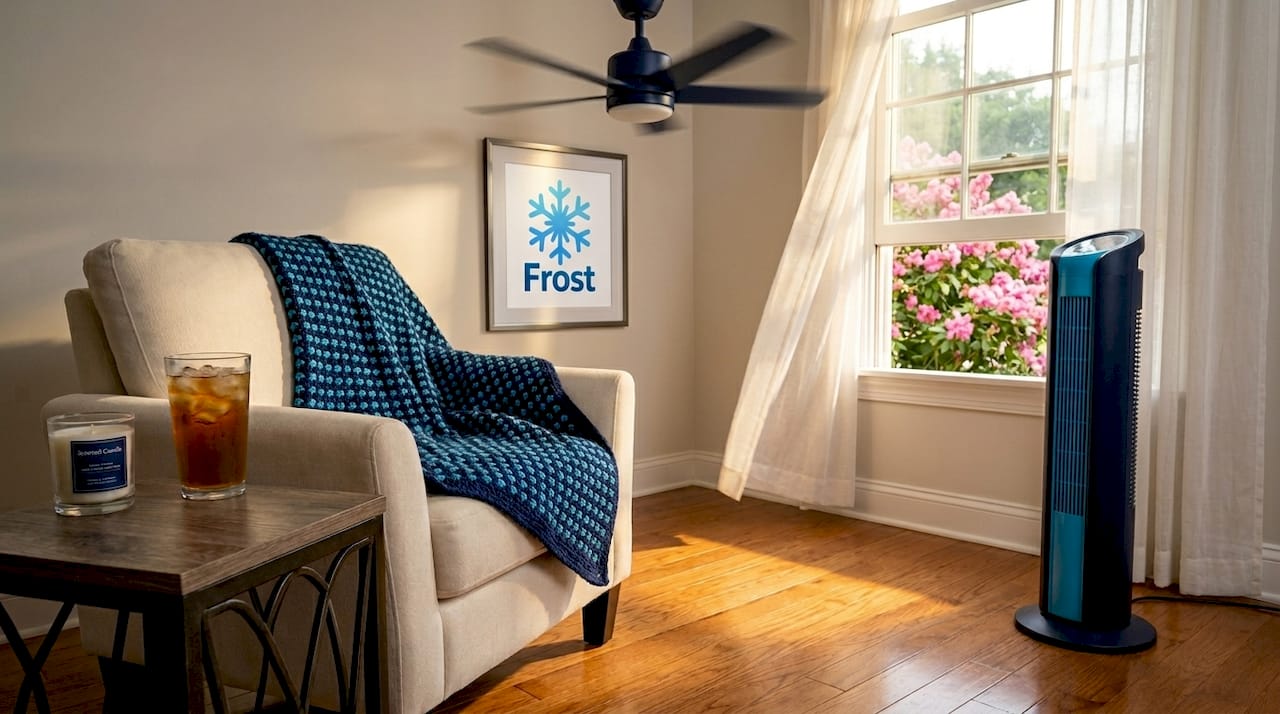
The BBC advises placing a fan directly in front of an open window to draw cooler outdoor air into the room. For an extra boost, ice cubes in front of a fan lower the perceived air temperature noticeably, making this one of the simplest and cheapest cooling tricks available.
Ceiling fans are most effective in rooms with ceilings above 2.4 metres. Set them to rotate anti-clockwise in summer to push air downward. Portable tower fans and window-mounted box fans suit renters or rooms where ceiling installation isn't practical.
Pro Tip: Fans cool people, not rooms. Turn them off when you leave a room to avoid wasting electricity.
3. Whole-house fans
A whole-house fan sits in the loft hatch or ceiling and pulls cool outdoor air through open windows while exhausting warm air out through the attic. This is one of the best home cooling methods for properties in temperate climates where outdoor temperatures drop significantly at night.
Whole-house fans require airflow of at least half the home's volume per minute, and attic venting must provide roughly 1 square foot of net free area per 750 CFM of fan capacity. Undersized attic vents are the most common reason whole-house fans underperform or become noisy. Before purchasing, calculate your home's volume and check your existing attic vent area against the fan's rated CFM.
"Whole-house fans move air but do not dehumidify. In hot, humid regions they are far less effective and can introduce uncomfortable moisture into the home." — Department of Energy
For homes in the South West of England, where summer humidity can be moderate, whole-house fans work well during cooler evenings but are less reliable during humid heatwaves. Pair them with good attic insulation for the best results.
4. Central air conditioning
Central air conditioning suits homes with existing ductwork and provides consistent, whole-home cooling. It remains the most common active cooling system in larger properties. Correct AC sizing using Manual J load calculations is critical because oversized units cycle on and off inefficiently, leaving rooms feeling clammy rather than cool.
Central AC works by circulating refrigerant between an indoor air handler and an outdoor condenser unit. The system draws warm air from rooms, passes it over a cold evaporator coil, and returns cooled air through ducts. Efficiency is measured in SEER ratings: the higher the SEER, the lower the running cost. Modern units typically range from SEER 14 to SEER 20 or above.
The main limitation is cost. Ducted systems require significant installation work in homes without existing ductwork, making them less practical for older UK properties.
5. Mini-split air conditioning systems
Mini-split systems, also called ductless air conditioners, are the most flexible of all cooling systems for homes. They consist of an outdoor compressor unit connected to one or more indoor wall-mounted units, with no ductwork required. This makes them ideal for period properties, extensions, and rooms where ducted systems would be impractical.
Each indoor unit cools its own zone independently, so you only cool occupied rooms. For a detailed comparison of UK air conditioning types, including mini-splits, multi-splits, and cassette units, the options vary considerably by room size and layout. Mini-splits are F-gas certified systems, meaning installation must be carried out by a qualified engineer.
Efficiency ratings for mini-splits are expressed as SEER and SCOP values. Leading manufacturers such as Mitsubishi Electric, Daikin, and Samsung produce units with SEER ratings above 20, making them among the most energy-efficient cooling options available today.
6. Heat pumps
Heat pumps are high-efficiency all-in-one heating and cooling solutions that move heat rather than generate it, making them significantly more efficient than traditional electric heaters or basic AC units. In cooling mode, a heat pump works identically to an air conditioner, extracting heat from indoors and releasing it outside. In winter, the process reverses.
Air source heat pumps are increasingly viable in the UK climate and are supported by the Boiler Upgrade Scheme, which offers grants to replace fossil fuel boilers. For homeowners who want year-round comfort from a single system, a heat pump is the strongest long-term investment on this list. Correct sizing, as with all AC equipment, depends on square footage, insulation level, and local climate zone.
7. Portable air conditioning units
Portable air conditioners are a practical option for renters, temporary spaces, or rooms where permanent installation isn't possible. They require no professional fitting: you position the unit, route the exhaust hose through a window kit, and plug it in. For a full breakdown of portable AC pros and cons, including noise levels and efficiency ratings, the trade-offs are worth understanding before you buy.
The main drawback is efficiency. Portable units are less efficient than mini-splits or central systems because the exhaust hose creates a negative pressure in the room, drawing warm air in through gaps. They also tend to be noisier. That said, for a single room during a short heatwave, a portable unit is a reasonable and affordable home cooling solution.
8. Evaporative coolers
Evaporative coolers, sometimes called swamp coolers, cool air by passing it over water-saturated pads. The water evaporates, absorbing heat and lowering air temperature by up to 10°C in dry conditions. They consume significantly less electricity than refrigerant-based air conditioners, making them one of the most energy-efficient cooling options for the right climate.
The critical limitation is humidity. Evaporative coolers add moisture to the air, so they are ineffective in humid conditions. In the UK, they perform best during dry, hot spells rather than humid summer days. For homes in drier inland areas, a portable evaporative cooler can be a cost-effective supplement to fans and shading.
9. Passive cooling: shading, reflective roofing, and window film
Passive cooling reduces heat gain without any electricity. External shading from trees, pergolas, or external blinds can cut solar heat gain through windows by up to 70%. Reflective or light-coloured roofing materials reduce the amount of solar energy absorbed by the roof structure. Window film applied to south and west-facing glazing blocks infrared radiation while maintaining natural light.
These measures work best when combined with good insulation. Closing blinds and curtains on south-facing windows before the sun reaches them is one of the simplest and most effective room cooling ideas for UK homes during summer. Natural fibre bedding and clothing also reduce perceived heat without any energy cost.
Pro Tip: Close south-facing blinds before 10am on hot days. Once the glass heats up, the heat is already inside.
10. Smart thermostats and thermostat strategy
Thermostat management is one of the most underused tools on any home cooling solutions guide. Raising your thermostat by 1°F saves approximately 3% on cooling bills when paired with fans for perceived cooling. Consumer Reports recommends a setting of around 78°F (approximately 26°C) as the balance point between comfort and efficiency.
Smart thermostats such as those from Nest, Hive, or Tado learn your schedule and adjust cooling automatically, preventing the system from running in empty rooms. They also provide energy reports that help you identify when and where your home is losing efficiency. For homes with mini-split or central AC, a smart thermostat is a low-cost upgrade with a measurable return.
Key takeaways
The most effective approach to home cooling combines passive heat reduction through insulation and shading with active systems sized correctly for your home's specific layout and climate.
| Point | Details |
|---|---|
| Start with insulation | Air sealing and insulation cut cooling costs by 15 to 45% before any active system is installed. |
| Size AC correctly | Oversized units cycle inefficiently; use Manual J calculations or consult a qualified installer. |
| Use fans strategically | Fans extend comfort at higher thermostat settings, saving roughly 3% per degree raised. |
| Match system to climate | Evaporative coolers suit dry climates; heat pumps and mini-splits suit the UK's varied conditions. |
| Layer your approach | No single method is sufficient; combining passive, ventilative, and active cooling delivers the best results. |
What I've learnt from helping homeowners cool their homes properly
Most homeowners I speak to have made the same mistake: they've bought a portable unit or a fan and wondered why the house is still unbearable by 3pm. The honest answer is that no active cooling device can overcome a poorly insulated, south-facing home with single glazing and no external shading. You're fighting physics with a hairdryer.
The sequence matters enormously. Sort the building fabric first. Even modest improvements to loft insulation and window seals will reduce the load your cooling system has to handle, which means a smaller, cheaper unit does the job. I've seen homeowners install oversized AC units in draughty houses and spend twice what they needed to on both equipment and running costs.
The other misunderstanding I encounter regularly is thermostat behaviour. Turning the thermostat down to 18°C when you get home doesn't cool the house faster. It just runs the system longer and costs more. Set it to your target temperature, use ceiling fans to circulate the air, and the room reaches comfort faster than you'd expect.
For most UK homes, a well-installed mini-split or air source heat pump paired with decent loft insulation and external shading is the combination that delivers genuine, year-round comfort. It's not the cheapest entry point, but it's the one that pays back over time.
— James
Ready to install the right cooling system for your home?
Frostairconditioning installs energy-efficient air conditioning systems across Exeter and the South West, with same-day installations available and 0% finance options to spread the cost. Whether you're considering a mini-split for a single room or a full multi-zone system for your whole property, the team is F-gas certified and experienced in matching the right system to your home's layout and insulation level.

For homeowners who want professional guidance on sizing, system selection, and installation, Frostairconditioning's domestic installation service covers everything from the initial survey to commissioning. Once your system is running, ongoing maintenance keeps it operating at peak efficiency year after year. Get in touch with Frostairconditioning to request a quote or book a same-day survey.
FAQ
What is the most energy-efficient home cooling option?
Heat pumps and high-SEER mini-split systems are the most energy-efficient active cooling options available. Paired with good insulation, they deliver the lowest running costs of any cooling system for homes.
Do fans actually cool a room down?
Fans do not lower air temperature. They create a wind-chill effect that makes occupants feel 3°F to 4°F cooler, which allows you to raise your thermostat setting and reduce AC running costs.
How do I choose between a mini-split and a portable AC unit?
Mini-splits are more efficient, quieter, and better suited to permanent installation. Portable units suit renters or temporary use where wall-mounted equipment isn't permitted.
Can insulation really reduce my cooling bills?
Proper insulation and air sealing reduce heating and cooling costs by 15 to 45%. Loft insulation and draught-proofing deliver the fastest payback and are the recommended starting point before any active cooling system is installed.
What thermostat setting saves the most energy in summer?
Consumer Reports recommends setting your thermostat to approximately 26°C (78°F) and using ceiling fans to maintain comfort. Each degree you raise the setting saves around 3% on your cooling bill.