
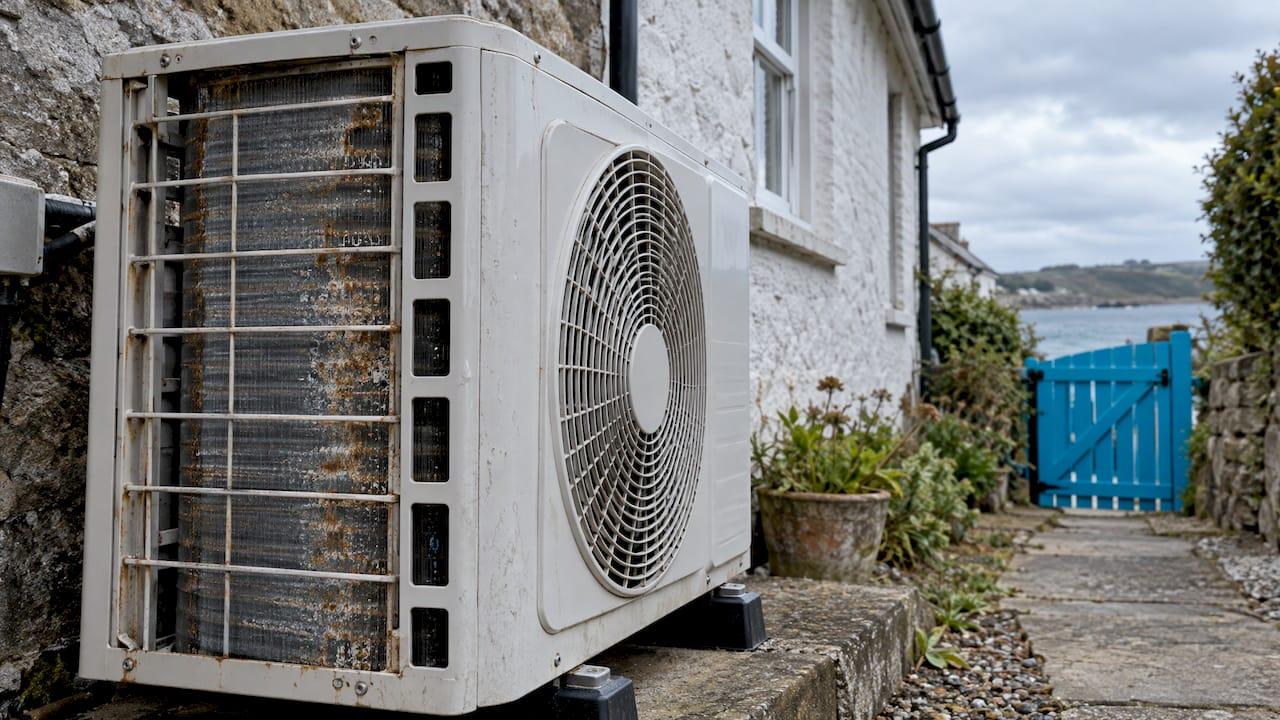
If your home is near the sea in Devon or Cornwall, the outdoor unit of an air conditioner faces salt, damp and wind all year. Corrosion is not a reason to go without cooling. It is a reason to get three things right: the position of the unit, the specification of the system, and a regular wash and check. Do those and a coastal system can serve you well. Skip them and salt quietly eats into the coil, the part that does the work.
This guide explains what salt air does to a unit, what it costs you in performance, which signs to watch for, and how we would approach a coastal installation.
TL;DR
- Salt spray and humidity speed up corrosion on the outdoor unit's metal coil and casing, and the damage can be hidden for a long time.
- Corrosion lowers cooling capacity and efficiency before anything visibly fails, so your bills can rise first.
- Siting matters: keep the unit out of direct sea spray, let rain fall on it, and rinse it with fresh water.
- Some manufacturers offer coastal-protected models or coil treatments, so ask about them at the survey stage, before you buy.
- Have a coastal system serviced at least yearly. Our free survey is the right moment to talk through your site.
Table of Contents
- Why salt air attacks an air conditioner
- What corrosion costs you in performance
- Signs of corrosion to look for
- Choosing a system for a coastal home
- Where to put the outdoor unit
- Maintenance that slows corrosion down
- Our view on coastal installations
- Getting a coastal system installed
- FAQ
- Sources
Why salt air attacks an air conditioner
An air conditioner has two halves. The indoor unit sits in your room. The outdoor unit holds the compressor and a coil of thin tubes and fins that releases heat into the air. That coil is the part that corrodes, because it has to be open to the air to work.
Mitsubishi Electric's UK guidance explains that salt spray from breaking waves and onshore winds carries sodium chloride onto metal surfaces, speeding up the electrochemical reactions that cause corrosion. High coastal humidity makes it worse, because the longer a surface stays damp, the faster it corrodes. Onshore winds also carry salt and moisture inland, so you do not need a sea view to be affected.
A second factor is built into the coil itself. Most coils combine copper tubes with aluminium fins. A UK coil protection specialist notes that corrosion arises from this copper and aluminium pairing, together with pollutants and moisture, and that coastal areas are particularly prone. Where two different metals touch in a damp, salty film, one of them is sacrificed. That is called galvanic corrosion, and the aluminium is the one that loses.
How far inland does it reach?
There is no single safe distance. Mitsubishi Electric's UK siting chart uses distance from the sea, from 0 m out to 1 km, and whether the unit faces the sea or is shielded by buildings to decide between its coastal protection models and standard ones. That tells you the practical lesson: a unit on a seafront wall, a unit on a cliff-top bungalow and a unit tucked behind a house on the same road face very different conditions. Exposure depends on wind direction, how open the site is and where on the building the unit sits.
In Devon and Cornwall, with long Atlantic and Channel coastlines and frequent south-westerlies, that matters for a lot of homes, from Exmouth and Torquay to Falmouth, Newquay and Penzance.
What corrosion costs you in performance
Corrosion is easy to dismiss as cosmetic. It is not. The same UK source states that corrosion diminishes efficiency and capacity, raising energy consumption and reducing cooling ability.
The best-known measurement comes from a Texas A&M field study. Researchers left two air conditioners exposed for about a year in Galveston, a coastal city in Texas. Sensible and latent capacity fell by roughly 4.6% and 20.9%, and efficiency dropped by 11.5% and 8.3%. Sensible capacity is the cooling of the air temperature. Latent capacity is the removal of moisture. The study also found pitting in the aluminium at the point where tube meets fin.

That location explains the pattern. When the join between copper and aluminium corrodes, heat passes less easily from tube to fin, so the unit works harder for less cooling. Performance slips well before anything leaks or stops.
Two cautions about reading that study. It was in a hot, humid Texas climate rather than the UK, and it covered one year. Use it to understand the mechanism, not as a forecast for your own unit. What carries over is the direction: salt and damp reduce capacity and efficiency, and slowly.
The long-term risk
Eventually, corrosion can reach the refrigerant tubes themselves. A pinhole means a leak, and a leak means a repair by an F-Gas certified engineer, because refrigerant handling is regulated in the UK. Our engineers are F-Gas certified and REFCOM registered, so a corroded coil is something we assess and put right rather than something you have to chase.
Signs of corrosion to look for
You can inspect the outdoor unit from a safe distance, with the unit switched off at the isolator, every few weeks in the first year. Look for:
- White powdery spots or pitting on the fins. The coil specialist advises looking for persistent white spots or pitting that does not disappear when the coil is cleaned. Fresh salt deposits rinse off. Pitting does not.
- Rust on screws, panels, brackets and the base. Orange staining usually appears on fixings first.
- Flaking or bubbling paint on the casing, especially around scratches.
- Bent or crumbling fins that crumble when touched. Do not poke at them: fins are fragile and cuts are easy.
- A drift in performance. The room takes longer to cool, the unit runs longer, or your electricity use creeps up.
Damage around the copper tubes is often out of sight. The same source says it may need further observation with tools such as endoscopes, which is a job for an engineer, not a homeowner. If you notice any of the signs above, book an inspection rather than waiting for a failure in the first heatwave.
Choosing a system for a coastal home
The first question for any coastal property is whether a standard unit is enough or whether the site needs extra protection. Manufacturers take this seriously, and several offer options:
- Coastal-protected models. Mitsubishi Electric's UK range includes coastal protection (-BS) versions of some products, selected using the distance-from-sea chart mentioned earlier.
- Coil treatment. Daikin UK offers a protective treatment to the coil and fins of its condensers, recommended for salt-laden air projects. Daikin quotes a lead time of two to three weeks for this, so it needs planning ahead rather than a last-minute decision.
Both are examples of what a premium manufacturer builds for coastal sites. We install Mitsubishi, Daikin, Samsung and Toshiba systems, and our Daikin and Mitsubishi ranges are the ones to ask about for a seafront or cliff-top property. Which option suits you depends on how exposed your wall is, and that is what a survey is for.
A quick exposure check you can do yourself
- Can you see the sea from where the unit would stand, or does the wind come straight off the water?
- Do you find salt crust on windows, car paintwork or garden furniture after a gale?
- Is the wall open, or shielded by other buildings?
- Is there already rust on metal fixtures, gates or railings nearby?
The more yes answers to the first, second and fourth questions, the more seriously you should treat protection. Outdoor items tell you a lot: the same weathering logic behind checks for weatherproof outdoor furniture applies to metal that lives outside next to the sea.
Where to put the outdoor unit
Position is the cheapest form of protection, and it is part of the installation, so it costs you nothing extra when planned at the start. Mitsubishi Electric's UK coastal tips recommend you avoid direct sea-spray exposure, make sure rain can fall on the unit rather than placing it directly under eaves, and install it level so water drains.

The point about rain surprises people. A sheltered spot sounds sensible, but under a deep overhang, salt deposits never get washed off by rain and sit on the coil. A spot that gets some rain but is screened from the worst of the wind-driven spray is the aim.
In practice that means:
- Choose the side of the house facing away from the prevailing wind and the water where possible.
- Use a wall or a building line to shield the unit from direct spray, without boxing it in.
- Keep airflow open. A cramped unit recirculates its own warm air and stays damp for longer. Our guide to keeping airflow open around outdoor units covers this.
- Respect the clearances and planning rules for placement, set out in our outdoor unit placement guide.
- Mount it securely. On older coastal houses with hollow block walls, a poor fixing is a problem of its own, as we explain in our guide to mounting outdoor units.
If the ideal spot conflicts with a neighbour, a boundary or the look of the house, the survey is where those trade-offs are settled in practice.
Maintenance that slows corrosion down
Salt does the most harm when it stays put. Regular removal is the whole game.
What you can do
Mitsubishi Electric's coastal guidance advises you inspect and wash the unit regularly with fresh water, and repair scratches as soon as possible. Scratches matter because bare metal is where corrosion starts.
A sensible homeowner routine for a coastal property:
- Switch the unit off at the isolator before touching it.
- Rinse the casing and the coil face gently with fresh water from a low-pressure hose, from the front, never with a jet that can bend the fins.
- Do it after storms with strong onshore wind, and at least every few months otherwise.
- Touch up scratched paint on the casing.
- Keep plants, leaves and debris clear of the unit.
Our homeowner cleaning guide goes through what is safe to clean yourself and what to leave to an engineer.
What an engineer should do
The coil needs proper cleaning, an inspection of the tube joints, and a check of refrigerant circuit health. Mitsubishi Electric's maintenance guidance says that standard residential systems should be serviced at least annually, while coastal systems may need more frequent servicing. It also says installers are responsible for assessing corrosion risk and recommending extra protection. That page is from its New Zealand site, but the principle holds anywhere with salt air.
For a coastal home we would treat yearly as the minimum. Our annual service contracts put that visit in the diary so it does not slip, and our seasonal service checklist explains what a visit covers and the F-Gas rules behind it. If the unit sits idle over winter, our winter care guide is worth reading too.
Our view on coastal installations
We install and look after air conditioning along the Devon and Cornwall coast, and the lesson is simple: corrosion is mostly decided on day one, not year five.
The position of the outdoor unit, the choice of a premium system from a manufacturer that takes coastal conditions seriously, and a regular service plan do far more than any fix after the damage has started. That is why we run a free survey before any installation: we look at your wall, your exposure and your options together, and we tell you what we would fit and where.
Our engineers are local, F-Gas certified and REFCOM registered, and we do not use subcontractors. So the person who surveys your site is the kind of person who will service the system afterwards, and a coil that is washed and checked every year is a coil that lasts. If corrosion has already begun on an existing unit, we can inspect it, and our emergency breakdown response is there if something fails.
If you are choosing between a cheap unit and a better one for a seafront home, think about the ten years, not the first summer.
James
Getting a coastal system installed
If you are planning air conditioning for a home within reach of salt air, we can survey the property free of charge, advise on siting and on the manufacturer options above, and install the system, often within one to two days, with same day or next day installs available. Systems come from Samsung, Mitsubishi, Toshiba and Daikin, and 0% finance is available if you prefer to spread the cost. See our domestic installation page for how it works.

Already have a unit by the sea? Our service and maintenance plans cover annual servicing and emergency call-outs across Devon and Cornwall.
FAQ
Does air conditioning work near the sea?
Yes. Coastal homes run air conditioning successfully when the system is chosen and sited for the conditions. The risk is to the outdoor unit's coil and casing, which is why position, protection and regular rinsing matter. A survey before installation settles which of those apply to your property.
How often should a coastal air conditioner be serviced?
At least once a year. Mitsubishi Electric advises that coastal systems may need servicing more often than the annual standard for ordinary homes. Rinsing the outdoor unit with fresh water between services helps keep salt off the coil.
Can I fix corrosion myself?
You can rinse off salt and touch up scratched paint on the casing with the power off. Pitting on the coil, corroded tube joints and anything near refrigerant should be left to an F-Gas certified engineer, because refrigerant handling is regulated in the UK. We can inspect the unit and advise.
Does corrosion make my air conditioner less efficient?
Yes, it can. Corrosion at the joint between copper tubes and aluminium fins reduces heat transfer, so capacity and efficiency fall before the unit fails. A Texas field study measured losses within about a year of coastal exposure. Regular cleaning and a service visit help keep the coil in good order.
Do I need a special model if I live in Devon or Cornwall?
Not always. It depends on how close you are to the water, how exposed the unit's wall is and which way the wind blows. Manufacturers publish distance-based guidance and offer coastal models or coil treatments for exposed sites. Our free survey is the place to decide.
Sources
- Mitsubishi Electric UK: Ecodan coastal guidance
- Mitsubishi Electric UK: coastal siting chart
- Mitsubishi Electric New Zealand: maintenance and responsibilities
- Daikin UK: National Solutions Centre
- HVAC corrosion FAQ
- Texas A&M: effects of galvanic corrosion on air conditioners