
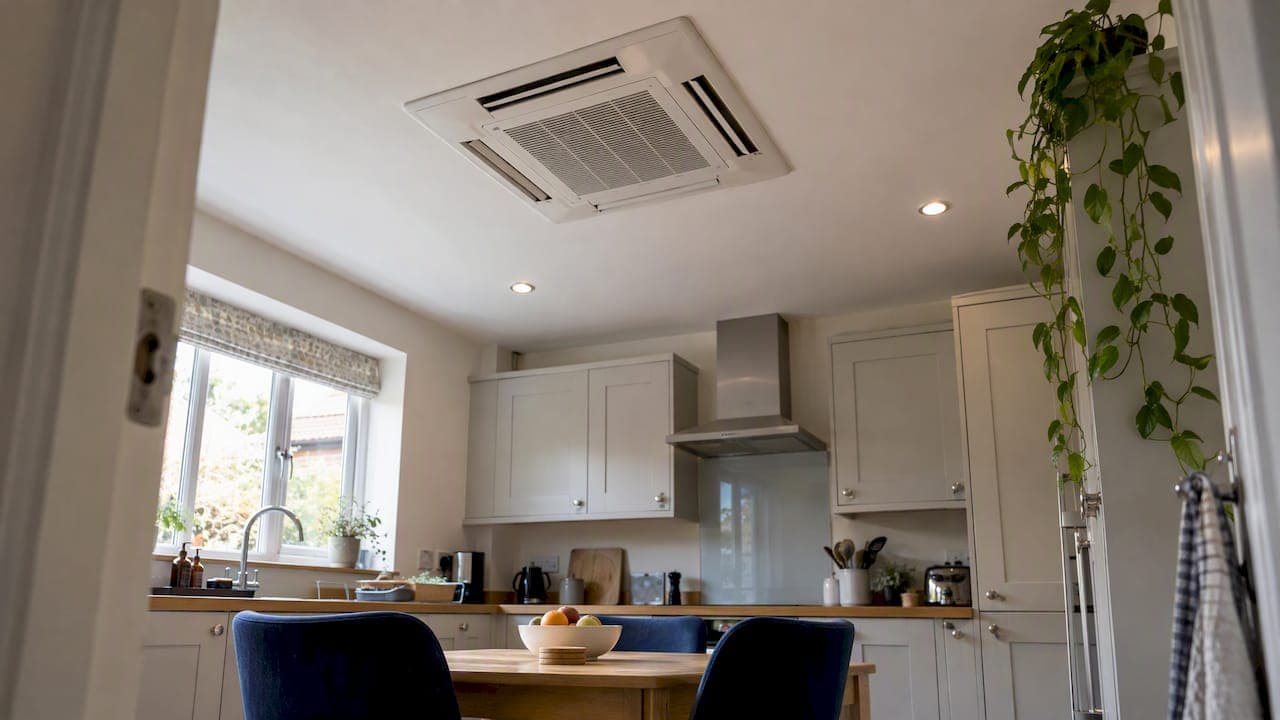
A ceiling cassette sits flush in the ceiling and pushes conditioned air out in several directions along the ceiling surface. It draws room air back in through a central grille. Done well, the cool air spreads across the room and drops gently, so nobody sits in a draught. Done badly, you get cold spots, warm corners or a damp patch on the ceiling. The difference comes down to ceiling height, where the unit sits, how the louvres are set and how the room is shaped.
This guide explains what actually happens to the air, what can go wrong, and what to ask before you commit to a cassette in your home.
TL;DR
- A standard 4-way cassette draws air in through the middle and blows it out on four sides, so it covers a room more evenly than a single wall unit.
- Ceiling height matters. Most 4-way models are designed for roughly 2.5m to 4.5m, and the unit must be told the height in its settings or the air will not reach the floor properly.
- Corners and irregular rooms need planning. Installers can block off one or more outlets so air is not fired straight at a wall.
- A cassette recirculates indoor air. It does not replace ventilation.
- Cassettes are fixed refrigerant systems, so by law they must be installed by an F-Gas certified company.
Table of Contents
- How air moves through a ceiling cassette
- Ceiling height and throw distance
- Room shape, corners and blocked outlets
- Cassette or wall-mounted split: which airflow suits your room?
- Installation details that decide whether the airflow works
- Why the law matters here
- Our view on cassette airflow
- Getting a cassette installed in the South West
- Quick checks before you buy
- FAQ
- Sources
How air moves through a ceiling cassette
A cassette has two jobs: take in room air and send it back out at the right temperature. The intake is the large central grille. Behind it sit the filter, a heat exchanger and a fan. The conditioned air leaves through slots around the edge of the panel.
The key trick is the direction of that outflow. A standard 4-way cassette discharges air horizontally along the ceiling. Because the air clings to the surface (the Coanda effect), it travels further before it falls. It then mixes gradually with the room air rather than landing on whoever is sitting underneath. That is the main reason people find cassettes more comfortable than a wall-mounted split in the same room, where the stream is aimed from one side.
Two practical points follow:
- The air needs ceiling space to travel along. If something sits close to the outlet, such as a beam or a deep light fitting, the flow breaks away early and falls in the wrong place.
- Cooling and heating behave differently. Cool air is heavy and falls naturally. Warm air wants to rise, so in heating mode the louvres are usually angled more steeply downwards to push warmth towards the floor.
Mitsubishi Electric describes its 4-way blow cassette as offering 72 different airflow patterns, with ceiling applications up to 4.2 metres. That tells you how much of the result depends on setting the unit up for the room instead of leaving it on factory defaults.
Ceiling height and throw distance
Height is the setting people overlook. The fan speed and the discharge angle are tuned to a stated installation height. Daikin's installer guide for its cassettes has a field setting for ceiling height, and for most 4-way models the permitted installation height falls between 2.5m and 4.5m depending on the model. Go outside the range, or leave the field settings wrong, and coverage and efficiency drop.
What that means in a house:
- Standard ceilings (about 2.4m to 2.7m). Usually well within range, but you still need the correct setting. Our guide to the 2.5m and 300mm rules for cassette placement covers the clearances in more detail.
- High ceilings, vaulted rooms and open-plan extensions. A cassette may suit the room, but the air has further to travel. Mitsubishi Heavy Industries' installation guidance suggests using a circulator if the ceiling is over 3m so that warm air does not collect at the top.
- Lowered ceilings. Many UK homes have a void of limited depth, so the unit's height and the ceiling space around it need checking at survey stage, not on installation day.
If an installer cannot tell you the installation height they have assumed and the setting they will use, ask again.
Room shape, corners and blocked outlets
A cassette is designed for the middle of a room. Real rooms are rarely that tidy. If the unit has to sit near a wall, one of its four outlets will blow straight at the plaster. The air then bounces back, circulates poorly, and can cool the wall surface enough to cause condensation.

The usual fix is a blocking kit. Installers can convert a 4-way cassette to a 3-way or 2-way pattern, which sends all the air into the room instead. Some units also let you adjust individual louvres from the remote or controller.
Other room features that change the airflow:
| Feature | What happens | Typical fix |
|---|---|---|
| Long, narrow room | Two outlets blow along the short walls and waste air | Block those outlets, or use two smaller units |
| L-shaped or open-plan space | Air does not reach the far leg | Separate units or a carefully placed unit at the junction |
| Unit near a wall | Air hits the wall and recirculates | Blocking kit, move the unit |
| Large window facing south | Solar gain overwhelms local cooling | Position the unit with the window in mind, check capacity |
| Tall ceiling | Warm air sits above head height | Correct height setting, circulator fan |
This is also why guessing capacity from floor area alone goes wrong. The volume of the room, its insulation and glazing all count. Our guides on sizing air conditioners for comfort and what cooling capacity means explain how to think about it.
Cassette or wall-mounted split: which airflow suits your room?
The People Also Ask boxes often ask how a cassette differs from a split. Both are split systems, with an indoor unit linked to an outdoor unit by refrigerant pipework. The difference is where the indoor unit sits and how it delivers air.
| Ceiling cassette | Wall-mounted split | |
|---|---|---|
| Air delivery | Several directions, along the ceiling | One direction, from one wall |
| Best for | Larger or open rooms, central positions | Bedrooms, smaller rooms, simple retrofits |
| Appearance | Flush panel, little protrudes | Visible unit on the wall |
| Ceiling work | Needs a ceiling void and often structural care | None |
| Wall space | Keeps it free | Takes some of it |
A wall unit is often the simpler and cheaper answer for a bedroom. A cassette earns its place where you want even cooling across a bigger room and have the ceiling void to hide it. If you are still deciding, our overview on how to choose an air conditioner for your home sets out the options.
Installation details that decide whether the airflow works
Good airflow is not just about the grille. It depends on what happens above the ceiling.
Space above the ceiling. Cassettes are not plug-and-play. Manufacturer instructions, such as Electriq's installation manual, call for room around the unit for refrigerant pipes, electrical connections and the condensate drain. In older properties the unit may mean cutting into joists, which needs proper reinforcement so the ceiling stays sound and does not vibrate over time.
Level mounting. The condensate drain relies on the unit being set correctly. Daikin's guide tells installers to check the unit is level and, where it matters for drainage, slightly tilted towards the drain side. A unit that is out of level can interfere with the drain pump and lead to water leaking into your ceiling.
Ventilation of the building itself. If your ceiling void is part of a roofspace, airflow and moisture in that space matter as well. This guide to roof ventilation types is a helpful read if you are unsure how your loft is ventilated before cutting into the ceiling below.
Fresh air. A cassette recirculates the air already in the room. The Energy Saving Trust says air-to-air heat pumps do not bring in fresh air, so you should keep your normal ventilation, such as trickle vents, to avoid moisture and air quality problems.
Filters. Airflow falls as the filter clogs. Clean filters on the schedule the manufacturer gives, and book regular servicing. Our guide on how often to service your aircon explains what to expect.

Why the law matters here
A ceiling cassette contains refrigerant, so it is covered by F-Gas rules. GOV.UK states that a company, including sole traders, must be certified by an approved body to service stationary equipment containing F gas operated by others, and air conditioning is listed. Individual engineers also need qualifications for installing, servicing and decommissioning RACHP systems.
That is why a cassette is never a DIY job. If a quote does not mention F-Gas certification, ask for it in writing. For the wider picture, see our list of 10 reasons for professional AC installation in the UK.
Our view on cassette airflow
We fit air conditioning across Devon, Cornwall and the wider South West, and the complaints we hear about cassettes are almost never about the machine. They are about the setup. A cassette is put in the wrong spot because the ceiling was easier there, or the height setting was left alone, or an outlet was left blowing at a wall.
So our approach starts with a free survey. We look at the room volume, the ceiling void, the glazing and where people actually sit. Then we choose between a cassette and a wall unit on the merits. Sometimes a cassette is the right answer and sometimes it is not, and we would rather say so before a ceiling is opened up.
Our engineers are F-Gas certified and REFCOM registered, and we do the work ourselves rather than passing it to subcontractors. For most installations that means one team who surveyed the room is the team who sets the airflow afterwards. We fit systems from Samsung, Mitsubishi, Toshiba and Daikin, all of which offer cassette ranges, so the choice follows the room and not the other way round.
If we had one piece of advice, it would be this: before you sign, ask where the unit will sit, what height the settings assume, and which outlets will be blocked. A good installer answers all three without hesitation.
— James
Getting a cassette installed in the South West
If you would like a cassette, or want a second opinion on whether one suits your room, our domestic installation service starts with a free survey. We design the system around your room, offer 0% finance, and same day or next day installs can be available. Installations are typically completed within one to two days. For shops, offices and cafés, see our commercial and shop fitting work, and for servicing or breakdowns, our service and maintenance page.
Running costs are a common worry too. Our guide to estimating and reducing your air conditioner bill is a good starting point, and the Energy Saving Trust notes that the tariff you are on has a large effect, advising that time-of-use tariffs can work well with heat pumps.
Quick checks before you buy
- Ask for the installation height and the setting the engineer will use.
- Ask which outlets, if any, will be blocked and why.
- Check the ceiling void depth and whether joists need to be cut and reinforced.
- Confirm the capacity is based on room volume, insulation and glazing, not floor area alone.
- Ask for the company's F-Gas certification and the engineer's qualifications.
- Agree where the condensate drain runs and whether a lift pump is needed.
- Keep your ventilation, and plan for filter cleaning and servicing.
FAQ
Does a ceiling cassette blow cold air directly onto you?
Not if it is set up properly. A 4-way cassette sends air along the ceiling, and it falls and mixes with room air gradually. Draughts usually point to a wrong height setting, a blocked outlet needed but not fitted, or a unit sited directly above a seat or bed.
Can a cassette work in a room with a low or high ceiling?
Most 4-way models are designed for roughly 2.5m to 4.5m, depending on the model, as set out in Daikin's installer guide. Above about 3m, a circulator can help. Below the range, a wall unit is usually the better choice.
What is the 3-minute rule for air conditioners?
Many systems include a short delay before the compressor restarts after switching off, so pressures in the refrigerant circuit can settle. If you turn the unit off and on again, expect a pause of a few minutes before cooling resumes. It is normal, not a fault.
Is a portable air conditioner a better option than a cassette?
They are different products. A portable unit is movable, while a cassette is a fixed system that must be installed by F-Gas certified engineers. GOV.UK sets out bans on certain F gases in new products, so check the refrigerant and rules before buying any unit.
Sources
- Daikin installer and user reference guide, FCAHG-F cassette
- Mitsubishi Electric, 4-way blow ceiling cassette system
- Mitsubishi Heavy Industries, VRF indoor installation sheets
- Electriq, ceiling cassette installation manual
- Energy Saving Trust, air-to-air heat pumps
- Energy Saving Trust, heat pump fact check
- GOV.UK, company certification to work with F gas
- GOV.UK, qualifications to work with F gas
- GOV.UK, bans on F gas in new products and equipment