
Air conditioning noise level is the amount of sound, measured in decibels (dB), that an AC unit produces during operation. It directly affects how comfortable your home feels, particularly in bedrooms and quiet living spaces. Modern split systems can operate as quietly as 19 dB indoors, while portable units typically reach 42–65 dB. That gap is enormous in practice. Understanding air conditioning noise levels explained properly means knowing not just the numbers, but what they feel like to live with every day.
What do air conditioning noise levels mean?
The decibel scale is logarithmic, not linear. That means a 10 dB increase doubles perceived loudness to the human ear. A unit rated at 50 dB sounds twice as loud as one rated at 40 dB, even though the number only went up by ten. This is the single most important thing to understand when comparing AC sound levels on a spec sheet.
Most homeowners assume a few decibels here or there makes little difference. It does. A difference of just 3 dB is noticeable to most people in a quiet room. When you are trying to sleep or concentrate, even small differences in air conditioner sound levels matter considerably.
The table below puts common AC noise ratings in context with everyday sounds you already know.
| Decibel level | Everyday equivalent | Typical AC context |
|---|---|---|
| 19–25 dB | Rustling leaves, whisper | Split system on lowest setting |
| 30–35 dB | Quiet library | Split system on medium setting |
| 40–45 dB | Normal conversation at distance | Split system at full output |
| 50–55 dB | Busy office background noise | Portable unit on low |
| 60–65 dB | Normal conversation, close range | Portable unit at full output |
Reading this table, you can see why split systems dominate the quiet air conditioning options market. A portable unit on low sits where a split system sits at full power.
How do different AC systems compare on noise?
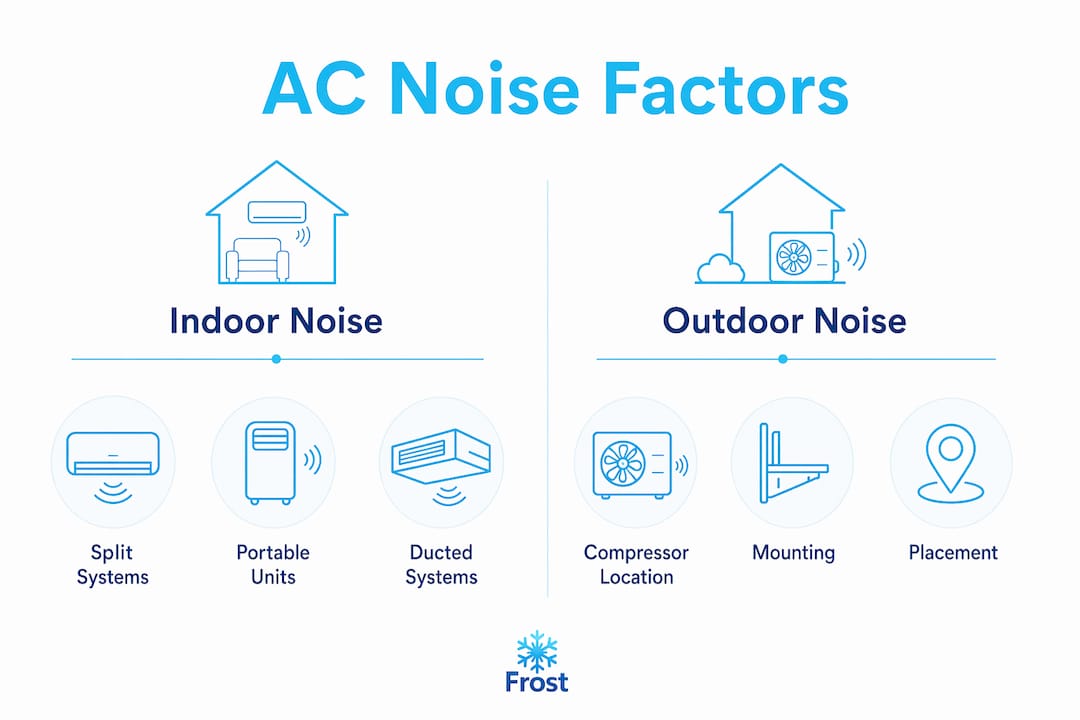
Split systems are the quietest residential option available. The compressor, which generates most of the noise, sits outside in the condenser unit. The indoor head unit only moves air, which is a much quieter job. Indoor split systems run between 19 and 45 dB, with outdoor condensers typically producing 40–60 dB.
Portable units are the loudest common option. They house the compressor indoors, so all that mechanical noise stays in the room with you. Noise ratings of 42–65 dB are standard across the category. That upper end is genuinely disruptive in a bedroom or home office.
Ducted systems sit between the two. The air handling unit is hidden in a loft or ceiling void, which keeps noise out of living spaces. Fan noise travels through ductwork, but a well-designed installation keeps this to a low background hum. Window units are louder than split systems but quieter than most portable units, though they are rarely installed in UK homes.
| System type | Indoor noise range | Outdoor noise | Key noise consideration |
|---|---|---|---|
| Split system | 19–45 dB | 40–60 dB | Quietest indoor option; compressor is outside |
| Ducted system | 25–40 dB (at grille) | 40–55 dB | Duct design affects fan noise distribution |
| Portable unit | 42–65 dB | N/A (all indoors) | Loudest option; compressor inside the room |
| Window unit | 40–55 dB | Partial (rear-facing) | Rarely used in UK; moderate noise profile |
Pro Tip: Choose an inverter split system over a fixed-speed model. Inverter technology modulates compressor speed continuously rather than switching on and off at full power, which keeps noise levels steady and low throughout operation.
What factors influence AC noise beyond the unit specs?
Correct sizing is the most overlooked factor in AC noise control. Oversized units cycle more frequently and run at higher pressures than necessary, creating more noise than a properly matched inverter system. An oversized unit also creates more airflow than the room needs, and excess airflow produces wind noise that homeowners often mistake for a mechanical fault. Getting the correct AC sizing right from the start prevents this entirely.
Outdoor unit placement has a dramatic effect on perceived noise. Reflective surfaces and narrow spaces amplify condenser noise significantly. A condenser mounted between two brick walls will sound noticeably louder than the same unit in an open garden position. Proper clearance and thoughtful aircon placement reduce this effect considerably.
Vibration transmission is a separate problem from airborne noise. Anti-vibration pads on ground mounts reduce structural noise transmission more effectively than wall brackets, which can transfer compressor vibrations directly into the building fabric. Once vibration enters a wall or floor, it amplifies and becomes difficult to eliminate without remounting the unit.
Key installation factors that affect noise levels:
- System sizing: An undersized unit runs constantly at full power. An oversized unit short-cycles noisily. Neither is acceptable.
- Outdoor unit clearance: Allow adequate space on all sides. Avoid positioning condensers in corners or against solid walls.
- Anti-vibration mounts: Ground-mounted condensers with rubber isolation pads are quieter than wall-bracket installations.
- Indoor unit height and direction: Mounting the indoor head too low or pointing airflow directly at a seating area increases perceived noise.
- Ductwork design: Poorly designed ducts create turbulence and whistling at grilles, adding noise that has nothing to do with the unit itself.
Pro Tip: Ask your installer specifically about anti-vibration mounting options before work begins. This is rarely mentioned unless you raise it, but it makes a measurable difference to noise inside the home.
How can you reduce air conditioning noise at home?
Noise reduction starts at the product selection stage, not after installation. Choose a model with a published minimum noise rating below 30 dB and a dedicated sleep or quiet mode. These modes reduce fan speed and compressor output during overnight hours. Read the quiet AC systems guide before shortlisting models to understand what specifications actually matter.
Practical steps to reduce AC noise in your home:
- Position indoor units away from bedrooms and quiet zones where possible. If a bedroom unit is unavoidable, choose the quietest available model and use sleep mode.
- Use acoustic screening for outdoor condensers. Timber louvre screens or dense planting reduce noise reaching neighbours and reflect less sound back towards the building.
- Schedule regular maintenance. Loose panels, worn fan bearings, and debris in the outdoor unit all increase noise over time. A service maintenance visit catches these issues before they become disruptive.
- Check for rattles after installation. A new unit should be near-silent. Any rattling or vibration in the first weeks indicates a mounting or panel issue that needs correcting immediately.
- Set realistic expectations for peak cooling days. Even the quietest inverter system runs harder on a 30°C day. Noise will increase slightly during peak demand. This is normal and not a fault.
For more targeted advice, the noise reduction tips guide covers specific scenarios including party walls, loft conversions, and open-plan living spaces.
How does AC noise affect sleep quality and home comfort?
Noise directly disrupts sleep quality, concentration, and relaxation. Experts recommend indoor bedroom noise below 40 dB, with 19–32 dB preferred for light sleepers. A split system on a low setting sits comfortably within that range. A portable unit does not, even on its lowest setting.
The type of noise matters as much as the volume. A steady, low hum is far less disruptive than intermittent noise that starts and stops. Fixed-speed compressors that cycle on and off create exactly that kind of interruption. Inverter systems, which modulate continuously, produce a consistent background sound that most people adapt to quickly. This is why quiet bedroom air conditioning guides consistently recommend inverter split systems over any other type.
Home offices present a similar challenge. Video calls and focused work require a quiet background. A unit producing 45 dB in a small room is the equivalent of a constant conversation happening nearby. Choosing a split system with a low minimum output solves this without compromise.
There is also a psychological dimension. Homeowners who are aware of their AC running tend to find it more intrusive than those who barely notice it. A quieter system builds confidence that the unit is working correctly and not disturbing neighbours, which adds genuine peace of mind beyond the numbers.
Key takeaways
The quietest air conditioning choice for UK homeowners is a correctly sized inverter split system, installed with anti-vibration mounts and positioned away from reflective surfaces.
| Point | Details |
|---|---|
| Split systems are quietest | Indoor noise of 19–45 dB makes split systems the best choice for bedrooms and quiet rooms. |
| Decibel scale is logarithmic | A 10 dB increase doubles perceived loudness, so small spec differences have real impact. |
| Sizing affects noise directly | Oversized units cycle noisily; correct sizing keeps inverter systems running quietly and smoothly. |
| Placement shapes outdoor noise | Avoid reflective surfaces and tight spaces around the condenser to prevent noise amplification. |
| Bedroom target is under 40 dB | Light sleepers benefit most from units rated 19–32 dB, achievable with modern inverter split systems. |
What the spec sheet does not tell you
Manufacturers measure noise under controlled conditions at the lowest fan speed. Real-world noise is typically 10–15 dB higher when cooling demand increases. That is not a flaw in the product. It is a gap between laboratory conditions and a hot afternoon in a south-facing living room.
The homeowners I speak with most often are surprised by this. They chose a unit rated at 26 dB and expected near-silence throughout summer. What they got was 26 dB on a mild evening and noticeably more on a warm day. Neither figure was wrong. The spec sheet just did not tell the full story.
Correct sizing closes that gap more than any other single decision. A properly sized inverter system rarely needs to run at full output, so it spends most of its life in the quiet lower range. An oversized unit hits its peak noise more often because it short-cycles rather than modulating smoothly. System sizing is the most overlooked noise factor in residential installation, and it costs nothing extra to get right.
My honest advice: ask your installer to justify the system size with a heat load calculation, not just a room size estimate. Ask about anti-vibration mounting before they start. And treat the quoted dB figure as a best-case number, not a guarantee.
— James
Frostairconditioning: quiet home cooling done properly
Frostairconditioning installs domestic air conditioning across Exeter and the South West, with a focus on getting sizing, placement, and mounting right from day one. Every installation is carried out by F-Gas certified engineers, and same-day installs are available for homeowners who need cooling quickly.

Choosing a quiet system is only half the job. The other half is installing it correctly so it stays quiet. Frostairconditioning offers domestic installation tailored to your home layout, with honest advice on which systems suit your rooms and noise requirements. 0% finance is available, making it straightforward to choose the right unit rather than the cheapest one. Request a quote to get started.
FAQ
What is a good noise level for a bedroom air conditioner?
Experts recommend below 40 dB for bedroom use, with 19–32 dB preferred for light sleepers. Modern inverter split systems achieve this comfortably on low and medium settings.
Why is my air conditioner louder than its rated noise level?
Manufacturers test at low fan speed under controlled conditions. Real-world noise rises by 10–15 dB when cooling demand increases, which is normal behaviour rather than a fault.
Are split systems quieter than portable air conditioners?
Split systems are significantly quieter indoors. The compressor sits outside, so indoor noise stays between 19 and 45 dB. Portable units house the compressor in the room and typically produce 42–65 dB.
Does the size of an air conditioning unit affect how noisy it is?
Yes. Oversized units cycle more frequently at higher pressures, creating more noise. A correctly sized inverter system modulates smoothly and runs quietly for longer periods.
Can I reduce outdoor condenser noise after installation?
Acoustic timber screens or dense planting around the condenser reduce noise reaching neighbours. Avoiding reflective surfaces near the unit and ensuring adequate clearance on all sides also helps considerably.