

Cooling capacity is defined as the amount of heat an air conditioning system can remove from an indoor space over a set period of time. It is the single most important figure to understand when choosing an air conditioner for your home. Get it right and your system runs efficiently, keeps you comfortable, and costs less to run. Get it wrong and you will either be sweating through summer or paying far more than necessary on your energy bills. This guide explains what cooling capacity means, how it is measured, and how to use that knowledge to make a confident decision.
What is cooling capacity and how is it measured?
Cooling capacity measures how much heat an air conditioning system can remove over time, expressed in BTU/h, kilowatts, or tons of refrigeration. These are the three units you will see on manufacturer spec sheets and installer quotes across the UK. Understanding what each one means in practice stops you from being confused by the numbers.
BTU/h stands for British Thermal Units per hour. One BTU is the energy needed to raise one pound of water by one degree Fahrenheit. For air conditioning, it tells you how much heat the unit pulls out of your room every hour. A typical small bedroom unit might be rated at 7,000 BTU/h, while a large open-plan living space could need 18,000 BTU/h or more.
Kilowatts (kW) is the metric unit used widely in the UK and Europe. The conversion is straightforward: 1 kW equals approximately 3,412 BTU/h. Most UK installers and manufacturers quote cooling capacity in kW, so this is the figure you will most commonly encounter when comparing systems.
Tons of refrigeration is a unit inherited from the days when ice was used to cool buildings. One ton equals 12,000 BTU/h, or roughly 3.517 kW. You are less likely to see tons quoted for domestic systems in the UK, but it appears in commercial HVAC specifications and some imported equipment.
Quick reference: cooling capacity unit conversions
| Unit | Equivalent in BTU/h | Equivalent in kW |
|---|---|---|
| 1 ton of refrigeration | 12,000 BTU/h | ~3.517 kW |
| 1 kW | ~3,412 BTU/h | 1 kW |
| 5 kW (typical UK lounge) | ~17,060 BTU/h | 5 kW |
| 2.5 kW (small bedroom) | ~8,530 BTU/h | 2.5 kW |
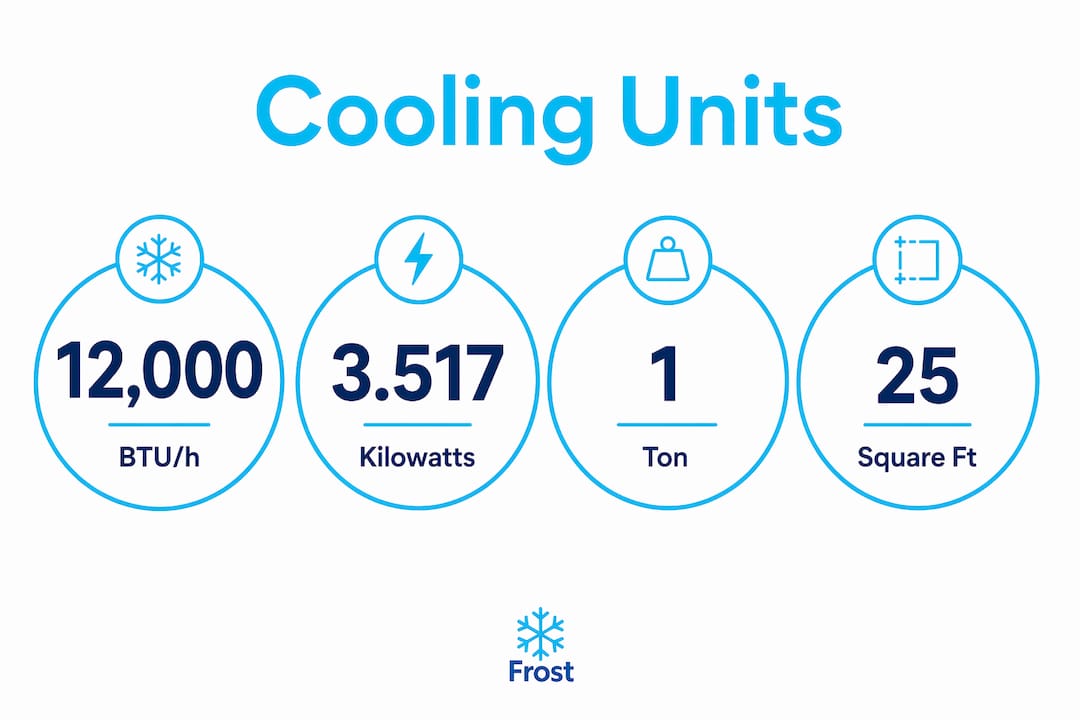
These figures give you a practical frame of reference. A 2.5 kW unit is a common starting point for a UK bedroom, while a 5–7 kW unit suits a larger living area.
How to calculate cooling capacity for a UK home
The cooling capacity you need depends on far more than just the size of your room. Professional AC sizing uses around 10 key parameters, including insulation R-values, solar gain, occupancy, and local climate zone. That said, a useful starting point for UK homes in moderate climates is 20–25 BTU per square foot.
Here is a simple worked example. A UK living room measuring 20 feet by 15 feet has a floor area of 300 square feet. At 25 BTU per square foot, the base estimate is 7,500 BTU/h, or roughly 2.2 kW. That figure then needs adjusting for the following factors:
- Insulation quality. A poorly insulated room with single-glazed windows loses cool air far faster. Add 10–15% to your base figure for older UK properties with limited insulation.
- Window size and orientation. South-facing rooms with large windows receive significantly more solar gain. Add up to 10% for each large south-facing window.
- Ceiling height. Standard UK ceilings are around 2.4 metres. For rooms with higher ceilings, increase your estimate proportionally.
- Occupancy. Each additional person in a room generates roughly 600 BTU/h of heat. A home office used by two people needs more capacity than a spare bedroom.
- Local climate. The south-west of England, including Exeter, experiences warmer summers than Scotland. Factor in your regional peak temperatures when sizing.
Once you have your adjusted cooling load, the equipment capacity should exceed that figure. A safety margin of 15–25% above the calculated load is recommended to handle peak demand and allow proper system cycling. This distinction matters: the cooling load is what your room requires; the cooling capacity is what the equipment delivers. Capacity should always be slightly higher than load, but not excessively so.
Pro Tip: Before calling an installer, measure your room dimensions and note which direction your main windows face. This takes five minutes and means any quote you receive will be based on real data rather than guesswork.
For a more detailed breakdown of sizing for UK properties, the Frostairconditioning sizing guide covers local climate factors in depth.
Why bigger is not always better: common sizing mistakes
The most widespread misconception about cooling capacity in HVAC is that a more powerful unit will always cool better. Oversized AC units cause short-cycling, poor dehumidification, increased wear, and higher energy consumption. Short-cycling means the unit reaches its set temperature too quickly, switches off, and then switches back on again in rapid succession. This is hard on the compressor and wastes energy.
The comfort problem with an oversized unit is less obvious but equally frustrating. When a system short-cycles, it does not run long enough to remove moisture from the air. The result is a room that feels cold but clammy. In the UK, where summer humidity can be significant, this matters.
Undersized units create the opposite problem. A unit that is too small runs continuously without ever reaching the target temperature. Ignoring latent load leads to discomfort despite apparent climate control, and a constantly running compressor wears out far sooner than one that cycles correctly.
Here is what to watch for when evaluating a quote:
- Single-stage systems should be sized at 90–115% of the calculated cooling load. Going above 115% risks the short-cycling issues described above.
- Variable-capacity systems offer more flexibility and can be sized at 115–130% of load without the same short-cycling risk, because they modulate their output rather than switching fully on or off.
- Sensible vs latent cooling. Total cooling capacity covers both sensible cooling (reducing air temperature) and latent cooling (removing moisture). The ratio between these is called the Sensible Heat Ratio (SHR). For humid UK summers, a system with a lower SHR handles moisture more effectively.
Pro Tip: Ask any installer for the Sensible Heat Ratio of the unit they are recommending. A good installer will know this figure. If they cannot answer, that tells you something important about the quality of their sizing process.
Understanding common HVAC sizing errors before you buy protects you from an expensive mistake.
How to choose the right cooling capacity system for your home
Applying the cooling capacity definition to your own home requires a structured approach. The following steps give you a reliable path from first estimate to final decision.
Start with a room-by-room floor area measurement. Add up the total square footage of the spaces you want to cool and apply the 20–25 BTU per square foot guideline for UK moderate climates. This gives you a working baseline before any adjustments.
Next, assess your building envelope. Check the age and type of your insulation, the number and orientation of windows, and whether you have double or triple glazing. Older UK properties, particularly Victorian and Edwardian terraces, typically need a higher capacity per square foot than modern new-builds. The homeowner's guide to sizing covers this in practical detail.
Then consider the type of system. A single split unit suits most UK bedrooms and living rooms. Multi-split systems allow one outdoor unit to serve several indoor units, which is useful for cooling multiple rooms without multiple external installations. Variable-capacity (inverter) systems adjust their output continuously and are generally more efficient than fixed-speed alternatives.
Finally, get a professional load calculation. The Manual J method, used by qualified HVAC engineers, accounts for all the parameters above in a structured calculation. Selecting correct cooling capacity must account for climate, building envelope insulation, solar radiation, and external variables. A professional calculation takes the guesswork out entirely and gives you a defensible basis for the system you choose.
The role of humidity in HVAC performance is worth reading before your consultation, particularly if your home feels damp in summer.
Key takeaways
Cooling capacity is the defining specification for any air conditioning system, and matching it accurately to your home's actual heat load is the difference between a system that works well and one that costs you money.
| Point | Details |
|---|---|
| Cooling capacity definition | Cooling capacity measures heat removed per hour, expressed in BTU/h, kW, or tons of refrigeration. |
| UK sizing baseline | Use 20–25 BTU per square foot as a starting estimate for moderate UK climates. |
| Safety margin matters | Equipment capacity should exceed calculated cooling load by 15–25% to handle peak demand. |
| Bigger is not better | Oversized units short-cycle, fail to dehumidify, and wear out faster than correctly sized systems. |
| Sensible and latent cooling | Total capacity must address both temperature reduction and moisture removal for UK summer comfort. |
Why I think most UK homeowners are sold the wrong size unit
I have seen this pattern repeatedly across the south-west. A homeowner gets two or three quotes, and the installer who wins the job often recommends the largest unit they can justify. The reasoning sounds sensible: "Better to have too much than too little." In practice, it is the wrong call almost every time.
An oversized unit in a typical UK semi-detached house will short-cycle from April through to September. The homeowner notices the room never quite feels right, there is a faint dampness in the air, and the unit seems to be running noisily on and off all day. They assume it is a fault. It is not a fault. It is a sizing error.
The shift I have seen work well is moving towards inverter-driven, variable-capacity systems. These units modulate their output to match the actual load at any given moment. They run quietly, they handle humidity properly, and they are significantly more efficient over a full cooling season. The upfront cost is slightly higher, but the running cost difference over three to five years more than covers it.
Climate patterns in the UK are also shifting. Summers in the south-west are warmer and more humid than they were twenty years ago. The sizing assumptions that worked in 2005 may underperform by 2030. When you are investing in a system today, size for the climate you are likely to experience over the next decade, not just the last one.
My honest advice: insist on a proper load calculation before agreeing to any installation. A qualified, F-Gas certified installer will do this as standard. If a quote arrives without one, ask why.
— James
Get the right cooling capacity installed by Frostairconditioning

Frostairconditioning is an F-Gas certified air conditioning installer based in Exeter, covering the south-west of the UK. Every domestic installation begins with a proper sizing assessment so you get the right cooling capacity for your specific home, not a generic recommendation. The team offers same-day installs where possible, 0% finance options, and ongoing service and maintenance to keep your system running at peak efficiency. Whether you are cooling a single bedroom or a whole house, Frostairconditioning sizes every system to your actual needs. Get a free personalised quote today and find out exactly what your home requires.
FAQ
What is cooling capacity in simple terms?
Cooling capacity is the amount of heat an air conditioning system can remove from a room per hour. It is measured in BTU/h, kilowatts, or tons of refrigeration.
How do I calculate the cooling capacity I need?
Start with 20–25 BTU per square foot of floor area for a UK home in a moderate climate, then adjust upward for poor insulation, large south-facing windows, high ceilings, and additional occupants.
What is the difference between cooling load and cooling capacity?
Cooling load is the amount of heat your room generates and needs removing. Cooling capacity is the rated output of the equipment. Capacity should exceed load by 15–25% to handle peak conditions.
Why does an oversized air conditioner cause problems?
An oversized unit cools the room too quickly, causing short-cycling. This prevents proper moisture removal, leaves the air feeling clammy, increases wear on the compressor, and raises running costs.
What cooling capacity do I need for a typical UK living room?
A living room of around 20 square metres typically requires a unit rated at 2.5–3.5 kW, depending on insulation quality, window orientation, and how many people use the space regularly.