
Choosing the wrong air conditioner is one of the most expensive mistakes a homeowner can make. Too small and it never cools the room properly; too large and you end up with clammy, damp air because the unit cycles off before it can remove moisture. Knowing how to choose air conditioner systems that actually suit your home, your rooms, and your budget takes more than a quick online search. This guide cuts through the noise and gives Devon and Cornwall homeowners a practical framework to get it right first time.
Table of Contents
- Assessing your home's cooling needs
- Understanding different air conditioner types and installation options
- Determining the right size and capacity for your air conditioner
- Evaluating energy efficiency and user-friendly features
- Ensuring proper installation and planning for maintenance
- Our honest take on how most people get this wrong
- Ready to get the right system installed?
- Frequently asked questions
Assessing your home's cooling needs
Before you look at a single product listing, you need to understand what your home is actually asking of a cooling system. Getting this wrong is where most people trip up.
Start by measuring your key rooms. Not just the living room or bedroom you feel is the problem, but every space you want to cool. Ceiling height matters too. Standard UK rooms sit around 2.4 metres, but older Devon and Cornwall properties, particularly stone cottages and Georgian terraces, can have higher ceilings that add significant volume to heat.
Insulation quality plays a bigger role than most people expect. A well-insulated modern home in Exeter retains cool air far better than a poorly insulated Victorian end-of-terrace in Falmouth. South-facing rooms with large glazed windows will gain far more solar heat, which directly affects the capacity you need.
Key factors to map before buying:
- Room dimensions (length × width × ceiling height)
- Number and orientation of windows
- Quality of wall and loft insulation
- How much direct sun each room receives
- Whether the space is a kitchen, home office, or high-occupancy room
- How quickly specific rooms heat up during summer
The starting point for sizing is straightforward: about 20 BTU per square foot of living space. But treat that as a floor, not a ceiling. Devon and Cornwall's climate shapes AC choices in ways that aren't obvious at first glance. The South West sees milder but increasingly humid summers, which means moisture control matters as much as raw cooling power.
| Room type | Adjustment needed |
|---|---|
| Standard shaded room | Base BTU (20 per sq ft) |
| Sunny south-facing room | Add 10% to base |
| Kitchen | Add 4,000 BTU |
| Each extra occupant beyond two | Add 600 BTU |
| High-ceiling room (above 2.7m) | Scale up by ceiling volume ratio |
Oversizing is genuinely damaging. A unit that cools the air too fast never runs long enough to pull humidity out, leaving the room feeling sticky and cold rather than comfortable. The best air conditioning guide for UK homes goes into this in detail, and it is worth reading before you commit to a capacity.
Pro Tip: Walk through your home on a hot afternoon and note which rooms become unbearable first. These are your priority zones and will drive the sizing decisions for every unit you buy.
Understanding different air conditioner types and installation options
Once you know your cooling load, the next step is selecting the right system type. Installation costs and feasibility vary considerably depending on which route you take, and some options simply are not practical in older South West properties.

Split systems are the most popular choice for UK homeowners right now, and for good reason. They are quiet, efficient, and can cover individual rooms or multiple zones depending on the configuration. They need a small hole through an external wall for the refrigerant pipe, which is usually straightforward in most Devon and Cornwall properties.
Portable units look appealing because they need no fixed installation, but they exhaust hot air through a hose that still needs to vent outside, usually through a window kit. They are louder than split systems and less efficient, but useful if you rent or want flexibility.
Window units are rare in the UK compared to the US, mainly because UK sash and casement windows are not designed for them. They work if you have the right window type, but most Devon and Cornwall homes do not.
Central air conditioning suits larger, newer homes. It is the most expensive option upfront and requires ductwork, making it impractical in most South West properties unless you are already renovating extensively.
| System type | Approx cost | Capacity | Installation complexity | Mobility |
|---|---|---|---|---|
| Split system | £1,200 to £3,000 | High | Professional required | Fixed |
| Portable unit | £300 to £800 | Low to medium | DIY friendly | Fully mobile |
| Window unit | £200 to £700 | Low to medium | Moderate DIY | Fixed |
| Central air | £5,000+ | Very high | Professional required | Fixed |
For more detail on which system suits your property type, the guide on types of air conditioning for UK homes breaks each option down clearly. And if you are thinking about getting something installed quickly, it is worth understanding AC installation requirements before you book.
Pro Tip: If you have a listed building or live in a conservation area common in parts of Cornwall, check planning restrictions before ordering a split system. External wall penetrations and outdoor units can require permission.
Determining the right size and capacity for your air conditioner
This is where selecting the right air conditioner becomes precise. The calculation itself is not complicated, but skipping steps leads to expensive mistakes.
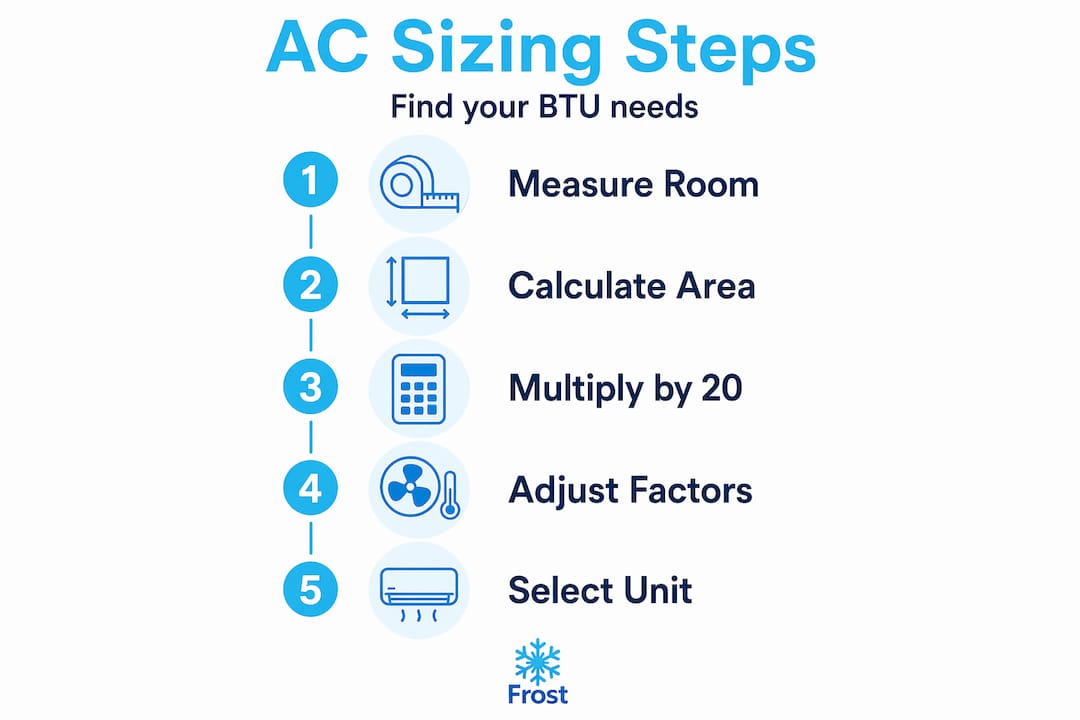
Follow these five steps:
- Measure the room length and width in feet, then multiply to get square footage.
- Multiply the square footage by 20 to get your base BTU requirement.
- Add 10% if the room gets significant direct sunlight for most of the day.
- Add 600 BTU per additional occupant if more than two people regularly use the room.
- Add 4,000 BTU if the room is a kitchen or contains significant heat-generating equipment.
Energy.gov recommends 20 BTU per square foot as the base, with adjustments for room height, shading, and local climate. For Devon and Cornwall's humid coastal areas, erring slightly higher on capacity is sensible.
Electrical readiness is something a surprising number of buyers overlook entirely. Units over 7.5 amps require dedicated circuits or 240V service. Many older South West homes are running on ageing consumer units that may need upgrading before a larger split system can be safely installed.
| Unit capacity (BTU) | Amperage draw | Circuit requirement |
|---|---|---|
| Up to 10,000 BTU | 5 to 7 amps | Standard 13A socket |
| 10,000 to 15,000 BTU | 7.5 to 10 amps | Dedicated circuit |
| 15,000 BTU and above | 10+ amps | 240V or dedicated supply |
You can read more about improving AC efficiency once your sizing is correct, as correct sizing and efficient operation go hand in hand.
Pro Tip: Always check the actual voltage and amperage on the unit's specification plate before purchase, not just the headline BTU figure. Manufacturers round these numbers in marketing materials.
Evaluating energy efficiency and user-friendly features
Getting the size right is the hard part. Choosing between models of the same capacity comes down to efficiency ratings and the features that make daily use practical.
Efficiency ratings to understand:
- EER2 is the stricter 2023 standard. New room ACs are rated with EER2 and ENERGY STAR certification identifies the most efficient models.
- CEER (Combined Energy Efficiency Ratio) is specific to window units and factors in standby power use. CEER values range from 9 to 16, with higher numbers meaning lower running costs.
- For split systems in the UK, look for the SEER2 rating. Above 20 is excellent; below 14 is poor.
Beyond ratings, the features that actually improve day-to-day use are often overlooked when tips for choosing air conditioner systems get written up. Here is what genuinely matters:
- Washable, accessible filters. Some units require near-disassembly to clean the filter. Avoid these.
- Programmable timers. The ability to pre-cool a room before you arrive home saves significant energy.
- Directional louvres. Being able to direct airflow away from people avoids the unpleasant draught feeling that puts many people off air conditioning entirely.
- Sleep or eco modes. These reduce fan speed and allow temperature to rise slightly overnight, cutting running costs without affecting sleep quality.
- Wi-Fi control. Genuinely useful, particularly for holiday homes in Cornwall, but should never be the primary reason to choose a unit.
For detailed energy efficiency tips for AC in practice, particularly regarding how to run your unit economically in the South West's shoulder seasons, there is further guidance worth bookmarking.
Pro Tip: Run your AC in eco or fan-only mode on mild days rather than switching it off entirely. Keeping the air circulating prevents the humidity build-up that makes Devon and Cornwall homes feel stuffy in autumn.
Ensuring proper installation and planning for maintenance
Even the best unit performs poorly if it is installed badly. Installation is where the risks, and the savings, are largest.
Installation checklist:
- Confirm your installer holds F-Gas certification (legally required in the UK for refrigerant handling).
- Check your consumer unit has sufficient capacity for the new circuit demand.
- Budget for any wiring upgrades before committing to a system.
- Ensure the outdoor unit location meets manufacturer clearance requirements.
- Seal all wall penetrations properly to prevent draughts and pest ingress.
Many air conditioners require professional installation, and the cost of getting it wrong exceeds the cost of getting it right from the start. A split system installed by an uncertified person voids the warranty and may also invalidate your home insurance.
Safety warning: Never install an AC unit on a circuit that is already close to capacity. Electrical overload is a leading cause of domestic fires in the UK. If in doubt, have a qualified electrician assess your supply before installation begins.
For planned maintenance, build these habits:
- Clean or rinse filters every two to four weeks during heavy summer use.
- Wipe down the external coil fins annually with a soft brush.
- Check that the condensate drain is clear, particularly in autumn when leaves block outlets.
- Book an annual service for split systems to check refrigerant pressure and electrical connections.
AC installation certified steps covers the process in detail, and if speed matters, the guide on same-day AC installation explains what is genuinely possible without cutting corners.
Pro Tip: Set a recurring reminder on your phone for filter cleaning on the first of each month from May to September. It takes five minutes and keeps the unit running at full efficiency through the whole season.
Our honest take on how most people get this wrong
After fitting systems across Devon and Cornwall, the pattern is consistent. Most homeowners spend the bulk of their research time comparing brand names and smart features, then make the actual size and type decision in about ten minutes based on price. That is backwards.
The brand matters far less than the BTU calculation and the installation quality. A mid-range split system correctly sized and professionally installed will outperform a premium unit that is 30% oversized and poorly fitted every single time. We see this regularly, particularly in older properties where buyers assumed bigger meant better.
There is also a tendency to treat air conditioning as a summer-only purchase. What to consider when buying air conditioner systems for the South West should include their heating capability. Most modern inverter split systems operate as heat pumps, providing efficient heating in winter too. In Cornwall especially, where gas central heating is absent in many rural properties, this is not a secondary feature. It is a primary reason to buy.
The homes that get the most value from air conditioning are not the ones with the most expensive systems. They are the ones where the owner took the time to size correctly, hired a certified installer, and keeps up with basic filter maintenance. That combination beats any premium brand feature.
Ready to get the right system installed?
If you have worked through this guide and you are confident about what your home needs, the next step is getting a professional assessment and installation you can trust.

At Frost Air Conditioning, we are F-Gas certified and cover the whole of Devon and Cornwall from our Exeter base. We offer 0% finance so the upfront cost does not have to stand in the way, and same-day installs are available for homes that are ready to go. Whether you need a single-room split system or a multi-zone setup for a larger property, we will size it correctly, install it safely, and leave you with a unit that works properly from day one. Get in touch with us to arrange your free assessment.
Frequently asked questions
How do I calculate the correct size air conditioner for my room?
Measure the room's length and width to find its area, then multiply by 20 to get your base BTU requirement, using the Energy.gov sizing guidance to adjust for sunlight, occupancy, and ceiling height.
What is the difference between EER, EER2, and CEER ratings?
EER measures operational efficiency; EER2 is a stricter 2023 standard; CEER factors in standby energy use and gives a more accurate picture of real-world running costs for window units.
Do I need professional installation for an air conditioner?
Split and central systems always require a certified installer. Many AC types require professional installation, and in the UK, anyone handling refrigerants must hold F-Gas certification by law.
How often should I clean or replace my air conditioner's filter?
Clean filters every two to four weeks during heavy use, or monthly as a minimum, as regular filter maintenance directly affects both efficiency and indoor air quality.