
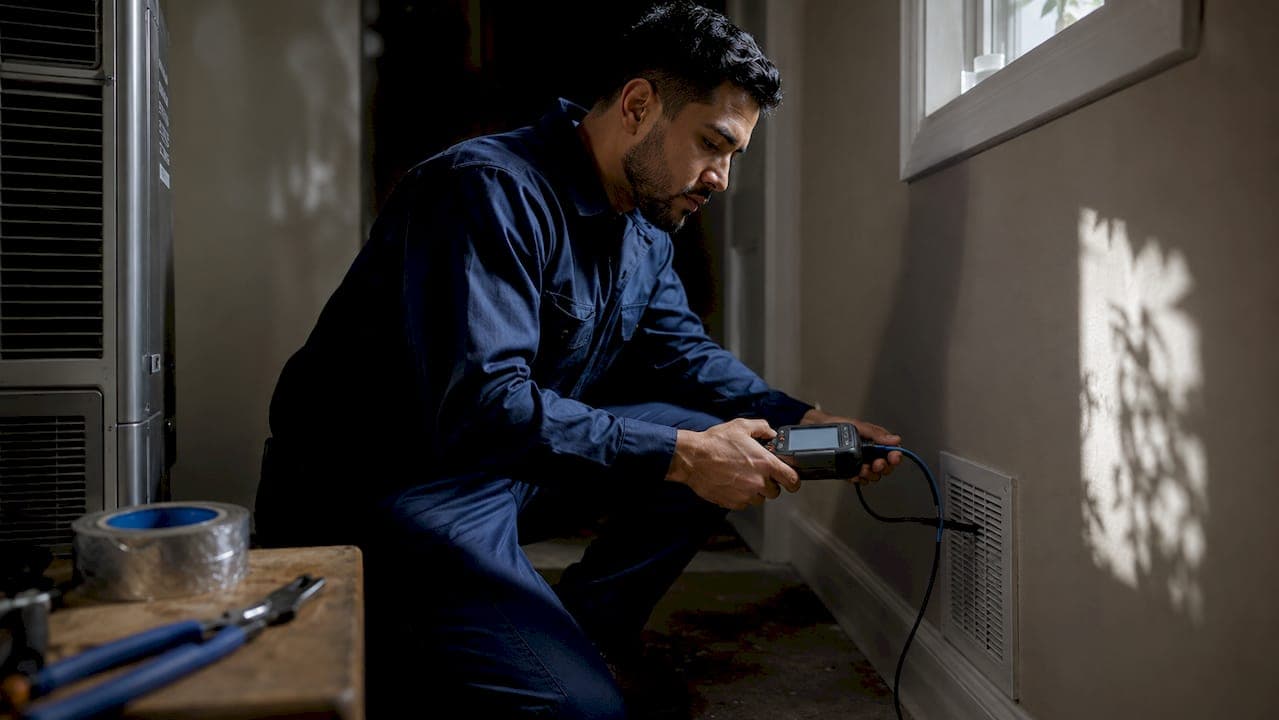
Air balancing is defined as the systematic measurement and adjustment of airflow in an HVAC system to deliver the design-specified volume of conditioned air to every zone. Done correctly, it eliminates hot and cold spots, cuts energy waste, and extends the life of your equipment. Industry benchmarks set by ASHRAE require airflow to land within ±10% of design specifications for a system to perform as intended. Frostairconditioning carries out this process as a standard part of every domestic installation across the South West, because a system that moves the wrong amount of air is a system that costs you more and delivers less.
What is air balancing and how does it work?
Air balancing is the process of measuring how much air, in cubic feet per minute (CFM), each supply and return vent delivers, then adjusting the system until every room receives its intended share. The industry term for the full professional service is Testing, Adjusting, and Balancing, or TAB. Both phrases describe the same goal: making your HVAC system perform the way it was designed to.
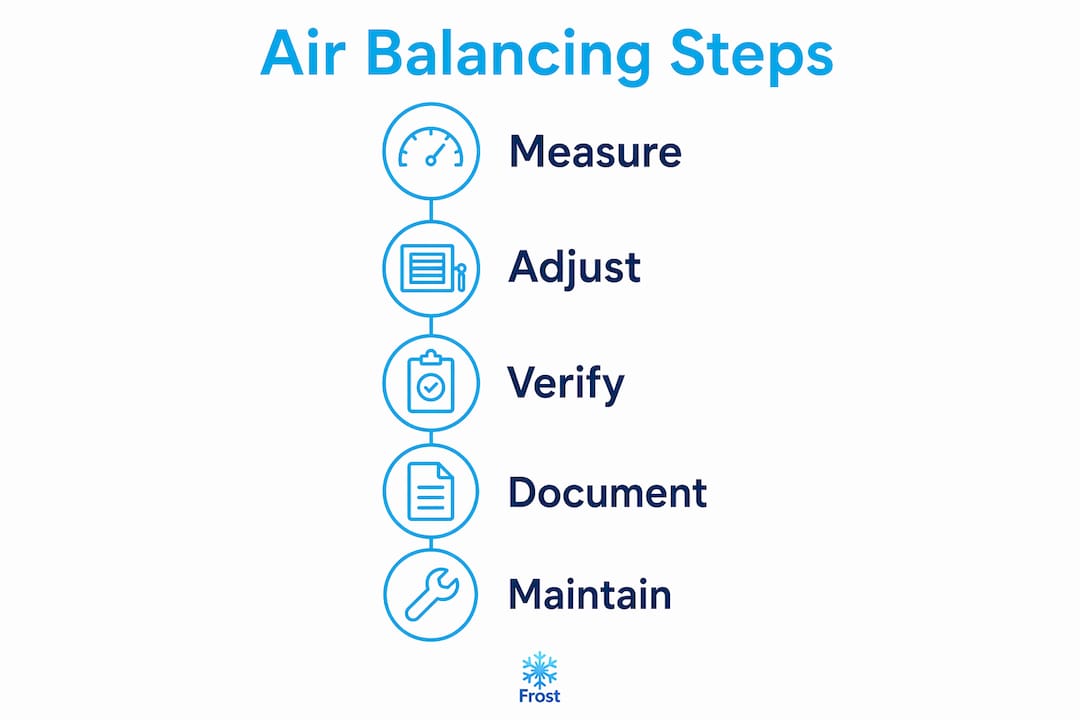
The step-by-step process
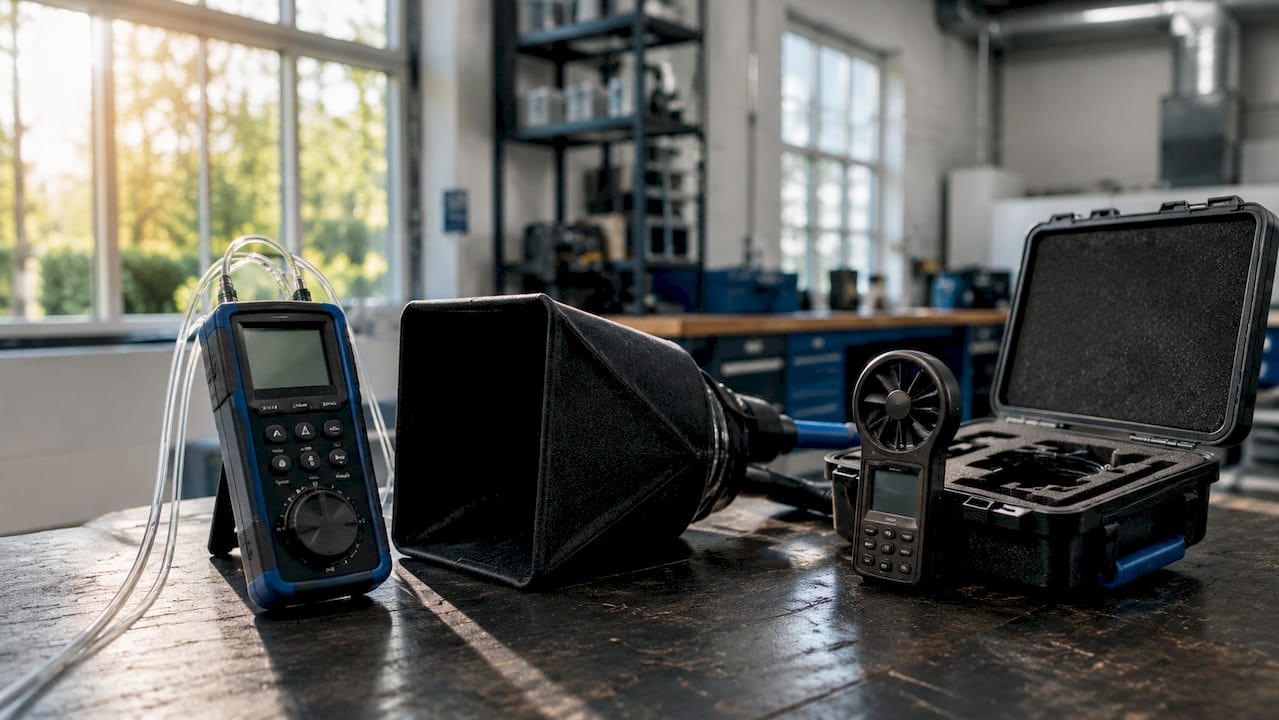
- Measure baseline airflow. A technician uses an anemometer or a balometer to record the CFM at every supply register and return grille. Static pressure readings across the ductwork are taken at the same time.
- Compare against design specifications. The measured figures are checked against the original HVAC design, typically drawn up using ACCA Manual D for duct sizing and Manual J for load calculations. Any register outside the ±10% ASHRAE tolerance is flagged.
- Adjust dampers and fan speed. Branch dampers inside the ductwork are opened or closed to redirect airflow. The blower motor speed may also be recalibrated to raise or lower the system's total output.
- Re-measure and document. Every register is measured again after adjustments. Professional TAB services produce a formal balancing report that records CFM deviations and confirms compliance with design tolerances.
- Lock settings. Once targets are met, damper positions are locked to prevent accidental changes during routine maintenance visits.
An unbalanced system forces the blower motor to work harder than it should. Imbalanced systems increase mechanical wear, energy consumption, and running costs, while balancing restores the intended load profile and reduces strain on every component.
Pro Tip: Ask your HVAC engineer for a copy of the balancing report after any new installation or major service. It gives you a baseline to compare against in future years and is useful evidence if a warranty claim ever arises.
What signs indicate your home needs air balancing?
Most homeowners notice something is wrong before they know what to call it. The signs are consistent and worth acting on quickly.
- Room-to-room temperature differences. A temperature differential of 2°F or more between rooms signals a likely imbalance, particularly after HVAC modifications or renovations. In UK terms, that is roughly 1°C of unexplained variation between spaces on the same floor.
- Persistent hot or cold spots. One bedroom that never cools down in summer, or a living room that stays draughty in winter, points directly to uneven airflow distribution.
- Rising energy bills without a change in usage. When the system compensates for poor distribution by running longer cycles, your bills climb even though your habits have not changed.
- Noisy ductwork or registers. Whistling or rattling at vents often means air is being forced through a restricted path, a classic symptom of pressure imbalance.
- Poor indoor air quality. Rooms receiving too little conditioned air accumulate humidity, dust, and stale air faster than the rest of the property.
Certain events make balancing almost certain to be necessary. These include completing a home renovation that altered room sizes or added partition walls, upgrading to a new HVAC unit, installing a zoning system, or adding a room to the property. After any of these changes, the original airflow design no longer matches the physical space.
Minor register adjustments are something a homeowner can attempt. Full airflow balancing, involving damper settings and blower calibration, requires a certified technician with the right instruments.
How is air balancing carried out professionally?
TAB certification and governing standards
Professional air balancing falls under the Testing, Adjusting, and Balancing discipline. Certification bodies including AABC (Associated Air Balance Council) and NEBB (National Environmental Balancing Bureau) set the standards that qualified technicians work to. In the UK, HVAC engineers follow CIBSE guidance alongside ASHRAE Standard 111, which governs the measurement, testing, and balancing of HVAC systems.
Certified technicians use tools including anemometers, balometers, and digital static pressure gauges. Results are documented in a formal report that records every CFM reading against the design target, with deviations expressed as a percentage. This report is not just paperwork. It is the evidence base for future maintenance decisions and any regulatory compliance checks.
Air balancing versus system balancing
Air balancing addresses the air side only, meaning supply, return, and exhaust airflows through ductwork. System balancing is a broader term that also covers hydronic, or water-side, flow in systems that use chilled or hot water for thermal delivery. If your property has a fan coil unit connected to a chilled water circuit, full system balancing covers both the air and water sides. For most UK homes with split or ducted air conditioning, air balancing alone is the relevant service.
Pro Tip: When commissioning a new system, ask whether air conditioning commissioning is included in the installation quote. Balancing is the final step of commissioning and should never be treated as an optional add-on.
Common misconceptions about air balancing
Several widely held beliefs about airflow management cause real damage to HVAC systems. Knowing what not to do is as useful as knowing the correct approach.
- Closing vents does not balance airflow. Closing individual registers raises static pressure throughout the ductwork. Higher static pressure forces the blower motor to work against greater resistance, accelerating wear and reducing efficiency. The correct method uses branch dampers, not register covers.
- Air balancing is not the same as duct cleaning. Duct cleaning removes debris from inside the ductwork. Air balancing adjusts how much air flows through it. The two services address different problems and neither substitutes for the other.
- Balancing cannot fix a leaking duct system. Balancing works best once duct leaks and insulation deficiencies are corrected. Adjusting dampers on a leaking system is a temporary measure. The underlying loss of conditioned air continues until the duct integrity is restored.
- Improper balancing carries real risks. Forcing too much airflow across a heat exchanger can cause overheating. Restricting return air can cause the evaporator coil to freeze. Both outcomes lead to costly repairs that a proper balancing procedure would have prevented.
Pro Tip: Before booking a balancing service, ask the engineer to inspect your ductwork for leaks first. Fixing a leaking duct before balancing means the adjustments actually hold.
How to maintain good airflow balance over time
Keeping your system balanced is an ongoing responsibility, not a one-off task. These steps give homeowners and property managers a practical framework.
- Carry out seasonal visual checks. Walk through the property each spring and autumn. Hold your hand near every register to feel whether air is flowing. Note any rooms that feel noticeably warmer or cooler than adjacent spaces.
- Adjust for seasonal stratification. Stack effect and heat stratification in two-storey homes cause upper floors to overheat in summer and overcool in winter. Seasonal damper adjustments, slightly favouring upper floors in summer and lower floors in winter, help manage this without a full rebalance.
- Schedule professional balancing after any modification. Renovations, new equipment, and zoning changes all alter the airflow demands on your system. A professional check after each change prevents small imbalances from compounding into larger problems.
- Take out a maintenance agreement. Regular servicing by a certified engineer catches pressure drift and damper slippage before they affect comfort. Frostairconditioning's service maintenance programme covers exactly this kind of ongoing performance monitoring for homes across the South West.
- Link balancing to broader efficiency goals. A well-balanced system uses less energy to achieve the same comfort level. Pairing balanced airflow with good insulation and energy-efficient operation compounds the savings over time.
Air balancing is also the final step in HVAC commissioning. Treating it as part of a broader commissioning process, rather than a standalone fix, produces the most durable results.
Key takeaways
Air balancing is the single most effective adjustment you can make to an HVAC system to improve comfort, cut running costs, and protect equipment from premature wear.
| Point | Details |
|---|---|
| Industry tolerance standard | ASHRAE requires airflow within ±10% of design specifications for a system to perform correctly. |
| Key warning sign | A temperature difference of 2°F or more between rooms signals a likely need for professional balancing. |
| Closing vents causes harm | Shutting registers raises static pressure and risks blower motor damage; use branch dampers instead. |
| Fix ducts before balancing | Duct leaks and insulation gaps must be resolved first, or balancing adjustments will not hold. |
| Ongoing maintenance matters | Seasonal checks and a professional maintenance agreement keep airflow balanced as the property changes over time. |
Why I think most homeowners underestimate air balancing
James here. After years of working on domestic HVAC installations across the South West, the pattern I see most often is this: a homeowner spends a significant amount on a new system, the installation looks clean, and then six months later they are back in touch asking why one bedroom is always too warm.
Nine times out of ten, the system was never properly balanced after installation. The equipment is fine. The ductwork is fine. The airflow just was not set up to match the actual layout of the home.
What surprises people is that balancing is not a luxury or an advanced upgrade. It is the final step that makes everything else work. A system without it is like a car with the wheels not aligned. It runs, but not as well as it should, and the wear adds up faster than you expect.
The other thing I have noticed is that newer, more efficient systems are actually less forgiving of imbalance than older ones. Variable-speed drives and inverter compressors are calibrated to precise airflow conditions. Put them in a system where the airflow is off by 20%, and you lose most of the efficiency gains you paid for.
My honest advice: treat balancing as part of the installation cost, not an afterthought. If you are managing a property with multiple zones or floors, schedule a professional check every two to three years even if nothing feels obviously wrong. The cost is modest. The savings in energy and avoided repairs are not.
— James
Frostairconditioning: professional air balancing for South West homes
Frostairconditioning installs, services, and balances air conditioning systems for homeowners and property managers across Exeter and the wider South West. Every installation follows industry standards for airflow measurement and adjustment, and the team carries F-Gas certification as standard.

Whether you need a new domestic installation with full commissioning and balancing included, or a professional assessment of an existing system that is not performing evenly, Frostairconditioning can help. Same-day installs are available, and 0% finance options make it straightforward to get the right system in place without delay. Request a free quote and get a clear picture of what your home actually needs.
FAQ
What is air balancing in simple terms?
Air balancing is the process of adjusting your HVAC system so that every room receives the correct amount of conditioned air. Technicians measure airflow at each vent and adjust dampers and fan settings until the system matches its original design.
How often should air balancing be carried out?
A professional balance is recommended after any renovation, equipment change, or zoning modification. For properties with multiple floors or zones, a check every two to three years keeps performance consistent even without obvious problems.
Can I balance my HVAC system myself?
Minor register adjustments are possible without specialist tools, but full air balancing requires an anemometer, static pressure gauge, and access to branch dampers inside the ductwork. Attempting it without the right equipment risks raising static pressure and damaging the blower motor.
Does air balancing require a permit in the UK?
Adjusting dampers and fan settings does not typically require a building permit. If balancing involves modifying the ductwork configuration, local building regulations may apply, and a qualified engineer will advise accordingly.
What is the difference between air balancing and system balancing?
Air balancing covers the air side of an HVAC system, meaning supply, return, and exhaust airflows through ductwork. System balancing also includes the water side, adjusting flow in hydronic circuits used in chilled water or hot water systems.