
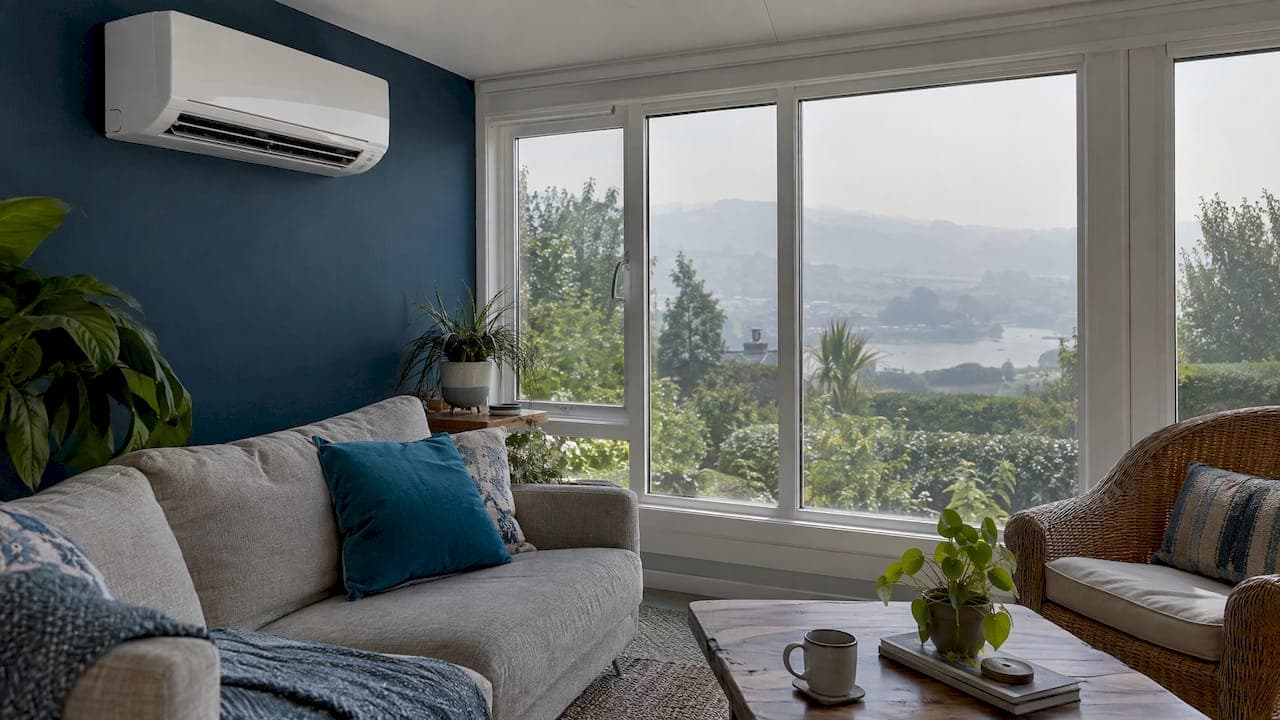
Yes, you can use home air conditioning during a wildfire smoke event, as long as the system recirculates the air already inside and does not pull air in from outdoors. Keep windows and doors shut, switch off any unit or ventilation setting that draws in outside air, and keep the filters clean. That is the short version. The rest of this guide explains why, what a split system can and cannot do, and how to prepare your home in Devon, Cornwall or anywhere else in the UK before the next hot, dry spell.
TL;DR
- UKHSA says that, where there is no risk from spreading fire, the most effective step is to stay indoors with doors and windows closed.
- Turn off any air conditioning system that draws air in from outside. A standard wall-mounted split system recirculates indoor air, so it can be used with everything closed.
- Smoke still gets in around closed windows. In UK homes monitored during wildfires, PM2.5 stayed two to four times above normal background levels even with windows shut.
- Clean filters and regular servicing matter more than any special mode. Check them before summer, not during an incident.
Table of Contents
- Why wildfire smoke is now a UK home issue
- How smoke gets into your home
- Do air conditioners filter smoke from outside?
- Settings to use when smoke is in the air
- Portable air cleaners and what they add
- Your ventilation system and the air it moves
- When to open the windows again
- Preparing your system before summer
- Planning an installation with air quality in mind
- Our view on aircon and smoke
- Fitting or servicing aircon in the South West
- FAQ
- Sources
Why wildfire smoke is now a UK home issue
For most of us, wildfire smoke used to be something that happened in California or Australia. That is changing. Climate researchers describe wildfires as an emergent risk for the UK. Past impacts on homes have been limited, but hazardous fire weather is projected to increase significantly, particularly in summer. The UK already sees thousands of vegetation fires a year. Most are small, and the severe ones tend to come in hot, dry springs and summers and are often started by human activity.
The smoke is the part that reaches people who are nowhere near the flames. It carries fine particles known as PM2.5, small enough to be breathed deep into the lungs. Gorse, heathland and moorland fires, which are common across Devon and Cornwall, can send a plume over towns and villages miles away depending on the wind.
The practical question for a homeowner is simple: when the air outside is bad, what is the safest way to run the cooling and ventilation you already have, or are thinking of installing?

How smoke gets into your home
A house is not a sealed box. Air moves in through open windows, but also through gaps around frames, letterboxes, trickle vents, extractor fans, chimneys and cable entries. Government research on UK indoor air makes the point that indoor air quality depends on outdoor air coming in, pollutants being lost, and what is emitted indoors. People also spend 80 to 90 per cent of their time indoors, so what you do inside matters a great deal.
The National Centre for Atmospheric Science looked at UK households during wildfires. It found that smoke pollution entered every monitored home, and that indoor levels were significantly higher where windows had been opened. Closing windows reduced exposure, but did not remove the problem: PM2.5 stayed two to four times higher than normal background levels.
That result shapes everything else in this guide. Closed windows are the first and biggest step. Cleaner air inside after that comes from controlling what your cooling system draws in, and from filtering the air already in the room.
Do air conditioners filter smoke from outside?
This is the question most people type, and the honest answer has two parts.
An air conditioner is built to cool, not to purify. What it does with smoke depends on its type:
| System type | Where its air comes from | Smoke considerations |
|---|---|---|
| Wall-mounted split or multi-split | Recirculates room air through the indoor unit | Can be used with doors and windows closed; air passes through the unit's filter each cycle |
| Ducted system | Recirculates return air, unless it has a fresh-air intake | Switch off or close any fresh-air or outdoor vent setting |
| Window or wall-mounted single unit | Can bring in some outside air depending on model | Use only with outdoor vents closed and the room sealed |
| Evaporative cooler | Draws in and humidifies outside air | Do not use when it is smoky |
| Mechanical ventilation with outdoor intake | Brings in outside air by design | Follow UKHSA advice to switch off systems that draw air in |
The Victorian Government's health guidance, written for Australian households that face smoke far more often than we do, says split systems and window or wall units can be used with external doors and windows closed, provided outdoor vents are off or closed. It also says evaporative coolers should not be used when it is smoky. UKHSA gives the same direction for the UK: during a smoke event, turn off any air conditioning that draws air in from outside.
So a standard domestic split system is one of the better ways to stay cool during smoky weather, because it lets you keep every window shut. The alternative, opening windows to cool down, is exactly what the UK monitoring study linked to higher indoor smoke.
The second part of the answer is about filtration. The filter in an indoor unit is designed mainly to protect the coil and the fan from dust and fibres. It does catch some airborne particles each time air passes through, but it is not a substitute for a dedicated high-efficiency filter or air cleaner. Systems differ, and the specification of the model you own or are buying decides how much it contributes. If indoor air quality matters to you, ask about it at the survey stage.
Settings to use when smoke is in the air
When there is smoke outside, work through this list in order.
- Close everything. Windows, doors, loft hatches if they are drafty, and any trickle vents you can shut. Close curtains too, because they help with heat gain as well.
- Set the unit to recirculate. On a split system this is normal operation. On ducted or multi-function units, check that any fresh-air intake or outdoor vent is closed or off. If you are unsure how your system is configured, your installer can tell you.
- Switch off anything that draws in outside air. This includes evaporative coolers and any ventilation unit with an external intake, as UKHSA advises.
- Choose cooling or fan mode, whichever keeps you comfortable. There is no need for a special smoke mode. What matters is that air is recirculating, not that the compressor is running flat out.
- Keep a single room as your clean room. Pick the room where you spend most time, such as a bedroom or living room, and keep the door closed. A single room is easier to keep cool and easier to keep clean.
- Avoid adding indoor smoke. Do not light candles, burn incense, use a wood burner or fry food at high heat. Indoor emissions add to what has come in from outside.
For ducted central systems, American guidance from the EPA suggests setting the fan to "On" rather than "Auto" so the system runs as often as possible, and using a MERV 13 filter, or the highest-efficiency filter the system can take. MERV is the US rating scale, and ducted systems in UK homes are far less common than in the US. If you do have one, ask your engineer which filter grade your unit can accept without reducing airflow.
Keeping cool without opening windows
Heatwaves and wildfire smoke often arrive together, which is the real difficulty. You are told to keep windows shut on the hottest day of the year. Reducing heat coming in through the glass helps your cooling system work less and keeps rooms more bearable. Guidance on how to block heat from windows covers coverings that cut solar gain, and it pairs naturally with a closed-window approach.
If you have been weighing up natural ventilation against mechanical cooling, our article on natural ventilation versus air conditioning in UK homes sets out when each makes sense. Smoky days are a clear example of when open windows stop being a free option.
Portable air cleaners and what they add
The EPA describes portable air cleaners as devices intended to deliver cleaner air to a single room, and they work best with doors and windows closed. The US Centers for Disease Control and Prevention reviewed the evidence and found that indoor air filtration, through central HVAC or portable cleaners, is an effective way to reduce exposure to wildfire smoke, provided the devices are properly maintained and use the right filtration technology.
In practice, that means air conditioning and air cleaning do different jobs. The air conditioner keeps you cool with the windows shut. A portable cleaner with a suitable filter gives you extra particle removal in the room you are sheltering in. Many households in smoke-prone regions use both.

Your ventilation system and the air it moves
If your home has a heat recovery ventilation unit, the ducts and filters matter. A unit that brings in outdoor air should be dealt with as UKHSA advises during a smoke event, and its filters should be in good condition before one starts. Homeowners looking at what is involved in keeping these systems clean may find a guide to residential HRV cleaning useful for understanding how filters and ducts are maintained. Always follow the manufacturer's advice and the guidance of a qualified engineer for your own unit.
When to open the windows again
When the outdoor smoke clears, you do not need to stay shut in. UKHSA says that when conditions improve, you may wish to open windows to cool and ventilate your home, but should keep monitoring official advice because conditions can change rapidly.
A sensible routine:
- Check the local air quality forecast first. The UK's Daily Air Quality Index measures short-term health risks from five pollutants, including PM2.5 and PM10, and PM2.5 can include smoke.
- Follow local media and official updates, as UKHSA advises, because wind direction can bring smoke back within hours.
- Open windows for a short, deliberate burst of ventilation rather than leaving them open all day.
- Replace or clean the indoor unit filters afterwards. They will have been working harder than usual.
People with asthma, heart or lung conditions, older people, pregnant women and young children are more vulnerable to smoke. If you or someone you look after has breathing difficulties, follow your GP or asthma nurse's advice and your own action plan, and call NHS 111 or 999 as appropriate if symptoms get worse.
Preparing your system before summer
Smoke season, like heatwave season, is predictable enough to prepare for. A system that is clean, correctly configured and recently serviced is far more reliable on the day you need it. Before the warm months:
- Clean or replace filters. Washable filters in the indoor unit should be cleaned regularly. Our guide on how air conditioning impacts your home health and comfort explains why.
- Book a service. An engineer can check the coil, drain, refrigerant circuit and electrical connections. Details of our service and maintenance options are on our site.
- Know your system. Find out whether any part of it brings in outside air, and how to switch that off.
- Learn the basics of resetting it. If a unit trips or faults, our walkthrough on how to reset home aircon shows what you can safely do yourself.
- Stock spare filters if your unit's manufacturer offers them.
Dust is a related concern. If you have had building work done, see how renovation dust affects your air conditioning unit and how to protect it. The same logic applies to smoke: particles load the filter, and a loaded filter reduces airflow.
Planning an installation with air quality in mind
If you are choosing a system now, you can design for cleaner air from the start. Things to raise at a survey:
- Recirculating indoor units, so you can cool with the home sealed.
- Filter options for the models you are considering, and how easy they are to reach and clean.
- Placement of indoor units in the rooms where you actually shelter, usually bedrooms and the main living space.
- Multi-split versus single units, depending on how many rooms you want to cool.
- Servicing, so filters and coils are checked on a schedule.
Our wider reading on how air conditioning can improve your home's air quality and home air conditioning efficiency, comfort and real options go into more detail on these choices.
Our view on aircon and smoke
We install air conditioning across Exeter, Devon, Cornwall and the wider South West, and the question about smoke is one we expect to hear more of.
Our advice is simple. The cleanest cooling option on a smoky day is a system that recirculates the air in your home, so you never have to open a window. A properly installed split or multi-split system does that. It is why we design systems around how a household actually lives: which rooms people sleep in, which they shelter in, and where the heat comes from.
What makes the difference is the quality of the installation and the care afterwards. Our engineers are F-Gas certified and REFCOM registered, and we complete installations without subcontractors, typically within one to two days. We fit systems from Samsung, Mitsubishi, Toshiba and Daikin, and we would rather talk through filters, unit positions and servicing at a free survey than leave you to find out on the hottest day of the year.
Keep the system serviced, keep the filters clean, and know which settings keep outside air out. That is most of what you need.
James
Fitting or servicing aircon in the South West
If you want a system that lets you cool the house with the windows shut, our domestic installation service starts with a free survey. We supply premium systems from Samsung, Mitsubishi, Toshiba and Daikin, and 0% finance is available. Same-day or next-day installs may be possible depending on availability.

Already have a system? Our service plans and annual service contracts keep filters, coils and drains in order, and our emergency breakdown response is there if something fails in a heatwave. Businesses can see our shop fitting and commercial work.
FAQ
Can I use my air conditioner when there is wildfire smoke outside?
Yes, if it recirculates indoor air and you keep external doors and windows closed. Split systems and wall units can be used this way, with any outdoor vents switched off or closed. UKHSA advises turning off any system that draws air in from outside.
Do air conditioners filter smoke from the outside?
A standard split system does not bring in outside air, so it is not filtering smoke from outdoors. It passes room air through its own filter, which catches some particles. For extra protection in one room, a portable air cleaner with a suitable filter can help alongside your aircon.
Should I open the windows to cool down on a smoky day?
Not while smoke is in the air. UK monitoring during wildfires found higher indoor smoke in homes where windows were opened. Keep windows closed, use your cooling and block sun on the glass, then ventilate once official advice says conditions have improved.
How do I check the air quality near me?
Look up the Daily Air Quality Index, which includes PM2.5, a pollutant that can contain smoke, and follow local media and official updates. If you or a family member has a lung or heart condition, follow your GP's advice and seek help if symptoms worsen.
Does my air conditioner need servicing after a smoke event?
It is sensible to check and clean the indoor unit filters afterwards, as they will have trapped more particles than usual. A scheduled annual service lets an engineer check the whole system, including coils and drains.
Sources
- UKHSA: Why severe wildfires are becoming more frequent in the UK and how to cope with the health risks
- NCAS: Wildfire smoke and heat create indoor air quality challenge for UK households
- Defra: Indoor Air Quality report
- Better Health Channel: Using air conditioners when it's smoky outside
- US EPA: Frequent questions about wildland fire smoke
- US EPA: Indoor air filtration
- CDC: Evidence on the use of air filtration during wildfires
- GOV.UK: Using the Daily Air Quality Index
- Copernicus NHESS: Past and future trends in fire weather for the UK
- How to block heat from windows
- Residential HRV cleaning