
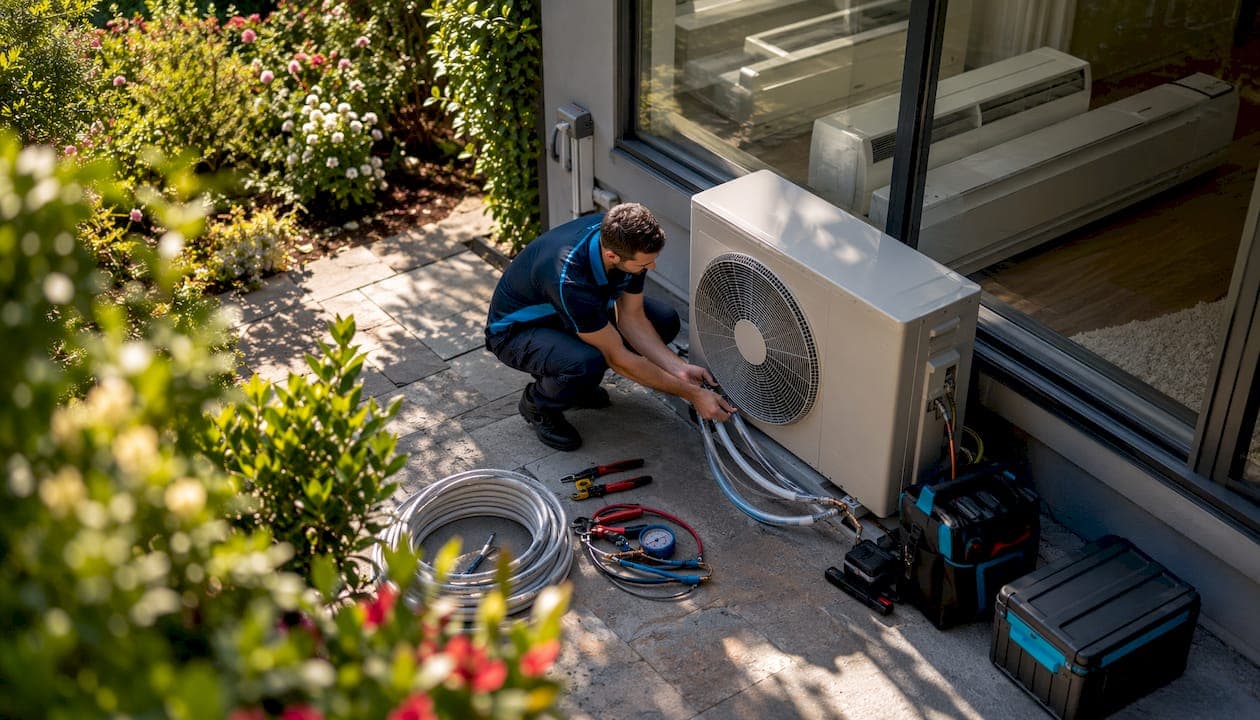
A multi-room air conditioning system, properly called a multi-split system, connects one outdoor compressor unit to two or more indoor units, each controlled independently. For most UK homes that want room-by-room temperature control without tearing out walls for ductwork, it is the most practical solution available. Daikin's product range shows configurations supporting up to five indoor units from a single outdoor compressor, with the ability to mix indoor unit styles across rooms. Any installation involving refrigerant handling in the UK requires a F-Gas/REFCOM certified installer. Frostairconditioning supplies and fits multi-split systems across Exeter and the South West, with REFCOM-certified engineers and 0% finance available.
At a glance:
- One outdoor unit serves multiple indoor units, each with its own thermostat and remote
- No ductwork required, making it well-suited to existing UK homes
- Reverse-cycle models provide both heating and cooling year-round
- Brands available include Daikin, Samsung, Mitsubishi Electric, Toshiba, and Bosch
- Installation must be carried out by an F-Gas/REFCOM certified engineer
Table of Contents
- What does a multi-split system actually consist of?
- How does a multi-room AC system actually work?
- Which indoor unit types suit which rooms?
- What are the real benefits for UK homeowners?
- What are the downsides worth knowing about?
- How much does a multi-room system typically cost in the UK?
- What does installation actually involve?
- How does a multi-split compare with other cooling options?
- What should you ask before choosing a system?
- What manufacturers and installers say about these systems
- Key takeaways
- The part most homeowners get wrong at the quote stage
- Get a bespoke multi-room system designed for your home
- Useful sources and further reading
What does a multi-split system actually consist of?
The system has four main parts, and understanding them helps enormously when a surveyor visits.
- Outdoor compressor/condenser unit: The single unit mounted outside the property. It houses the compressor, condenser coil, and fan. One unit does the work for every room in the system.
- Refrigerant pipework: Slim copper pipes carrying refrigerant between the outdoor unit and each indoor head. Because they are narrow (typically 6–10 mm), they can be routed through walls, lofts, and floor voids with far less disruption than ducting.
- Indoor units (heads): Mounted in each room. Wall-mounted units are most common, but cassette, floor-standing, and concealed-duct options exist. Each connects independently to the outdoor unit.
- Controls and thermostats: Each indoor unit has its own remote control or wall thermostat. Many systems also support app-based control via Wi-Fi.
- Condensate drain and electrical wiring: Each indoor unit needs a condensate drain to remove moisture and a dedicated electrical supply.
Because there is no ductwork, a multi-split retrofit into an existing house is far less invasive than installing a central ducted system. For a new build, both options are viable, but the multi-split's flexibility in mixing indoor unit types on one outdoor unit gives it a clear advantage where rooms have different ceiling heights or layouts.
How does a multi-room AC system actually work?
The refrigerant circuit is the engine of the whole system. Here is what happens from the moment you press a button on a remote:
- You call for cooling (or heating) in a room. The indoor unit's thermostat signals the outdoor unit that it needs refrigerant flow.
- The outdoor compressor activates. An inverter-driven compressor adjusts its speed to match the demand from whichever indoor units are active. This variable-speed operation is what makes multi-zone ductless systems more energy-efficient than older fixed-speed alternatives.
- Refrigerant flows to the active indoor unit(s). In cooling mode, the refrigerant arrives as a cool, low-pressure liquid. It passes through the indoor unit's evaporator coil, absorbing heat from the room air. The fan blows cooled air back into the room.
- The refrigerant returns to the outdoor unit. Now carrying the absorbed heat, it passes through the condenser coil outside, releasing that heat to the outdoor air. The compressor then re-pressurises it and the cycle repeats.
- In heating mode, the cycle reverses. The system extracts heat energy from outside air (even at low temperatures) and transfers it indoors. This is the heat-pump principle that makes reverse-cycle multi-splits so efficient for UK winters.
- Independent zone control. Each indoor unit has its own expansion valve and control circuit, so one room can be cooling while another heats, and a third stays off entirely. The outdoor unit's inverter compressor modulates continuously to serve all active zones simultaneously.
The inverter technology is worth understanding. Unlike a basic on/off compressor, an inverter unit ramps up quickly to reach the target temperature, then idles at a low speed to maintain it. That steady, low-power maintenance phase is where the energy savings accumulate. You can read more about boosting AC energy efficiency at home to get the most from this.

Which indoor unit types suit which rooms?
Different indoor unit styles suit different rooms, and one of the genuine strengths of a multi-split setup is that you can mix them on a single outdoor unit.
- Wall-mounted units: The most popular choice for bedrooms and living rooms. Mounted high on a wall, they distribute air across the room effectively and are straightforward to install. Most UK domestic installs use these.
- Ceiling cassette units: Recessed into the ceiling, with airflow in four directions. Ideal for open-plan kitchen-diners or larger reception rooms where a wall unit would create an uneven temperature spread.
- Concealed duct units: Hidden above a false ceiling or in a void, with only a slim grille visible. The most discreet option, popular in period properties or rooms where aesthetics are a priority. They require slightly more installation work.
- Floor-mounted units: Sit low on the wall, similar to a radiator position. Useful in rooms with limited wall space above head height, such as loft conversions with sloping ceilings, or conservatories.
Pro Tip: When planning a multi-split system, tell your installer the ceiling height and any architectural constraints in each room before the survey. A cassette unit in a room with a standard 2.4 m ceiling needs a false ceiling void to recess into — if that is not feasible, a wall unit is the practical answer.
Capacity matters too. A small bedroom needs a 2.0–2.5 kW indoor unit; a large open-plan living space may need 5.0 kW or more. Correct sizing at the design stage prevents the two most common complaints: a unit that cannot reach temperature on a hot day, and one that short-cycles and fails to dehumidify properly.

What are the real benefits for UK homeowners?
The case for a multi-split system rests on a handful of genuinely practical advantages, not marketing language.
- Independent room temperatures. Each person sets their own room to their preferred temperature. No more household arguments about the thermostat, and no energy wasted conditioning rooms that are empty. Multi-zone systems let you turn off unused rooms entirely, which a ducted central system cannot do without zone dampers.
- One outdoor unit keeps the exterior tidy. A single compressor box replaces what would otherwise be two, three, or four separate outdoor units. This matters in conservation areas, terraced properties, or anywhere outdoor space is limited.
- Year-round heating and cooling. Reverse-cycle multi-splits work as air-source heat pumps in winter. With UK summers provisionally among the warmest on record and cold winters still the norm, a system that handles both is genuinely useful.
- Quieter living spaces. The compressor sits outside. Indoor units produce around 19–26 dB(A) at low fan speed, which is quieter than a typical conversation. Contrast that with a portable unit grinding away in the corner of the room.
- No ductwork, less disruption. Slim refrigerant pipes thread through walls and ceilings far more easily than ducting. For a Victorian terrace or a 1930s semi, that difference is significant. See the advantages of split AC systems for a fuller breakdown.
- Energy efficiency from inverter technology. Because the compressor modulates rather than switching on and off, the system avoids the energy spikes of fixed-speed alternatives. Correct sizing amplifies this further.
What are the downsides worth knowing about?
No system is without trade-offs, and a multi-split is no exception.
- Higher upfront cost than a single-split. Adding more indoor units and a larger outdoor unit increases both equipment and labour costs. A two-room system costs noticeably more than a single-room installation, and the gap widens with each additional head.
- Outdoor unit capacity limits. Every outdoor unit has a maximum combined capacity for the indoor units connected to it. Exceed that limit and the system underperforms. A good installer sizes the outdoor unit to the total load, not just the largest room.
- Visible pipework and indoor heads. Refrigerant lines running along walls or through trunking are visible unless concealed during a renovation. Multiple indoor units also change the look of a room. Concealed-duct options solve this but add cost and require ceiling voids.
- Long pipe runs reduce efficiency. Most manufacturers specify a maximum pipe run (often 25–30 m per indoor unit, with some ranges extending further). Longer runs increase refrigerant charge, add installation time, and can slightly reduce performance.
- Installation complexity. Routing pipework through multiple floors or across a large property takes longer and costs more than a straightforward single-room install. Structural work, scaffolding, or routing through a loft can all extend the timeline.
- F-Gas compliance is non-negotiable. In the UK, anyone handling refrigerants must hold F-Gas/REFCOM certification. Using an uncertified installer is illegal, voids manufacturer warranties, and leaves you without valid commissioning records. Always verify certification before signing anything.
How much does a multi-room system typically cost in the UK?
There is no single honest answer to this, and any installer who quotes without a site survey is guessing. That said, the cost drivers are consistent and worth understanding before you call anyone.
- Number of indoor units. Each additional head adds equipment cost and installation time. A two-head system is the common starting point; four or five heads represent a significant step up in both price and complexity.
- Indoor unit type. Wall-mounted units are the most cost-effective. Cassette and concealed-duct units require more installation work and, in the case of concealed units, potential ceiling modifications.
- Pipe run length and complexity. Longer runs need more copper pipework, more labour, and sometimes more refrigerant. Routing through lofts, around structural elements, or across multiple floors adds time.
- Electrical work. The outdoor unit needs a dedicated circuit. If your consumer unit requires an upgrade or a new circuit is a complex run, that adds to the total.
- Site access. High external walls may need scaffolding or a cherry picker. Ground-floor outdoor unit positions are simpler and cheaper.
Cost varies widely across the UK, and installation quotes reflect local labour rates, access conditions, and the specific equipment specified. The only reliable figure is the one from a surveyor who has seen your property. Lifetime cost is the better frame: a correctly sized inverter system running efficiently for 15 years, with annual servicing, typically costs less over its life than a cheaper, poorly sized alternative that runs harder and breaks sooner. Frostairconditioning offers 0% finance, which spreads the upfront cost without adding to the total. Consider why air conditioning is a smart home investment for a longer-term perspective on running costs.
What does installation actually involve?
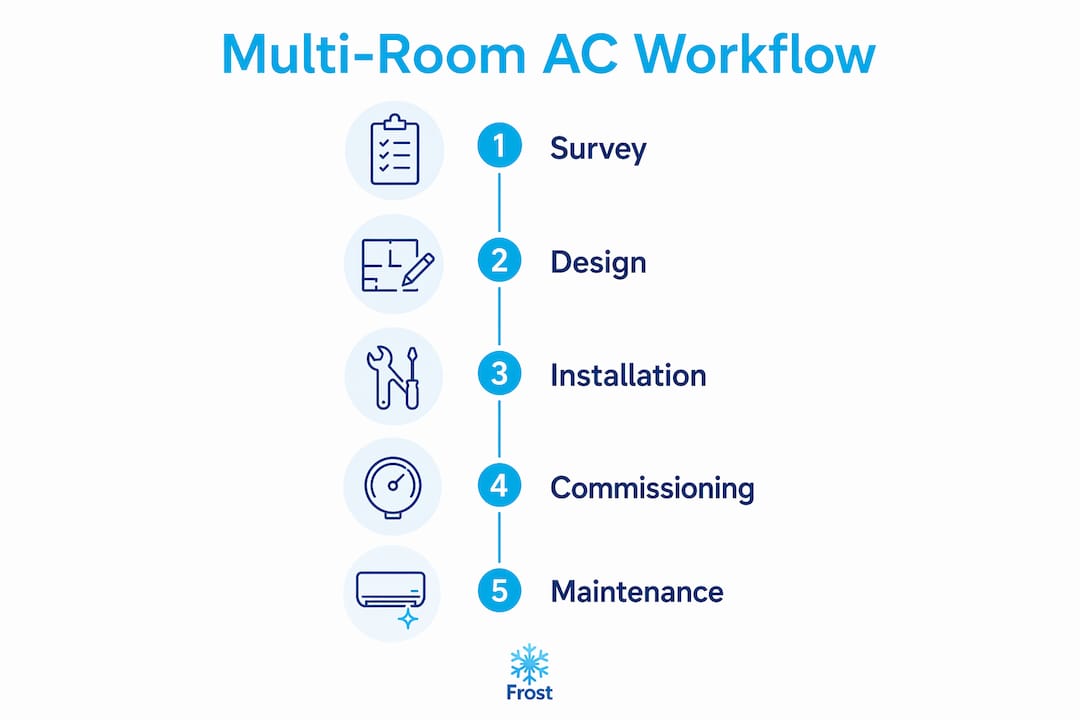
A well-run multi-split installation follows a clear sequence. Here is what to expect:
- Pre-survey design. Before any work begins, a competent installer will ask for floor plans, room dimensions, ceiling heights, and your typical usage patterns. This shapes the system design and the quote.
- Site survey and quote. An engineer visits to assess outdoor unit placement, pipe routing options, electrical supply, and any access challenges. This is where accurate pricing happens.
- Scheduling and equipment delivery. Lead times vary by manufacturer and model. Frostairconditioning offers same-day and next-day installations for straightforward jobs; larger or more complex systems need more planning time.
- Outdoor unit mounting. The compressor is fixed to a wall bracket or ground frame, positioned for adequate airflow clearance and minimal noise impact on neighbours.
- Pipework installation. Refrigerant lines, condensate drain pipes, and electrical cables are routed from the outdoor unit to each indoor head. This is the most time-consuming phase on complex jobs.
- Indoor unit fitting. Each head is mounted, connected to the pipework, and wired. Condensate drains are routed to an appropriate discharge point.
- System commissioning. The engineer pressure-tests the refrigerant circuit, evacuates moisture, charges the system, and runs functional checks on every zone. This step requires F-Gas/REFCOM certification.
- Handover and paperwork. You receive commissioning records, warranty documentation, and a walkthrough of the controls. Keep these documents: they are required for warranty claims and future servicing.
A two or three-head system in a straightforward property typically takes one to two days. Four or five heads, or a property requiring complex pipe routing, can take two to three days. Structural work, scaffolding, or significant electrical upgrades extend this further.
Pro Tip: Before the survey, note where you want each indoor unit positioned and photograph the proposed outdoor unit location. Installers can work faster and quote more accurately when they can see the site constraints clearly from the start.
How does a multi-split compare with other cooling options?
| System type | Best for | Indoor units | Typical efficiency | Indoor noise | Installation complexity | Heating capability |
|---|---|---|---|---|---|---|
| Multi-split | Multiple rooms, mixed styles, no ductwork | Multiple | High (inverter) | Very low | Moderate | Yes (heat pump) |
| Single-split | One room or one zone | 1 | High (inverter) | Very low | Low | Yes (heat pump) |
| Ducted central | Whole-house, new builds | N/A (central) | Moderate–high | Low (remote plant) | High | Yes (with heat pump) |
| Portable unit | Temporary, rental properties | N/A | Low | High | None | Limited |
A single-split is the right answer when you only need one room conditioned and want the lowest possible upfront cost. A ducted system suits new builds or whole-house retrofits where ductwork can be concealed during construction, and where central control of every room from one interface is preferred. The multi-split sits between these: more rooms than a single-split, less disruption than ducted, and genuine zoning that a ducted system without zone dampers cannot match.
Portable units are worth mentioning only to dismiss them for permanent use. They are noisy, inefficient, and require a window or wall penetration for the exhaust hose. For a homeowner comparing home cooling solutions, a multi-split is almost always the better long-term choice over portable alternatives. For a deeper look at the ducted option specifically, see what is ducted air conditioning.
What should you ask before choosing a system?
A practical checklist for the decision stage and the installer conversation:
Before you call anyone:
- How many rooms do you want to condition, and what are their approximate sizes?
- Do you have a preferred indoor unit style, or are aesthetics flexible?
- What is your budget range, including installation?
- Are there any planning constraints (conservation area, listed building, flat with lease restrictions)?
- Where could the outdoor unit realistically go, and is there a clear pipe route to each room?
Questions to ask every installer:
- Can you show your F-Gas/REFCOM certification?
- Which manufacturer and model are you proposing, and what is the SEER/SCOP rating?
- How long are the proposed pipe runs, and what refrigerant type does the system use?
- What warranty does the manufacturer offer, and do you provide commissioning paperwork?
- Do you offer annual maintenance contracts?
- Can you provide references for similar multi-room installs in properties like mine?
Red flags to watch for:
- A quote provided without a site visit
- Vague answers about certification or commissioning records
- No explanation of how the outdoor unit was sized to the combined indoor load
- Pressure to commit before a survey has been completed
What manufacturers and installers say about these systems
Daikin's multi-split range supports configurations of up to five indoor units and allows mixing of indoor unit styles, which gives homeowners genuine flexibility in how they design a system around their property. Daikin also highlights inverter-driven compressors and R-32 refrigerant on selected ranges as a way to improve seasonal efficiency and reduce environmental impact compared with older refrigerants.
Samsung, Mitsubishi Electric, Toshiba, and Bosch all offer comparable multi-split ranges for the UK residential market, each with their own inverter technology and indoor unit options. The consistent message across manufacturers is that correct sizing and certified installation are what determine whether a system performs to its rated efficiency. As LG's technical guidance notes, poor sizing or excessively long pipe runs degrade performance regardless of how capable the hardware is.
Installer commentary reinforces this. The practical benefits most commonly cited by engineers in the field are quieter rooms, cleaner exteriors, and the flexibility to retrofit without structural work. These are the factors that most often tip a homeowner's decision. For anyone wanting an independent perspective on ductless systems, this homeowner's guide to ductless mini-splits covers the fundamentals clearly.
Frostairconditioning's engineers hold F-Gas/REFCOM certification and supply systems from Daikin, Samsung, Mitsubishi Electric, and Toshiba. That combination of manufacturer access and certified installation is what ensures the system you are quoted is the system that actually performs.
Key takeaways
A multi-room (multi-split) AC system is the most practical way for UK homeowners to achieve independent room-by-room temperature control without ductwork, provided the outdoor unit is correctly sized and installed by an F-Gas/REFCOM certified engineer.
| Point | Details |
|---|---|
| What it is | One outdoor compressor connects to 2–5 indoor units, each controlled independently. |
| Survey is non-negotiable | Accurate quotes require a site visit; pipe run length and access drive cost as much as equipment. |
| F-Gas/REFCOM certification | UK law requires certified engineers for refrigerant handling; always verify before signing. |
| Mix indoor unit styles | Wall, cassette, concealed-duct, and floor units can combine on one outdoor unit for a custom fit. |
| Frostairconditioning | Supplies and installs multi-split systems across the South West with REFCOM-certified engineers and 0% finance. |
The part most homeowners get wrong at the quote stage
Most people focus on the indoor units and forget the outdoor unit. It is an understandable mistake: the indoor heads are what you see every day, so they dominate the conversation. But the outdoor unit is where the system either works or does not.
An undersized outdoor unit cannot serve all the indoor heads simultaneously at full load. On a hot August day, when every room is calling for cooling at once, an undersized compressor will struggle to keep up. The rooms furthest from the outdoor unit tend to suffer most. This is not a fault that shows up on a showroom floor or in a manufacturer brochure — it only becomes apparent when the system is under real demand.
The second thing homeowners consistently underestimate is pipe run complexity. A straight run from the outdoor unit to a bedroom directly above is simple. Routing pipework around a chimney breast, through a loft, across a hallway ceiling, and down into a ground-floor room is a different job entirely. That complexity affects both installation time and long-term efficiency. A surveyor who has physically walked the route will price it accurately; one who has not will not.
The practical preparation that makes the biggest difference: before your survey, walk every room you want to condition and note the most likely pipe route from each to the outdoor unit. Photograph any obstacles — structural beams, existing services, narrow voids. That information alone can cut an hour from a surveyor's visit and sharpen the quote considerably.
Get a bespoke multi-room system designed for your home
Frostairconditioning installs multi-split systems across Exeter and the South West, with REFCOM-certified engineers who size, design, and commission every system properly. The difference between a system that performs and one that disappoints almost always comes down to the survey and the sizing — and that is where the process starts.

Domestic installation covers the full service: free site survey, bespoke system design, supply and installation of Daikin, Samsung, Mitsubishi Electric, and Toshiba systems, commissioning paperwork, and manufacturer warranty. 0% finance is available, spreading the cost without adding to it. Annual service maintenance contracts keep the system running at peak efficiency and protect your warranty. Same-day and next-day installations are available for straightforward jobs. Contact Frostairconditioning to book a free survey and get an accurate quote for your property.
Useful sources and further reading
- Daikin multi-split product range — manufacturer overview of configurations and indoor unit options
- Daikin multi-zone ductless systems — inverter technology and refrigerant information
- LG: multi-split vs single-split — technical comparison of system types
- Advantages of split AC systems for UK homes — Frostairconditioning blog
- Types of domestic AC units: a homeowner's guide — indoor unit styles explained
- What is ducted air conditioning? — comparison resource for homeowners weighing alternatives
- Home cooling solutions: best methods — broader comparison of UK cooling approaches
- Ductless AC: energy-efficient cooling — partner resource on ductless system benefits