
A central air conditioning system cools and dehumidifies your entire home from a single unit, distributing conditioned air to multiple rooms through a network of ducts controlled by a thermostat. Unlike a window unit or portable cooler that tackles one room at a time, a whole-home cooling solution manages your property's thermal load in one go. The result is consistent temperatures throughout every room, quieter operation than room units, and air that passes through filters before it reaches you.
For UK homeowners, central AC is less common than in North America, but interest has grown sharply as summers have become hotter. Here is what the system actually involves:
- A central unit (indoor and outdoor components) handles all cooling
- Ductwork carries conditioned air to supply registers in each room
- Return ducts pull warm air back to be cooled again
- A single thermostat controls the whole system
- Air passes through filters on every cycle, reducing dust and allergens
How does a central air conditioning system actually work?
Central air does not generate cold air. It removes heat from inside your home and releases it outside, a process called the refrigeration cycle. Understanding the sequence makes it much easier to spot problems and maintain the system properly.
- The thermostat signals the system. When indoor temperature rises above your set point, the thermostat triggers the air handler and outdoor unit to start.
- Warm air is drawn in. The blower fan pulls warm air from your rooms through return ducts back to the indoor unit.
- The evaporator coil absorbs heat. Refrigerant inside the evaporator coil is cold and low-pressure. As warm air passes over it, the refrigerant absorbs the heat and evaporates into a gas.
- The compressor pressurises the refrigerant. The outdoor compressor raises the pressure of the gaseous refrigerant, which also raises its temperature significantly.
- The condenser coil releases heat outside. The hot, high-pressure refrigerant flows to the condenser coil. The outdoor fan blows air across it, releasing the absorbed heat into the outside air.
- The expansion valve resets the refrigerant. Passing through the expansion valve, the refrigerant drops in pressure and temperature, ready to absorb heat again.
- Cooled air is distributed. The blower pushes the now-cooled, dehumidified air through supply ducts to registers in each room.
- The cycle repeats. The process continues until the thermostat reads the target temperature, then the system pauses until heat builds again.
Dehumidification happens as a by-product of step three: moisture in the warm air condenses on the cold evaporator coil and drains away, which is why central AC makes a room feel noticeably less sticky than a fan alone.
What are the key components of a central AC system?
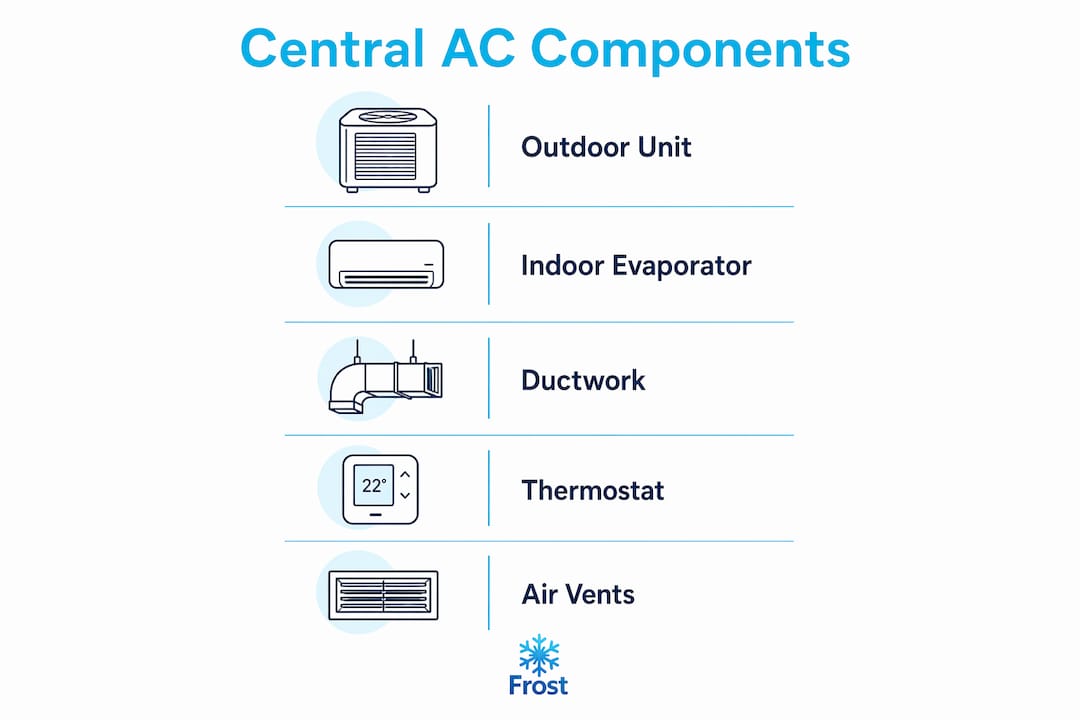
A central air conditioning system is made up of several distinct parts, each with a specific job. Knowing what they are helps you understand service reports and spot warning signs early.
- Evaporator coil: Located inside the home within the air handler or furnace cabinet. Refrigerant absorbs heat here, cooling the air that passes over it.
- Condenser coil: Sits in the outdoor unit. This is where absorbed heat is released to the outside air.
- Compressor: Also in the outdoor unit. It pressurises the refrigerant, driving the entire cycle. The compressor is typically the most expensive component to replace.
- Expansion valve: Regulates how much liquid refrigerant enters the evaporator coil, controlling the rate of cooling.
- Air handling unit (AHU): The indoor blower assembly that circulates air through the duct system. The US Department of Energy refers to this as the Air Handling Unit, and the term is widely used by UK installers too.
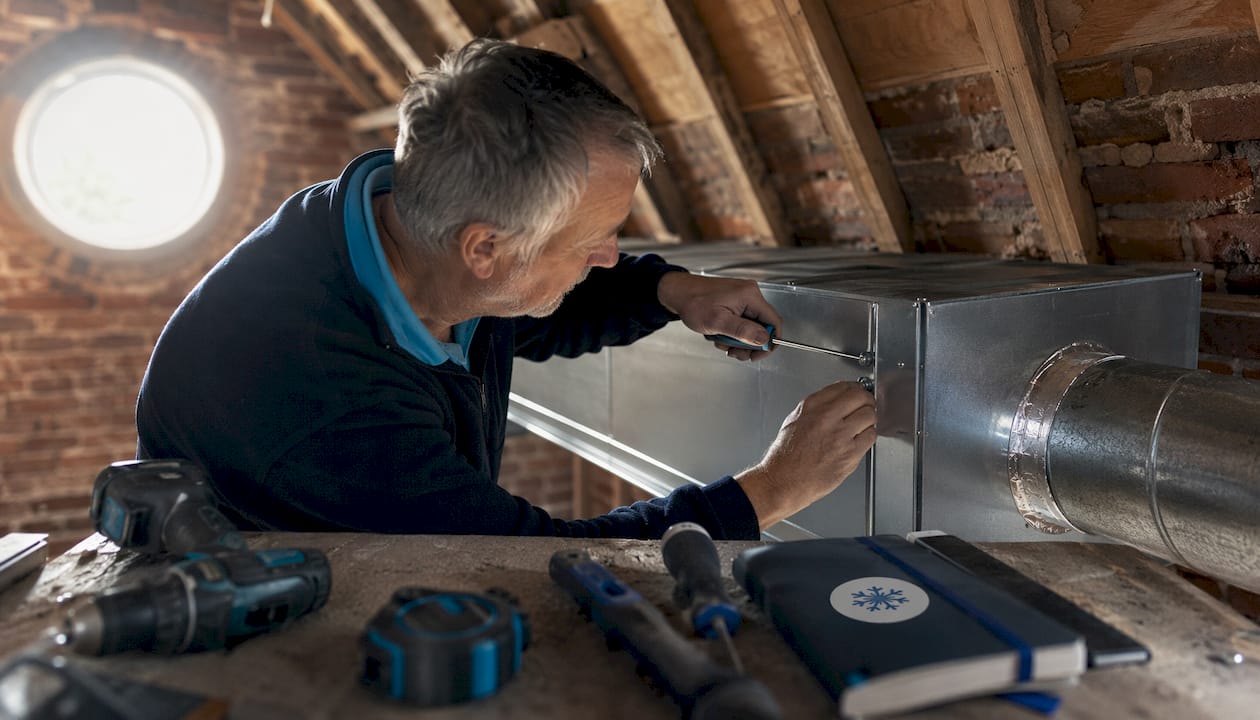
- Ductwork: The network of channels that carries cooled air to supply registers and returns warm air to the unit. Poorly sealed ducts are one of the biggest sources of energy waste.
- Thermostat: The control interface. Modern programmable or smart thermostats can cut running costs by scheduling cooling around your routine.
- Refrigerant: The working fluid that carries heat around the system. Current systems use refrigerants with lower global warming potential than older R-22 types, in line with UK F-Gas regulations.
- Air filters: Fitted at return air grilles or within the AHU, these trap dust, pollen, and other particles on every cycle.
Split-system vs packaged unit: Most UK residential installations use a split system, where the outdoor unit houses the compressor and condenser, and the indoor unit houses the evaporator and blower. A packaged unit combines everything into one cabinet placed outside the home, which suits properties with limited indoor plant space. Both types use ductwork and a thermostat to control temperature.
Where a home already has a forced-air heating system, the existing ductwork can often be shared with the central AC, making installation in existing homes more straightforward than starting from scratch.
Pros and cons of central AC for UK homeowners
Central air conditioning suits some homes far better than others. The benefits are real, but so are the costs and constraints.
The case for central AC:
- Even temperature throughout the home. Every room reaches the same set point, with no hot spots or cold corridors.
- Quieter than room units. The compressor sits outside, so indoor noise is limited to the gentle hum of the air handler.
- Better air quality. Integrated filtration removes dust, allergens, and pollutants on every cycle, something portable or window units cannot match.
- Discreet installation. Ducts and registers are built into walls and ceilings, leaving rooms uncluttered.
- Whole-home efficiency. Managing one thermal load centrally is more efficient than running several independent room units simultaneously.
The drawbacks to weigh up:
- Higher upfront cost. Installation in a UK home without existing ductwork is a significant investment, covering equipment, ductwork fabrication, and labour.
- Ductwork space requirements. Older UK properties with solid walls or low ceilings can make duct routing difficult or impossible without major building work.
- Running costs. A central system consumes more electricity than a single room unit, though it replaces multiple units across the home.
- All-or-nothing cooling. Standard systems cool the whole house at once; zoning is possible but adds cost.
- Maintenance commitment. Filters, coils, and ducts all need regular attention to keep the system running efficiently.
| Pros | Cons |
|---|---|
| Consistent temperature across all rooms | Higher installation cost than room units |
| Quiet operation (compressor is outside) | Requires ductwork, complex in older properties |
| Whole-home air filtration | Higher electricity consumption than a single unit |
| Discreet, unobtrusive appearance | All rooms cooled simultaneously by default |
| More efficient than multiple standalone units | Regular professional servicing required |
How does central AC compare with other cooling options in the UK?
The UK market offers several alternatives, and the right choice depends on your home's size, layout, and budget.
- Central AC vs multi-split systems: A multi-split system connects one outdoor unit to several indoor wall-mounted units, each with its own controls. There is no ductwork, making it far easier to retrofit into older UK properties. Each room can be set independently, which suits households where different rooms are used at different times. Central AC wins on air quality and uniformity; multi-split wins on installation flexibility. You can read more about domestic AC options for south-west UK homes specifically.
- Central AC vs window or portable units: Window units and portable coolers are cheap to buy but cool only one room, generate considerable noise, and offer no filtration beyond a basic mesh. For a property with more than two or three rooms to cool, the running cost of multiple room units adds up quickly, and the comfort gap versus central AC is substantial.
- Central AC vs single-split systems: A single-split pairs one outdoor unit with one indoor wall unit. Ideal for a single room or open-plan space, but it cannot serve a whole home without multiple outdoor units, which increases both cost and outdoor visual impact.
- Suitability by home size: Central AC makes most sense in larger properties where multiple rooms need cooling simultaneously. For a one or two-bedroom flat, a multi-split or single-split is usually more practical and cost-effective.
- Energy efficiency: Central systems carry SEER ratings that indicate seasonal efficiency. Higher-rated units cost more upfront but reduce running costs over time. Multi-split inverter systems are also highly efficient, often matching or exceeding central AC on a room-by-room basis.
- Installation complexity: Central AC requires ductwork, which adds time, cost, and disruption. Multi-split and single-split systems need only a small hole through an external wall for the refrigerant pipe and cable, making them far less invasive.
Pro Tip: If your home already has a forced-air heating system with existing ductwork, adding central AC is considerably cheaper and quicker than a fresh installation. Ask your installer to assess the existing duct condition before quoting.
Central air maintenance tips every UK homeowner should follow
Routine maintenance is the single biggest factor in how long a central AC system lasts and how much it costs to run. Neglect it and you will pay in higher energy bills and early equipment failure.
- Replace or clean air filters regularly. A clogged filter forces the blower to work harder, reducing airflow and straining the motor. During heavy use in summer, check often.
- Clean the evaporator and condenser coils annually. Dirty coils reduce heat transfer efficiency. The condenser coil in particular collects debris, leaves, and grass cuttings from the outdoor unit.
- Check and clear the condensate drain. The drain removes moisture collected at the evaporator coil. A blocked drain can cause water damage and trigger the system to shut down.
- Inspect ductwork for leaks. Gaps or loose joints in ducts allow cooled air to escape into wall cavities rather than reaching your rooms. Sealing leaks is one of the most cost-effective improvements you can make.
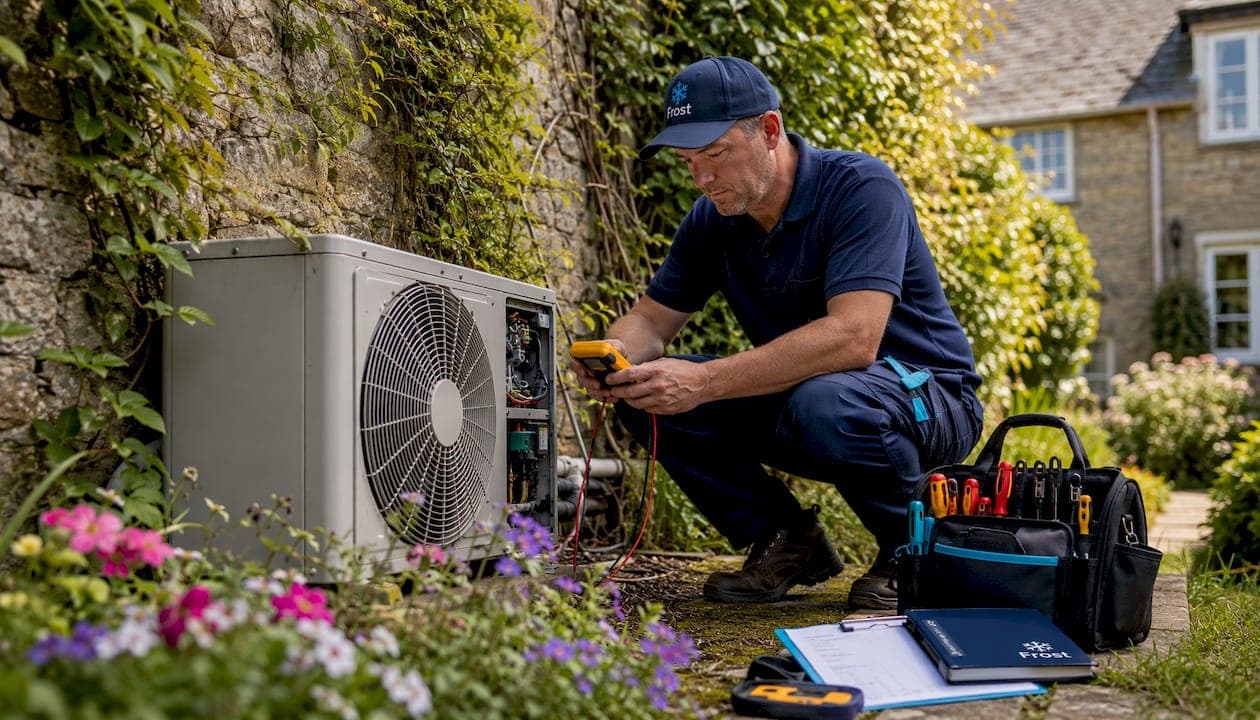
- Keep the outdoor unit clear. Maintain at least 60cm of clearance around the condenser unit. Overgrown shrubs and garden furniture restrict airflow and reduce efficiency.
- Book a professional service annually. A qualified F-Gas certified engineer will check refrigerant levels, electrical connections, and overall system performance. Refrigerant top-ups must be carried out by a certified technician under UK F-Gas regulations.
- Size the system correctly from the start. An oversized unit causes short cycling, where the system switches on and off too frequently, wearing out components faster and failing to dehumidify the air properly. Always insist on a formal load calculation before installation.
For specific troubleshooting advice on common central AC faults, Frostairconditioning has a dedicated guide covering the issues UK homeowners encounter most often.
Frostairconditioning installs central and split air conditioning systems across Exeter and the wider south-west, with F-Gas certified engineers and same-day installations available. Flexible 0% finance options mean you can spread the cost without paying more. Get a free quote or explore the full range of domestic installation services to find the right system for your home.

Key takeaways
A central air conditioning system is the most effective whole-home cooling solution for larger UK properties, provided the installation is sized correctly and maintained annually.
| Point | Details |
|---|---|
| What it is | A central AC system cools multiple rooms from one unit via ductwork and a thermostat. |
| How it works | The refrigeration cycle moves heat from inside to outside; it does not generate cold air directly. |
| Best for larger homes | Central AC suits properties where several rooms need simultaneous, even cooling. |
| Air quality benefit | Integrated filtration on every cycle removes dust and allergens that room units cannot address. |
| Correct sizing matters | An oversized unit causes short cycling, reducing comfort and shortening equipment life. |