

The five main types of domestic AC units are central air conditioning, split systems, ductless mini-splits, portable units, and window units. Each suits a different home size, budget, and installation setup. Choosing the wrong type costs you money upfront and on every energy bill afterwards. This guide covers every major home air conditioning system, with real costs, efficiency figures, and honest advice on which suits your home.
1. What are the main types of domestic AC units?
Domestic air conditioning splits into five core categories. Central air conditioning covers whole homes via ductwork. Split and ductless mini-split systems serve individual rooms or zones. Portable and window units offer low-cost, flexible cooling for single spaces. Each type carries different installation requirements, running costs, and comfort levels. Knowing which category fits your home before you buy saves you from expensive mistakes.
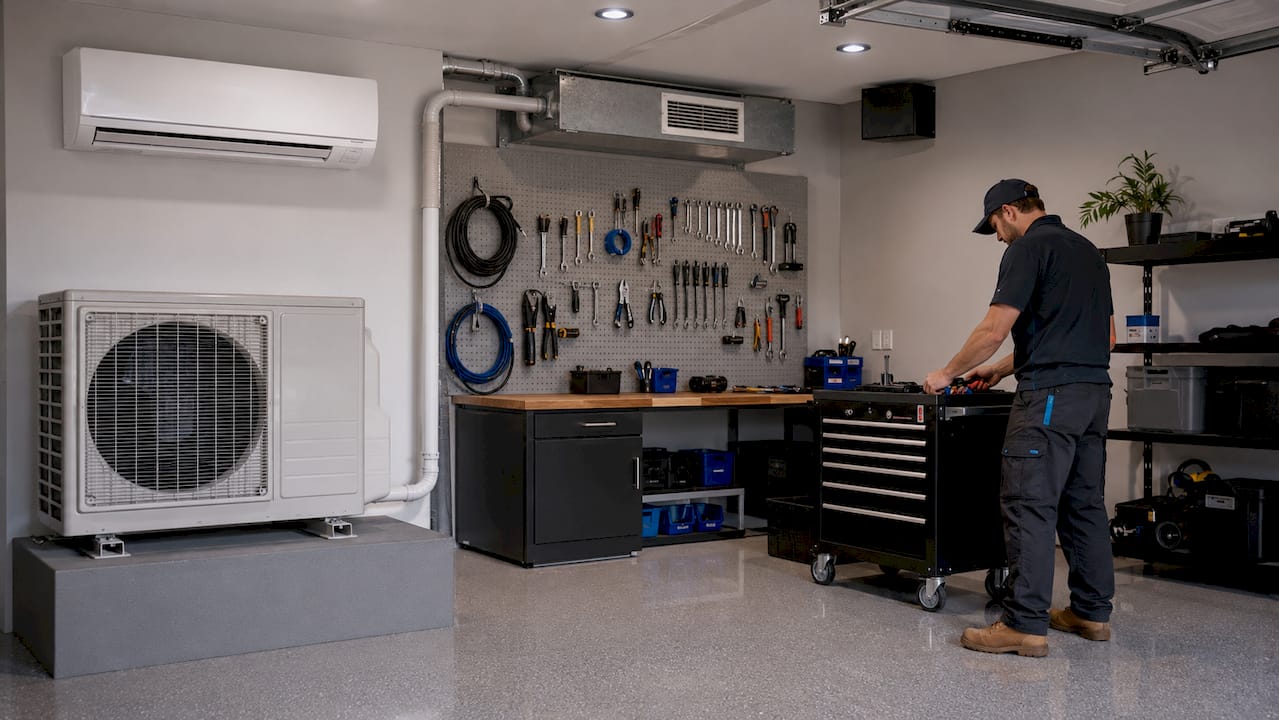
2. Central air conditioning systems
Central air conditioning is the standard choice for whole-home cooling in larger properties. A central system uses an outdoor condenser unit and an indoor air handler connected through a network of ducts. Central air conditioning can consume over 2,000 kilowatt-hours per year, so choosing a unit with a high SEER rating matters enormously. Modern systems reach SEER ratings of up to 26, which translates directly into lower annual bills.
Central AC installation costs between £4,000 and £8,000 including fitting. That figure reflects the complexity of ductwork, electrical work, and commissioning. The payback comes through consistent whole-home comfort and the option to add a heat pump variation that provides both heating and cooling. Reverse-cycle versions are popular, though their heating effectiveness drops sharply in very cold outdoor temperatures, so they suit the UK's mild winters well.
Key benefits of central air conditioning:
- Even temperature distribution across every room
- Compatible with smart thermostats and zoning controls
- Variable capacity models run at low speeds for quieter operation and better dehumidification
- Heat pump variants provide year-round climate control
Pro Tip: If your home already has ductwork from an older heating system, a central AC retrofit is far cheaper than starting from scratch. Always ask your installer to assess duct condition before quoting.
3. Split and ductless mini-split systems
Split systems are the most popular home air conditioning choice across the UK and Europe. A split system pairs an outdoor compressor with one or more indoor wall-mounted units. Ductless mini-splits work on the same principle but require no ductwork at all, making them far less invasive to install. Installing ducted AC in a home without existing ducts is costly and disruptive, which is exactly why ductless mini-splits suit older UK properties so well.
The real advantage is zoning. Each indoor unit operates independently, so you cool only the rooms in use rather than the entire house. Inverter technology adjusts compressor speed continuously rather than switching on and off, which cuts running costs compared to older fixed-speed systems. Variable capacity systems also run quietly and improve dehumidification, which matters during humid British summers.
Advantages of split and mini-split systems:
- No ductwork required for ductless models
- Individual room control reduces wasted energy
- Quieter operation than window or portable units
- Inverter models offer better long-term value despite higher upfront cost
- Suitable for extensions, loft conversions, and older homes
Professional sizing is non-negotiable with split systems. An oversized unit cools air too quickly without removing enough humidity, leaving rooms feeling clammy. An undersized unit struggles on the hottest days. A qualified installer will carry out a full load calculation before recommending a model. Frostairconditioning carries F-gas certification and offers same-day installs across the South West, so sizing and fitting happen correctly from day one.
4. Portable and window air conditioning units
Portable AC units and window units sit at the affordable end of the market. Window units cost between £100 and £1,100, making them the lowest-cost entry point for home cooling. Portable units require no permanent installation. You move them between rooms and vent them through a window using a hose kit. Both types suit renters, occasional use, or supplementary cooling in rooms a central system does not reach.
Sizing matters even at this level. Window ACs should be sized at 15–20 BTUs per square foot of room space, and a Combined Energy Efficiency Ratio (CEER) of 12 or higher indicates a genuinely efficient model. A low CEER rating means the unit draws more electricity for the same cooling output, which adds up quickly over a summer.
| Feature | Portable AC | Window AC |
|---|---|---|
| Installation | No fitting required | Mounted in window frame |
| Upfront cost | £200–£600 | £100–£1,100 |
| Portability | Moves between rooms | Fixed location |
| Noise level | Moderate to high | Moderate |
| Energy efficiency | Lower (CEER varies) | Better with CEER 12+ |
| Best use | Renting, occasional use | Single room, budget cooling |
Pro Tip: Portable units vent warm air out but also draw some conditioned air back through gaps around the hose. Seal the window kit properly with foam tape to stop this and improve efficiency noticeably.
5. Packaged units, geothermal, and evaporative coolers
Not every home fits the standard split or central model. Three alternative systems are worth knowing about.
Packaged HVAC units combine the compressor, condenser, and air handler into a single outdoor cabinet. Packaged systems are ideal for homes with limited indoor space but existing ductwork. All the mechanical components sit outside, which frees up loft or utility room space and simplifies servicing. Carrier and similar manufacturers offer packaged units that handle both heating and cooling from one external box.
Geothermal heat pumps extract heat from the ground rather than the air. They deliver very low running costs over time but require significant groundwork during installation, making upfront costs high. They suit new builds or major renovations where ground loops can be laid without disrupting a finished garden.
Evaporative coolers work by passing air over water-saturated pads, which lowers air temperature through evaporation. They use far less electricity than refrigerant-based systems. The catch is that they only work effectively in dry climates. In the UK's humid conditions, evaporative coolers add moisture to already damp air, which reduces comfort rather than improving it. They are rarely the right choice for British homes.
6. How do all AC types compare on cost, efficiency, and comfort?
Choosing between home air conditioning systems comes down to four factors: upfront cost, running cost, installation complexity, and how well the system suits your home's existing infrastructure. Matching your AC type to existing ductwork avoids expensive retrofits that can double the installation bill.
| AC type | Typical install cost | Energy efficiency | Best suited for |
|---|---|---|---|
| Central AC | £4,000–£8,000 | SEER up to 26 | Large homes with existing ducts |
| Split / mini-split | £1,000–£3,500 | High (inverter models) | Rooms, extensions, older homes |
| Portable unit | £200–£600 | Moderate | Renters, occasional use |
| Window unit | £100–£1,100 | Good with CEER 12+ | Single rooms, tight budgets |
| Packaged unit | £3,000–£7,000 | High | Homes with limited indoor space |
Long-term value consistently favours inverter-based systems and heat pumps despite their higher purchase price. The energy savings over five to ten years typically outweigh the cost difference against a cheaper fixed-speed unit. For most UK homeowners, a ductless mini-split or split system offers the best balance of installation cost, running cost, and comfort. For larger homes with existing ducts, central AC remains the most practical whole-home solution.
Noise is a factor many buyers overlook. Central and split systems with variable capacity compressors are the quietest options. Portable units are the loudest, often reaching 50–60 decibels in operation, which is noticeable in a bedroom or home office.
Key takeaways
The right type of domestic AC unit depends on your home's size, existing infrastructure, and budget, with ductless mini-splits offering the best all-round value for most UK homes.
| Point | Details |
|---|---|
| Match type to infrastructure | Homes with existing ducts suit central AC; homes without suit ductless mini-splits. |
| Size correctly every time | Oversizing causes humidity problems; undersizing fails on hot days. |
| Prioritise efficiency ratings | Look for SEER 16+ on central units and CEER 12+ on window units to control running costs. |
| Portable units have limits | Best for renters or supplementary cooling, not as a primary whole-home solution. |
| Inverter systems pay back | Higher upfront cost is offset by lower energy bills over five to ten years. |
What I've learned from fitting AC in hundreds of UK homes
The question I hear most often is: "Which type is best?" The honest answer is that no single system wins for every home. What I have seen repeatedly is that homeowners underestimate how much their existing infrastructure drives the decision. If you have no ductwork, a central system is not just expensive. It is genuinely disruptive, involving weeks of work cutting through walls and ceilings. A ductless mini-split achieves the same comfort in a day.
I have also seen buyers fixate on upfront cost and choose a portable unit for a room they use every day. Within two summers, the energy bills and the noise have worn them down. A properly sized energy efficient AC unit costs more on day one but stops being a source of frustration by day two.
The other mistake I see constantly is skipping the load calculation. Proper sizing is not guesswork. It accounts for room volume, insulation, window orientation, and occupancy. An oversized unit cools air rapidly without removing enough humidity, which leaves a clammy, uncomfortable feel even when the temperature reads correctly. Get the sizing right and every other decision becomes easier.
If you are in the South West and weighing up your options, read our guide on choosing an air conditioner for UK homes before committing to anything.
— James
Ready to install the right AC unit for your home?
Frostairconditioning covers domestic installations across Exeter and the wider South West, with F-gas certified engineers and same-day installs available. Whether you are considering a ductless mini-split for a single room or a full split system for your whole home, the team will carry out a proper load calculation and recommend the right unit for your setup.

Frostairconditioning also offers 0% finance options, so upfront cost does not have to be a barrier to getting the right system. Ongoing service and maintenance keeps your unit running at peak efficiency year after year. For a no-obligation quote tailored to your home, visit the domestic installation page or request a quote directly.
FAQ
What is the most energy efficient AC unit for a home?
Ductless mini-split systems with inverter technology and high SEER ratings are the most energy efficient option for most homes. Central AC systems with SEER ratings up to 26 are also highly efficient when properly sized for the property.
How do I choose between a window unit and a split AC?
A window unit suits single rooms on a tight budget, while a split AC offers quieter operation, better efficiency, and zoning capability. If you use the room daily, a split system delivers better long-term value despite the higher installation cost.
What size AC unit do I need for my room?
Window and portable units should be sized at 15–20 BTUs per square foot of room space. For split systems and central AC, a professional load calculation is the only reliable method, as it accounts for insulation, ceiling height, and window area.
Can I install a portable AC unit without a window?
No. Portable AC units require a vent hose to expel hot air outside, which means access to a window or external wall opening is necessary. Without proper venting, the unit recirculates warm air and provides no useful cooling.
What types of AC systems work for older UK homes without ductwork?
Ductless mini-split systems are the best fit for older UK homes without existing ductwork. They require only a small hole through an external wall for the refrigerant pipe, making installation far less invasive than retrofitting a full ducted system.