
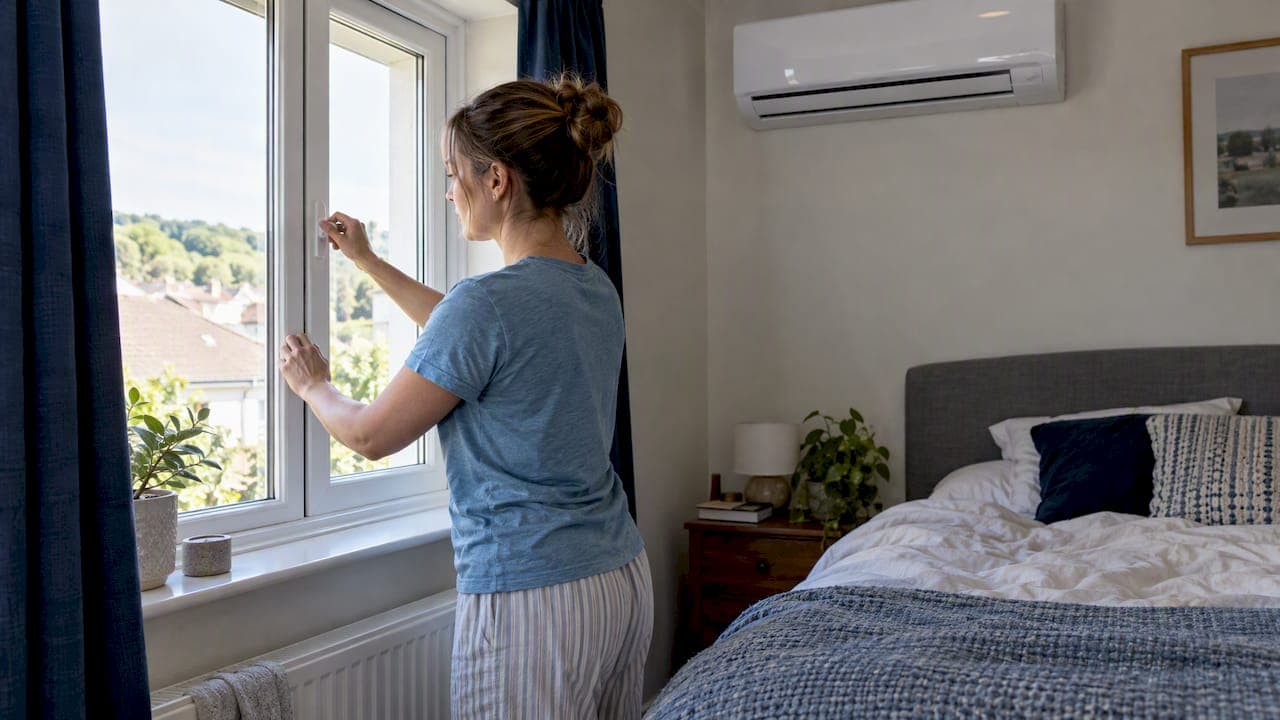
Pollen season and hot weather often arrive together, which leaves you choosing between open windows and a sneezing fit. Air conditioning can help you stay cool with the windows shut, and a clean, well-fitted system may cut some of the pollen you breathe indoors. It is not an air purifier, though, and a neglected unit can make things worse. Below we cover when pollen peaks in Devon and Cornwall, how it gets into your home, and what to do about it. We also explain how to set up and look after an air conditioner so it works with your hay fever.
TL;DR
- Grass pollen is the main trigger for most people. In the South West it is usually high from late May to the end of July, peaking from early June to mid-July.
- Keeping windows shut on high-pollen days and cooling the room mechanically stops the biggest direct route for pollen, but pollen also arrives on clothes, hair and bedding.
- Air conditioning only helps if the filters are clean and the system is properly installed. Clean the filters every two weeks in heavy use, and book a service each spring.
- Don't over-chill. Keep the room no more than 5 °C cooler than outside and aim for 40% to 60% humidity.
- Fit before the season, not in the middle of it. A spring survey and install is far less stressful than a heatwave scramble.
Table of Contents
- When is pollen season in Devon and Cornwall?
- How pollen gets into your home
- What air conditioning can do for pollen, and what it can't
- Setting your system up for hay fever season
- A spring routine that makes sense
- Other steps that work alongside cooling
- Our perspective
- Getting ready before the season: how we can help
- FAQ
- Sources
When is pollen season in Devon and Cornwall?
The Met Office describes three overlapping phases of UK pollen: trees from late March to mid-May, grass from mid-May to July, and weeds from the end of June into September. If your symptoms start with the first warm days of spring, trees are the likely culprit. If they hit hardest in June and July, it is grass.
For the South West, which includes Devon and Cornwall, the University of Worcester's pollen calendar puts grass pollen at high risk from late May to the end of July, peaking from early June to mid-July. That is exactly when you most want to cool your home.
The overlap with cooling demand is the whole problem, so here it is in one place:
| Pollen type | Typical UK window | Cooling overlap |
|---|---|---|
| Tree (birch, oak, ash and others) | Late March to mid-May | Low, but warm spring days can start it |
| Grass | Mid-May to July | High: peak summer heat |
| Weed | End of June to September | Moderate: late summer warm spells |
Why some days are far worse than others
Weather decides how much pollen is in the air. The Met Office says that for grass, 18 to 28 °C on dry, low-humidity days with a gentle breeze can bring high counts, while rain reduces airborne concentrations. MyHealth Devon adds that counts tend to rise through the day as temperatures climb and more flowers open, often peaking in the early evening on warm, sunny days.
That pattern matters for how you use your home. The hot, dry, still afternoons when you most want to cool a room are the same ones when counts tend to be highest.
A warming climate may stretch the problem. A systematic review of temperature and pollen found that warmer temperatures generally go with earlier and longer pollen seasons and higher concentrations. For homeowners, that means the window in which you want a cool, low-pollen room is unlikely to shrink.
How pollen gets into your home
Most people picture pollen drifting in through an open window, and that is certainly one route. GOV.UK's guidance on indoor airborne allergens notes that particles, including pollen, can come in from outside through windows, and that ventilation and the way people use a home also shape indoor air quality.
There is a second route that is easy to forget. A peer-reviewed study of how pollen enters dwellings found two important routes: ventilation systems, and adhesion to textiles such as clothes, laundry and bedding. Pollen could even enter through air ducts with windows closed and fans running. Most of the pollen that came in through ventilation stayed near the windows. More than half of what had settled on futons or laundry was still there after brushing or shaking.
In practice, that gives you a simple list of leaks to think about:
- Open windows and doors, especially in the afternoon and early evening.
- Trickle vents and any mechanical ventilation without decent filtration.
- Your own clothes and hair after time outdoors.
- Washing dried outside, and bedding aired by an open window.
- Pets coming in from the garden.
If you are also thinking about how air moves through the fabric of your house, our friends' guide to roof ventilation types explains how loft and roof airflow is designed, which is useful background before you decide how much to rely on natural ventilation in summer.
What air conditioning can do for pollen, and what it can't
The honest answer is: it helps with some things and not others.
What it can do. A split or multi-split system lets you keep windows closed and still cool the room. That removes the direct open-window route. It also recirculates indoor air through a filter, so airborne dust and some pollen are captured each time air passes through. GOV.UK recommends active air cleaning with filters designed to reduce particulate matter and bioaerosols, a category that includes pollen.
What it can't do. A standard wall-mounted unit is not a medical device or a HEPA purifier. It does not remove pollen already stuck to bedding and carpets, and it will not cancel out an open back door. A UK-home modelling study found that, compared with natural ventilation, air conditioning reduced modelled PM2.5 exposure by up to 4.5% with 30% filtration efficiency, but increased it by up to 5.8% at 10%. The result depended on the filter and on where particles came from. PM2.5 is not pollen itself, but the lesson carries over: filter quality and condition decide whether you gain or lose.
GOV.UK also points out that mechanical ventilation can worsen indoor air quality if poorly installed. That is a good reason to have a system designed and fitted properly rather than picked up as a quick fix.
If you want more on the wider benefits, we have written about how air conditioning can improve your home's air quality and the top five air conditioning benefits for allergies.

Setting your system up for hay fever season
Keep the filters clean

This is the single most useful habit. Daikin's UK maintenance guidance says to clean filters every two weeks during heavy use, or more often if allergies are a concern, by vacuuming on low suction or rinsing under lukewarm water. Dirty or blocked filters reduce airflow, and weak cooling, odd smells or water leaks are signs it is time for a professional to look.
A simple routine for June and July:
- Switch the unit off at the isolator or remote.
- Open the front panel and slide out the filters.
- Vacuum gently, or rinse in lukewarm water if the manual allows.
- Let them dry fully in the shade before refitting.
- Do it again two weeks later, and sooner after a high-pollen spell.
Always follow your own unit's manual. If a filter looks damaged, or you are unsure how to reach it safely, leave it to an engineer.
Don't over-chill, and watch the humidity
The ECARF Institute, a European allergy body, sets criteria for allergy-friendly air conditioning. It recommends keeping indoor humidity between 40% and 60% and keeping room temperature no more than 5 °C below the outdoor temperature, to avoid drying out mucous membranes. On a 28 °C day, that means setting about 23 °C rather than 18 °C. Dry, irritated airways tend to make hay fever feel worse, so a gentler setting is kinder to you and your energy bill.
The same guidance suggests that people with allergies may air rooms only in the early hours, when outdoor counts are lower. Combined with MyHealth Devon's note that counts build through the day, that points to a practical pattern: ventilate briefly early, then close up and cool.
Mind the damp and the mould
A unit that stays wet inside can grow its own allergens. Running a short dry cycle after use helps, and we explain how in our guide to stopping aircon mould with a 15 to 20 minute dry cycle.
A spring routine that makes sense
The best time to prepare is before the grass season starts. Daikin recommends professional servicing at least annually, preferably in spring before it gets hot. In Devon and Cornwall, that means April or early May, ahead of the late-May grass rise.
A sensible calendar:
- March to April: book a service, check the filters, and run the system briefly to confirm it cools and drains properly.
- Mid-May to July: clean filters fortnightly, keep windows shut on high-pollen afternoons, and wash bedding regularly.
- August to September: a lighter check, as weed pollen lingers and warm spells continue.
- Autumn and winter: follow sensible shutdown care, covered in our winter care guide for air conditioners.
Our seasonal aircon service checklist and pre-summer aircon check guide set out what a spring visit covers and how F-Gas rules apply.
Other steps that work alongside cooling
Air conditioning is one layer. The research points to several that stack well:
- Clean near windows often. Pollen that enters by ventilation tends to stay near the window, so frequent cleaning there pays off.
- Vacuum laundry and bedding after airing. Brushing or shaking leaves more than half the pollen behind.
- Shower and change after time outdoors, particularly in the evening.
- Dry washing indoors on high-count days.
- Consider a dedicated air cleaner with a filter designed for particles, in the bedroom if sleep is the issue.
- Speak to a pharmacist or GP if over-the-counter treatment is not controlling your symptoms. An air conditioner does not replace medical advice.
Our perspective
We install and service air conditioning across Exeter, Devon, Cornwall and the wider South West, and the pollen conversation comes up every spring. Our view is simple: a system fitted properly and kept clean is a real comfort for allergy sufferers, but it is only as good as its filters and its upkeep.
The mistakes we see are rarely about the brand. They are about timing and neglect: a unit bought in a heatwave and never serviced, filters that have not been touched for a year, or a thermostat set so low the room feels dry and sore. Our engineers are F-Gas certified and REFCOM registered, we carry out the work ourselves rather than using subcontractors, and we offer free surveys so the system is sized and positioned for the room, not just dropped on the wall.
If hay fever is the reason you are looking at air conditioning, tell us at the survey. We can point you to the right indoor unit placement, talk through filter care, and set up a service plan so spring checks do not slip your mind.
— James
Getting ready before the season: how we can help
We design and fit domestic systems from Samsung, Mitsubishi, Toshiba and Daikin, and same day or next day installs are available when you need cooling quickly. Installations are typically completed within one to two days, and 0% finance is available. Start with our domestic installation page, or see our service and maintenance options if you already have a system that needs a spring check or an annual contract. You can also view our service plans.
Running a shop or office? Our shop fitting and commercial service covers customer-facing premises too.
FAQ
Can air conditioning help with hay fever?
It can help by letting you keep windows shut and by filtering recirculated air, which reduces one major route for pollen. It will not clear pollen already on bedding, clothes or carpets, and it is no substitute for treatment from a pharmacist or GP. The benefit depends heavily on clean filters and proper installation.
How often should I clean my air conditioner filters in pollen season?
Daikin advises every two weeks during heavy use, and more often if allergies are a concern. Vacuum them on low suction or rinse in lukewarm water, and let them dry fully before refitting. Check your unit's manual first.
What temperature should I set the air conditioning at if I have allergies?
ECARF recommends keeping the room no more than 5 °C cooler than outside, with indoor humidity between 40% and 60%. On a 28 °C day, that means roughly 23 °C. Colder than that can dry your airways and may aggravate symptoms.
When should I get my air conditioner serviced before hay fever season?
Annually at minimum, and ideally in spring before the heat arrives. In Devon and Cornwall, grass pollen usually becomes high from late May, so April or early May is a sensible target.
Sources
- When is hay fever season in the UK? (Met Office)
- Pollen calendars by area (University of Worcester)
- Hayfever (MyHealth Devon)
- A systematic review of the effects of temperature and pollen
- Indoor airborne allergens (GOV.UK)
- Two routes for pollen entering indoors (PubMed)
- Exploring the impact of air conditioning on indoor air quality
- AC maintenance guide: filters, costs and servicing (Daikin UK)
- ECARF criteria for air conditioning units