
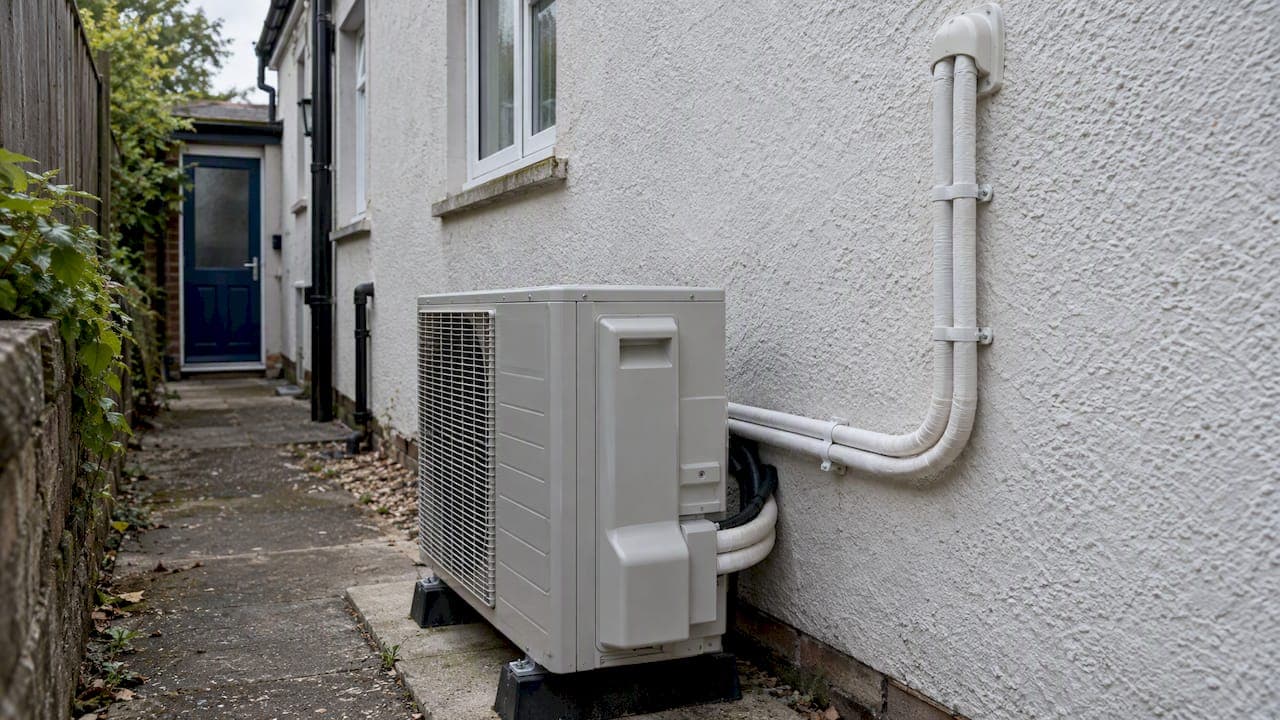
The maximum pipe length on a split air conditioner depends on the model, not on a single rule. For typical domestic single-split units it is usually somewhere between 20 and 30 metres between the indoor and outdoor unit. Daikin's FTXC/RXC installation manual, for example, gives 20m for the smaller RXC20/25/35 outdoor units and 30m for the RXC50/60/71. Larger commercial systems can go much further. But the limit that matters for your home is the one in your chosen unit's manual, and a good installer aims well below it.
If you are searching because someone has quoted you for a long pipe run, or your outdoor unit has to sit a fair way from the room, this guide explains what the numbers mean, what happens when you approach them, and what to ask before you sign.
TL;DR
- Domestic split systems typically allow around 20 to 30m of refrigerant pipe, but the exact figure is model-specific. Always check the installation manual for the unit you are buying.
- There is a minimum as well: the Daikin manual above gives 3m, mainly so noise and vibration from the outdoor unit do not carry into the indoor unit.
- Beyond a set length (7m on some Mitsubishi Electric models), extra refrigerant must be added. That is a job only a certified engineer can legally do.
- Shorter is better. Long runs cost more in pipework and gas and can reduce efficiency.
- Portable units are different: their exhaust hose is a short duct, not a refrigerant line.
Table of Contents
- Two kinds of "pipe length": which one are you asking about?
- Typical maximum lengths by system type
- The minimum matters too
- When extra refrigerant is needed
- Height difference, bends and pipe size
- Why the shortest sensible run wins
- What to do if your layout needs a long run
- Perspective: what we see on site
- Checking your installer, not just the pipe
- A worked example
- Getting it surveyed
- FAQ
- Sources
Two kinds of "pipe length": which one are you asking about?
The phrase gets used for several different things, and the answers differ.
Split and multi-split systems. Two copper pipes (a liquid line and a gas line) carry refrigerant between the outdoor and indoor units. This is what the manufacturer's maximum, minimum and "no extra gas" lengths refer to.
Portable air conditioners. These have no refrigerant pipe run. They use an exhaust hose, and makers set a short limit on it. One manufacturer's guidance puts the maximum at 1.5 metres and tells owners not to extend it. Longer ducting makes the unit work harder and can cause it to overheat or lose cooling power.
Condensate drain pipes. The drain that carries away condensation has its own fall and length considerations. It is separate from the refrigerant circuit and not covered by the figures below.
The rest of this article is about refrigerant pipework on split systems, since that is what most people mean.
Typical maximum lengths by system type
There is no universal number, but the manufacturer documents show the pattern.
| System type | Typical maximum run | Where this comes from |
|---|---|---|
| Small domestic single split (e.g. Daikin RXC20/25/35) | 20m | Daikin installation manual |
| Larger domestic single split (e.g. Daikin RXC50/60/71) | 30m | Same manual |
| Light commercial Sky Air Alpha | Up to 85m on some models | Daikin RZAG product page |
| Portable unit exhaust hose | 1.5m on one maker's guidance | Manufacturer support page |
Treat the table as an illustration of why you cannot quote one figure for everything. A small bedroom unit and a commercial Sky Air system are designed for entirely different duties. Commercial systems that allow very long runs are not comparable with a standard domestic single split.
You may also see figures such as 7.5m "standard" and 14m maximum on forums and Q&A sites. Those are rough rules of thumb from particular older or smaller models, not a safe basis for your own installation. Your unit's manual overrides them.

The minimum matters too
Most homeowners only ask how long the pipe can be. The minimum is just as real. The Daikin manual above lists a minimum allowable piping length of 3m for those models.
The reason is practical. A very short line set can pass compressor vibration and noise straight into the wall and the indoor unit. A unit that is perfectly quiet on a longer, properly supported run can become annoying if the two units are squeezed right back to back.

This catches people out with a back-to-back installation, where the outdoor unit goes directly on the other side of the wall. If the room allows it, a properly planned route with a little slack and proper support beats the shortest possible line.
When extra refrigerant is needed
The factory charge in an outdoor unit is calculated for a standard pipe length. Go past that and the system needs additional refrigerant, in an amount set by the manufacturer.
The threshold varies by brand and model. On one Mitsubishi Electric split model, the installation manual says no gas charge is needed for pipe lengths up to 7m, and a prescribed amount must be added beyond that. Other models differ, so you cannot carry that 7m figure over to any other unit.
Two points follow from this:
- The amount is calculated per metre, per pipe size. It is not a guess, and an engineer should record it on the commissioning paperwork.
- Adding refrigerant is regulated work. In the UK, anyone installing, servicing or repairing equipment with fluorinated gases must be properly certified, and the business needs a company certificate too. REFCOM's F-Gas guidance sets out these requirements. If you want to understand what that looks like in practice, our guide to verifying F-Gas certification and the company register walks through it.
Running a long pipe without correcting the charge is a classic cause of poor cooling and, over time, compressor trouble. The system looks fine on day one and then underperforms in the first hot spell.
Height difference, bends and pipe size
Length is not the only number in the manual. Most manuals also set a maximum height difference between the indoor and outdoor units, and the installer reference guides include a section on refrigerant piping length and height difference. If the outdoor unit sits on a roof or the indoor unit is on an upper floor, check this limit as well as the run length.
Pipe diameter is also specified per model. Daikin's installer reference guide lists annealed copper in sizes such as 6.4mm (1/4") and 9.5mm (3/8"). Using the wrong size is not a harmless shortcut, because the pipe has to match the unit's connections and the capacity it is designed to carry.
Every bend and joint adds resistance. A route with many tight turns performs worse than its measured length suggests, which is another reason to plan the path before drilling anything.
Why the shortest sensible run wins
The goal is never to reach the maximum. Manufacturer instructions say to keep field piping as short as possible, and the logic is simple:
- Efficiency. Longer lines mean more pressure drop and more work for the compressor.
- Refrigerant. More pipe means more gas, which costs more and means more joints that could leak over the years.
- Cost. More copper, insulation, trunking and labour.
- Appearance. Long external runs need neat, protected routing.
- Reliability. Sustained strain on the compressor is not what you want for the next 10 to 15 years.
So when we plan a job, the question is where the indoor unit does its best work for the room, then where the outdoor unit can sit nearby with sensible access for servicing, and then the shortest tidy route between them.
What to do if your layout needs a long run
Sometimes the geometry forces it: a terraced Exeter house with no side access, a flat where the only outdoor spot is a balcony two floors away, or a Cornish cottage where the outbuilding is the only place for the condenser. You have options.
- Choose a unit with a higher limit. Larger domestic models typically allow longer runs than the smallest ones, as the Daikin 20m and 30m figures show.
- Reposition the outdoor unit. A wall bracket, a ground stand or a different elevation can cut metres.
- Consider concealing the pipe. Routing through a loft or void can be shorter and neater than running outside, subject to the manual's limits and good access for inspection.
- Use a multi-split carefully. Several rooms from one outdoor unit have both per-room and total pipe limits. Check both.
- Accept the extra charge. If the run is within limits, adding the specified refrigerant is a normal, correctly documented part of the job.
In every case, the answer comes from a survey, not a phone estimate.
Perspective: what we see on site
People usually arrive with a question about maximum length, but what they really want to know is whether their layout will work. In our experience, the pipe limit is rarely the problem. The problem is the plan: where the indoor unit goes, whether the outdoor unit can be reached for servicing, and whether the route is tidy.
We do the work with our own local F-Gas certified engineers rather than subcontractors, which matters here because the person who surveys the route is the person who sets the charge and commissions the system. Nobody downstream is guessing at what was intended. We check the exact model's manual before we quote, because the limits differ by unit, and we would rather tell you to move the outdoor unit a few metres than sell you a long run.
One more thing we say often: DIY is not a sensible option here. REFCOM's guidance is clear that handling these refrigerants needs certified people, and the commissioning (pulling a vacuum on the line set to remove air and moisture, then charging to specification) is where amateur installs fail. A system with moisture in it can fail early.
— James
Checking your installer, not just the pipe
A pipe length that is within spec on paper still depends on the person fitting it. Three quick checks before you hire anyone:
- Company F-Gas certification. Ask for the certificate and the registration body, such as REFCOM. Our article on five checks to verify UK F-Gas compliance explains how.
- Individual qualifications. F-Gas certification is a legal minimum, not the whole picture. REFCOM's competence guidance refers to training and assessment to NVQ/SVQ Level 2 as a minimum for working with refrigerant and pipework.
- A written survey. The quote should state the model, the pipe route, the expected length and whether additional refrigerant is needed.
Wholesalers are also restricted in supplying pre-charged split systems unless a certified professional will do the installation, as REFCOM's guide to pre-charged split system delivery explains. That is one more reason a legal DIY fit is effectively off the table.
For more on why the fitting itself matters, see our piece on reasons for professional AC installation, and for the refrigerant itself, air conditioner gas: what UK homeowners need to know.
A worked example
Imagine a three-bedroom house in Exeter where you want cooling in the main bedroom on the first floor. The indoor unit goes on the bedroom wall. The only practical outdoor spot is a side wall at ground level.
The route runs down the outside of the house, perhaps 10 to 12 metres including the vertical drop and a couple of bends. That is comfortably inside the 20m limit for a small Daikin model like those above, but beyond the 7m threshold at which one Mitsubishi Electric model needs added gas. So on that model the engineer calculates and adds refrigerant per the manual, and records it. On another model the threshold could be different. That is why we say the manual for the exact unit decides, not a general rule.
Now take the same house with a rear garden outbuilding that needs cooling 25m away. A small unit is out. A larger one might work, but at that point we would look again at whether a different outdoor position or a multi-split is more sensible.
Getting it surveyed
We cover Exeter and the wider South West, including Devon and Cornwall, with free surveys. Installations are typically completed within one to two days, and same-day installs are available. If you want a system fitted, the domestic installation page explains how it works. We supply Samsung, Mitsubishi, Toshiba and Daikin systems, and 0% finance is available. For shops and offices, see shop fitting and commercial. If you already have a system and suspect a poor pipe job or gas problem, our service and maintenance team can inspect it, and we offer emergency breakdown response.
If you are weighing up a purchase more generally, our complete UK air conditioning buying guide covers sizing and running costs.
FAQ
What is the maximum pipe length for a split air conditioner?
It depends on the model. Typical domestic units allow around 20 to 30m, such as 20m and 30m for different Daikin RXC outdoor units. Larger commercial systems can allow much more, with some Sky Air models listed up to 85m. Check the installation manual for your exact unit.
Is there a minimum pipe length?
Yes. The Daikin manual above gives 3m as the minimum for those models. A very short run can transmit vibration and noise from the outdoor unit into the indoor unit and the wall.
Do I need extra refrigerant for a longer pipe run?
Often, yes. Each manufacturer sets a length beyond which extra gas must be added. One Mitsubishi Electric model, for example, needs none up to 7m. Only a certified engineer can legally add it, and the amount should be recorded.
Can I extend the pipes myself?
Not legally or sensibly. Work on equipment containing F-Gas refrigerants must be done by certified individuals working for a certified company. Poor evacuation or a bad joint can also cause early failure.
How long can a portable air conditioner hose be?
Very short. One manufacturer states a maximum of 1.5m and says not to extend the exhaust hose. A portable unit has no refrigerant pipe run to lengthen.
Sources
- Daikin FTXC/RXC installation manual
- Daikin Sky Air Alpha RZAG-NV1 product page
- Daikin ARXM/RXM installer reference guide
- Mitsubishi Electric MSZ-GA installation manual
- REFCOM F-Gas certification guidance
- REFCOM competence requirements for the RACHP sector
- REFCOM guide to delivery of pre-charged split systems